
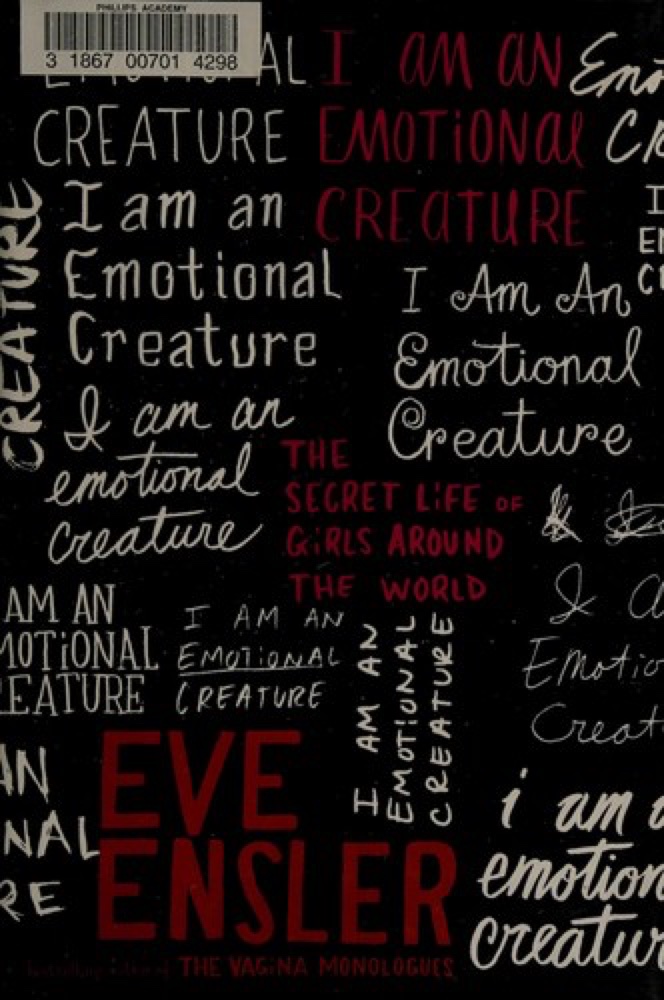
 I am an Emotional Creature
Quotes from the Book
I was always reaching for love, but it turns out love doesn't involve reaching. I was always dreaming of the big love, the ultimate love, the love that would sweep me off my feet or 'break open the hard shell of my lesser self' (Daisaku Ikeda). The love that would bring on my surrender. The love that would inspire me to give everything. As I lay there, it occurred to me that while I had been dreaming of this big love, this ultimate love, I had, without realizing it, been giving and receiving love for most of my life. As with the trees that were right in front of me, I had been unable to value what sustained me, fed me, and gave me pleasure. And as with the trees, I was so busy waiting for and imagining and reaching and dreaming and preparing for this huge big love that I had totally missed the beauty and perfection of the soft-boiled eggs and Bolivian quinoa.
36
Wanting to fall in love and being totally unable to trust, hungering for connection and always finding it claustrophobic.
24
What if, instead of being afraid of even talking about death, we saw our lives in some ways as preparation for it. What if we were taught to ponder it and reflect on it and talk about it and enter it and rehearse it and try it on?What if, rather than being cast out and defined by some terminal category, you were identified as someone in the middle of a transformation that could deepen your soul, open your heart, and all the while-even if and particularly when you were dying-you would be supported by and be part of a community?
23
Somatize: how the body defends itself against too much stress, manifesting psychological distress as physical symptoms in the stomach or nerves or uterus or vagina... women who had suffered physical, emotional, and sexual abuse tended to somatize more. It turns out that somatization is related to hysteria, which stems from the Greek cognate of uterus... Uterus = hysteria. Hysteria -- a word to make women feel insane for knowing what they know. Hysteria is caused by suffering from a huge traume where there is an underlying conflict.
20
Three of the ten principles governing the City of Joy are (a) tell the truth, (b) stop waiting to be rescued, and (c) give away what you want the most.
17
You will touch this joy and you will suddenly know it is what you were looking for your whole life, but you were afraid to even acknowledge the absence because the hunger for it was so encompassing.
15
What if our understanding of ourselves were based not on static labels or stages but on our actions and our ability and our willingness to transform ourselves? What if we embraced the messy, evolving, surprising, out-of-control happening that is life and reckoned with its proximity and relationship to death? What if, instead of being afraid of even talking about death, we saw our lives in some ways as preparation for it? What if we were taught to ponder it and reflect on it and talk about it and enter it and rehearse it and try it on? What if our lives were precious only up to a point? What if we held them loosely and understood that there were no guarantees? So that when you got sick you weren’t a stage but in a process? And cancer, just like having your heart broken, or getting a new job, or going to school, were a teacher? What if, rather than being cast out and defined by some terminal category, you were identified as someone in the middle of a transformation that could deepen your soul, open your heart, and all the while—even if and particularly when you were dying—you would be supported by and be part of a community? And what if each of these things were what we were waiting for, moments of opening, of the deepening and the awakening of everyone around us? What if this were the point of our being here rather than acquiring and competing and consuming
11
I despise charity. It gives crumbs to a few and silences the others.
11
A mother's body against a child's body makes a place. It says you are here. Without this body against your body there is no place. I envy people who miss their mother. Or miss a place or know something called home. The absence of a body against my body created a gap, a hole, a hunger. This hunger determined my life. ... The absence of a body against my body made attachment abstract. Made my own body dislocated and unable to rest or settle. A body pressed against your body is the beginning of nest. I grew up not in a home but in a kind of free fall of anger and violence that led to a life of constant movement, of leaving and falling. It is why at one point I couldn't stop drinking and fucking. Why I needed people to touch me all the time. It had less to do with sex than location. When you press against me, or put yourself inside me. When you hold me down or lift me up, when you lie on top of me and I can feel your weight, I exist. I am here.
11
Wouldn't it be incredible if everyone could be purged, somehow, of the projected not-them badness that they internalized and perhaps have acted out because their souls have been so damaged? Wouldn't it be incredible if everyone could find the joy that comes with committing to our own goodness? Perhaps we would stop dividing ourselves into malignancies of various forms.
10
It will move through you and you will touch joy and suddenly realize you have never felt joy because it requires abandon. It grows from gratitude and cannot exist where there is mad cynicism or distrust. You will touch this joy and you will suddenly know it is what you were looking for your whole life, but you were afraid to even acknowledge the absence because the hunger for it was so encompassing.
9
I did not live in the forests. I lived in the concrete city where I could not see the sky or sunset or stars. I moved at the pace of engines and it was faster than my own breath. I became a stranger to myself and to the rhythms of the Earth.
7
The signs accumulated. But I did not respond. I would not wake up. We will not wake up. This terrifying sleep of denial. Is it an underlying belief that we as a human species are not worth it? Do we secretly feel we have lost our right to be here in all our selfishness and stupidity, our cruelty and greed?
7
The world has done that already -- possessed the Congo and pillaged her and dominated her and robbed her of agency and occupation. Love is something else, something rising and contagious and surprising. It isn't aware of itself. It isn't keeping track. It isn't something you sign for. It's endless and generous and enveloping. It's in the drums, in the voices, in the bodies of the wounded made suddenly whole, by the music, by each other, dancing.
7
So much of life, it seems to me, is the framing and naming of things.
6
Ho bevuto fino a impazzire, mi sono stordita con le droghe a sedici anni, sono sgattaiolata fuori con uomini adulti per andare all’ultimo spettacolo del Fillmore East, ho vissuto nuda nelle comuni e ho rubato. Ho scritto la mia tesi sul suicidio nella poesia contemporanea americana lavorando come barista mentre mi facevo scopare sul tavolo da biliardo nel retro. Sono stata un’assistente in una clinica per schizofrenici a Chelsea e capogruppo in un centro d’accoglienza per senzatetto sulla Trentesima. Ho seguito le tracce di Giovanna d’Arco in Francia, preso un treno per Roma a mezzanotte e indossato tacchi a spillo per una lesbica italiana feticista della pelle. Ho preso acidi per tre giorni sul treno da Montréal a Vancouver, dove ho passato una notte con un famoso musicista jazz musulmano che mi ha sedotto con il suo sassofono e le sue invocazioni predicatorie. Ho trovato il modo di entrare in campi di accoglienza per vittime di stupro in Bosnia, ho indossato il burqa nell’Afghanistan dei talebani, ho guidato caricata a caffè attraverso le strade minate del Kosovo. Dovevo vedere, sapere, toccare, trovare l’orecchio. Forse stavo inscenando la mia cattiveria, o cercando la mia bontà, o avvicinandomi alla disumanità più profonda per provare a capire come sopravvivere al peggio di cui siamo capaci. Poi sono andata in Congo, ed è là che tutto è andato in frantumi. Là, dove, in un solo colpo, i peggiori atti di crudeltà incontravano la più pura gentilezza. Ero arrivata fin là.
6
Wouldn’t it be incredible if everyone could find the joy that comes with committing to our own goodness? Perhaps we would stop dividing ourselves into malignancies of various forms.” SCAN
5
When the world is right, it will be the unpaid and unsung people like Cindy who will be the honored ones, the ones who get paid the most, and they will sit at the big table. When the world is right, it will be these invisible people who we see and cherish.
5
The question is not: Will you die? The question is which you needs to die off, so that the new self can live and thrive in a new, loving world.
4
Prostration: placing the body in reverence, to submit, to surrender. In many faiths it is used to relinquish the ego. In Tibetan tantric Buddhism they do one hundred thousand prostrations to overcome pride. In Islam, prostration has been known to overcome many diseases.
4
Doctors never believe how simple it is to give patients dignity. It takes a sentence. It takes a short walk around a table.
3
Make it new. Take me to the core of holy destruction and death and let me survive your excruciating heat. Let me throw what isn't useful into your flame. Dissolve it there and make me new, make me whole.
2
dare you to stop counting and start acting. To stop pleasing and start defying. I dare you to trust what you know. The second wind is beyond data.
2
Hysteria--a word to make women feel insane for knowing what they know.
1
Wouldn’t it be incredible if everyone could be purged, somehow, of the projected not-them badness that they internalized and perhaps have acted out because their souls have been so damaged?
1
Watch on YouTube
About Eve Ensler
We have collected 37 quotes from 2 books by Eve Ensler on BookQuoters.
More about the author →More by Eve Ensler
I am an Emotional Creature
About the book
From the bestselling author of The Vagina Monologues and one of Newsweek’s 150 Women Who Changed the World, a visionary memoir of separation and connection—to the body, the self, and the world
Playwright, author, and activist Eve Ensler has devoted her life to the female body—how to talk about it, how to protect and value it. Yet she spent much of her life disassociated from her own body—a disconnection brought on by her father’s sexual abuse and her mother’s remoteness. “Because I did not, could not inhabit my body or the Earth,” she writes, “I could not feel or know their pain.”
But Ensler is shocked out of her distance. While working in the Congo, she is shattered to encounter the horrific rape and violence inflicted on the women there. Soon after, she is diagnosed with uterine cancer, and through months of harrowing treatment, she is forced to become first and foremost a body—p
Book details
- First published
- 2013
- Author
- Eve Ensler
- Genre
- Biography
- Goodreads rating
- 4.25 (2k ratings)
Keep reading
 Falling Back in Love with Being Human: Letters to Lost Souls
 Make It Scream, Make It Burn
 Coup de Grâce
 Anthropology of an American Girl
 Now Is the Time to Open Your Heart
 Like Streams to the Ocean: Notes on Ego, Love, and the Things That Make Us Who We Are
 Creatures of a Day: And Other Tales of Psychotherapy
 This Here Flesh: Spirituality, Liberation, and the Stories That Make Us
 A Room Called Earth
 Dusk, Night, Dawn: On Revival and Courage
 On Connection
 Tropic of Cancer
 A History of My Brief Body
 The House of Hidden Meanings
 Women, Food and God: An Unexpected Path to Almost Everything
 The Chronology of Water
 Belonging: Remembering Ourselves Home
 Sexus
Sexus
 Close to the Knives: A Memoir of Disintegration
 Women's Bodies, Women's Wisdom: Creating Physical and Emotional Health and Healing
 The Book of Awakening: Having the Life You Want by Being Present to the Life You Have
 The World and Other Places: Stories
 Smilla's Sense of Snow
 They're Going to Love You
 Dear Senthuran: A Black Spirit Memoir
 Untamed
 Split Tooth
 The Cancer Journals
 The Empusium
 Journal of a Solitude
 Yoga Bitch: One Woman's Quest to Conquer Skepticism, Cynicism, and Cigarettes on the Path to Enlightenment
 Good Bones and Simple Murders
 The Passion According to G.H.
 Tropic of Capricorn
 The Diary of Anaïs Nin, Vol. 1: 1931-1934
 Just as I Am
 Managing Expectations: A Memoir in Essays – A Poignant Collection of Personal Stories on Acting, Failure, and Motherhood's Joy
 What If This Were Enough?: Essays
 Kitchen Table Wisdom: Stories that Heal
 A Little Devil in America: Notes in Praise of Black Performance
 The Trauma Cleaner: One Woman's Extraordinary Life in the Business of Death, Decay, and Disaster
 In the Dream House
 Sign Here
 Grace (Eventually): Thoughts on Faith
 Faith, Hope and Carnage
 Carry On, Warrior: Thoughts on Life Unarmed
 A Burst of Light
 Traveling Mercies: Some Thoughts on Faith
 We Can Do Hard Things: Answers to Life's 20 Questions
 Art and Lies
 Dream Count
 Night Train to Lisbon
 The Invitation
 Marrow
 To Shake the Sleeping Self: A Journey from Oregon to Patagonia, and a Quest for a Life with No Regret
 The Golden Notebook
 On Being Human: A Memoir of Waking Up, Living Real, and Listening Hard
 Drive Your Plow Over the Bones of the Dead
 All the Women in My Brain: And Other Concerns
 The Hurting Kind: Poems