
 Right Kind of Wrong: The Science of Failing Well
Quotes from the Book
Remember, always, that everything you know, and everything everyone knows, is only a model. Get your model out there where it can be viewed. Invite others to challenge your assumptions and add their own.
78
There are no separate systems. The world is a continuum. Where to draw a boundary around a system depends on the purpose of the discussion.
55
You think that because you understand “one” that you must therefore understand “two” because one and one make two. But you forget that you must also understand “and.
35
Let's face it, the universe is messy. It is nonlinear, turbulent, and chaotic. It is dynamic. It spends its time in transient behavior on its way to somewhere else, not in mathematically neat equilibria. It self-organizes and evolves. It creates diversity, not uniformity. That's what makes the world interesting, that's what makes it beautiful, and that's what makes it work.
30
We can't impose our will on a system. We can listen to what the system tells us, and discover how its properties and our values can work together to bring forth something much better than could ever be produced by our will alone.
30
a system must consist of three kinds of things: elements, interconnections, and a function or purpose.
27
Purposes are deduced from behavior, not from rhetoric or stated goals.
25
So, what is a system? A system is a set of things—people, cells, molecules, or whatever—interconnected in such a way that they produce their own pattern of behavior over time.
22
Addiction is finding a quick and dirty solution to the symptom of the problem, which prevents or distracts one from the harder and longer-term task of solving the real problem.
19
No one can define or measure justice, democracy, security, freedom, truth, or love. No one can define or measure any value. But if no one speaks up for them, if systems aren’t designed to produce them, if we don’t speak about them and point toward their presence or absence, they will cease to exist.
18
If you define the goal of a society as GNP, that society will do its best to produce GNP. It will not produce welfare, equity, justice, or efficiency unless you define a goal and regularly measure and report the state of welfare, equity, justice, or efficiency.
16
Thou shalt not distort, delay, or withhold information.
16
A system* is an interconnected set of elements that is coherently organized in a way that achieves something.
14
An important function of almost every system is to ensure its own perpetuation.
14
You can drive a system crazy by muddying its information streams.
13
Missing information flows is one of the most common causes of system malfunction. Adding or restoring information can be a powerful intervention, usually much easier and cheaper than rebuilding physical infrastructure.
12
The most damaging example of the systems archetype called “drift to low performance” is the process by which modern industrial culture has eroded the goal of morality. The workings of the trap have been classic, and awful to behold. Examples of bad human behavior are held up, magnified by the media, affirmed by the culture, as typical. This is just what you would expect. After all, we’re only human. The far more numerous examples of human goodness are barely noticed. They are “not news.” They are exceptions. Must have been a saint. Can’t expect everyone to behave like that. And so expectations are lowered. The gap between desired behavior and actual behavior narrows. Fewer actions are taken to affirm and instill ideals. The public discourse is full of cynicism. Public leaders are visibly, unrepentantly amoral or immoral and are not held to account. Idealism is ridiculed. Statements of moral belief are suspect. It is much easier to talk about hate in public than to talk about love.
12
You can’t navigate well in an interconnected, feedback-dominated world unless you take your eyes off short-term events and look for long term behavior and structure; unless you are aware of false boundaries and bounded rationality; unless you take into account limiting factors, nonlinearities and delays.
10
Everything we think we know about the world is a model. Our models do have a strong congruence with the world. Our models fall far short of representing the real world fully.
9
This ancient Sufi story was told to teach a simple lesson but one that we often ignore: The behavior of a system cannot be known just by knowing the elements of which the system is made.
9
Once you start listing the elements of a system, there is almost no end to the process. You can divide elements into sub-elements and then sub-sub-elements. Pretty soon you lose sight of the system. As the saying goes, you can’t see the forest for the trees.
8
If a factory is torn down but the rationality which produced it is left standing, then that rationality will simply produce another factory. If a revolution destroys a government, but the systematic patterns of thought that produced that government are left intact, then those patterns will repeat themselves. . . . There’s so much talk about the system. And so little understanding. —ROBERT PIRSIG, Zen and the Art of Motorcycle Maintenance
8
A system just can’t respond to short-term changes when it has long term delays. That’s why a massive central-planning system, such as the Soviet Union or General Motors, necessarily functions poorly.
8
Because of feedback delays within complex systems, by the time a problem becomes apparent it may be unnecessarily difficult to solve. — A stitch in time saves nine.
7
Systems thinkers see the world as a collection of stocks along with the mechanisms for regulating the levels in the stocks by manipulating flows.
7
God grant us the serenity to exercise our bounded rationality freely in the systems that are structured appropriately, the courage to restructure the systems that aren’t, and the wisdom to know the difference!
6
A change in purpose changes a system profoundly, even if every element and interconnection remains the same.
6
stop looking for who’s to blame; instead you’ll start asking, “What’s the system?” The concept of feedback opens up the idea that a system can cause its own behavior.
6
We know a tremendous amount about how the world works, but not nearly enough. Our knowledge is amazing; our ignorance even more so. We can improve our understanding, but we can't make it perfect.
6
Watch on YouTube
About Donella H. Meadows
We have collected 29 quotes from 1 book by Donella H. Meadows on BookQuoters.
More about the author →About the book
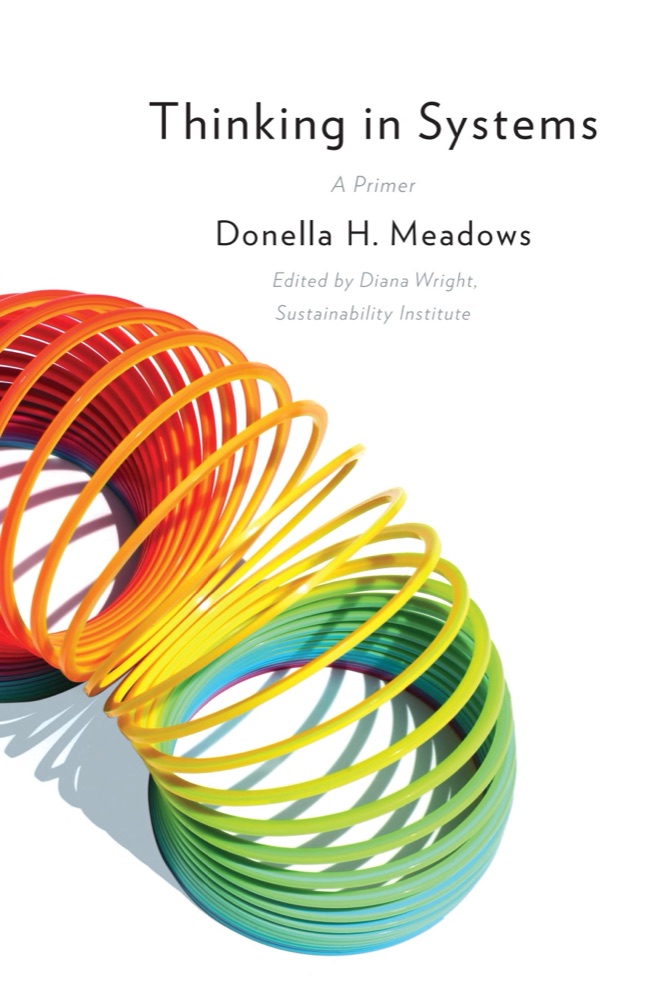
Meadows’ Thinking in Systems, is a concise and crucial book offering insight for problem solving on scales ranging from the personal to the global. Edited by the Sustainability Institute’s Diana Wright, this essential primer brings systems thinking out of the realm of computers and equations and into the tangible world, showing readers how to develop the systems-thinking skills that thought leaders across the globe consider critical for 21st-century life.
Some of the biggest problems facing the world—war, hunger, poverty, and environmental degradation—are essentially system failures. They cannot be solved by fixing one piece in isolation from the others, because even seemingly minor details have enormous power to undermine the best efforts of too-narrow thinking.
While readers will learn the conceptual tools and methods of systems thinking, the heart of the book is grander than met
Book details
- First published
- 2008
- Author
- Donella H. Meadows
- Genre
- Nonfiction
- Goodreads rating
- 4.18 (24k ratings)
Keep reading
Right Kind of Wrong: The Science of Failing Well
 Algorithms to Live By: The Computer Science of Human Decisions
 Zen and the Art of Motorcycle Maintenance
 Black Box Thinking: Why Some People Never Learn from Their Mistakes - But Some Do
 The Fifth Discipline: The Art & Practice of The Learning Organization
 Small Is Beautiful: Economics as if People Mattered
 The Big Picture: On the Origins of Life, Meaning, and the Universe Itself
 Antifragile: Things That Gain from Disorder
 The Design of Everyday Things
 How the Mind Works
 Chaos: Making a New Science
 The Art of Thinking Clearly
 Life 3.0: Being Human in the Age of Artificial Intelligence
 The Black Swan: The Impact of the Highly Improbable
 The Price of Tomorrow: Why Deflation is the Key to an Abundant Future
 The Information: A History, a Theory, a Flood
 21 Lessons for the 21st Century
 The Tipping Point: How Little Things Can Make a Big Difference
 Revolution
 Walden Two
 Getting Things Done: The Art of Stress-Free Productivity
 Seeing Like a State: How Certain Schemes to Improve the Human Condition Have Failed
 Gödel, Escher, Bach: An Eternal Golden Braid
 The Singularity is Near: When Humans Transcend Biology
 Endgame, Vol. 1: The Problem of Civilization
 Emotional Design: Why We Love (or Hate) Everyday Things
 Homo Deus: A History of Tomorrow
 Think Like a Rocket Scientist: Simple Strategies You Can Use to Make Giant Leaps in Work and Life
 Rationality: From AI to Zombies
 Shop Class as Soulcraft: An Inquiry Into the Value of Work
 How to Take Smart Notes
 The Grand Design
 The Fatal Conceit: The Errors of Socialism
 The Signal and the Noise: Why So Many Predictions Fail—But Some Don't
 Complexity: A Guided Tour
 Think: A Compelling Introduction to Philosophy
 God's Debris: A Thought Experiment
 The World Is Flat: A Brief History of the Twenty-first Century
 Alchemy: The Surprising Power of Ideas That Don't Make Sense
 The 7 Habits of Highly Effective People: Personal Workbook
 Adapt: Why Success Always Starts with Failure
 My Ishmael
 Superforecasting: The Art and Science of Prediction
 The Meaning of It All: Thoughts of a Citizen-Scientist
 A Whole New Mind: Why Right-Brainers Will Rule the Future
 The Social Animal: The Hidden Sources of Love, Character, and Achievement
 Hackers & Painters: Big Ideas from the Computer Age
 Ways of Being: Animals, Plants, Machines: The Search for a Planetary Intelligence
 Finite and Infinite Games: A Vision of Life as Play and Possibility
 Genome
 First Things First
 The Master Key System
 Science and Sanity: An Introduction to Non-Aristotelian Systems and General Semantics
 What Technology Wants
 The Lost World
 Revenge of the Tipping Point
 Power vs. Force
 Made to Stick: Why Some Ideas Survive and Others Die
 The Utopia of Rules: On Technology, Stupidity, and the Secret Joys of Bureaucracy
 Understanding Media: The Extensions of Man