
 The Black Swan: The Impact of the Highly Improbable
Quotes from the Book
the human mind does not run on logic any more than a horse runs on petrol
19
It is much easier to be fired for being illogical than it is for being unimaginative. The fatal issue is that logic always gets you to exactly the same place as your competitors.
14
Irrational people are much more powerful than rational people, because their threats are so much more convincing.
12
Not everything that makes sense works, and not everything that works makes sense.
11
you are not thinking; you are merely being logical
11
the uber map is a psychological moonshot, because it does not reduce the waiting time for a taxi but simply makes waiting 90% less frustrating
11
it is perfectly possible to be both rational and wrong.
7
The trouble with market research is that people don’t think what they feel, they don’t say what they think, and they don’t do what they say.
6
And in reality ‘context’ is often the most important thing in determining how people think, behave and act:
6
It’s important to remember that big data all comes from the same place – the past. A new campaigning style, a single rogue variable or a ‘black swan’ event can throw the most perfectly calibrated model into chaos.
6
Hillary thinks like an economist, while Donald is a game theorist, and is able to achieve with one tweet what would take Clinton four years of congressional infighting. That’s alchemy; you may hate it, but it works.
6
when you demand logic, you pay a hidden price: you destroy magic
5
There is a parallel in the behaviour of bees, which do not make the most of the system they have evolved to collect nectar and pollen. Although they have an efficient way of communicating about the direction of reliable food sources, the waggle dance, a significant proportion of the hive seems to ignore it altogether and journeys off at random. In the short term, the hive would be better off if all bees slavishly followed the waggle dance, and for a time this random behaviour baffled scientists, who wondered why 20 million years of bee evolution had not enforced a greater level of behavioural compliance. However, what they discovered was fascinating: without these rogue bees, the hive would get stuck in what complexity theorists call ‘a local maximum’; they would be so efficient at collecting food from known sources that, once these existing sources of food dried up, they wouldn’t know where to go next and the hive would starve to death. So the rogue bees are, in a sense, the hive’s research and development function, and their inefficiency pays off handsomely when they discover a fresh source of food. It is precisely because they do not concentrate exclusively on short-term efficiency that bees have survived so many million years.
4
There is an important lesson in evaluating human behaviour: never denigrate a behaviour as irrational until you have considered what purpose it really serves.
4
Rory’s Rules of Alchemy The opposite of a good idea can also be a good idea. Don’t design for average. It doesn’t pay to be logical if everyone else is being logical. The nature of our attention affects the nature of our experience. A flower is simply a weed with an advertising budget. The problem with logic is that it kills off magic. A good guess which stands up to observation is still science. So is a lucky accident. Test counterintuitive things only because no one else will. Solving problems using rationality is like playing golf with only one club. Dare to be trivial. If there were a logical answer, we would have found it.
4
We don’t value things; we value their meaning. What they are is determined by the laws of physics, but what they mean is determined by the laws of psychology.
4
Remember, if you never do anything differently, you’ll reduce your chances of enjoying lucky accidents.
4
what matters is not whether an idea is true or effective, but whether it fits with the preconceptions of a dominant cabal
4
This distinction matters a great deal. Unlike short-term expediency, long-term self-interest, as the evolutionary biologist Robert Trivers has shown, often leads to behaviours that are indistinguishable from mutually beneficial cooperation. The reason the large fish does not eat its cleaner fish is not because of altruism but because over the long-term, the cleaner fish is more valuable to it alive than dead. The cleaner fish in turn could cheat by ignoring the ectoparasites and eating bits of the host fish’s gills instead, but its long-term future is better if the big fish becomes a repeat customer.* What keeps the relationship honest and mutually beneficial is nothing other than the prospect of repetition.
3
You will never uncover unconscious motivations unless you create an atmosphere in which people can ask apparently fatuous questions without fear of shame.
3
Evolution is like a brilliant uneducated craftsman: what it lacks in intellect it makes up for in experience.
3
all big data comes from the same place: the past. Yet a single change in context can change human behaviour significantly.
3
Many pretend to despise and belittle that which is beyond their reach.
3
No living creature can evolve and survive in the real world by processing information in an objective, measured and proportionate manner.
3
Our conscious mind tries hard to preserve the illusion that it deliberately chose every action you have ever taken; in reality, in many of these decisions it was a bystander at best, and much of the time it did not even notice the decision being made.
3
For a business to be truly customer-focused, it needs to ignore what people say. Instead it needs to concentrate on what people feel.
3
Some scientists believe that driverless cars will not work unless they learn to be irrational. If such cars stop reliably whenever a pedestrian appears in front of them, pedestrian crossings will be unnecessary and jaywalkers will be able to march into the road, forcing the driverless car to stop suddenly, at great discomfort to its occupants. To prevent this, driverless cars may have to learn to be ‘angry’, and to occasionally maliciously fail to stop in time and strike the pedestrian on the shins.
3
if we allow the world to be run by logical people, we will only discover logical things. But in real life, most things aren’t logical – they are psycho-logical.
2
Why are people happy with the idea that nature has an accounting function, but much less comfortable with the idea that it also has a marketing function? Should we despise flowers because they are less efficient than grasses?
2
Find one or two things your boss is rubbish at and be quite good at them.’ Complementary talent is far more valuable than conformist talent.
2
Watch on YouTube
About Rory Sutherland
We have collected 30 quotes from 1 book by Rory Sutherland on BookQuoters.
More about the author →About the book
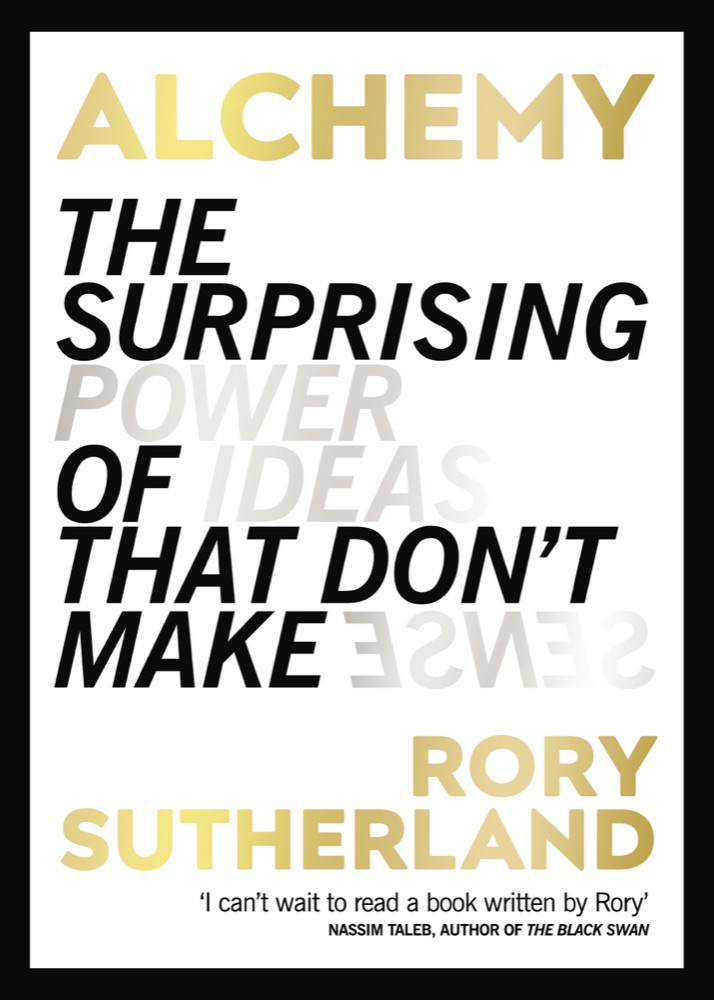
‘A breakthrough book. Wonderfully applicable to everything in life, and funny as hell.’ Nassim Nicholas Taleb
To be brilliant, you have to be irrationalWhy is Red Bull so popular – even though everyone hates the taste? Why do countdown boards on platforms take away the pain of train delays? And why do we prefer stripy toothpaste?We think we are rational creatures. Economics and business rely on the assumption that we make logical decisions based on evidence.
But we aren’t, and we don’t.
In many crucial areas of our lives, reason plays a vanishingly small part. Instead we are driven by unconscious desires, which is why placebos are so powerful. We are drawn to the beautiful, the extravagant and the absurd – from lavish wedding invitations to tiny bottles of the latest fragrance. So if you want to influence people’s choices you have to bypass reason. The best ideas don’t make rati
Book details
- First published
- 2019
- Author
- Rory Sutherland
- Genre
- Nonfiction
- Goodreads rating
- 4.20 (10k ratings)
Keep reading
The Black Swan: The Impact of the Highly Improbable
 The Art of Thinking Clearly
 Rationality: From AI to Zombies
 You Are Not So Smart
 Think Like a Freak
 God's Debris: A Thought Experiment
 Fooled by Randomness: The Hidden Role of Chance in Life and in the Markets
 How the Mind Works
 You Are Now Less Dumb: How to Conquer Mob Mentality, How to Buy Happiness, and All the Other Ways to Outsmart Yourself
 How We Decide
 Algorithms to Live By: The Computer Science of Human Decisions
 Thinking, Fast and Slow
 Predictably Irrational: The Hidden Forces That Shape Our Decisions
 Antifragile: Things That Gain from Disorder
 21 Lessons for the 21st Century
 Blink: The Power of Thinking Without Thinking
 Echopraxia
 Zen and the Art of Motorcycle Maintenance
 Black Box Thinking: Why Some People Never Learn from Their Mistakes - But Some Do
 The Age of Magical Overthinking: Notes on Modern Irrationality
 The Undoing Project: A Friendship That Changed Our Minds
 Logicomix: An Epic Search for Truth
 Superforecasting: The Art and Science of Prediction
 Think Like a Rocket Scientist: Simple Strategies You Can Use to Make Giant Leaps in Work and Life
 Freedom Evolves
 Eating the Dinosaur
 The Drunkard's Walk: How Randomness Rules Our Lives
 Mistakes Were Made (But Not by Me): Why We Justify Foolish Beliefs, Bad Decisions, and Hurtful Acts
 The Blank Slate: The Modern Denial of Human Nature
 But What If We're Wrong? Thinking About the Present As If It Were the Past
 Being Wrong: Adventures in the Margin of Error
 Stumbling on Happiness
 Barking Up the Wrong Tree: The Surprising Science Behind Why Everything You Know About Success Is (Mostly) Wrong
 The Tao of Pooh
 The Elephant in the Brain: Hidden Motives in Everyday Life
 The Social Animal: The Hidden Sources of Love, Character, and Achievement
 Made to Stick: Why Some Ideas Survive and Others Die
 What the Dog Saw and Other Adventures
 Blindsight
 Genesis
 The Meaning of It All: Thoughts of a Citizen-Scientist
 Math with Bad Drawings
 Think: A Compelling Introduction to Philosophy
 Same as Ever: A Guide to What Never Changes
 The Moral Landscape: How Science Can Determine Human Values
 What's Our Problem?: A Self-Help Book for Societies
 Freakonomics: A Rogue Economist Explores the Hidden Side of Everything
 All the Birds in the Sky
 Influence: The Psychology of Persuasion
 How to Fail at Almost Everything and Still Win Big: Kind of the Story of My Life
 The Righteous Mind: Why Good People Are Divided by Politics and Religion
 Think Again: The Power of Knowing What You Don't Know
 What Do You Care What Other People Think?
 Curious: The Desire to Know and Why Your Future Depends On It
 Imager
 Rework
 Science and Sanity: An Introduction to Non-Aristotelian Systems and General Semantics
 Adapt: Why Success Always Starts with Failure
 Even Cowgirls Get the Blues