 The Book: On the Taboo Against Knowing Who You Are
Quotes from the Book
To be prepared against surprise is to be trained. To be prepared for surprise is to be educated.
125
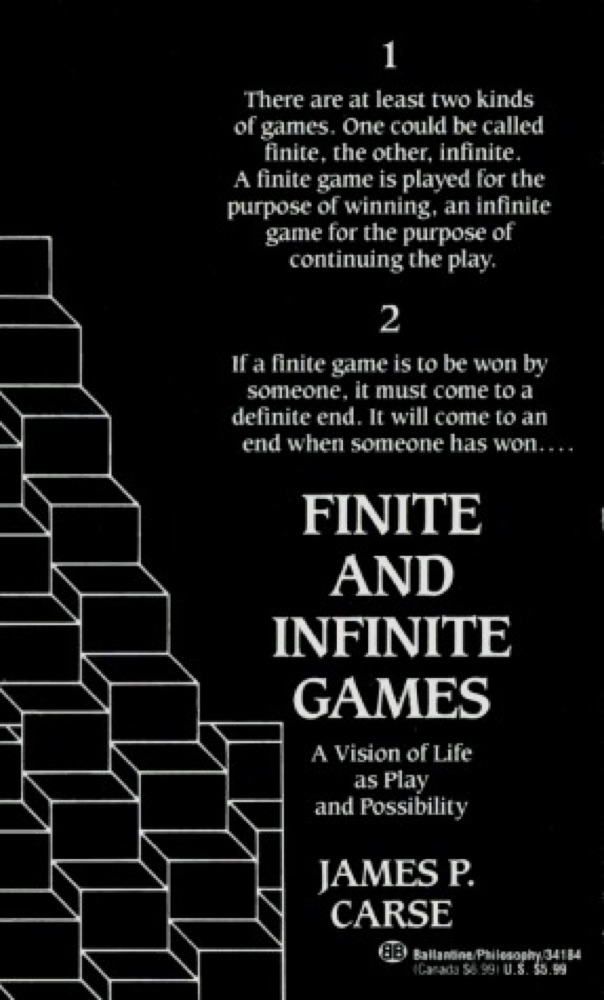
A finite game is played for the purpose of winning, an infinite game for the purpose of continuing the play.
77
Strength is paradoxical. I am not strong because I can force others to do what I wish as a result of my play with them, but because I can allow them to do what they wish in the course of my play with them.
48
We are playful when we engage others at the level of choice, when there is no telling in advance where our relationship with them will come out-- when, in fact, no one has an outcome to be imposed on the relationship, apart from the decision to continue it.
30
Because infinite players prepare themselves to be surprised by the future, they play in complete openness. It is not an openness as in candor, but an openness as in vulnerability. It is not a matter of exposing one's unchanging identity, the true self that has always been, but a way of exposing one's ceaseless growth, the dynamic self that has yet to be.
27
No one can play a game alone. One cannot be human by oneself. There is no selfhood where there is no community. We do not relate to others as the persons we are; we are who we are in relating to others. Simultaneously the others with whom we are in relation are themselves in relation. We cannot relate to anyone who is not also relating to us. Our social existence has, therefore, an inescapably fluid character... this ceaseless change does not mean discontinuity; rather change is itself the very basis of our continuity as persons.
20
To be serious is to press for a specified conclusion. To be playful is to allow for possibility whatever the cost to oneself.
19
if we cannot tell a story about what happened to us, nothing has happened to us.
19
What will undo any boundary is the awareness that it is our vision, and not what we are viewing, that is limited.
18
War presents itself as necessary for self-protection, when in fact it is necessary for self-identification.
17
Therefore, poets do not 'fit' into society, not because a place is denied them but because they do not take their 'places' seriously. They openly see its roles as theatrical, its styles as poses, its clothing costumes, its rules conventional, its crises arranged, its conflicts performed and its metaphysics ideological.
15
Only that which can change can continue: this is the principle by which infinite players live.
14
I can explain nothing to you unless I first draw your attention to patent inadequacies in your knowledge; discontinuities in the relations between objects, or the presence of anomalies you cannot account for by any of the laws known to you. You will remain deaf to my explanations until you suspect yourself of falsehood.
14
Titles are public. They are for others to notice. I expect others to address me according to my titles, but I do not address myself with them-- unless, of course, I address myself as an other.
12
It is a highly valued function of society to prevent changes in the rules of the many games it embraces... Deviancy, however, is the very essence of culture. Whoever merely follows the script, merely repeating the past, is culturally impoverished. There are variations in the quality of deviation; not all divergence from the past is culturally significant. Any attempt to vary from the past in such a way as to cut the past off, causing it to be forgotten, has little cultural importance. Greater significance attaches to those variations that bring the tradition into view in a new way, allowing the familiar to be seen as unfamiliar, as requiring a new appraisal of all that we have been- and therefore all that we are. Cultural deviation does not return us to the past, but continues what was begun but not finished in the past... Properly speaking, a culture does not have a tradition; it is a tradition.
12
There is no possibility of conversation with a loudspeaker.
9
Nature does not change; it has no inside or outside. It is therefore not possible to travel through it. All travel is therefore change within the traveler, and it is for that reason that travelers are always somewhere else. To travel is to grow.
8
Gardening is not outcome-oriented. A successful harvest is not the end of a gardener's existence, but only a phase of it. As any gardener knows, the vitality of a garden does not end with a harvest. It simply takes another form. Gardens do not "die" in the winter but quietly prepare for another season.
8
Evil is never intended as evil. Indeed, the contradiction inherent in all evil is that it originates in the desire to eliminate evil. ... Evil arises in the honored belief that history can be tidied up, brought to a sensible conclusion. It is evil to act as though the past is bringing us to a specifiable end. It is evil to assume that the past will make sense only if we bring it to an issue we have clearly in view. It is evil for a nation to believe it is "the last, best hope on earth." It is evil to think history is to end with a return to Zion, or with the classless society, or with the Islamicization of all living infidels. Your history does not belong to me. We live with each other in a common history.
7
Storytellers do not convert their listeners; they do not move them into the territory of a superior truth. Ignoring the issue of truth and falsehood altogether, they offer only vision. Storytelling is therefore not combative; it does not succeed or fail. A story cannot be obeyed. Instead of placing one body of knowledge against another, storytellers invite us to return from knowledge to thinking, from a bounded way of looking to an horizonal way of seeing.
7
Of course, immortality of the soul-- the bare soul, cleansed of any personality traces-- is rarely what is desired in the yearning for immortality... More often what one intends to preserve is a public personage, a permanently veiled selfhood.
7
Genuine travelers travel not to overcome distance but to discover distance. It is not distance that makes travel necessary, but travel that makes distance possible. Distance is not determined by the measurable length between objects, but by the actual differences between them. The motels around the airports in Chicago and Atlanta are so little different from the motels around the airports of Tokyo and Frankfurt that all essential distances dissolve in likeness. What is truly separated is distinct; it is unlike. "The only true voyage would be not to travel through a hundred different lands with the same pair of eyes, but to see the same land through a hundred different pairs of eyes" (Proust).
6
True poets lead no one unawares. It is nothing other than awareness that poets-that is, creators of all sorts-seek. They do not display their art so as to make it appear real; they display the real in a way that reveals it to be art.
5
Nature is the realm of the unspeakable. It has no voice of its own, and nothing to say. We experience the unspeakability of nature as its utter indifference to human culture.
4
It is, therefore, this fluidity that presents us with an unavoidable challenge: how to contain the serious within the truly playful; that is, how to keep all our finite games in infinite play.
4
To use the machine for control is to be controlled by the machine.
3
The strategy of infinite players is horizontal. They do not go to meet putative enemies with power and violence, but with poiesis and vision. They invite them to become a people in passage. Infinite players do not rise to meet arms with arms; instead, they make use of laughter, vision, and surprise to engage the state and put its boundaries back into play.
3
I AM THE GENIUS of myself, the poietes who composes the sentences I speak and the actions I take. It is I, not the mind, that thinks. It is I, not the will, that acts. It is I, not the nervous system, that feels.
2
Watch on YouTube
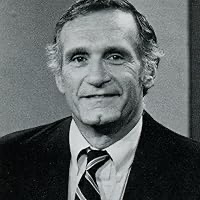
About James P. Carse
We have collected 28 quotes from 1 book by James P. Carse on BookQuoters.
More about the author →About the book
An extraordinary book that will dramatically change the way you experience life. Finite games are the familiar contests of everyday life, the games we play in business and politics, in the bedroom and on the battlefied -- games with winners and losers, a beginning and an end. Infinite games are more mysterious -- and ultimately more rewarding. They are unscripted and unpredictable; they are the source of true freedom. In this elegant and compelling work, James Carse explores what these games mean, and what they can mean to you. He offers stunning new insights into the nature of property and power, of culture and community, of sexuality and self-discovery, opening the door to a world of infinite delight and possibility. "An extraordinary little book . . . a wise and intimate companion, an elegant reminder of the real." -- Brain/Mind Bulletin
Book details
- First published
- 1986
- Author
- James P. Carse
- Genre
- Philosophy
- Goodreads rating
- 3.72 (8k ratings)
Keep reading
The Book: On the Taboo Against Knowing Who You Are
 Children of Dune
 The Wisdom of Insecurity: A Message for an Age of Anxiety
 Rationality: From AI to Zombies
 Genesis
 Hunters of Dune
 Chapterhouse: Dune
 Freedom from the Known
 The Art of Being
 The Philosopher and the Wolf
 The Glass Bead Game
 Maps of Meaning: The Architecture of Belief
 Gnomon
 Creativity: Unleashing the Forces Within
 Total Freedom: The Essential Krishnamurti
 Endgame, Vol. 1: The Problem of Civilization
 The Left Hand of Darkness
 No Time To Spare: Thinking About What Matters
 The Human Condition
 Stories of Your Life and Others
 Think: A Compelling Introduction to Philosophy
 Myths to Live By
 The Story of My Experiments With Truth
 Twilight of the Idols
 The Source of Self-Regard: Selected Essays, Speeches, and Meditations
 Daybreak: Thoughts on the Prejudices of Morality
 The Stone Gods
 The Player of Games
 Even Cowgirls Get the Blues
 Conversations with God: An Uncommon Dialogue, Book 1
 The Ethics of Ambiguity
 Walden Two
 Untimely Meditations
 Power vs. Force
 House Corrino
 12 Rules for Life: An Antidote to Chaos
 In the Light of What We Know
 Undoing Gender
 The Power of Myth
 Dune
Dune
 The Myth of Sisyphus
 The Fifth Science
 The Socrates Express: In Search of Life Lessons from Dead Philosophers
 Pensées
 Gödel, Escher, Bach: An Eternal Golden Braid
 The Dispossessed
 Intimacy: Trusting Oneself and the Other
 A Circle of Quiet
 Asymmetry
 Nutshell
 Freedom Evolves
 The I Ching or Book of Changes
 Ancillary Justice
 A Language Older Than Words
 How to Use Your Enemies
 Ishmael: An Adventure of the Mind and Spirit
 The Oath of the Vayuputras
 The Meaning of It All: Thoughts of a Citizen-Scientist
 Striking Thoughts: Bruce Lee's Wisdom for Daily Living