 Proto: How One Ancient Language Went Global
Quotes from the Book
When you look in the mirror you see not just your face but a museum. Although your face, in one sense, is your own, it is composed of a collage of features you have inherited from your parents, grandparents, great-grandparents, and so on. The lips and eyes that either bother or please you are not yours alone but are also features of your ancestors, long dead pergaps as individuals but still very much alive as fragments in you. Even complex qualities such as your sense of balance, musical abilities, shyness in crowds, or susceptbility to sickness have been lived before. We carry the past around with us all the time, and not just in our bodies. It lives also in our customs, including the way we speak. The past is a set of invisible lenses we wear constantly, and through these we perceive de world and the world perceives us. We stand always on the shoulders of our ancestors, wheter or not we look down to acknowledge them.
16
It is oddly ironic that capitalist archaeologists made the mode of production central to their definition of the Neolithic, and Marxist archaeologists ignored it.
9
The Rig Veda was a ritual canon, not a racial manifesto. If you sacrificed in the right way to the right gods, which required performing the great traditional prayers in the traditional language, you were an Aryan; otherwise you were not. The Rig Veda made the ritual and linguistic barrier clear, but it did not require or even contemplate racial purity.
4
Although cow bones and charred seeds cannot easily be displayed in the national museum, archaeology is not about collecting pretty things but about solving problems, so in the following pages much attention is devoted to animal bones and charred seeds.
1
Both linguists and archaeologists have made communication across the disciplines almost impossible by speaking in dense jargons that are virtually impenetrable to anyone but themselves.
1
The connection between animals, brothers, and power was the foundation on which new forms of male-centered ritual and politics developed among Indo-European-speaking societies. That is why the cow (and brothers) occupied such a central place in Indo-European myths relating to how the world began.
Cattle and sheep herds can grow rapidly with a little luck. Vulnerable to bad weather and theft, they can also decline rapidly. Herding was a volatile, boom-bust economy, and required a flexible, opportunistic social organization.
Between about 14,000 and 12,000 BCE the warming climate that ended the last Ice Age melted the northern glaciers and the permafrost, releasing their combined meltwater in a torrential surge that flowed south into the Caspian basin. The late Ice-Age Caspian ballooned into a vast interior sea designated the Khvalynian Sea. For two thousand years the northern shoreline stood near Saratov on the middle Volga and Orenburg on the Ural River, restricting east-west movement south of the Ural Mountains. The Khvalynian Sea separated the already noticeably different late-glacial forager cultures that prospered east and west of the Ural Mountains.4 Around 11,000–9,000 BCE the water finally rose high enough to overflow catastrophically through a southwestern outlet, the Manych Depression north of the North Caucasus Mountains, and a violent flood poured into the Black Sea, which was then well below the world ocean level. The Black Sea basin filled up until it overflowed, also through a southwestern outlet, the narrow Bosporus valley, and finally poured into the Aegean. By 8000 BCE the Black Sea, now about the size of California and seven thousand feet deep, was in equilibrium with the Aegean and the world ocean.
The myth of Man and Twin established the importance of the sacrifice and the priest who regulated it. The myth of the “Third one” defined the role of the warrior, who obtained animals for the people and the gods. Many other themes are also reflected in these two stories: the Indo-European fascination with binary doublings combined with triplets, two’s and three’s, which reappeared again and again, even in the metric structure of Indo-European poetry; the theme of pairs who represented magical and legal power (Twin and Man, Varuna-Mitra, Odin-Tyr); and the partition of society and the cosmos between three great functions or roles: the priest (in both his magical and legal aspects), the warrior (the Third Man), and the herder/cultivator (the cow or cattle).
The agricultural towns of Old Europe were the most technologically advanced and aesthetically sophisticated in all of Europe between about 6000 and 4000 BCE.
The speakers of Proto-Indo-European were a cattle-keeping people. Where did the cattle come from? Both cattle and sheep were introduced from outside, probably from the Danube valley (although we also have to consider the possibility of a diffusion route through the Caucasus Mountains). The Neolithic pioneers who imported domesticated cattle and sheep into the Danube valley probably spoke non—Indo-European languages ultimately derived from western Anatolia. Their arrival in the eastern Carpathians, northwest of the Black Sea, around 5800 BCE, created a cultural frontier between the native foragers and the immigrant farmers that persisted for more than two thousand years.
As a font of tradition and success in a new land, the charter group exercised a kind of historical cultural hegemony over later generations. Their genes, however, could easily be swamped by later migrants, which is why it is often futile to pursue a genetic fingerprint associated with a particular language.
Charter groups leave an inordinate cultural imprint on later generations, as the latter copy the charter group’s behavior, at least publicly. This explains why the English language, English house forms, and English settlement types were retained in nineteenth-century Ohio, although the overwhelming majority of later immigrants was German. The charter group, already established when the Germans arrived, was English.
Colonist speech generally is more homogeneous than the language of the homeland they left behind. Dialectical differences were fewer among Colonial-era English speakers in North America than they were in the British Isles. The Spanish dialects of Colonial South America were more homogeneous than the dialects of Southern Spain, the home region of most of the original colonists. Linguistic simplification has three causes. One is chain migration, where colonists tend to recruit family and friends from the same places and social groups that the colonists came from. Simplification also is a normal linguistic outcome of mixing between dialects in a contact situation at the destination.
Eastern North America was colonized by four distinct migration streams that originated in four different parts of the British Isles. When they touched down in eastern North America, they created four clearly bounded ethnolinguistic regions between about 1620 and 1750. The Yankee dialect was spoken in New England. The same region also had a distinctive form of domestic architecture—the salt-box clapboard house—as well as its own barn and church architecture, a distinctive town type (houses clustered around a common grazing green), a peculiar cuisine (often baked, like Boston baked beans), distinct fashions in clothing, a famous style of gravestones, and a fiercely legalistic approach to politics and power. The geographic boundaries of the New England folk-culture region, drawn by folklorists on the basis of these traits, and the Yankee dialect region, drawn by linguists, coincide almost exactly. The Yankee dialect was a variant of the dialect of East Anglia, the region from which most of the early Pilgrim migrants came; and New England folk culture was a simplified version of East Anglian folk culture. The other three regions also exhibited strongly correlated dialects and folk cultures, as defined by houses, barn types, fence types, the frequency of towns and their organization, food preferences, clothing styles, and religion. One was the mid-Atlantic region (Pennsylvania Quakers from the English Midlands), the third was the Virginia coast (Royalist Anglican tobacco planters from southern England, largely Somerset and Wessex), and the last was the interior Appalachians (borderlanders from the Scotch-Irish borders). Both dialect and folk culture are traceable in each case to a particular region in the British Isles from which the first effective European settlers came.
Other post-Roman ethnolinguistic frontiers followed the same pattern. After the fall of Rome German speakers moved into the northern cantons of Switzerland, and the Gallic kingdom of Burgundy occupied what had been Gallo-Roman western Switzerland. The frontier between them still separates ecologically similar regions within a single modern state that differ in language (German-French), religion (Protestant-Catholic), architecture, the size and organization of landholdings, and the nature of the agricultural economy. Another post-Roman migration created the Breton/French frontier across the base of the peninsula of Brittany, after Romano-Celts migrated to Brittany from western Britain around 400–600 CE, fleeing the Anglo-Saxons. For more than fifteen hundred years the Celtic-speaking Bretons have remained distinct from their French-speaking neighbors in rituals, dress, music, and cuisine. Finally, migrations around 900–1000 CE brought German speakers into what is now northeastern Italy, where the persistent frontier between Germans and Romance speakers inside Italy was studied by Eric Wolf and John Cole in the 1960s. Although in this case both cultures were Catholic Christians, after a thousand years they still maintained different languages, house types, settlement organizations, land tenure and inheritance systems, attitudes toward authority and cooperation, and quite unfavorable stereotypes of each other. In all these cases documents and inscriptions show that the ethnolinguistic oppositions were not recent or invented but deeply historical and persistent.
One is that tribal languages are generally more numerous in any long-settled region than tribal material cultures. Silver and Miller noticed, in 1997, that most tribal regions had more languages than material cultures. The Washo and Shoshone in the Great Basin had very different languages, of distinct language families, but similar material cultures; the Pueblo Indians had more languages than material cultures; the California Indians had more languages than stylistic groups; and the Indians of the central Amazon are well known for their amazing linguistic variety and broadly similar material cultures.
Ancient European tribal identities—Celt, Scythian, Cimbri, Teuton, and Pict—are now frequently seen as convenient names for chameleon-like political alliances that had no true ethnic identity, or as brief ethnic phenomena that were unable to persist for any length of time, or even as entirely imaginary later inventions.
They occupied a part of the world—the steppes—where the sky is by far the most striking and magnificent part of the landscape, a fitting environment for people who believed that all their most important deities lived in the sky.
The homeland of Proto-Uralic probably was in the forest zone centered on the southern flanks of the Ural Mountains. Many argue for a homeland west of the Urals and others argue for the east side, but almost all Uralic linguists and Ural-region archaeologists would agree that Proto-Uralic was spoken somewhere in the birch-pine forests between the Oka River on the west (around modern Gorky) and the Irtysh River on the east (around modern Omsk).
The most famous definition of the basic divisions in Proto-Indo-European society was the tripartite scheme of Georges Dumézil, who suggested that there was a fundamental three-part division between the ritual specialist or priest, the warrior, and the ordinary herder/cultivator. Colors might have been associated with these three roles: white for the priest, red for the warrior, and black or blue for the herder/cultivator; and each role might have been assigned a specific type of ritual/legal death: strangulation for the priest, cutting/stabbing for the warrior, and drowning for the herder/cultivator.
The speakers of Proto-Indo-European were farmers and stockbreeders: we can reconstruct words for bull, cow, ox, ram, ewe, lamb, pig, and piglet. They had many terms for milk and dairy foods, including sour milk, whey, and curds. When they led their cattle and sheep out to the field they walked with a faithful dog. They knew how to shear wool, which they used to weave textiles (probably on a horizontal band loom). They tilled the earth (or they knew people who did) with a scratch-plow, or ard, which was pulled by oxen wearing a yoke. There are terms for grain and chaff, and perhaps for furrow. They turned their grain into flour by grinding it with a hand pestle, and cooked their food in clay pots (the root is actually for cauldron, but that word in English has been narrowed to refer to a metal cooking vessel). They divided their possessions into two categories: movables and immovables; and the root for movable wealth (*peku-, the ancestor of such English words as pecuniary) became the term for herds in general.10 Finally, they were not averse to increasing their herds at their neighbors’ expense, as we can reconstruct verbs that meant “to drive cattle,” used in Celtic, Italic, and Indo-Iranian with the sense of cattle raiding or “rustling.
Most linguists at least agree that the fauna and flora designated by the reconstructed vocabulary are temperate-zone types (birch, otter, beaver, lynx, bear, horse), not Mediterranean (no cypress, olive, or laurel) and not tropical (no monkey, elephant, palm, or papyrus). The roots for horse and bee are most helpful.
We can say with great confidence that wheeled vehicles were not invented until after 4000 BCE; the surviving evidence suggests a date closer to 3500 BCE. Before 4000 BCE there were no wheels or wagons to talk about.
No actual woven woolen textiles are firmly dated before about 3000 BCE, but they were very widespread by 2800 BCE. A woven woolen textile fragment that might predate 3000 BCE was found in a grave in the North Caucasus Mountains, probably a grave of the Novosvobodnaya culture (although there is some uncertainty about the provenience).
The animal-bone evidence from the Near East suggests that wool sheep appeared after about 3400 BCE. Because sheep were not native to Europe, domesticated Near Eastern sheep were imported to Europe by the first farmers who migrated to Europe from Anatolia about 6500 BCE. But the mutation for longer wool might have appeared as an adaptation to cold winters after domesticated sheep were introduced to northern climates, so it would not be surprising if the earliest long-wool sheep were bred in Europe.
Linen made from flax was the oldest woven textile. Woolen thread was invented only after spinners of flax and other plant fibers began to obtain the longer animal fibers that grew on mutant wool sheep. When did this genetic alteration happen? The conventional wisdom is that wool sheep appeared about 4000–3500 BCE.
They retained shared cognate names for at least three deities: (1) Erinys/Sara yū, a horse-goddess in both traditions, born of a primeval creator-god and the mother of a winged horse in Greek or of the Divine Twins in Indo-Iranian, who are often represented as horses; (2) Kérberos/Śárvara, the multiheaded dog that guarded the entrance to the Otherworld; and (3) Pan/Pūán, a pastoral god that guarded the flocks, symbolically associated in both traditions with the goat.
The people who spoke Pre-Celtic and Pre-Italic lost contact with the eastern and northern groups of Indo-European speakers before the sat∂m and ruki innovations occurred. We cannot yet discuss where the boundaries of these linguistic regions were, but we can say that Pre-Italic and Pre-Celtic departed to form a western regional–chronological block, whereas the ancestors of Indo-Iranian, Baltic, Slavic, and Armenian stayed behind and shared a set of later innovations. Tocharian, the easternmost Indo-European language, spoken in the Silk Road caravan cities of the Tarim Basin in northwestern China, also lacked the sat∂m and ruki innovations, so it seems to have departed equally early to form an eastern branch.
Most Vedic specialists agree that the 1,028 hymns of the Rig Veda were compiled into what became the sacred form in the Punjab, in northwestern India and Pakistan, probably between about 1500 and 1300 BCE. But the deities, moral concepts, and Old Indic language of the Rig Veda first appeared in written documents not in India but in northern Syria.
Watch on YouTube
About David W. Anthony
About the book
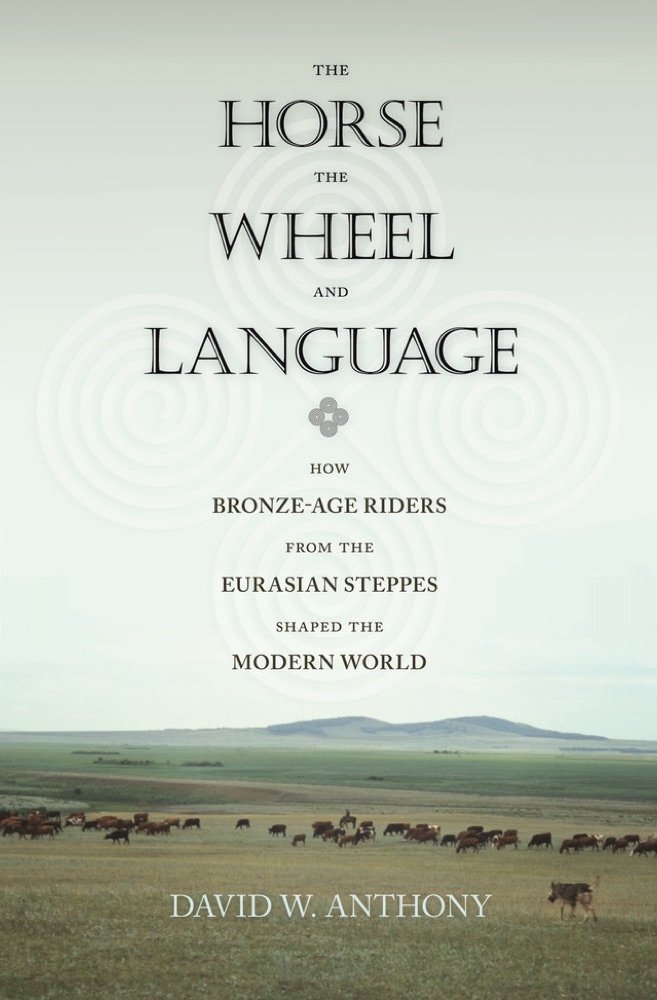
Roughly half the world's population speaks languages derived from a shared linguistic source known as Proto-Indo-European. But who were the early speakers of this ancient mother tongue, and how did they manage to spread it around the globe? Until now their identity has remained a tantalizing mystery to linguists, archaeologists, and even Nazis seeking the roots of the Aryan race. The Horse, the Wheel, and Language lifts the veil that has long shrouded these original Indo-European speakers, and reveals how their domestication of horses and use of the wheel spread language and transformed civilization.
Linking prehistoric archaeological remains with the development of language, David Anthony identifies the prehistoric peoples of central Eurasia's steppe grasslands as the original speakers of Proto-Indo-European, and shows how their innovative use of the ox wagon, horseback riding, and t
Book details
- First published
- 2007
- Author
- David W. Anthony
- Genre
- History
- Goodreads rating
- 4.00 (4k ratings)
Keep reading
Proto: How One Ancient Language Went Global
 A History of the World in 100 Objects
 1491: New Revelations of the Americas Before Columbus
 Magicians of the Gods: The Forgotten Wisdom of Earth's Lost Civilization
 Guns, Germs, and Steel: The Fates of Human Societies
 Sea People: The Puzzle of Polynesia
 Europe: A History
 Women's Work: The First 20,000 Years: Women, Cloth, and Society in Early Times
 The New Penguin History of The World
 Fingerprints of the Gods: The Evidence of Earth's Lost Civilization
 The Dawn of Everything: A New History of Humanity
 Children of Ash and Elm: A History of the Vikings
 The Unfolding of Language: An Evolutionary Tour of Mankind's Greatest Invention
 Saxons, Vikings, and Celts: The Genetic Roots of Britain and Ireland
 Through the Language Glass: Why the World Looks Different in Other Languages
 Salt: A World History
 The Violinist's Thumb: And Other Lost Tales of Love, War, and Genius, as Written by Our Genetic Code
 Civilization: The West and the Rest
 Made in America: An Informal History of the English Language in the United States
 The Spell of the Sensuous: Perception and Language in a More-Than-Human World
 The Third Chimpanzee: The Evolution and Future of the Human Animal
 2312
2312
 The Mother Tongue: English and How It Got That Way
 Our Oriental Heritage
 In the Land of Invented Languages: Esperanto Rock Stars, Klingon Poets, Loglan Lovers, and the Mad Dreamers Who Tried to Build a Perfect Language
 At Home: A Short History of Private Life
 A Short History of Progress
 Collapse: How Societies Choose to Fail or Succeed
 Sapiens: A Brief History of Humankind
 Culture and Imperialism
 Imperium
 The Social Conquest of Earth
 Trilobite: Eyewitness to Evolution
 Shadows of Forgotten Ancestors
 Timaeus
 Dark Emu
 The Chalice and the Blade: Our History, Our Future (Updated With a New Epilogue)
 The Wizard and the Prophet: Two Remarkable Scientists and Their Dueling Visions to Shape Tomorrow's World
 The Book of General Ignorance
 How the Irish Saved Civilization
 Always Coming Home
 The Ancestor's Tale: A Pilgrimage to the Dawn of Evolution
 Almanac of the Dead
 From Dawn to Decadence: 500 Years of Western Cultural Life, 1500 to the Present
 Underland: A Deep Time Journey
 Femina: A New History of the Middle Ages, Through the Women Written Out of it
 Arctic Dreams
 The Wayfinders: Why Ancient Wisdom Matters in the Modern World
 Becoming Kin: An Indigenous Call to Unforgetting the Past and Reimagining Our Future
 The Lost City of the Monkey God
 The Folklore of Discworld
 Dragons of Eden: Speculations on the Evolution of Human Intelligence
 The Nutmeg's Curse: Parables for a Planet in Crisis
 The Histories
 The Invention of the Jewish People
 The Inconvenient Indian: A Curious Account of Native People in North America
 Last and First Men
 Flashpoints: The Emerging Crisis in Europe
 The Discarded Image: An Introduction to Medieval and Renaissance Literature
 Religion Explained: The Evolutionary Origins of Religious Thought