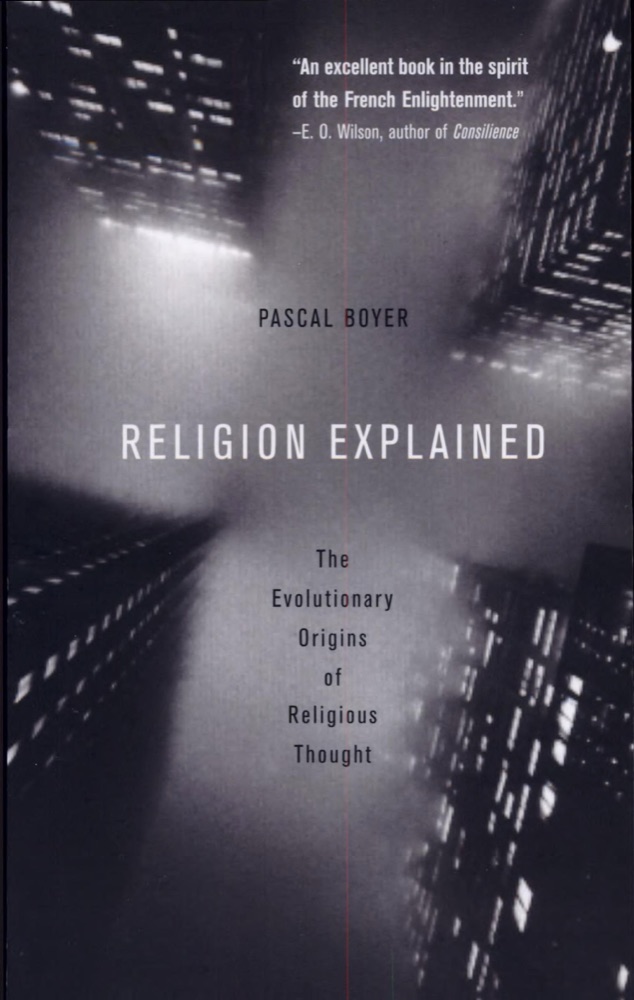

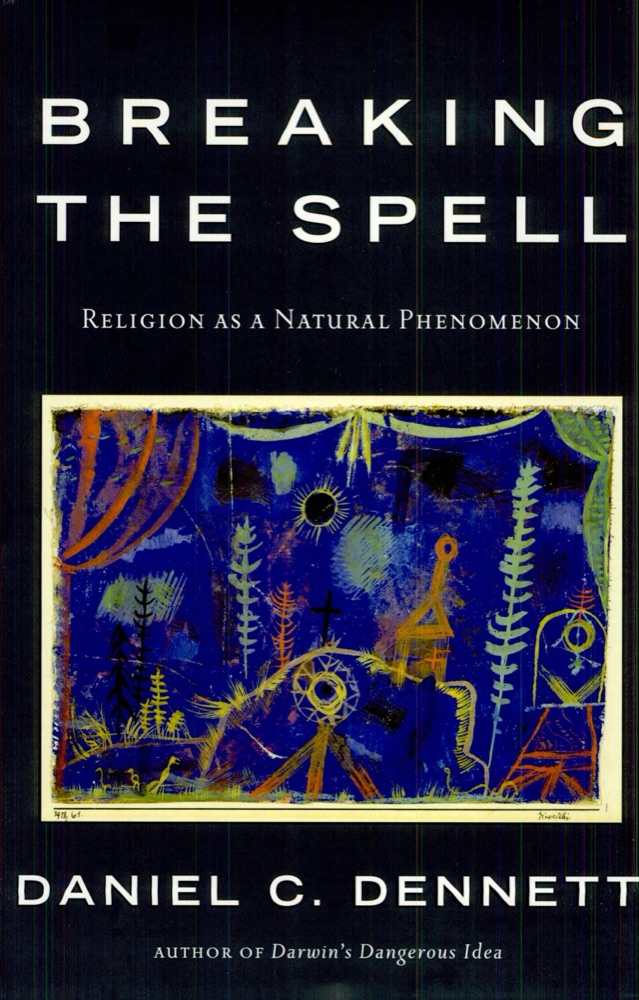
 Breaking the Spell: Religion as a Natural Phenomenon
Quotes from the Book
[T]he choice of human groupings for cultural comparisons is not a natural or scientific choice, but a political one.
8
What we mean when we say that something is "cultural" is that it is roughly similar to what we find in other members of the particular group we are considering, and unlike what we would find in members of a contrast group. This is why it is confusing to say that people share a culture, as if culture were common property. We may have strictly identical amounts of money in our respective wallets without sharing any of it!
7
If religion allays anxiety, it cures only a small part of the disease it creates.
6
Having concepts of gods and spirits does not really make moral rules more compelling but it sometimes makes them more intelligible. So we do not have gods because that makes society function. We have gods in part because we have the mental equipment that makes society possible but we cannot always understand how society functions.
3
Most accounts of the origins of religion emphasize one of the following suggestions: human minds demand explanations, human hearts seek comfort, human society requires order, human intellect is illusionprone.
2
To sum up, then, fundamentalism is neither religion in excess nor politics in disguise. It is an attempt to preserve a particular kind of hierarchy based on coalition, when this is threatened by the perception of cheap and therefore likely defection.
2
Societies have religion because social cohesion requires something like religion. Social groups would fall apart if ritual did not periodically reestablish that all members are part of a greater whole.
2
There is no human society without some musical tradition. Although the traditions are very different, some principles can be found everywhere.
2
If people feel a conflict between their inclinations and a norm that is followed by everybody else, it is a conflict within their heads.
1
I do not think that people have religion because they relax their usually strict criteria for evidence and accept extraordinary claims; I think they are led to relax these criteria because some extraordinary claims have become quite plausible to them.
1
Having a normal human brain does not imply that you have religion. All it implies is that you can acquire it, which is very different.
1
Consider morality. In some places people say that the gods laid down the rules people live by. In other places the gods or ancestors simply watch people and sanction their misdemeanours. In both cases people make a connection between moral understandings (intuitions, feelings and reasoning about what is ethical and what is not) and supernatural agents (gods, ancestors, spirits).
1
Consider the explanation of thunderstorms as the booming voice of ancestors venting their anger at some human misdemeanour. To explain a limited aspect of the natural world (loud, rolling, thumping sounds during storms) we have to assume a whole imaginary world with superhuman agents (Where did they come from? Where are they?) that cannot be seen (Why not?) in a distant place that cannot be reached (How does the noise come through all the way?), whose voices produce thunder (How is that possible? Do they have special mouths? Are they gigantic?).
1
If people tell you that ‘religion is faith in a doctrine that teaches us how to save our souls by obeying a wise and eternal Creator of the universe’, these people probably have not travelled or read enough. In many cultures people think that the dead come back to haunt the living but this is not universal. In some places people believe that certain special individuals can communicate with gods or dead people, but this idea is not found everywhere. In some places people assume that humans have a soul which survives after death, but this idea is not universal. When we put forward general explanations of religion, we had better make sure that they apply outside our parish.
1
A common explanation is that we imagine person-like agents who rule our destinies because this produces a reassuring view of our existence and the world around us. We project human features onto nonhuman aspects of our world because that makes these aspects more familiar and therefore less frightening.
1
That we have evolved capacities for social interaction means that we tend to represent morality and misfortune in a very special way, which makes the connection with supernatural agents extremely easy and apparently obvious.
1
...the fact that early humans did decorate corpses, lay out the bodies in particular postures or bury people with flowers, aligned horns or tools would support the notion that some ritualization of death is a very ancient human activity.
1
Religion is not just about flying mountains, talking trees and biological monsters but also about agents whose mental states matter a lot, about connections with predation and death, about links with morality and misfortune.
1
...coalitional dynamics would predict that whatever outsiders do is often little concern to fundamentalists. What matters is what other members of the group are likely to do.
1
People may have finely tuned coalitional capacities, but they do not necessarily have access to how these work. The cues that make some people appear reliable and others less so are computed in ways that often escape conscious attention.
1
Social exchange is certainly among the oldest of human behaviors, as humans have depended on sharing and exchanging resources for a very long time.
1
The journalistic cliché that this is the -information age- is misleading if it suggests that in the past, either recent or distant, we did not depend on information.
1
Our inference systems may be there because they provide solutions to problems that were recurrent in normal human environments for hundred of thousands of years.
1
confusos justo allí donde la precisión sería fundamental.
Watch on YouTube
About Pascal Boyer
We have collected 24 quotes from 1 book by Pascal Boyer on BookQuoters.
More about the author →About the book
Many of our questions about religion, says the internationally renowned anthropologist Pascal Boyer, were once mysteries, but they no longer we are beginning to know how to answer questions such as "Why do people have religion?" and "Why is religion the way it is?" Using findings from anthropology, cognitive science, linguistics, and evolutionary biology, Boyer shows how one of the most fascinating aspects of human consciousness is increasingly admissible to coherent, naturalistic explanation. And Man Creates God tells readers, for the first time, what religious feeling is really about, what it consists of, and how it originates. It is a beautifully written, very accessible book by an anthropologist who is highly respected on both sides of the Atlantic. As a scientific explanation for religious feeling, it is sure to arouse controversy.
Book details
- First published
- 2001
- Author
- Pascal Boyer
- Genre
- Nonfiction
- Goodreads rating
- 3.98 (2k ratings)
Keep reading
Breaking the Spell: Religion as a Natural Phenomenon
 The Social Conquest of Earth
 Sapiens: A Brief History of Humankind
 The Righteous Mind: Why Good People Are Divided by Politics and Religion
 On Human Nature
 21 Lessons for the 21st Century
 The Blank Slate: The Modern Denial of Human Nature
 The Moral Landscape: How Science Can Determine Human Values
 Religion for Atheists: A Non-Believer's Guide to the Uses of Religion
 Straw Dogs: Thoughts on Humans and Other Animals
 Enlightenment Now: The Case for Reason, Science, Humanism, and Progress
 A Hunter-Gatherer's Guide to the 21st Century: Evolution and the Challenges of Modern Life
 The Better Angels of Our Nature: Why Violence Has Declined
 The Future of an Illusion
 A Little History of Religion
 A Language Older Than Words
 Dragons of Eden: Speculations on the Evolution of Human Intelligence
 The Varieties of Religious Experience
 Maps of Meaning: The Architecture of Belief
 The Fatal Conceit: The Errors of Socialism
 God's Debris: A Thought Experiment
 The Portable Atheist: Essential Readings for the Nonbeliever
 Homo Deus: A History of Tomorrow
 god is Not Great: How Religion Poisons Everything
 The Sign
 The Meaning of It All: Thoughts of a Citizen-Scientist
 The End of Faith: Religion, Terror, and the Future of Reason
 Myths to Live By
 Moral Tribes: Emotion, Reason, and the Gap Between Us and Them
 Why People Believe Weird Things: Pseudoscience, Superstition, and Other Confusions of Our Time
 The Occult
 The Gospel of the Flying Spaghetti Monster
 The Social Animal: The Hidden Sources of Love, Character, and Achievement
 The God Delusion
 A Devil's Chaplain: Reflections on Hope, Lies, Science, and Love
 God Is Not One: The Eight Rival Religions That Run the World--and Why Their Differences Matter
 Living with a Wild God: A Nonbeliever's Search for the Truth about Everything
 The Dawn of Everything: A New History of Humanity
 Humankind: A Hopeful History
 Genesis
 The Cosmic Serpent: DNA and the Origins of Knowledge
 A Short History of Myth
 The Story of B: An Adventure of the Mind and Spirit
 The Varieties of Scientific Experience: A Personal View of the Search for God
 How Should We Then Live? The Rise and Decline of Western Thought and Culture
 Outgrowing God: A Beginner’s Guide to Atheism
 Consilience: The Unity of Knowledge
 The Perennial Philosophy
 The Sane Society
 When I Was a Child I Read Books
 The Demon-Haunted World: Science as a Candle in the Dark
 The Parafaith War
 Echopraxia
 Darwin's Dangerous Idea: Evolution and the Meanings of Life
 Think: A Compelling Introduction to Philosophy
 From Dawn to Decadence: 500 Years of Western Cultural Life, 1500 to the Present
 The Power of Myth
 Why There Is No God: Simple Responses to 20 Common Arguments for the Existence of God
 Undeniable: Evolution and the Science of Creation
 The Wayfinders: Why Ancient Wisdom Matters in the Modern World