
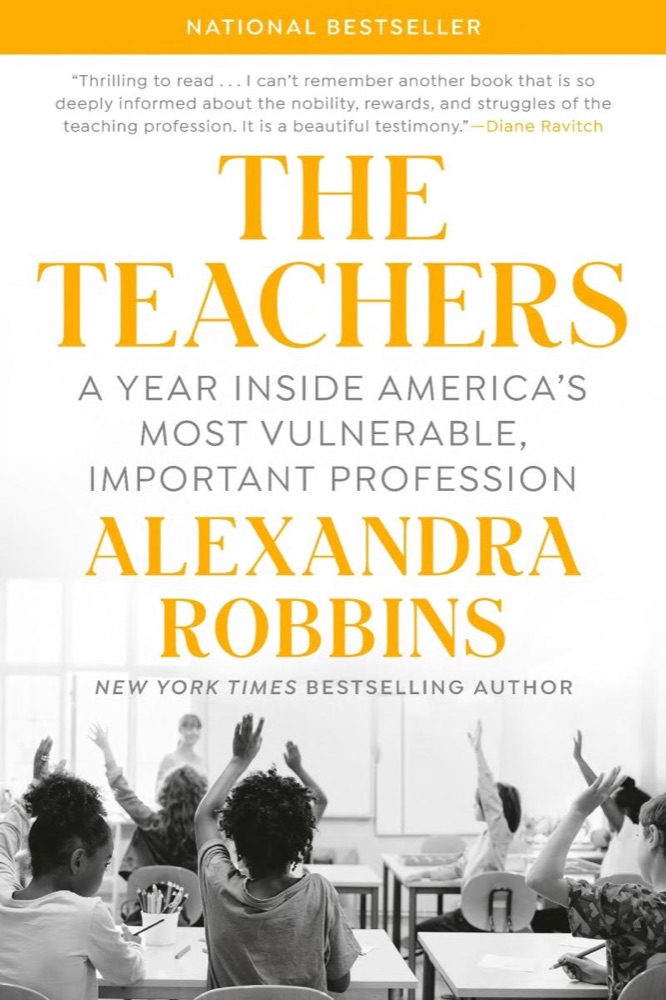
 The Teachers: A Year Inside America's Most Vulnerable, Important Profession
Quotes from the Book
Conformity is not an admirable trait. Conformity is a copout. It threatens self-awareness. It can lead groups to enforce rigid and arbitrary rules.
11
It was the fact that they tried so hard that doomed them.
9
No student should be encouraged -- by anyone -- to change himself until he's "normal," a term that says everything and means nothing.
8
Although she was gregarious, she inadvertently separated herself from people because she was so often inside her own head, focusing on her creativity.
6
Nothing is more unnerving to the truly conventional than the unashamed misfit.
5
If schools celebrated student scientists the same way they celebrate student athletes, more students would be encouraged to pursue the subject. Instead, science is considered nerdy because schools help students to paint it that way.
5
If there is a single factor that spells out the difference between the cafeteria fringe headed for greatness and those doomed for low self-worth, even more than a caring teacher or a group of friends, it is supportive, accepting parents who not only love their children unconditionally, but also don't make them feel as if their idiosyncrasies qualify as "conditions" in the first place.
5
When a child sees herself through the prism of her peer group, the resulting self image can be distorted.
5
Nonconformists aren't just going against the grain; they're going against the brain. Either their brains aren't taking the easy way out to begin with, or in standing apart from their peers, these students are standing up to their biology.
4
Social standing does not necessarily translate to social acceptance.
4
Being an outsider doesn't necessarily indicate any sort of social failing. We do not view a tuba player as musically challenged if he cannot play the violin.
4
What made Einstein special was his impertinence, his nonconformity, and his distaste for dogma. Einstein’s genius reminds us that a society’s competitive advantage comes not from teaching the multiplication or periodic tables but from nurturing rebels. Grinds have their place, but unruly geeks change the world. (Walter Issacson, Wired)
4
Polarization is just one of many ways group membership can change an individual. Perhaps the most striking effect of group membership is that it can modify individuals’ perceptions of themselves. Unable to separate their personal introspection from the ways they believe other people perceive them, teenagers may have what psychologists call an “imaginary audience,” meaning they believe that other people are just as attuned to their appearance and behavior as they are (cue any pimple cream commercial). These perceptions can affect various aspects of their lives. For example, psychologists found that when Asian girls were subtly reminded about their Asian identity, they performed better on math tests. When they were subtly reminded about their gender, however, they performed worse.
4
Too many parents fail to understand that there is a difference between fitting in and being liked, that there is a difference between being "normal" and being happy. High school is temporary. Family is not.
3
The human brain takes in information from other people and incorporates it with the information coming from its own senses, neuroscientist Gregory Berns has written. Many times, the group's opinion trumps the individual's before he even becomes aware of it.
3
Conformity is a mask behind which students can hide their identity or the fact that they haven't yet figured out their identity.
3
How could he encapsulate in a pithy admissions-interview line all of his unique ideas and interests?
2
Groups satisfy our brain's natural inclination to make sense of hordes of people we encounter and observe. This quality is so inherent that children intuitively understand the need to form groups without adults having to teach them.
2
Imagine what it must be like for teenagers who don't feel they have room to breathe in their own homes. If you are a parent reading this book, you care about your child. If she is quirky, unusual, or nonconformist, ask yourself whether you are doing everything you can to nurture her unusual interests, style, or skills, or whether instead you are directly or subtly pushing her to hide them.
2
Teenage drinking has been declining since 1999, but students vastly overestimate their classmates' use of alcohol, drugs, and cigarettes. For example, a study conducted at a Midwestern high school when teenage alcohol use was peaking found that students believed that 92% of their peers Frank alcohol and 85% smoked cigarettes. When researchers surveyed the school to unearth the actual statistics, they learned that 47% of students had consumed alcohol and 17% smoked.
2
In the midst of a crowd, an individual's layers of restraint peel away, revealing potentially barbaric instincts and a susceptibility to a "crowd contagion.
2
Students usually don't refer to themselves as nerds until someone else accuses them of being one.
2
Group membership can modify individuals' perceptions of themselves. Unable to separate their personal introspection from the ways they believe other people perceive them, teenagers may have what psychologists call an "imaginary audience", meaning that they believed that other people are just as attuned to their appearance and behavior as they are.
2
Polarization (is) a tendency for groups to form judgments that are more extreme than individuals' personal opinions.
2
If teachers are uncomfortable at their own school, they will pass on their uncertainties or negative attitude to students.
2
Instead of revamping school policies to welcome every child, many school systems are bent on revamping the students to conform to their schools.
2
Membership in small groups allows people to feel similar and different at the same time: similar because they are a part of a group in different because the group is separate from the masses.
1
Watch on YouTube
About Alexandra Robbins
We have collected 35 quotes from 2 books by Alexandra Robbins on BookQuoters.
More about the author →More by Alexandra Robbins
The Teachers: A Year Inside America's Most Vulnerable, Important Profession
About the book
When school lunchroom doors open, hungry students rush in, searching for tables where they wouldn't be outsiders. Of course, in middle school and high school, almost everyone is an outsider: the nerds, the new girls, the band geeks, the loners; even the "popular" cheerleaders. Alexandra Robbins' The Geeks Shall Inherit the Earth takes us inside the hallways of real schools to show us how shifting cliques and permanent marginalization affect children. Following individual students over the course of a year, she tracks the plight and possibilities of self-confessed nerds, freaks, punks, Goths, and weirdos. Her central message is heartening: Our increasingly homogenized society ultimately needs and welcomes the cafeteria fringe.
Book details
- First published
- 2009
- Author
- Alexandra Robbins
- Genre
- Nonfiction
- Goodreads rating
- 3.59 (5k ratings)
Keep reading
 What Made Maddy Run: The Secret Struggles and Tragic Death of an All-American Teen
 The Element: How Finding Your Passion Changes Everything
 What the Dog Saw and Other Adventures
 The Social Animal: The Hidden Sources of Love, Character, and Achievement
 Revolution from Within: A Book of Self-Esteem
 Excellent Sheep: The Miseducation of the American Elite and the Way to a Meaningful Life
 Coming Apart: The State of White America, 1960-2010
 An Absolutely Remarkable Thing
 The Coddling of the American Mind: How Good Intentions and Bad Ideas Are Setting up a Generation for Failure
 Impro: Improvisation and the Theatre
 Different, Not Less: A Neurodivergent's Guide to Embracing Your True Self and Finding Your Happily Ever After
 Selfie: How the West Became Self-Obsessed
 One in a Millennial: On Friendship, Feelings, Fangirls, and Fitting In
 The 57 Bus
 Lila: An Inquiry Into Morals
 Surrounded by Idiots
 The Age of Magical Overthinking: Notes on Modern Irrationality
 Party of One: The Loner's Manifesto
 A Hunter-Gatherer's Guide to the 21st Century: Evolution and the Challenges of Modern Life
 All the Birds in the Sky
 David and Goliath: Underdogs, Misfits, and the Art of Battling Giants
 The Nix
 Letters to a Young Contrarian
 Quiet: The Power of Introverts in a World That Can't Stop Talking
 The Person You Mean to Be: How Good People Fight Bias
 The 7 Habits Of Highly Effective Teens
 The Vanishing American Adult: Our Coming-of-Age Crisis—and How to Rebuild a Culture of Self-Reliance
 The Elephant in the Brain: Hidden Motives in Everyday Life
 Troubled: A Memoir of Foster Care, Family, and Social Class
 Revenge of the Tipping Point
 Originals: How Non-Conformists Move the World
 Think Like a Freak
 Girl, Woman, Other
 Please Understand Me II: Temperament, Character, Intelligence
 Lead from the Outside: How to Build Your Future and Make Real Change
 The Diamond Age
 We Learn Nothing
 King Dork
 Far from the Tree: Parents, Children, and the Search for Identity
 The Misfits
 The Laws of Human Nature
 Slow Learner
 You Are Now Less Dumb: How to Conquer Mob Mentality, How to Buy Happiness, and All the Other Ways to Outsmart Yourself
 Parasitic Mind: How Infectious Ideas Are Killing Common Sense
 The Rebel Angels
 Creation Lake
 The Collapse of Parenting: How We Hurt Our Kids When We Treat Them Like Grown-Ups
 Special Topics in Calamity Physics
 Becoming
 Paris: A Memoir for Young Women in the Age of Influencers
 Creative Schools: The Grassroots Revolution That's Transforming Education
 iGen: Why Today’s Super-Connected Kids Are Growing Up Less Rebellious, More Tolerant, Less Happy--and Completely Unprepared for Adulthood--and What That Means for the Rest of Us
 Punished by Rewards: The Trouble with Gold Stars, Incentive Plans, A's, Praise and Other Bribes
 Tress of the Emerald Sea
 Social Intelligence: The New Science of Human Relationships
 White
White
 Noumenon