
 The Science of Storytelling
Quotes from the Book
One of the dictums that defines our culture is that we can be anything we want to be – to win the neoliberal game we just have to dream, to put our minds to it, to want it badly enough. This message leaks out to us from seemingly everywhere in our environment: at the cinema, in heart-warming and inspiring stories we read in the news and social media, in advertising, in self-help books, in the classroom, on television. We internalize it, incorporating it into our sense of self. But it’s not true. It is, in fact, the dark lie at the heart of the age of perfectionism. It’s the cause, I believe, of an incalculable quotient of misery. Here’s the truth that no million-selling self-help book, famous motivational speaker, happiness guru or blockbusting Hollywood screenwriter seems to want you to know. You’re limited. Imperfect. And there’s nothing you can do about it.
27
This is where low self-esteem gets built into the core of the machine. For Aristotle, a person had innate potential and was naturally moving towards perfection. But for the Christians, a person was born in a state of sin and falling towards hell. God, not the individual, was where perfection lay. This meant that a person wanting to become more perfect would have to engage in a constant war with themselves – a war, not with forces out in the world, but with their own soul, their conscience, their mind and thoughts. And because perfection only existed outside the human realm, that struggle would always be hopeless. The Christians had given the Western self a soul, and then begun to torture it.
12
Western culture prefers us not to believe we're defined or limited. It wants us to buy the fiction that the self is open, free, nothing but pure, bright possibility; that we're all born with the same suite of potential abilities, as neural 'blank slates', as if all human brains come off the production line at Foxconn. This seduces us into accepting the cultural lie that says we can do anything we set our minds to, that we can be whoever we want to be. This false idea is of immense value to our neoliberal economy. The game it compels us to play can best be justified morally if all the contestants start out with an equal shot at winning. Moreover, if we believe we're all the same, this legitimizes calls for deregulated corporation and smaller government: it means that men and women who lose simply didn't want it badly enough, that they just didn't believe - in which case, why should anyone else catch their fall?
11
Already, every day, millions of us are needled and outraged by the hysterically stated views of those with whom we don’t agree. Our irritation pushes us into a place of fiercer opposition. The more emotional we become, the less rational we become, the less able to properly reason. In an attempt to quieten the stress, we begin muting, blocking, de-friending and unfollowing. And we’re in an echo chamber now, shielded from diverse perspectives that might otherwise have made us wiser and more empathetic and open. Safe in the digital cocoon we’ve constructed, surrounded by voices who flatter us with agreement, we become yet more convinced of our essential rightness, and so pushed even further away from our opponents, who by now seem practically evil in their bloody-minded wrongness
6
... and a motto in a frame: sometimes i feel like giving up but then i remember of a lot of motherfuckers to prove wrong
3
I was aware and increasingly suspicious of the separation between the things i felt and the voice that interpreted those feelings. We really are, as people sometimes glibly say, a mystery to ourselves. we really are
3
In the memorable words of Professor Roy Baumeister, ‘Life is change that yearns for stability
2
The Ancient Greeks had this idea that being physically beautiful was the same as being ethically good and, likewise, being physically ugly was the same as being ethically bad.’ They had a word for this: kalokagathia, which came from kalos, meaning beautiful, kai, meaning ‘and’, and agathos, meaning ‘good’. ‘This idea, that the bodily form is inherently important for understanding who someone is, is very much still with us,’ he said. The scholar Professor Werner Jaeger has written of kalokagathia’s roots in early Greek aristocracy, describing it as their ‘ideal of human perfection, an ideal towards which the elite of the race was constantly trained’. Just as John Pridmore’s self snatched core ideas of who he was and who he ought to be from his culture, so does mine.
2
... for now though our investigation into how future enters and then changes us must return to the idea of the self as a storyteller. In doing so we will realize just how porous the boundary is really is between the stories that surround us and the story that is us.
2
Here’s the truth that no million-selling self-help book, famous motivational speaker, happiness guru or blockbusting Hollywood screenwriter seems to want you to know. You’re limited. Imperfect. And there’s nothing you can do about it.
1
a stable ‘authentic’ self begins with us looking out at the world and other people, and seeing how they treat us. That’s how we build our model of who we are.
1
I love, too, the comfort of the crowd: being enveloped in a mass of others whilst safe in my status as a stranger.
1
If our fate was now a personal matter, that meant turning the pursuit of perfection inwards. New thinkers, the Cynics and the Stoics, preached that human civilization was corrupt and that happiness lay in refusing its old lures. The perfect self was not one of fame and glory, after all, but one of pious virtue. The righteous man lived humbly and obediently. He trained himself to resist temptation. In order to protect our soul from the evil that was everywhere, we had to purge ourselves of the sinful excesses of our youth and become pure. And so we got down on our knees and we crossed ourselves and prayed.
1
the Ann Arbor, Michigan, School Board, near where I live, had a debate as to whether the primary mission of their schools was imparting knowledge or raising self-esteem. Self-esteem won.
1
Because of the way our brains function, our sense of ‘me’ naturally runs in narrative mode: we feel as if we’re the hero of the steadily unfolding plot of our lives, one that’s complete with allies, villains, sudden reversals of fortune, and difficult quests for happiness and prizes. Our tribal brains cast haloes around our friends and plant horns on the heads of our enemies. Our ‘episodic memory’ means we experience our lives as a sequence of scenes – a simplistic chain of cause and effect. Our ‘autobiographical memory’ helps imbue these scenes with subtextual themes and moral lessons. We’re constantly moving forward, pursuing our goals, on an active quest to make our lives, and perhaps the lives of others, somehow better. And our biased brains ensure that the ‘invisible actor’ that is us seems like a good person – someone morally decent whose values and opinions are usually correct. The healthy, happy brain runs a gamut of sly tricks in order to help us feel this way. It ensures we’re often over-generous with our estimation of ourselves, imagining we’re better looking, kinder, wiser, more intelligent, have better judgement, are less prejudiced and more effective in our personal and working lives than is actually true.
1
In many ways, we can't help but experience our lives as story... we feel as if we're the hero of the steadily unfolding plot of our lives, one that's complete with allies, villains, sudden reversals of fortune, and difficult quests for happiness and prizes. Our tribal brains cast haloes around our friends and plant horns on the heads of our enemies. Our episodic memory means we experiences our lives as a sequence of scenes... We're constantly moving forward, pursuing our goals, on an active quest to make our lives, and perhaps the lives of others, somehow better. To have a self is to feel as if we are, in the words of neuroscientist Professor Chris Frith, the invisible actor at the center of the world.
1
Baumeister theorised that the process starts when events in a person's life "fall severely short of standards and expectations." The self then blames itself for these failures, and loses faith in its ability to repair what's gone wrong. "We believe it's a felling of being defeated and humiliated from which you cannot escape," said Rory. It's not enough just to feel like a failure, a self must also lose faith in its capacity to change. "It can be internally and also externally, so you're trapped by life circumstances, you can't see a way out, or your job prospects aren't going to change and so on"... "This sense of entrapment, which all comes back to control.
1
We've found this relationship between social perfectionism and suicidality in all populations where we've done the work, including among the disadvantaged and the affluent." What's not yet known is why. "Our hypothesis is that social perfectionists are much more sensitive to signals of failure in the environment.
1
If you're prone to social perfectionism, your self-esteem will be dangerously dependent on keeping the roles and responsibilities you believe you have. You'll tend to agree with statements such as "Success means I must work harder to please others." It's not what you expect of yourself. "It's what you think other people expect
1
What Cate had noticed was a symptom of a hard form of individualism that characterized not only these people, but so many of us who share their culture. When we defined ourselves, all those centuries ago, as things that were separate from our environment and from each other, we turned our back on a truth that the descendants of Confucius knew well. We're connected. We're a highly social species. Almost everything we do impacts on someone else, in one way or another. Changes we make to our environment form ripples that spread out, far into the human universe. These ripples are easy to ignore. Especially for us Westerners, many are invisible. But they're there, no matter how convenient or seductive it might be to pretend otherwise and deny responsibility for anyone but our own sacred selves.
1
It isn’t just that Easterners versus Westerners think about the world differently,’ Nisbett told me. ‘They’re literally seeing a different world. We’ve found that if you show people pictures for three seconds
It’s more a quiet understanding, an awareness that the way I am occasionally causes offence, and compensating, sometimes apologizing, but also trying not to attack myself for being myself.
But it does suggest that your choices might not have been as free as they’d felt; that they’d been made under a heavy yet invisible genetic influence; that your soul is possessed by dead ancestors, who, working in conspiracy with the ghosts of your culture, mostly win.
To find out mine, I took a test called the Newcastle Personality Assessor.
We think it’s a fundamental human right to not only know your code and the code of the things that live on you but also to write your own code and personalize it.
Whereas older generations protested in empathy with distant peoples – in apartheid South Africa, in Vietnam, in Biafra and in solidarity with those in Latin America or the Caribbean who were suffering as a result of US foreign policy – today’s privileged, angry students seem far more preoccupied with changing the world for themselves and those near them.
And, then, into this culture of self-love came an innovation from the silicon realm: the selfie camera. That taking a picture of yourself and displaying it to the world for comments and likes has become such a lasting phenomenon says a great deal about who we have become.
We have a word for people who have become drunk on their own hollow self-esteem boosting. It is narcissist.
Watch on YouTube
About Will Storr
We have collected 66 quotes from 3 books by Will Storr on BookQuoters.
More about the author →More by Will Storr
The Science of Storytelling
 The Status Game: On Human Life and How to Play It
About the book
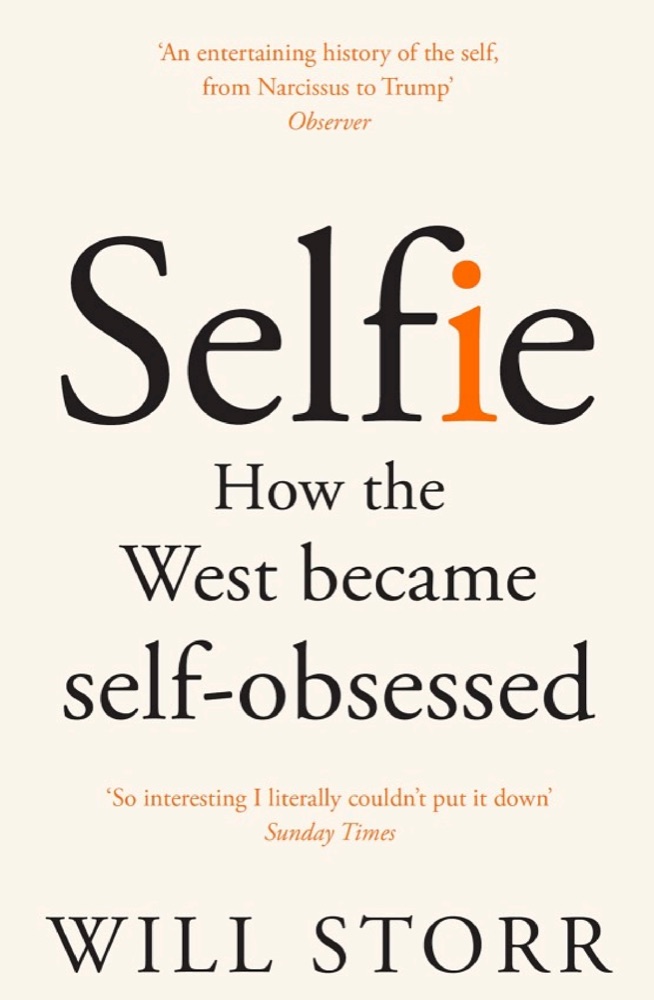
‘Fascinating’ Guardian‘Brilliant’ Evening Standard‘Electrifying’ Financial Times‘So interesting I literally couldn’t put it down’ Sunday TimesWe are living in an age of heightened individualism. Success is a personal responsibility. Our culture tells us that to succeed is to be slim, rich, happy, extroverted, popular – flawless.The pressure to conform to this ideal has changed who we are. We have become self-obsessed. And our expectation of perfection comes at a cost. Millions are suffering under the torture of this impossible fantasy.It was not always like this. To explain how we got here, Will Storr takes us on a journey across continents and centuries. Full of thrilling and unexpected connections between history, psychology, economics, neuroscience and more, Selfie is an unforgettable book that makes sense of who we have become.As featured on Russell Brand’s Under The Skin podcast.
Book details
- First published
- 2017
- Author
- Will Storr
- Genre
- Nonfiction
- Goodreads rating
- 3.91 (4k ratings)
Keep reading
 Revolution from Within: A Book of Self-Esteem
 Trick Mirror: Reflections on Self-Delusion
 The Laws of Human Nature
 Bright-Sided: How the Relentless Promotion of Positive Thinking Has Undermined America
 What If This Were Enough?: Essays
 Six Pillars of Self-Esteem
 Status Anxiety
 On Connection
 Toward a Psychology of Being
 Like Streams to the Ocean: Notes on Ego, Love, and the Things That Make Us Who We Are
 12 Rules for Life: An Antidote to Chaos
 How Do We Know We're Doing It Right: & Other Essays on Modern Life
 The Measure of a Man: A Spiritual Autobiography
 Becoming
 The Art of Being
 The Bassoon King: My Life in Art, Faith, and Idiocy
 Bonds That Make Us Free: Healing Our Relationship, Coming to Ourselves
 We Learn Nothing
 A Way of Being
 How to Stay Sane in an Age of Division
 Finding Meaning in the Second Half of Life: How to Finally, Really Grow Up
 They Called Us Exceptional: And Other Lies That Raised Us
 The Courage to Be Disliked: How to Free Yourself, Change Your Life and Achieve Real Happiness
 The Source of Self-Regard: Selected Essays, Speeches, and Meditations
 The Age of Magical Overthinking: Notes on Modern Irrationality
 Man's Search for Himself
 Elizabeth Finch
 The House of Hidden Meanings
 The School of Life: An Emotional Education
 Very Good Lives: The Fringe Benefits of Failure and the Importance of Imagination
 The Social Animal: The Hidden Sources of Love, Character, and Achievement
 The 7 Habits Of Highly Effective Teens
 The Culture of Narcissism: American Life in An Age of Diminishing Expectations
 Asymmetry
 White
White
 Mastery
 The Argonauts
 On Becoming a Person: A Therapist's View of Psychotherapy
 Underground: The Tokyo Gas Attack and the Japanese Psyche
 The Golden Notebook
 The Perfectionist's Guide to Losing Control: A Path to Peace and Power
 101 Essays That Will Change The Way You Think
 A Room Called Earth
 Demian
 If You Have to Cry, Go Outside: And Other Things Your Mother Never Told You
 The Second Mountain
 The Dice Man
 Creation Lake
 Stories of Your Life and Others
 Karamo: My Story of Embracing Purpose, Healing, and Hope
 Atlas of the Heart: Mapping Meaningful Connection and the Language of Human Experience
 In The Blood
 Dare to Lead
 On Our Best Behavior: The Seven Deadly Sins and the Price Women Pay to Be Good
 Daybreak: Thoughts on the Prejudices of Morality
 A Language Older Than Words
 An Absolutely Remarkable Thing
 Dream Count
 Every Exquisite Thing
 The Book: On the Taboo Against Knowing Who You Are