
 Empire of Illusion: The End of Literacy and the Triumph of Spectacle
Quotes from the Book
We demand too much of life, too little of ourselves.
75
Our growing dependence on technologies no one seems to understand or control has given rise to feelings of powerlessness and victimization. We find it more and more difficult to achieve a sense of continuity, permanence, or connection with the world around us. Relationships with others are notably fragile; goods are made to be used up and discarded; reality is experienced as an unstable environment of flickering images. Everything conspires to encourage escapist solutions to the psychological problems of dependence, separation, and individuation, and to discourage the moral realism that makes it possible for human beings to come to terms with existential constraints on their power and freedom.
69
The contemporary climate is therapeutic, not religious. People today hunger not for personal salvation, let alone for the restoration of an earlier golden age, but for the feeling, the momentary illusion, of personal well-being, health, and psychic security.
33
For all his inner suffering, the narcissist has many traits that make for success in bureaucratic institutions, which put premium on the manipulation of interpersonal relations, discourage the formation of deep personal attachments, and at the same time provide the narcissist with the approval he needs in order to validate his self-esteem.
22
In a society in which the dream of success has been drained of any meaning beyond itself, men have nothing against which to measure their achievements except the achievements of others.
20
In the last twenty-five years, the borderline patient, who confronts the psychiatrist not with well-defined symptoms but with diffuse dissatisfactions, has become increasingly common. He does not suffer from debilitating fixations or phobias or from the conversion of repressed sexual energy into nervous ailments; instead he complains "of vague, diffuse dissatisfactions with life" and feels his "amorphous existence to be futile and purposeless." He describes "subtly experienced yet pervasive feelings of emptiness and depression," "violent oscillations of self-esteem," and "a general inability to get along." He gains "a sense of heightened self-esteem only by attaching himself to strong, admired figures whose acceptance he craves and by whom he needs to feel supported." Although he carries out his daily responsibilities and even achieves distinction, happiness eludes him, and life frequently strikes him as not worth living.
18
Every society reproduces its culture, its norms, its underlying assumptions, its modes of organizing experience— in the individual, in the form of personality.
16
Much of what is euphemistically known as the middle class, merely because it dresses up to go to work, is now reduced to proletarian conditions of existence. Many white-collar jobs require no more skill and pay even less than blue-collar jobs, conferring little status or security.
15
As Susan Sontag observes in her study of photography, “Reality has come to seem more and more like what we are shown by cameras.” Bourgeois families in the eighteenth and nineteenth centuries, Sontag points out, posed for portraits in order to proclaim the family’s status, whereas today the family album of photographs verifies the individual’s existence: the camera helps to weaken the older idea of development as moral education and to promote a more passive idea according to which development consists of passing through the stages of life at the right time and in the right order.
13
The denial of age in America culminates in the prolongevity movement, which hopes to abolish old age altogether. But the dread of age originates not in the "cult of youth" but in a cult of the self. Not only in its narcissistic indifference to future generations but in its grandiose vision of a technological utopia without old age, the prolongevity movement exemplifies the fantasy of "absolute, sadistic power" which, according to Kohut, so deeply colors the narcissistic outlook. Pathological in its psychological origins and inspiration, superstitious in its faith in medical deliverance, the prolongevity movement expresses in characteristic form the anxieties of a culture that believes it has no future.
13
When the images of power overshadow the reality, those without power find themselves fighting phantoms.
11
To live for the moment is the prevailing passion—to live for yourself, not for your predecessors or posterity. We are fast losing the sense of historical continuity, the sense of belonging to a succession of generations originating in the past and stretching into the future.
10
It appears that the prostitute, not the salesman, best exemplifies the qualities indispensable to success in American society.
10
Cameras and recording machines not only transcribe experience but alter its quality, giving to much of modern life the character of an enormous echo chamber, a hall of mirrors. . . . Modern life is so mediated by electronic images that we cannot help responding to others as if their actions—and our own—were being recorded and simultaneously transmitted to an unseen audience or stored up for close scrutiny at some later time. . . . The intrusion into everyday life of this all-seeing eye no longer takes us by surprise or catches us with our defenses down. We need no reminder to smile.
9
In a society that dreads old age and death, aging holds a special terror for those who fear dependence and whose' self-esteem requires the admiration usually reserved for youth, beauty, celebrity, or charm. The usual defenses against the ravages of age—identification with ethical or artistic values beyond one's immediate interests, intellectual curiosity, the consoling emotional warmth derived from happy relationships in the past—can do nothing for the narcissist. Unable to derive whatever com-fort comes from identification with historical continuity, he finds it impossible, on the contrary, "to accept the fact that a younger generation now possesses many of the previously cherished gratifications of beauty, wealth, power and, particularly, creativity. To be able to enjoy life in a process involving a growing identification with other people's happiness and achievements is tragically beyond the capacity of narcissistic personalities.
8
Therapy labels as sickness what might otherwise be judged as weak or willful actions; it thus equips the patient to fight (or resign himself to) the disease, instead of irrationally finding fault with himself. Inappropriately extended beyond the consulting room, however, therapeutic morality encourages a permanent suspension of the moral sense. There is a close connection, in turn, between the erosion of moral responsibility and the waning of the capacity for self-help—in the categories used by John R. Seeley, between the elimination of culpability and the elimination of competence. "What says 'you are not guilty' says also 'you cannot help yourself.' " Therapy legitimates deviance as sickness, but it simultaneously pronounces the patient unfit to manage his own life and delivers him into the hands of a specialist.
7
The illusion of feeling well-informed....a public that feels informed in proportion as it is to befuddled. In one of his characteristic pronouncements, at a press conference in May 1962, John F. Kennedy proclaimed the end of ideology in words that appealed to both these public needs-the need to believe that political decisions are in the hands of dispassionate, bipartisan experts and the need to believe that the problems experts deal with are unintelligible to laymen.
7
The parents' failure to serve as models of disciplined self-restraint or to restrain the child does not mean that the child grows up without a superego. On the contrary, it encourages the development of a harsh and punitive superego based largely on archaic images of the parents, fused with grandiose self-images. Under these conditions, the superego consists of parental introjects instead of identifications. It holds up to the ego an exalted standard of fame and success and condemns it with savage ferocity when it falls short of that standard. Hence the oscillations of self-esteem so often associated with pathological narcissism.
5
Ruling classes have always sought to instill in their subordinates the capacity to experience exploitation and material deprivation as guilt, while deceiving themselves that their own material interests coincide with those of mankind as a whole.
4
The new narcissist is haunted not by guilt but by anxiety. He seeks not to inflict his own certainties on others but to find a meaning in life. Liberated from the superstitions of the past, he doubts even the reality of his own existence.
3
Notwithstanding his occasional illusions of omnipotence, the narcissist depends on others to validate his self-esteem. He cannot live without an admiring audience. His apparent freedom from family ties and institutional constraints does not free him to stand alone or to glory in his individuality. On the contrary, it contributes to his insecurity, which he can overcome only by seeing his “grandiose self” reflected in the attentions of others, or by attaching himself to those who radiate celebrity, power, and charisma. For the narcissist, the world is a mirror, whereas the rugged individualist saw it as an empty wilderness to be shaped to his own design.
3
The self-consciousness that mocks all attempts at spontaneous action or enjoyment derives in the last analysis from the waning belief in the reality of the external world, which has lost its immediacy in a society pervaded by "symbolically mediated information." The more man objectifies himself in his work, the more reality takes on the appearance of illusion. As the workings of the modern economy and the modern social order become increasingly inaccessible to everyday intelligence, art and philosophy abdicate the task of explaining them to the allegedly objective sciences of society, which themselves have retreated from the effort to master reality into the classification of trivia. Reality thus presents itself, to laymen and "scientists" alike, as an impenetrable network of social relations-as "role playing," the "presentation of self in everyday life." To the performing self, the only reality is the identity he can construct out of materials furnished by advertising and mass culture, themes of popular film and fiction, and fragments torn from a vast range of cultural traditions, all of them equally contemporaneous to the contemporary mind.* In order to polish and perfect the part he has devised for himself, the new Narcissus gazes at his own reflection, not so much in admiration as in unremitting search of flaws, signs of fatigue, decay. Life becomes a work of art, while "the first art work in an artist," in Norman Mailer's pronouncement, "is the shaping of his own personality.
3
President Nixon's press secretary, Ron Ziegler, once demonstrated the political use of these techniques when he admitted that his previous statements on Watergate had become "inoperative." Many commentators assumed that Ziegler was groping for a euphemistic way of saying that he had lied. What he meant, however, was that his earlier statements were no longer believable. Not their falsity but their inability to command assent rendered them "inoperative." The question of whether they were true or not was beside the point.
3
Since “the society” has no future, it makes sense to live only for the moment, to fix our eyes on our own “private performance,” to become connoisseurs of our own decadence, to cultivate a “transcendental self-attention.
2
The mass media, with their cult of celebrity and their attempt to surround it with glamour and excitement, have made Americans a nation of fans, moviegoers. The media give substance to and thus intensify narcissistic dreams of fame and glory, encourage the common man to identify himself with the stars and to hate the “herd,” and make it more and more difficult for him to accept the banality of everyday existence.
2
In America, organized athletics teach militarism, authoritarianism , racism, and sexism, thereby perpetuating the "false consciousness" of the masses. Sports serve as an "opiate" of the people, diverting the masses from their real problems with a "dream world" of glamour and excitement. They promote sexual -rivalry among males-with "vestal virgins" leading the cheers from the sidelines-and thus prevent the proletariat from achieving revolutionary solidarity in the face of its oppressors.
2
All of us, actors and spectators alike, live surrounded by mirrors. In them, we seek reassurance of our capacity to captivate or impress others, anxiously searching out blemishes that might detract from the appearance we intend to project. The advertising industry deliberately encourages this preoccupation with appearances. In the twenties, "the women in ads were constantly observing themselves, ever self-critical. ... A noticeable proportion of magazine ads directed at women depicted them looking into mirrors. . . . Ads of the 1920s were quite explicit about this narcissistic imperative. They unabashedly used pictures of veiled nudes, and women in auto-erotic stances to encourage self-comparison and to remind women of the primacy of their sexuality." A booklet advertising beauty aids depicted on its cover a nude with the caption: "Your Masterpiece-Yourself.
2
The master propagandist, like the advertising expert, avoids obvious emotional appeals and strives for a tone that is consistent with the prosaic quality of modern life—a dry, bland matter-of-factness. Nor does the propagandist circulate "intentionally biased" information. He knows that partial truths serve as more effective instruments of deception than lies. Thus he tries to impress the public with statistics of economic growth that neglect to give the base year from which growth is calculated, with accurate but meaningless facts about the standard of living—with raw and uninterpreted data, in other words, from which the audience is invited to draw the inescapable conclusion that things are getting better and the present régime therefore deserves the people's confidence, or on the other hand that things are getting worse so rapidly that the present régime should be given emergency powers to deal with the developing crisis.
2
The poor have always had to live for the present, but now a desperate concern for personal survival, sometimes disguised as hedonism, engulfs the middle class as well.
2
Cultural radicalism has become so fashionable, and so pernicious in the support it unwittingly provides for the status quo, that any criticism of contemporary society that hopes to get beneath the surface has to criticize, at the same time, much of what currently goes under the name of radicalism.
1
Watch on YouTube
About Christopher Lasch
We have collected 30 quotes from 1 book by Christopher Lasch on BookQuoters.
More about the author →About the book
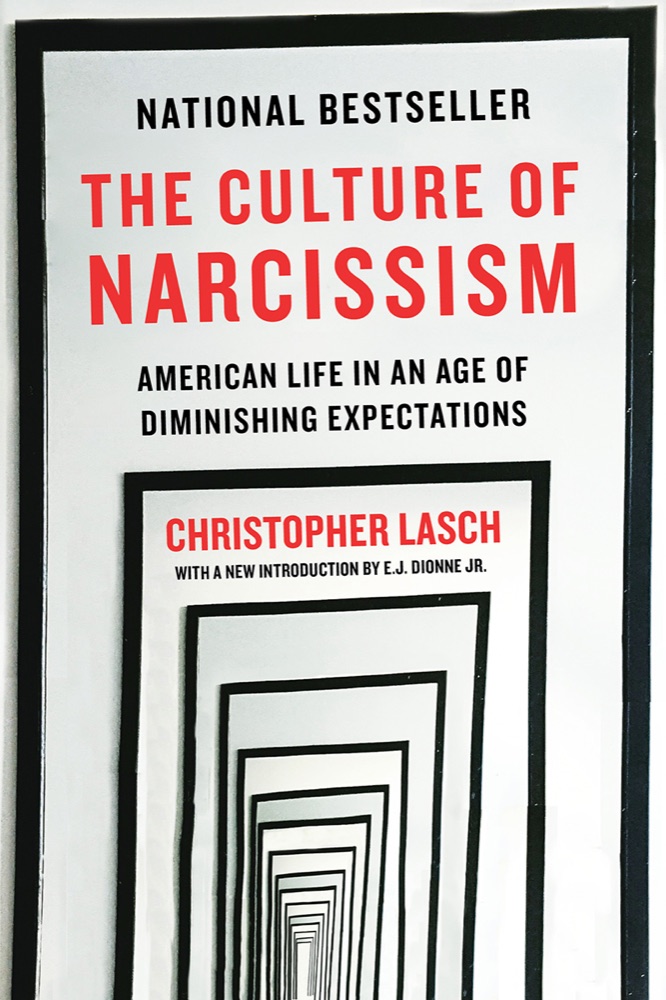
When The Culture of Narcissism was first published in 1979, Christopher Lasch was hailed as a “biblical prophet” (Time). Lasch’s identification of narcissism as not only an individual ailment but also a burgeoning social epidemic was groundbreaking. His diagnosis of American culture is even more relevant today, predicting the limitless expansion of the anxious and grasping narcissistic self into every part of American life.
The Culture of Narcissism offers an astute and urgent analysis of what we need to know in these troubled times.
Book details
- First published
- 1978
- Author
- Christopher Lasch
- Genre
- Nonfiction
- Goodreads rating
- 3.96 (4k ratings)
Keep reading
Empire of Illusion: The End of Literacy and the Triumph of Spectacle
 Status Anxiety
 Minima Moralia: Reflections on a Damaged Life
 The Sane Society
 Man's Search for Himself
 Selfie: How the West Became Self-Obsessed
 The Burnout Society
 Civilization and Its Discontents
 Life at the Bottom: The Worldview That Makes the Underclass
 Brave New World Revisited
 Escape from Freedom
 Anti-Oedipus: Capitalism and Schizophrenia
 The Denial of Death
 Toward a Psychology of Being
 Finding Meaning in the Second Half of Life: How to Finally, Really Grow Up
 The Blank Slate: The Modern Denial of Human Nature
 Trick Mirror: Reflections on Self-Delusion
 Untimely Meditations
 Bright-Sided: How the Relentless Promotion of Positive Thinking Has Undermined America
 The Age of Magical Overthinking: Notes on Modern Irrationality
 Creation Lake
 The Undiscovered Self
 White
White
 Daybreak: Thoughts on the Prejudices of Morality
 Human, All Too Human
 Dialectic of Enlightenment: Philosophical Fragments
 Cultural Amnesia: Necessary Memories from History and the Arts
 Solitude: A Return to the Self
 The Doors of Perception & Heaven and Hell
 The Man Without Qualities
 From Dawn to Decadence: 500 Years of Western Cultural Life, 1500 to the Present
 Understanding Media: The Extensions of Man
 What's Wrong with the World
 Walden Two
 The Fall of Babel
 The Soul of Man Under Socialism
 The Source of Self-Regard: Selected Essays, Speeches, and Meditations
 Lila: An Inquiry Into Morals
 The Politics of Experience/The Bird of Paradise
 Love's Executioner and Other Tales of Psychotherapy
 The Art of Seduction
 Irrational Man: A Study in Existential Philosophy
 Let Us Dream: The Path to a Better Future
 The Age of Absurdity: Why Modern Life makes it Hard to be Happy
 American Pastoral
 How to Be Alone
 The Laws of Human Nature
 The Pleasures and Sorrows of Work
 The Closing of the American Mind
 Sexual Personae: Art and Decadence from Nefertiti to Emily Dickinson
 The Atrocity Exhibition
 Humankind: A Hopeful History
 No Name in the Street
 The Attention Merchants: The Epic Scramble to Get Inside Our Heads
 America
 The Lucifer Effect: Understanding How Good People Turn Evil
 The Art of Being
 The Golden House
 The Freedom Manifesto
 Ghosts of My Life: Writings on Depression, Hauntology and Lost Futures