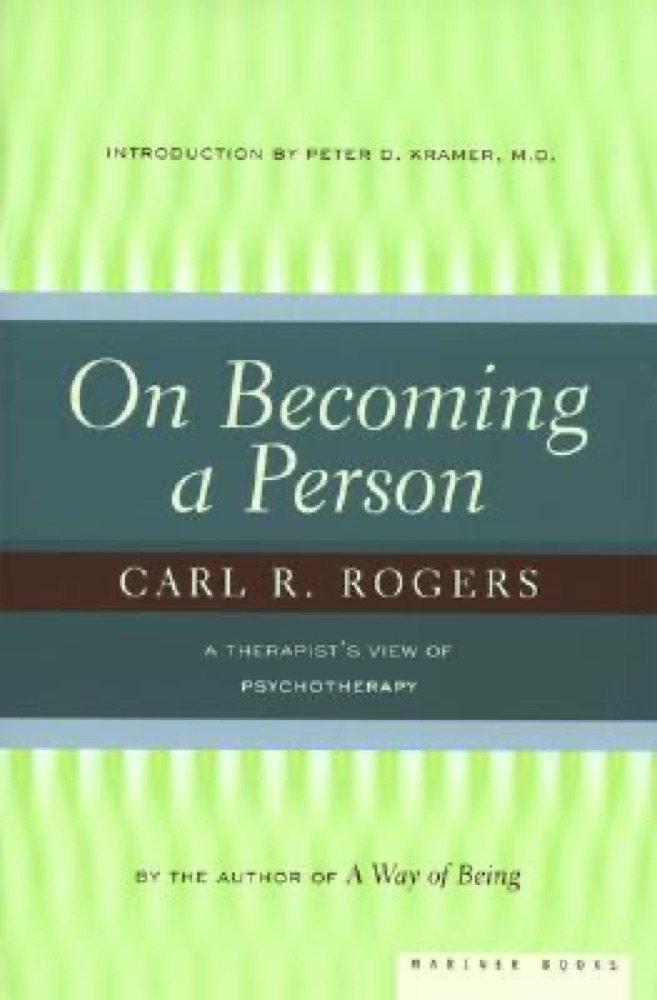
 On Becoming a Person: A Therapist's View of Psychotherapy
Quotes from the Book
People are just as wonderful as sunsets if you let them be. When I look at a sunset, I don't find myself saying, "Soften the orange a bit on the right hand corner." I don't try to control a sunset. I watch with awe as it unfolds.
561
To be with another in this [empathic] way means that for the time being, you lay aside your own views and values in order to enter another's world without prejudice. In some sense it means that you lay aside your self; this can only be done by persons who are secure enough in themselves that they know they will not get lost in what may turn out to be the strange or bizarre world of the other, and that they can comfortably return to their own world when they wish. Perhaps this description makes clear that being empathic is a complex, demanding, and strong - yet subtle and gentle - way of being.
85
I regret it when I suppress my feelings too long and they burst forth in ways that are distorted or attacking or hurtful.
58
When you are in psychological distress and someone really hears you without passing judgement on you, without trying to take responsibility for you, without trying to mold you, it feels damn good!
34
It is so obvious when a person is not hiding behind a facade but is speaking from deep within himself.
34
I am isolated. I sit in a glass ball, I see people through a glass wall. I scream, but they do not hear me. - Ellen West
23
When I look at a sunset as I did the other evening, I don’t find myself saying, “Soften the orange a little on the right hand corner, and put a bit more purple along the base, and use a little more pink in the cloud color.” I don’t do that. I don’t try to control a sunset. I watch it with awe as it unfolds. I like myself best when I can appreciate my staff member, my son, my daughter, my grandchildren, in this same way. I believe this is a somewhat Oriental attitude; for me it is a most satisfying one.
18
I find it very satisfying when I can be real, when I can be close to whatever it is that is going on within me. I like it when I can listen to myself. To really know what I am experiencing in the moment is by no means an easy thing, but I feel somewhat encouraged because I think that over the years I have been improving at it.
16
I like to think of myself as a quiet revolutionary.
14
The strongest force in our universe is not overriding power, but love.
13
One of the most satisfying feelings I know—and also one of the most growth-promoting experiences for the other person—comes from my appreciating this individual in the same way that I appreciate a sunset. People are just as wonderful as sunsets if I can let them be. In fact, perhaps the reason we can truly appreciate a sunset is that we cannot control it.
11
I found myself doing this same thing—playing a role of having greater certainty and greater competence than I really possess. I can’t tell you how disgusted with myself I felt as I realized what I was doing: I was not being me, I was playing a part.
10
I would prefer my experiences in communication to have a growth-promoting effect, both on me and on the other, and I should like to avoid those communication experiences in which both I and the other person feel diminished.
9
In place of the term “realness” I have sometimes used the word “congruence.” By this I mean that when my experiencing of this moment is present in my awareness and when what is present in my awareness is present in my communication, then each of these three levels matches or is congruent. At such moments I am integrated or whole, I am completely in one piece. Most of the time, of course, I, like everyone else, exhibit some degree of incongruence. I have learned, however, that realness, or genuineness, or congruence—whatever term you wish to give it—is a fundamental basis for the best of communication.
9
the more the therapist becomes a real person and avoids self-protective or professional masks or roles, the more the patient will reciprocate and change in a constructive direction. Of course, the therapist should accept the patient nonjudgmentally and unconditionally. And, of course, the therapist must enter empathically into the private world of the client.
8
He was persuaded of the reality and significance of human choice; he believed that experiential learning was a far more powerful approach to personal understanding and change than an endeavor resting upon intellectual understanding; he believed that individuals have within themselves an actualizing tendency, an inbuilt proclivity toward growth and fulfillment.
7
The paradigm of Western culture is that the essence of persons is dangerous; thus, they must be taught, guided and controlled by those with superior authority.
5
From what I have been saying, I trust it is clear that when I can permit realness in myself or sense it or permit it in another, I am very satisfied. When I cannot permit it in myself or fail to permit it in another, I am very distressed.
5
Can I freely permit this staff member or my son or my daughter to become a separate person with ideas, purposes, and values which may not be identical with my own?
5
Imagine another scene, one that occurred when he was twenty years older. At an academic symposium on Ellen West, a heavily studied patient who committed suicide several decades before, Rogers startled the audience by the depth and intensity of his reaction. He spoke about Ellen West as though he knew her well, as though it were only yesterday that she had poisoned herself. Not only did Rogers express his sorrow about her tragically wasted life, but also his anger at her physicians and psychiatrists who, through their impersonality and preoccupation with precise diagnosis, had transformed her into an object. How could they have? Rogers asked.
4
The intolerant "true believer" is a menace to any field, yet I suspect each one of us finds traces of that person in ourself.
4
The audience sat back, relaxed in their chairs, awaiting the expected mellow retrospective of a revered septuagenarian. Instead, Rogers rocked them with a series of challenges. He urged school psychologists not to content themselves merely with treating students damaged by an obsolete and irrelevant educational system but to change the system, to participate in designing an educational experience that would liberate the students’ curiosity and enhance the joy of learning.
3
We cannot deal with the increasing maldistribution of wealth, the increasing alienation of millions, or the lack of a unified purpose and goal by increasing the efficiency of production, increasing the automation of industry, accelerating our technology, or increasing our reliance on the profit motives of multinational corporations.
3
The question may well be raised, however, whether we could have a community or a society based on this hypothesis of multiple realities. Might not such a society be a completely individualistic anarchy? That is not my opinion. Suppose my grudging tolerance of your separate world view became a full acceptance of you and your right to have such a view. Suppose that instead of shutting out the realities of others as absurd or dangerous or heretical or stupid, I was willing to explore and learn about those realities? Suppose you were willing to do the same. What would be the social result? I think that our society would be based not on a blind commitment to a cause or creed or view of reality, but on a common commitment to each other as rightfully separate persons, with separate realities. The natural human tendency to care for another would no longer be “I care for you because you are the same as I,” but, instead, “I prize and treasure you because you are different from me.
3
I conclude that if nations follow their past ways, then, because of the speed of world communication of separate views, each society will have to exert more and more coercion to bring about a forced agreement as to what constitutes the real world and its values. Those coerced agreements will differ from nation to nation, from culture to culture. The coercion will destroy individual freedom. We will bring about our own destruction through the clashes caused by different world views.
1
Watch on YouTube
About Carl R. Rogers
We have collected 55 quotes from 2 books by Carl R. Rogers on BookQuoters.
More about the author →More by Carl R. Rogers
On Becoming a Person: A Therapist's View of Psychotherapy
About the book
A profound and deeply personal collection of essays by renowned psychologist Carl Rogers
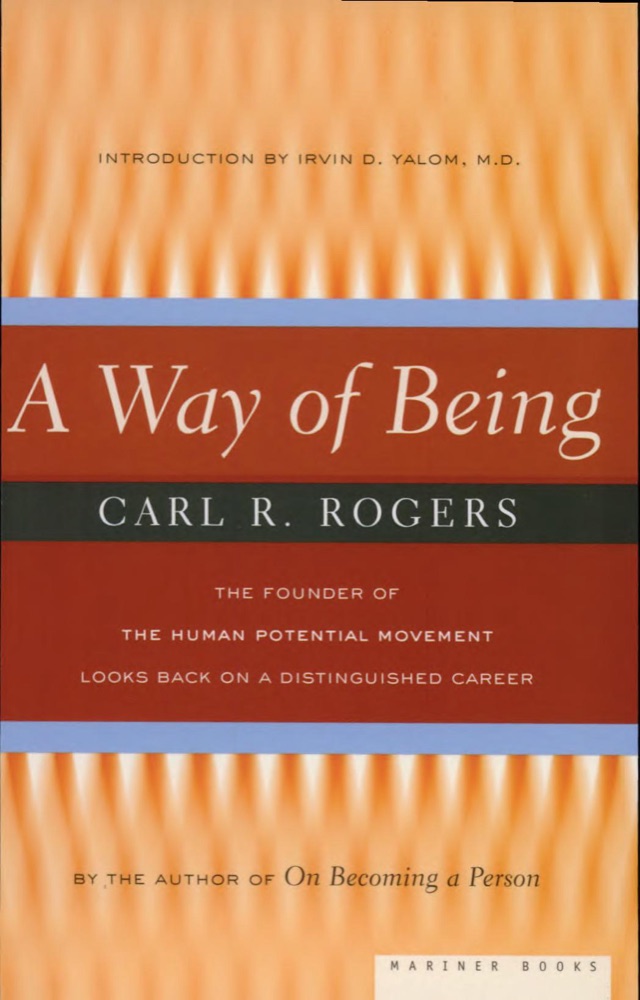
The late Carl Rogers, founder of the humanistic psychology movement and father of client-centered therapy, based his life's work on his fundamental belief in the human potential for growth. A Way of Being was written in the early 1980s, near the end of Carl Rogers's career, and serves as a coda to his classic On Becoming a Person. More philosophical than his earlier writings, it traces his professional and personal development and ends with a prophetic call for a more humane future.
Book details
- First published
- 1980
- Author
- Carl R. Rogers
- Genre
- Nonfiction
- Goodreads rating
- 4.22 (3k ratings)
Keep reading
On Becoming a Person: A Therapist's View of Psychotherapy
 The Laws of Human Nature
 The Art of Being
 On Connection
 Toward a Psychology of Being
 A Room Called Earth
 A Circle of Quiet
 The Measure of a Man: A Spiritual Autobiography
 Six Pillars of Self-Esteem
 Selfie: How the West Became Self-Obsessed
 The World According to Mister Rogers: Important Things to Remember
 A New Earth: Awakening to Your Life's Purpose
 Demian
 How to Know a Person: The Art of Seeing Others Deeply and Being Deeply Seen
 Like Streams to the Ocean: Notes on Ego, Love, and the Things That Make Us Who We Are
 The Divided Self: An Existential Study in Sanity and Madness
 Nonviolent Communication: A Language of Life
 The Source of Self-Regard: Selected Essays, Speeches, and Meditations
 Love's Executioner and Other Tales of Psychotherapy
 The Argonauts
 The Book: On the Taboo Against Knowing Who You Are
 Maybe You Should Talk to Someone: A Therapist, Her Therapist, and Our Lives Revealed
 Seth Speaks: The Eternal Validity of the Soul
 When Nietzsche Wept
 A Burst of Light
 Let Your Life Speak: Listening for the Voice of Vocation
 In Love with the World: A Monk's Journey Through the Bardos of Living and Dying
 Stories of Your Life and Others
 Mastery
 The Things You Can See Only When You Slow Down: How to Be Calm in a Busy World
 Bonds That Make Us Free: Healing Our Relationship, Coming to Ourselves
 Letter to My Daughter
 Ethics for the New Millennium
 Lost in Translation: A Life in a New Language
 Kitchen Table Wisdom: Stories that Heal
 The Golden Notebook
 Orbiting the Giant Hairball: A Corporate Fool's Guide to Surviving with Grace
 My Beloved World
 Finding Meaning in the Second Half of Life: How to Finally, Really Grow Up
 The Beauty of Living Twice
 The Varieties of Religious Experience
 The Buddha Walks into a Bar . . .: A Guide to Life for a New Generation
 Children of the Mind
 Open City
 The Four Agreements: A Practical Guide to Personal Freedom
 Girl with Curious Hair
 The Courage to Be Disliked: How to Free Yourself, Change Your Life and Achieve Real Happiness
 The Wise Heart: A Guide to the Universal Teachings of Buddhist Psychology
 Dear Senthuran: A Black Spirit Memoir
 Advice Not Given: A Guide to Getting Over Yourself
 Make It Scream, Make It Burn
 Knife: Meditations After an Attempted Murder
 Surprised by Joy: The Shape of My Early Life
 What If This Were Enough?: Essays
 A Hidden Wholeness: The Journey Toward an Undivided Life : Welcoming the soul and weaving community in a wounded world
 Buffering: Unshared Tales of a Life Fully Loaded
 Be a People Person
 Becoming Wise: An Inquiry into the Mystery and Art of Living
 Journal of a Solitude
 The Rainbow Comes and Goes: A Mother and Son on Life, Love, and Loss