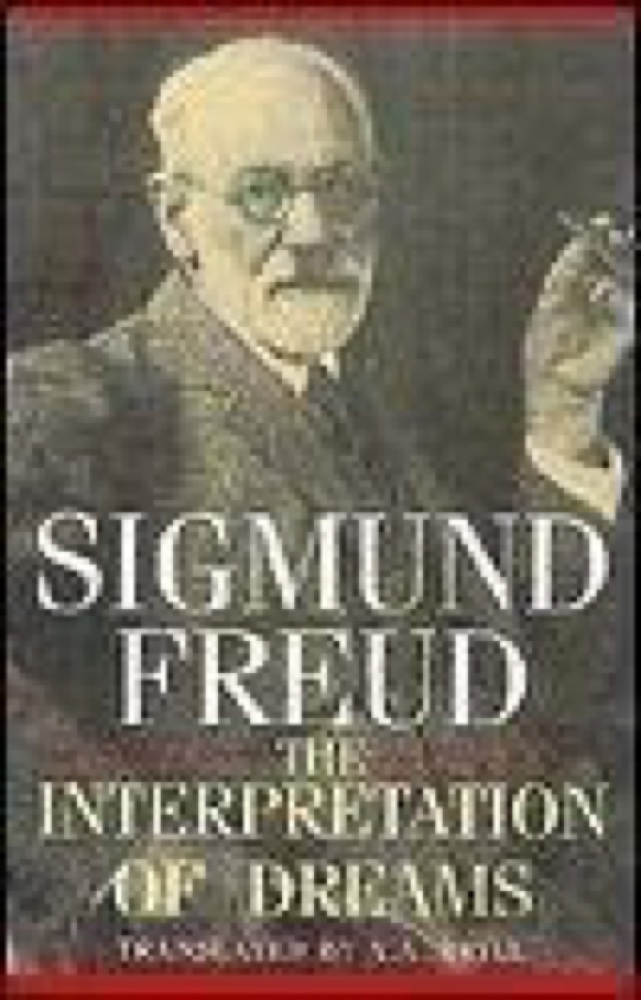
 The Interpretation of Dreams
Quotes from the Book
The patient cannot remember the whole of what is repressed in him, and what he cannot remember may be precisely the essential part of it.. He is obliged to repeat the repressed material as a contemporary experience instead of remembering it as something in the past.
31
Many of us will also find it hard to abandon our belief that in man himself there dwells an impulse towards perfection, which has brought him to his present heights of intellectual prowess and ethical sublimation, and from which it might be expected that his development into superman will be ensured. But I do not believe in the existence of such an inner impulse, and I see no way of preserving this pleasing illusion. The development of man up to now does not seem to me to need any explanation differing from that of animal development, and the restless striving towards further perfection which may be observed in a minority of human beings is easily explicable as the result of that repression of instinct upon which what is most valuable in human culture is built.
9
Most of the 'pain' we experience is of a perceptual order, perception either of the urge of unsatisfied instincts or of something in the external world which may be painful in itself or may arouse painful anticipations in the psychic apparatus and is recognised by it as 'danger.
6
It is plainly the case that children repeat everything in their play that has made a powerful impression on them, and that in so doing they abreact the intensity of the ecperience and make themselves so to speak master of the situation.
4
If man must himself die, after first losing his most beloved ones by death, he would prefer that his life be forfeit to an inexorable law of nature, the sublime †Å¬³Ç·, than to a mere accident which perhaps could have been in some way avoided. But perhaps this belief in the incidence of death as the necessary consequence of an inner law of being is also only one of those illusions that we have fashioned for ourselves 'so as to endure the burden of existence'. It is certainly not a primordial belief: the idea of a 'natural death' is alien to primitive races; they ascribe every death occurring among themselves to the influence of an enemy or an evil spirit. So let
4
Under the influence of the instinct of the ego for self-preservation it is replaced by the 'reality-principle ', which without giving up the intention of ultimately attaining pleasure yet demands and enforces the postponement of satisfaction, the renunciation of manifold possibilities of it, and the temporary endurance of 'pain' on the long and circuitous road to pleasure. The pleasure-principle however remains for a long time the method of operation of the sex impulses, which are not so easily educable, and it happens over and over again that whether acting through these impulses or operating in the ego itself it prevails over the reality-principle to the detriment of the whole organism.
3
The reaction to these claims of impulse and these threats of danger, a reaction in which the real activity of the psychic apparatus is manifested, may be guided correctly by the pleasure-principle or by the reality-principle which modifies this.
2
The details of the process by which repression changes a possibility of pleasure into a source of 'pain' are not yet fully understood, or are not yet capable of clear presentation, but it is certain that all neurotic 'pain' is of this kind, is pleasure which cannot be experienced as such.
2
So long as we trace the development from its final outcome backwards, the chain of events appears continuous, and we feel we have gained an insight which is completely satisfactory or even exhaustive. But if we proceed in the reverse way, if we start from the premises inferred from the analysis and try to follow these up to the final results, then we no longer get the impression of an inevitable sequence of events which could not have otherwise been determined.
2
The whole of drive function serves to bring about death. Seen in this light, the theoretical significance of the drives for self-preservation, for power, and for dominance is reduced. These are component drives for securing the organism's own path toward death...These guardians of life, too, were originally bodyguards of death.
1
The organism seeks to die in its own way.
1
I refer, of course, to the theory that Plato in his Symposium puts into the mouth of Aristophanes and which deals not only with the origin of the sexual instinct but also with its most important variations in relation to the object. Human nature was once quite other than now. Originally there were three sexes, three and not as to-day two: besides the male and the female there existed a third sex which had an equal share in the two first . . . . In these beings everything was double: thus, they had four hands and four feet, two faces, two genital parts, and so on. Then Zeus allowed himself to be persuaded to cut these beings in two, as one divides pears to stew them. . . . When all nature was divided in this way, to each human being came the longing for his own other half, and the two halves embraced and entwined their bodies and desired to grow together again.‘36 Are we to follow the clue of the poet-philosopher and make the daring assumption that living substance was at the time of its animation rent into small particles, which since that time strive for reunion by means of the sexual instincts? That these instincts—in which the chemical affinity of inanimate matter is continued—passing through the realm of the protozoa gradually overcome all hindrances set to their striving by an environment charged with stimuli dangerous to life, and are impelled by it to form a protecting covering layer? And that these dispersed fragments of living substance thus achieve a multicellular organisation, and finally transfer to the germ-cells in a highly concentrated form the instinct for reunion? I think this is the point at which to break off.
1
The compulsion which thereby finds expression is in no way different from the repetition-compulsion of neurotics, even though such persons have never shown signs of a neurotic conflict resulting in symptoms. Thus one knows people with whom every human relationship ends in the same way: benefactors whose protégés, however different they may otherwise have been, invariably after a time desert them in ill-will, so that they are apparently condemned to drain to the dregs all the bitterness of ingratitude; men with whom every friendship ends in the friend‘s treachery; others who indefinitely often in their lives invest some other person with authority either in their own eyes or generally, and themselves overthrow such authority after a given time, only to replace it by a new one; lovers whose tender relationships with women each and all run through the same phases and come to the same end, and so on. We are less astonished at this ‗endless repetition of the same‘ if there is involved a question of active behaviour on the part of the person concerned, and if we detect in his character an unalterable trait which must always manifest itself in the repetition of identical experiences.
1
In the traumatic neuroses there are two outstanding features which might serve as clues for further reflection: first that the chief causal factor seemed to lie in the element of surprise, in the fright; and secondly that an injury or wound sustained at the same time generally tended to prevent the occurrence of the neurosis.
1
pleasure or "pain" may be thought of in psycho-physical relationship to conditions of stability and instability,
1
We have decided to consider pleasure and 'pain' in relation to the quantity of excitation present in the psychic life—and not confined in any way—along such lines that 'pain' corresponds with an increase and pleasure with a decrease in this quantity.
1
Were we to appraise our speculations upon the life and death-instincts it would disturb us but little that so many processes go on which are surprising and hard to picture, such as one instinct being expelled by others, or turning from the ego to an object, and so on.
Watch on YouTube
About Sigmund Freud
We have collected 145 quotes from 8 books by Sigmund Freud on BookQuoters.
More about the author →More by Sigmund Freud
The Interpretation of Dreams
 Civilization and Its Discontents
 The Future of an Illusion
 Totem and Taboo
About the book
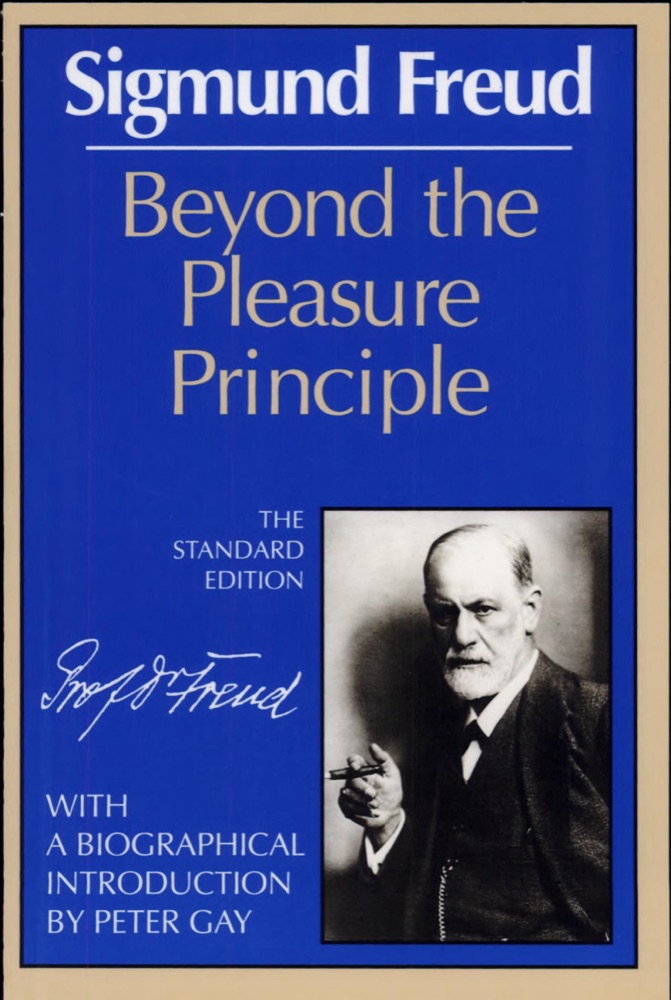
In reasoned progression he outlined core psychoanalytic concepts, such as repression, free association and libido. Of the various English translations of Freud's major works to appear in his lifetime, only one was authorized by Freud himself: The Standard Edition of the Complete Psychological Works of Sigmund Freud under the general editorship of James Strachey. Freud approved the overall editorial plan, specific renderings of key words and phrases, and the addition of valuable notes, from bibliographical and explanatory. Many of the translations were done by Strachey himself; the rest were prepared under his supervision. The result was to place the Standard Edition in a position of unquestioned supremacy over all other existing versions.Newly designed in a uniform format, each new paperback in the Standard Edition opens with a biographical essay on Freud's life and work —along with a n
Book details
- First published
- 1920
- Author
- Sigmund Freud
- Genre
- Nonfiction
- Goodreads rating
- 3.80 (6k ratings)
Keep reading
 Maps of Meaning: The Architecture of Belief
 Introductory Lectures on Psychoanalysis
 The Politics of Experience/The Bird of Paradise
 Toward a Psychology of Being
 Solitude: A Return to the Self
 Descartes' Error: Emotion, Reason and the Human Brain
 The Will to Meaning: Foundations and Applications of Logotherapy
 Man and His Symbols
 The Varieties of Religious Experience
 The Doors of Perception & Heaven and Hell
 Love's Executioner and Other Tales of Psychotherapy
Civilization and Its Discontents
Love's Executioner and Other Tales of Psychotherapy
Civilization and Its Discontents
 A Treatise of Human Nature
 The Man Who Mistook His Wife for a Hat and Other Clinical Tales
 The Consolations of Philosophy
 In an Unspoken Voice: How the Body Releases Trauma and Restores Goodness
 Eros and Civilization: A Philosophical Inquiry into Freud
 Modern Man in Search of a Soul
 Love and Will
 Escape from Freedom
 The Doors of Perception
 Flow: The Psychology of Optimal Experience
 Anti-Oedipus: Capitalism and Schizophrenia
 Daybreak: Thoughts on the Prejudices of Morality
 An Essay Concerning Human Understanding
 The Master and His Emissary: The Divided Brain and the Making of the Western World
 Finding Meaning in the Second Half of Life: How to Finally, Really Grow Up
 The Occult
 Natural Causes: An Epidemic of Wellness, the Certainty of Dying, and Killing Ourselves to Live Longer
 Myths to Live By
 Ego and Archetype: Individuation and the Religious Function of the Psyche
 In Search of Lost Time
 How to Change Your Mind: The New Science of Psychedelics
 The Divided Self: An Existential Study in Sanity and Madness
 The Ego and the Id
 The World as Will and Representation, Vol 1
 The Will to Power
 On Truth and Lies in a Nonmoral Sense
 A General Theory of Love
 An Enquiry Concerning Human Understanding
 The Denial of Death
 The Atrocity Exhibition
 The Philosopher and the Wolf
 The Interpretation of Murder
 Existential Psychotherapy
 The Sane Society
 Psych: The Story of the Human Mind
 A Philosophical Enquiry into the Origin of Our Ideas of the Sublime and Beautiful
 The Book: On the Taboo Against Knowing Who You Are
 The Schopenhauer Cure
 Understanding Media: The Extensions of Man
 Letting Go: The Pathway To Surrender
 The Fourth Way
 Correction
 Awakenings
 The Soul's Code: In Search of Character and Calling
 The Myth of Sisyphus
 In the Realm of Hungry Ghosts: Close Encounters with Addiction