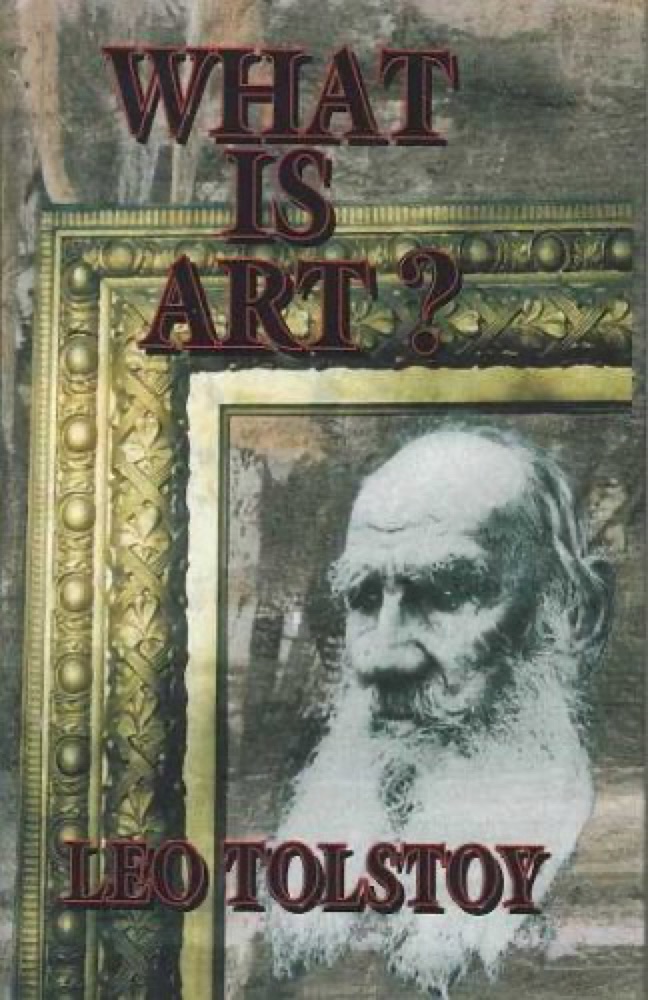
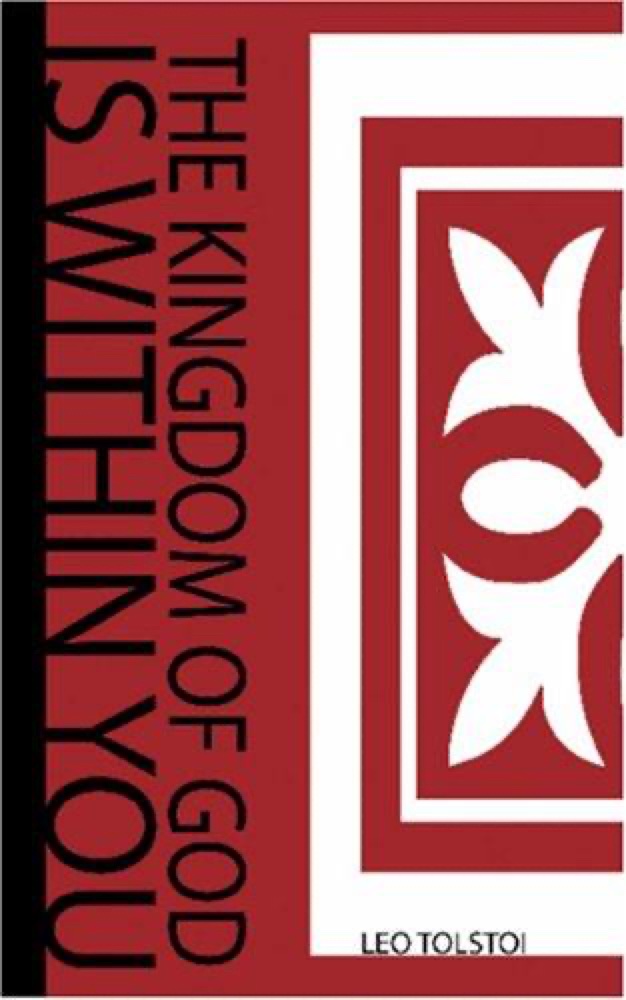
 The Kingdom of God Is Within You
Quotes from the Book
The business of art lies just in this, -- to make that understood and felt which, in the form of an argument, might be incomprehensible and inaccessible.
118
Art is not, as the metaphysicians say, the manifestation of some mysterious idea of beauty or God; it is not, as the aesthetical physiologists say, a game in which man lets off his excess of stored-up energy; it is not the expression of man's emotions by external signs; it is not the production of pleasing objects; and, above all, it is not pleasure; but it is a means of union among men, joining them together in the same feelings, and indispensable for the life and progress toward well-being of individuals and of humanity.
46
To evoke in oneself a feeling one has once experienced, and having evoked it in oneself, then by means of movements, lines, colors, sounds, or forms expressed in words, so to transmit that feeling that others may experience the same feeling - this is the activity of art.
25
I know that most men—not only those considered clever, but even those who are very clever, and capable of understanding most difficult scientific, mathematical, or philosophic problems—can very seldom discern even the simplest and most obvious truth if it be such as to oblige them to admit the falsity of conclusions they have formed, perhaps with much difficulty—conclusions of which they are proud, which they have taught to others, and on which they have built their lives.
12
What is precious to us in an author’s work is the labor of his soul and not the architectural structure in which he packs his thoughts and feelings.
8
A writer is precious and necessary for us only to the extent to which he reveals to us the inner labour of his soul.
7
A true work of art is the revelation of a new conception of life arising in the artist's soul, which, when expressed, lights up the path along with humanity progresses
6
We are accustomed to understand art to be only what we hear and see in theaters, concerts, and exhibitions, together with buildings, statues, poems, novels. . . . But all this is but the smallest part of the art by which we communicate with each other in life. All human life is filled with works of art of every kind — from cradlesong, jest, mimicry, the ornamentation of houses, dress, and utensils, up to church services, buildings, monuments, and triumphal processions. It is all artistic activity. So that by art, in the limited sense of the word, we do not mean all human activity transmitting feelings, but only that part which we for some reason select from it and to which we attach special importance.
6
To take the simplest example: one man laughs, and another, who hears, becomes merry; or a man weeps, and another, who hears, feels sorrow. A man is excited or irritated, and another man, seeing him, comes to a similar state of mind. By his movements, or by the sounds of his voice, a man expresses courage and determination, or sadness and calmness, and this state of mind passes on to others. A man suffers, expressing his sufferings by groans and spasms, and this suffering transmits itself to other people; a man expresses his feeling of admiration, devotion, fear, respect, or love to certain objects, persons, or phenomena, and others are infected by the same feelings of admiration, devotion, fear, respect, or love to the same objects, persons, and phenomena.
4
To take the simplest example: a boy, having experienced, let us say, fear on encountering a wolf, relates that encounter; and, in order to evoke in others the feeling he has experienced, describes himself, his condition before the encounter, the surroundings, the wood, his own light-heartedness, and then the wolf's appearance, its movements, the distance between himself and the wolf, etc. All this, if only the boy, when telling the story, again experiences the feelings he had lived through and infects the hearers and compels them to feel what the narrator had experienced, is art.
2
The artists of various sects, like the theologians of the various sects, mutually exclude and destroy themselves.
2
Each is glad that another feels what he feels ; glad of the communion established, not only between him, and all present, but also with all now living who will yet share the same impression; and more than that, he feels the mysterious gladness of a communion which, reaching beyond the grave, unites us with all men of the past who have been moved by the same feelings, and with all men of the future who will yet be touched by them.
1
As it is impossible to educate a man at school to be a religious teacher of men, so it is impossible to teach a man to be an artist.
Art is the expression of reasonable and conscious life, evoking in us both the deepest consciousness of existence and the highest feelings and loftiest thoughts.
Art is the expression of reasonable and conscious life,
show them, not in reasoning but in life itself, the joy of general union beyond the barriers set up by life itself
Without knowing what I am and why I am here, it is impossible for me to live. And I cannot know that, and consequently it is impossible for me to live,
Segundo Schelling, a arte é produto ou consequência da concepção de mundo segundo a qual o sujeito se torna o seu objecto e o próprio objecto se torna o seu próprio sujeito. A beleza é a imagem do infinito no finito. E o principal carácter da obra de arte é o infinito inconsciente. A arte é a união do subjectivo com o objectivo, da natureza com a razão, do inconsciente com o consciente. E por isso a arte é a mais elevada forma de conhecimento. A beleza é a contemplação das coisas em si mesmas, como elas são na base de todas as coisas (in den urbilden). O belo é produzido não pelo artista através do seu conhecimento ou vontade, mas pela própria ideia de beleza nele.
As is always the case, the more cloudy and confused the conception conveyed by a word, with the more aplomb and self-assurance do people use that word, pretending that what is understood by it is so simple and clear that it is not worth while even to discuss what it actually means
Quem sou eu? Um dos quatro filhos de um tenente-coronel na reserva, que ficou órfão aos sete anos de idade, tendo sido educado por mulheres e por estranhos e que, sem qualquer preparação mundana ou intelectual, se fez ao mundo por volta dos dezassete anos [...]. Sou feio, grosseiro, sujo e mal-educado, quando veio as coisas como o mundo as vê. Sou irascível, chato, intolerante e tímido como uma criança. Sou um labrego com todas as letras. O que sei aprendi-o sozinho, mal, aos solavancos, de modo descosido; e é bem pouco. Sou imoderado, indeciso, inconstante, estupidamente vaidoso e expansivo como todos os fracos. Coragem é coisa que não tenho. A minha preguiça é tal que a ociosidade se tornou para mim uma exigência. Sou boa pessoa, entendendo por isso que gosto do bem, fico de mal comigo quando dele me afasto e é com agrado que volto atrás. Todavia, há em mim uma coisa que pode mais que o bem: a glória. Sou tão ambicioso que, a darem-me a escolher entre a glória e a virtude, receio bem que escolhesse a primeira. Modesto é que não sou, sem sombra de dúvida. Por isso me vêem com este ar de cão batido, por fora, mas se querem saber o que é o orgulho, olhem lá para dentro.
In the narrative of Joseph there was no need to describe in detail, as is done nowadays, Joseph's blood-stained clothes, Jacob's dwelling and clothes, and the pose and attire of Potiphar's wife when, straightening a bracelet on her left arm, she said, "Come to me," and so on, because the feeling contained in this story is so strong that all details except the most necessary_-for instance, that Joseph went into the next room to weep all details are superfluous and would only hinder the conveying of the feeling, and therefore this story is accessible to all people, it touches people of all nations, ranks, ages, has come down to our time, and will live on for thousands of years. But take the details from the best novels of our time and what will remain?
Watch on YouTube
About Leo Tolstoy
We have collected 374 quotes from 18 books by Leo Tolstoy on BookQuoters.
More about the author →More by Leo Tolstoy
All books by Leo Tolstoy →
About the book
Huysmans Écrits sur l'art L'Art moderne - Certains - Trois Primitifs Huysmans a publié trois ouvrages de critique d'art : L'Art moderne (1883), Certains (1889) et Trois Primitifs (1905), composés à partir d'articles parus dans la presse. Après s'être essayé, dans L'Art moderne, au compte rendu de la visite des salons officiels et des expositions impressionnistes, il propose, dans Certains, l'inventaire de ses goûts personnels, en s'attachant à l'étude de peintres - Pierre Puvis de Chavannes, Gustave Moreau, Odilon Redon, Félicien Rops... - et de thèmes particuliers : « Le fer », « Le monstre », etc. Dans Trois Primitifs, enfin, il s'attarde sur des artistes jusque-là négligés : constitué d'une monographie de Mathias Grünewald et du récit de la visite de l'Institut Staedel de Francfort, ce texte apparaît comme un retour sur l'origine même de son intérêt pour les arts plastiques. Souvent i
Book details
- First published
- 1897
- Author
- Leo Tolstoy
- Genre
- Philosophy
- Goodreads rating
- 3.73 (4k ratings)
Keep reading
 Sculpting in Time
 The Romantic Manifesto
 Art as Therapy
 Irrational Man: A Study in Existential Philosophy
 Create Dangerously
 Art as Experience
 The Courage to Create
 The Birth of Tragedy
 Walking on Water: Reflections on Faith and Art
 Illuminations: Essays and Reflections
 Time Regained
 The World as Will and Representation, Vol 1
 A Philosophical Enquiry into the Origin of Our Ideas of the Sublime and Beautiful
 Death in Venice and Other Tales
 Phaedrus
 On Truth and Lies in a Nonmoral Sense
 Reality Hunger: A Manifesto
 The Mind of the Maker: Dorothy L. Sayers' Witty Classic on the Trinity, Christianity, and Human Creativity
 The Essential Writings of Ralph Waldo Emerson
 Modern Man in Search of a Soul
 Doctor Faustus
 Only Dull People Are Brilliant at Breakfast
 The Shock of the New
 The Essays of Ralph Waldo Emerson
 Phenomenology of Perception
 The Hero's Journey: Joseph Campbell on His Life & Work
 The Common Reader
 The Myth of Sisyphus and Other Essays
 All the Beauty in the World: The Metropolitan Museum of Art and Me
 Van Gogh Has a Broken Heart: What Art Teaches Us About the Wonder and Struggle of Being Alive
 Manifestoes of Surrealism
 Beauty
 The Intellectual Life: Its Spirit, Conditions, Methods
 The Recognitions
 Against Interpretation and Other Essays
 The Parallax View
 The Will to Power
 The Doors of Perception & Heaven and Hell
 The Varieties of Religious Experience
 Creativity: Flow and the Psychology of Discovery and Invention
 In Search of Lost Time
 The Letters of Vincent van Gogh
 Selected Non-Fictions
 A Treatise of Human Nature
 The Art of the Novel
 Pensées
 Silence: Lectures and Writings
 The Agony and the Ecstasy
 The Artist's Way
 Six Characters in Search of an Author
 Basic Writings
 Lust for Life
 The Glass Bead Game
 Truth and Method
 The Gift of Asher Lev
 Critique of Judgment
 Gravity and Grace
 The Myth of Sisyphus
 Mystery and Manners: Occasional Prose