
 The World as Will and Representation, Vol 1
Quotes from the Book
Human existence is so fragile a thing and exposed to such dangers that I cannot love without trembling.
294
All the natural movements of the soul are controlled by laws analogous to those of physical gravity. Grace is the only exception. Grace fills empty spaces, but it can only enter where there is a void to receive it, and it is grace itself which makes this void. The imagination is continually at work filling up all the fissures through which grace might pass.
205
Love of God is pure when joy and suffering inspire an equal degree of gratitude.
171
The world is the closed door. It is a barrier. And at the same time it is the way through. Two prisoners whose cells adjoin communicate with each other by knocking on the wall. The wall is the thing which separates them but it is also their means of communication. … Every separation is a link.
129
Justice. To be ever ready to admit that another person is something quite different from what we read when he is there (or when we think about him). Or rather, to read in him that he is certainly something different, perhaps something completely different from what we read in him. Every being cries out silently to be read differently.
93
You could not be born at a better period than the present, when we have lost everything.
84
He who has not God in himself cannot feel His absence.
82
Stars and blossoming fruit trees: Utter permanence and extreme fragility give an equal sense of eternity.
71
To love purely is to consent to distance, it is to adore the distance between ourselves and that which we love.
59
Electra weeping for the dead Orestes. If we love God while thinking that he does not exist, he will manifest his existence.
40
Time’s violence rends the soul; by the rent eternity enters.
32
Love needs reality. What is more terrible than the discovery that through a bodily appearance we have been loving an imaginary being. It is much more terrible than death, from death does not prevent the Beloved from having lived. That is the punishment for having fed love on imagination.
27
Friendship is not to be sought, not to be dreamed, not to be desired; it is to be exercised (it is a virtue).
23
The man who has known pure joy, if only for a moment ... is the only man for whom affliction is something devastating. At the same time he is the only man who has not deserved the punishment. But, after all, for him it is no punishment; it is God holding his hand and pressing rather hard. For, if he remains constant, what he will discover buried deep under the sound of his own lamentations is the pearl of the silence of God.
22
Distance is the soul of the beautiful.
19
If we know in what way society is unbalanced, we must do what we can to add weight to the lighter scale ... we must have formed a conception of equilibrium and be ever ready to change sides like justice, 'that fugitive from the camp of conquerors'.
19
It is impossible to forgive whoever has done us harm if that harm has lowered us. We have to think that it has not lowered us, but has revealed our true level.
17
The mind is not forced to believe in the existence of anything (subjectivism, absolute idealism, solipsism, skepticism: c.f. the Upanishads, the Taoists and Plato, who, all of them, adopt this philosophical attitude by way of purification). That is why the only organ of contact with existence is acceptance, love. That is why beauty and reality are identical. That is why joy and the sense of reality are identical.
17
Monotony is the most beautiful or the most atrocious thing. The most beautiful if it is a reflection of eternity--the most atrocious if it is the sign of an unvarying perpetuity. It is time surpassed or time sterilized.
15
Perfect joy excludes even the very feeling of joy, for in the soul filled by the object no corner is left for saying 'I'. We cannot imagine such joys when they are absent, thus the incentive for seeking them is lacking.
15
Among human beings, only the existence of those we love is fully recognized. Belief in the existence of other human beings as such is love.
13
Purity is the power to contemplate defilement.
11
Belief in immortality is harmful because it is not in our power to conceive of the soul as really incorporeal. So this belief is in fact a belief in the prolongation of life, and it robs death of its purpose.
11
Man's great affliction, which begins with infancy and accompanies him till death, is that looking and eating are two different operations. Eternal beatitude is a state where to look is to eat.
10
There is no doubt that here below matter and evil exercise 'all the causality which belongs to them'; the spectacle of the innumerable horrors of history is enough to prove that the kingdom of God is not of this world (does not Scripture describe the devil as the prince of this world?). Nevertheless God remains mysteriously present in creation: without in any way changing the calamities which weigh upon us, his grace plays upon the laws of gravity like the sun's rays in the clouds.
8
Art has no immediate future because all art is collective and there is no more collective life(there are only dead collections of people), and also because of this breaking of the true pact between the body and the soul. Greek art coincided with the beginning of geometry and with athleticism, the art of the Middle Ages with the craftsmen's guilds, the art of the Renaissance with the beginning of mechanics, etc....Since 1914 there has been a complete cut. Even comedy is almost impossible. There is only room for satire (when was it easier to understand Juvenal?). Art will never be reborn except from amidst a general anarchy - it will be epic no doubt, because affliction will have simplified a great many things...It is therefore quite useless for you to envy Leonardo or Bach. Greatness in our times must take a different course. Moreover it can only be solitary, obscure and without an echo...(but without an echo, no art).
7
Watch on YouTube
About Simone Weil
We have collected 26 quotes from 1 book by Simone Weil on BookQuoters.
More about the author →About the book
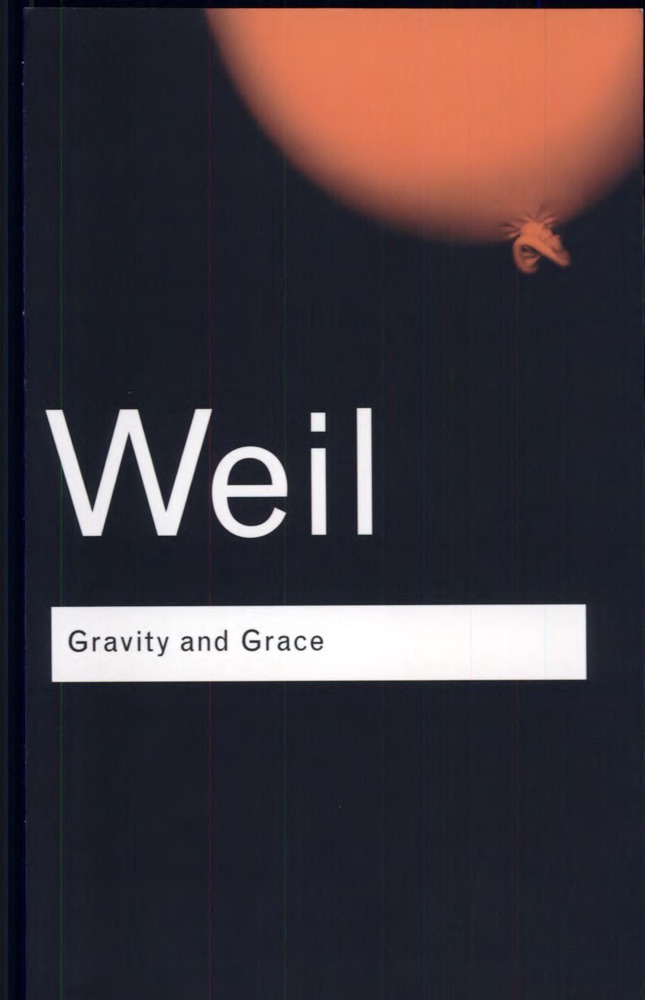
Gravity and Grace was the first ever publication by the remarkable thinker and activist, Simone Weil. In it Gustave Thibon, the farmer to whom she had entrusted her notebooks before her untimely death, compiled in one remarkable volume a compendium of her writings that have become a source of spiritual guidance and wisdom for countless individuals. On the fiftieth anniversary of the first English edition - by Routledge & Kegan Paul in 1952 - this Routledge Classics edition offers English readers the complete text of this landmark work for the first time ever, by incorporating a specially commissioned translation of the controversial chapter on Israel. Also previously untranslated is Gustave Thibon's postscript of 1990, which reminds us how privileged we are to be able to read a work which offers each reader such 'light for the spirit and nourishment for the soul'. This is a book that no
Book details
- First published
- 1947
- Author
- Simone Weil
- Genre
- Philosophy
- Goodreads rating
- 4.26 (4k ratings)
Keep reading
The World as Will and Representation, Vol 1
 No Man Is an Island
 De Profundis
 The Perennial Philosophy
 The God Who Weeps: How Mormonism Makes Sense of Life
 Twilight of the Idols/The Anti-Christ
 The Seven Storey Mountain
 The Weight of Glory
 The Problem of Pain
 Love and Will
 The Varieties of Religious Experience
 The Gay Science
 The Will to Power
 Tears and Saints
 Immortality
 The Essential Writings of Ralph Waldo Emerson
 The Brothers Karamazov
 Anam Cara: A Book of Celtic Wisdom
 The Unbearable Lightness of Being
 The Great Divorce
 The Treasured Writings of Kahlil Gibran
 Orthodoxy
 Works of Love
 The Book: On the Taboo Against Knowing Who You Are
 The Myth of Sisyphus
 Conversations with God: An Uncommon Dialogue, Book 1
 Thoughts in Solitude
 A Severe Mercy: A Story of Faith, Tragedy and Triumph
 The Myth of Sisyphus and Other Essays
 In Search of Lost Time
 When Nietzsche Wept
 We Who Wrestle with God: Perceptions of the Divine
 Proof of Heaven: A Neurosurgeon's Journey into the Afterlife
 The Consolation of Philosophy
 The Everlasting Man
 The Ethics of Ambiguity
 A Joseph Campbell Companion: Reflections on the Art of Living
 On the Suffering of the World
 The Power of Myth
 The Doors of Perception & Heaven and Hell
 Freedom from the Known
 My Bright Abyss: Meditation of a Modern Believer
 The Enneads
 Ben-Hur: A Tale of the Christ
 The Way Things Are
 East of Eden
 The Sickness Unto Death: A Christian Psychological Exposition for Upbuilding and Awakening
 The Upanishads
 The Symposium
 Eyeless in Gaza
 Father Joe: The Man Who Saved My Soul
 Strength to Love
 The Schopenhauer Cure
 A Soldier of the Great War
 This Here Flesh: Spirituality, Liberation, and the Stories That Make Us
 Tragic Sense of Life
 The Home and the World
 Modern Man in Search of a Soul
 No Death, No Fear: Comforting Wisdom for Life
 The Mountain Shadow