
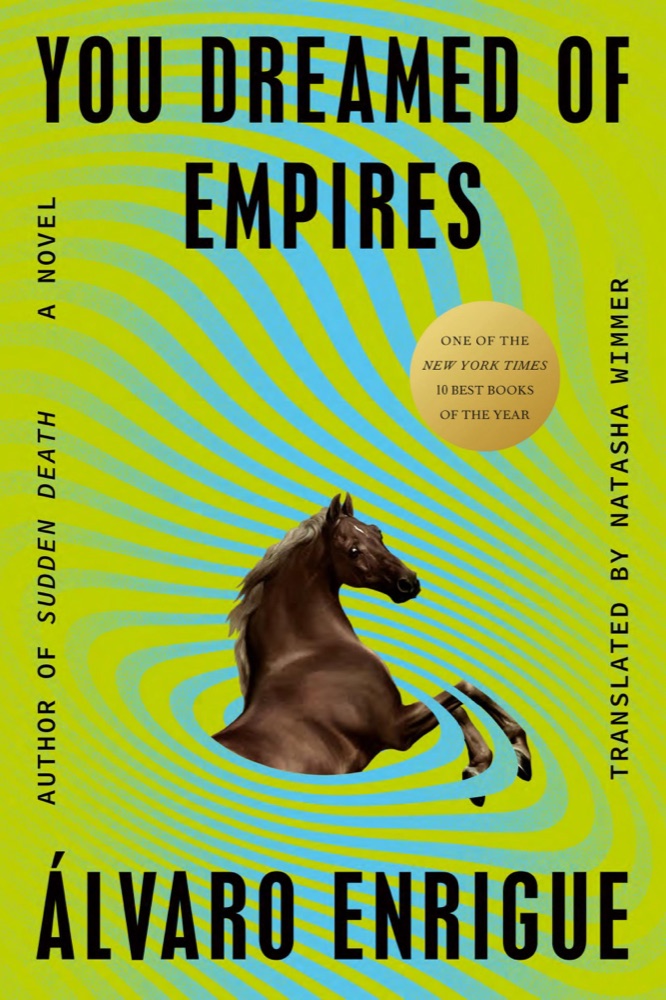
 You Dreamed of Empires
Quotes from the Book
But the only real things in a novel are the sequences of letters, words and sentences that make it up, and the paper on which they're printed. What they produce in a reader's head are private and unique landscapes of objects in motion that have only one thing in common: they don't exist.
3
These facts were confusing in their own time, and there’s no reason why they shouldn’t be confusing in a novel that doesn’t aspire to accurately represent that time, but does want to present it as a theory about the world we live in today.
2
Maybe all books are written simply because in every game the bad guys have the advantage and that is too much to bear.
2
El resto de la América infinita todavía ni siquiera sospechaba que en los siguientes doscientos años decenas de culturas milenarias que habían florecido aisladas y sin contaminantes ni defensas se iría inexorablemente a la mierda. No que importe: nada importa. Se extinguen las especies, los hijos se van de casa, los amigos consiguen novias intratables, las culturas desaparecen, las lenguas, un día, se dejan de hablar; los que sobreviven se convencen de que eran los más aptos
2
It isn't a book about Caravaggio or Quevedo, though Caravaggio and Quevedo are in the book, as are Cortés and Cuauhtémoc, and Galileo and Pius IV. Gigantic individuals facing off. All fucking, getting drunk, gambling in the void. Novels demolish monuments because all novels, even the most chaste, are a tiny bit pornographic.
1
When something is clear to a writer, I think it’s fair to ask him not to obscure it, but when something is unclear I think it should be left that way. The honest thing is to relay my doubts, and let the conversation move one step forward: the readers may know better.
1
I'm not sure that my friend's father liked my book. In an attempt to save me from my own imagination, he wrote me a six-page letter pointing out all the physical impossibilities and imaginary rules I had come up with to be able to say whatever the book says. The letter proves that the true art is reading, not writing, and it is a beautiful testament of loyalty: a friend of his son's is a friend of his. Commenting on some sexual incidents described in the novel, he noted: Now I know why you and my son are friends." This is a statement of complicity. It tells me that if we knew each other, he would forgive my defects just as he does his son's.
We Mexicans aren’t descendants of the Mexicas, but of the nations that joined with Cortés to overthrow them. We’re a country whose name is the product of nostalgia and guilt.
Nor was the professor especially particular in the exercise of his sexuality: he believed that in terms of texture and pressure there was little difference between the cunt of a sheep and the ass of the greatest artist of all time, so he might as well fuck him in the name of scientific experimentation.
Take, for example, an inexplicable organization called the Mexican National Front, consisting of thirty-two skinheads. The thirty-two morons who belong to the Front are admirers of Hitler—and even they explain on their website that Cortés was a bastard.
The question here is the responsibility I bear in the face of the reasonable fear that what is being said won’t be understood. The risk is worth the weight of that responsibility. The sole duty of a writer is to minister to his readers: to liberate them from inexactitude out of respect for the mysterious and touching pact of loyalty that they make with books. But the problem is that I don’t always know why name changes are significant in Mexico, and my hunch is that there is a whole history and politics behind it. When something is clear to a writer, I think it’s fair to ask him not to obscure it, but when something is unclear I think it should be left that way. The honest thing is to relay my doubts, and let the conversation move one step forward: the readers may know better.
Ya no era cosa de vida o muerte, sino de victoria y derrota--valores mucho más complejos y duros de llevar porque el que pierde un duelo a espada no tiene que vivir con ello.
La descripción de una obra de arte, como la de un sueño, detiene y vuelve decrépito un relato. Una obra de arte sólo sería contable si modificara la raya que va dibujando la Historia, y si una obra de arte, como un sueño, vale la pena ser recordada, es precisamente porque representa un sitio ciego para la Historia. El arte y los sueños no nos acompañan porque tengan la capacidad de mover cosas, sino porque detienen el mundo: funcionan como un paréntesis, un dique, la salud.
Watch on YouTube
About Álvaro Enrigue
We have collected 30 quotes from 2 books by Álvaro Enrigue on BookQuoters.
More about the author →More by Álvaro Enrigue
You Dreamed of Empires
About the book
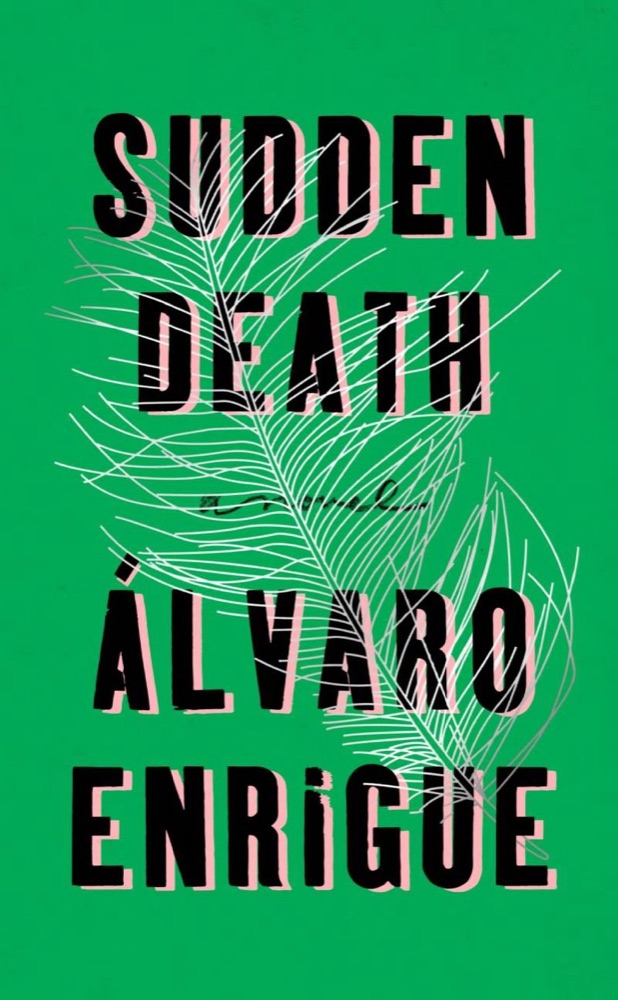
A daring, kaleidoscopic novel about the clash of empires and ideas in the sixteenth century that continue to reverberate throughout modernity—a story unlike anything you’ve ever read before. Sudden Death begins with a brutal tennis match that could decide the fate of the world. The bawdy Italian painter Caravaggio and the loutish Spanish poet Quevedo battle it out before a crowd that includes Galileo, Mary Magdalene, and a generation of popes who would throw Europe into the flames. In England, Thomas Cromwell and Henry VIII behead Anne Boleyn, and her crafty executioner transforms her legendary locks into the most sought-after tennis balls of the time. Across the ocean in Mexico, the last Aztec emperors play their own games, as conquistador Hernán Cortés and his Mayan translator and lover, La Malinche, scheme and conquer, fight and f**k, not knowing that their domestic comedy will chang
Book details
- First published
- 2013
- Author
- Álvaro Enrigue
- Genre
- Fiction
- Goodreads rating
- 3.76 (4k ratings)
The buzz
- The New York TimesReview in The New York Timesprofessional review (via Book Marks)
- The Washington PostReview in The Washington Postprofessional review (via Book Marks)
- Los Angeles TimesReview in Los Angeles Timesprofessional review (via Book Marks)
- LA Review of BooksReview in LA Review of Booksprofessional review (via Book Marks)
- SfgateReview in Sfgateprofessional review (via Book Marks)
- ElectricliteratureReview in Electricliteratureprofessional review (via Book Marks)
Keep reading
 Ficciones
 Elizabeth Costello
 Death in the Afternoon
 Dear Mr. M
 Dæmon Voices
 The Art of the Novel
 The Book of Sand and Shakespeare's Memory
 Gnomon
 Incidental Inventions
 The Aleph and Other Stories
 How to Read Literature
 The Wave in the Mind: Talks and Essays on the Writer, the Reader and the Imagination
 The Club Dumas
 Summertime
 The Book of Air and Shadows
 The Curtain: An Essay in Seven Parts
 How Not to Write a Novel: 200 Classic Mistakes and How to Avoid Them—A Misstep-by-Misstep Guide
 A Collection of Essays
 The Historian's Craft: Reflections on the Nature and Uses of History and the Techniques and Methods of Those Who Write It.
 Too Like the Lightning
 My Invented Country: A Nostalgic Journey Through Chile
 Firmin: Adventures of a Metropolitan Lowlife
 The Fencing Master
 The Book That Wouldn’t Burn
 My Last Sigh
 Mystery and Manners: Occasional Prose
 Experience
 The Black Book
 People of the Book
 How to Read Literature Like a Professor
 Reading Lolita in Tehran: A Memoir in Books
 Moravagine
 The Book That Held Her Heart
 The Labyrinth of Solitude and Other Writings
 The Book That Broke the World
 Skinny Legs and All
 The Western Lands
 The View from the Cheap Seats: Selected Nonfiction
 Aspects of the Novel
 The Summer Without Men
 The Floating Opera
 The Language of the Night: Essays on Writing, Science Fiction, and Fantasy
 Whose Story Is This? Old Conflicts, New Chapters
 Travels With My Aunt
 Let Me Tell You What I Mean
 How to Read Now
 The Ghost
 The Book of Laughter and Forgetting
 Empire of Silence
 Burning Questions: Essays and Occasional Pieces, 2004 to 2021
 Flaubert's Parrot
 The Last Librarian
 Brave New World / Brave New World Revisited
 Arm of the Sphinx
 From Dawn to Decadence: 500 Years of Western Cultural Life, 1500 to the Present
 The Year of Reading Dangerously
 A Luminous Republic
 Distant Star
 The Little Virtues
 Nothing to Be Frightened Of