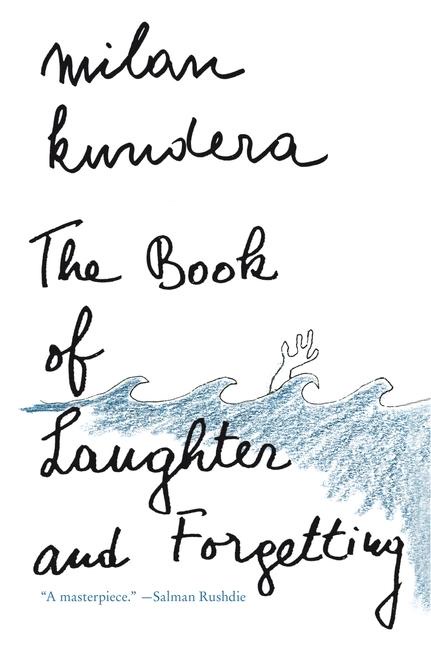

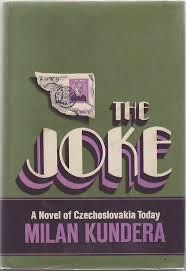
 The Joke
Quotes from the Book
Oh lovers! be careful in those dangerous first days! once you've brought breakfast in bed you'll have to bring it forever, unless you want to be accused of lovelessness and betrayal.
The struggle of man against power is the struggle of memory against forgetting
To laugh is to live profoundly.
Living is being happy: seeing, hearing, touching, drinking, eating, urinating, defecating, diving into the water and gazing at the sky, laughing and crying.
The stupidity of people comes from having an answer for everything. The wisdom of the novel comes from having a question for everything....The novelist teaches the reader to comprehend the world as a question. There is wisdom and tolerance in that attitude. In a world built on sacrosanct certainties the novel is dead. The totalitarian world, whether founded on Marx, Islam, or anything else, is a world of answers rather than questions. There, the novel has no place.
He was well aware that of the two of three thousand times he had made love (how many times had he made love in his life?) only two or three were really essential and unforgettable. The rest were mere echoes, imitations, repetitions, or reminiscences.
It takes so little, so infinitely little, for a person to cross the border beyond which everything loses meaning: love, convictions, faith, history. Human life -- and herein lies its secret -- takes place in the immediate proximity of that border, even in direct contact with it; it is not miles away, but a fraction of an inch.
Once the writer in every individual comes to life (and that time is not far off), we are in for an age of universal deafness and lack of understanding.
A mismatched outfit, a slightly defective denture, an exquisite mediocrity of the soul-those are the details that make a woman real, alive. The women you see on posters or in fashion magazines-the ones all the women try to imitate nowadays-how can they be attractive? They have no reality of their own; they're just the sum of a set of abstract rules. They aren't born of human bodies; they hatch ready-made from the computers." ~The Book of Laughter and Forgetting
Every love relationship rests on an unwritten agreement unthinkingly concluded by the lovers in the first weeks of their love. They are still in a kind of dream but at the same time, without knowing it, are drawing up, like uncompromising lawyers, the detailed clauses of their contract. O lovers! Be careful in those dangerous first days! Once you've brought breakfast in bed you'll have to bring it forever, unless you want to be accused of lovelessness and betrayal.
Children, Never look Back!" and this meant that we must never allow the future to be weighed down by memory . for children have no past, and that is the whole secret of the magical innocence of their smiles.
[W]e must never allow the future to collapse under the burden of memory.
When Don Quixote went out into the world, that world turned into a mystery before his eyes. That is the legacy of the first European novel to the entire subsequent history of the novel. The novel teaches us to comprehend the world as a question. There is wisdom and tolerance in that attitude.
...because love is continual interrogation. I don't know of a better definition of love.
Totalitarianism is not only hell, but all the dream of paradise-- the age-old dream of a world where everybody would live in harmony, united by a single common will and faith, without secrets from one another. Andre Breton, too, dreamed of this paradise when he talked about the glass house in which he longed to live. If totalitarianism did not exploit these archetypes, which are deep inside us all and rooted deep in all religions, it could never attract so many people, especially during the early phases of its existence. Once the dream of paradise starts to turn into reality, however, here and there people begin to crop up who stand in its way. and so the rulers of paradise must build a little gulag on the side of Eden. In the course of time this gulag grows ever bigger and more perfect, while the adjoining paradise gets even smaller and poorer.
Let us define our terms. A woman who writes her lover four letters a day is not a graphomaniac, she is simply a woman in love. But my friend who xeroxes his love letters so he can publish them someday--my friend is a graphomaniac. Graphomania is not a desire to write letters, diaries, or family chronicles (to write for oneself or one's immediate family); it is a desire to write books (to have a public of unknown readers). In this sense the taxi driver and Goethe share the same passion. What distinguishes Goethe from the taxi driver is the result of the passion, not the passion itself. "Graphomania (an obsession with writing books) takes on the proportions of a mass epidemic whenever a society develops to the point where it can provide three basic conditions: 1. a high degree of general well-being to enable people to devote their energies to useless activities; 2. an advanced state of social atomization and the resultant general feeling of the isolation of the individual; 3. a radical absence of significant social change in the internal development of the nation. (In this connection I find it symptomatic that in France, a country where nothing really happens, the percentage of writers is twenty-one times higher than in Israel. Bibi [character from the book] was absolutely right when she claimed never to have experienced anything from the outside. It is this absence of content, this void, that powers the moter driving her to write). "But the effect transmits a kind of flashback to the cause. If general isolation causes graphomania, mass graphomania itself reinforces and aggravates the feeling of general isolation. The invention of printing originally promoted mutual understanding. In the era of graphomania the writing of books has the opposite effect: everyone surrounds himself with his own writings as with a wall of mirrors cutting off all voices from without.
The history of music is mortal, but the idiocy of the guitar is eternal.
It takes so little, so infinitely little, for someone to find himself on the other side of the border, where everything - love, convictions, faith, history - no longer has meaning. The whole mystery of human life resides on the fact that it is spent in the immediate proximity of, and even in direct contact with, that border, that it is separated from it not by kilometers but by barely a millimeter.
She knew that there were all kinds of ways to make a conquest and that one of the surest roads to a woman's genitals was through her sadness.
That is when I understood the magical meaning of the circle. If you go away from a row, you can still come back into it. A row is an open formation. But a circle closes up, and if you go away from it, there is no way back. It is not by chance that the planets move in circles and that a rock coming loose from one of them goes inexorably away, carried off by centrifugal force. Like a meteorite broken off from a planet, I left the circle and have not stopped falling. Some people are granted their death as they are whirling around, and others are smashed at the end of their fall. And these others (I am one of them) always retain a kind of faint yearning for that lost ring dance, because we are all inhabitants of a universe where everything turns in circles.
The phrase "It's absolutely the same with me, I..." seems to be an approving echo, a way of continuing the other's thought, but that is an illusion: in reality it is a brute revolt against a brutal violence, an effort to free our own ear from bondage and to occupy the enemy's ear by force. Because all of man's life among his kind is nothing other than a battle to seize the ear of others.
For he was aware of the great secret of life: Women don't look for handsome men. Women look for men who have had beautiful women. Having an ugly mistress is therefore a fatal mistake.
And I ran after that voice through the streets so as not to lose sight of the splendid wreath of bodies gliding over the city, and I realized with anguish in my heart that they were flying like birds and I was falling like a stone, that they had wings and I would never have any.
The future is only an indifferent void no one cares about, but the past is filled with life, and its countenance is irritating, repellent, wounding, to the point that we want to destroy or repaint it. We want to be masters of the future only for the power to change the past.
Laughter, on the other hand, " Petrarch went on, "is an explosion that tears us away from the world and throws us back into our own cold solitude. Joking is a barrier between man and the world. Joking is the enemy of love and poetry. That's why I tell you yet again, and you want to keep in mind: Boccaccio doesn't understand love. Love can never be laughable. Love has nothing in common with laughter.
The woman he had loved most (he was thirty at the time) would tell him (he was nearly in despair when he heard it) that she held on to life by a thread. Yes, she did want to live, life gave her great joy, but she also knew that her 'i want to live' was spun from the threads of a spiderweb. It takes so little, so infinitely little, for someone to find himself on the other side of the border, where everything-- love, convictions, faith, history-- no longer has meaning. The whole mystery of human life resides in the fact that it is spent in the immediate proximity of, and even in direct contact with, that border, that it is separated from it not by kilometers but by barely a millimeter.
Joking is a barrier between man and the world. Joking is the enemy of love and poetry.
Tamina serves coffee and calvados to the customers (there aren't all that many, the room being always half empty) and then goes back behind the bar. Almost always there is someone sitting on a barstool, trying to talk to her. Everyone likes Tamina. Because she knows how to listen to people. But is she really listening? Or is she merely looking at them so attentively, so silently? I don't know, and it's not very important. What matters is that she doesn't interrupt anyone. You know what happens when two people talk. One of them speaks and the other breaks in: "It's absolutely the same with me, I..." and starts talking about himself until the first one manages to slip back in with his own "It's absolutely the same with me, I..." The phrase "It's absolutely the same with me, I..." seems to be an approving echo, a way of continuing the other's thought, but that is an illusion: in reality it is a brute revolt against a brutal violence, an effort to free our own ear from bondage and to occupy the enemy's ear by force. Because all of man's life among his kind is nothing other than a battle to seize the ear of others. The whole secret of Tamina's popularity is that she has no desire to talk about herself. She submits to the forces occupying her ear, never saying: "It's absolutely the same with me, I...
Watch on YouTube
About Milan Kundera
We have collected 272 quotes from 13 books by Milan Kundera on BookQuoters.
More about the author →More by Milan Kundera
All books by Milan Kundera →

Book details
- Author
- Milan Kundera
- Genre
- Classics
- Goodreads rating
- 3.94 (55k ratings) →
Keep reading
The Joke
 Identity
 Nutshell
 Eyeless in Gaza
 Complete Works of Oscar Wilde
 Sexus
Sexus
 The Magic Mountain
 The Summer Without Men
 The Magus
 Either/Or: A Fragment of Life
 The Fall
 The Tunnel
 The Picture of Dorian Gray
 The Secret History
 In Search of Lost Time
 Arch of Triumph
 Doctor Zhivago
 Two Years Eight Months and Twenty-Eight Nights
 A Luminous Republic
 The Humans
 The Story of the Lost Child
 The Spy
 A Tale of Love and Darkness
 The Elementary Particles
 Asymmetry
 The Golden Notebook
 The World as Will and Representation, Vol 1
 The Eighth Life
 Nothing to Be Frightened Of
 Crome Yellow
 Brideshead Revisited: The Sacred and Profane Memories of Captain Charles Ryder
 V.
V.
 The Abundance
 Arm of the Sphinx
 Monday or Tuesday
 The Tsar of Love and Techno
 The Unbearable Lightness of Being
 Daniel Deronda
 Flaubert's Parrot
 The Wisdom of Life
 The Signature of All Things
 Kafka on the Shore
 The Ides of March
 Empire of Silence
 Wild Ducks Flying Backward
 Just Above My Head
 You Can't Go Home Again
 The Fountainhead
 The Gay Science
 The Myth of Sisyphus and Other Essays
 All the King's Men
 Untimely Meditations
 Moravagine
 Embers
 Absalom, Absalom!
 The Myth of Sisyphus
 The Interpretation of Murder
 A History of the World in 10½ Chapters
 The Book That Broke the World
 Orlando