

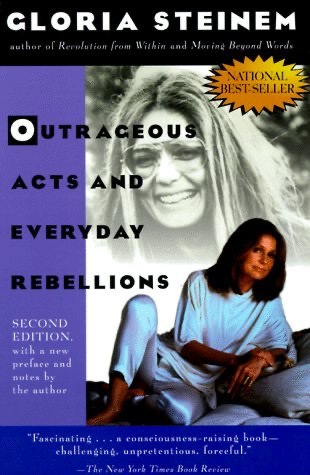
 Outrageous Acts and Everyday Rebellions
Quotes from the Book
You're always the person you were when you were born," she says impatiently. "You just keep finding new ways to express it.
301
I myself cried when I got angry, then became unable to explain why I was angry in the first place. Later I would discover this was endemic among female human beings. Anger is supposed to be "unfeminine" so we suppress it -until it overflows. I could see that not speaking up made my mother feel worse. This was my first hint of the truism that depression is anger turned inward; thus women are twice as likely to be depressed. My mother paid a high price for caring so much, yet being able to do so little about it. In this way, she led me toward am activist place where she herself could never go.
221
You should write about take no-shit women like me. Girls need to know they can break the rules" p.
173
Laughter is a rescue. p.
130
As Robin Morgan wrote so wisely, "Hate generalizes, love specifies". That's what makes going on the road so important. It definitely specifies.
122
Sometimes I think the only real division into two is between people who divide everything into two and those who don't.
115
When humans are ranked instead of linked, everyone loses.
110
Decisions are best made by the people affected by them.
95
If you find yourself drawn to an event against all logic, go. The universe is telling you something.
86
Also, one of the simplest paths to deep change is for the less powerful to speak as much as they listen, and for the more powerful to listen as much as they speak.
79
Long before all these divisions were opened between home and the road, betweens a woman's place and a man's world, humans followed the crops, the seasons, traveling with their families, our companions, animals, our tents. We built campfires and moved from place to place. This way of traveling is still in our cellular memory. Living things have evolved as travelers, Even migrating birds know that nature doesn't demand a choice between nesting and flight.
76
Remember: "For want of a nail, the horseshoe was lost, for want of a horseshoe, the horse was lost, for want of a horse, the battle was lost, for want of a battle, the war was lost." This parable should be the mantra of everyone who thinks her or his vote doesn't count.
56
If you want people to listen to you, you have to listen to them. If you hope people will change how they live, you have to know how they live. If you want people to see you, you have to sit down with them eye-to-eye.
51
Swiftboating enters the English language as a verb that means attacking strength instead of weakness. In feminist and other social justice contexts, this has long been called trashing, attacking leaders for daring to write, speak, or lead at all. Taking away the good is even more lethal than pointing out the bad. p.
46
I began to see that for some, religion was just a form of politics you couldn’t criticize.
45
We might have known sooner that the most reliable predictor of whether a country is violent within itself—or will use military violence against another country—is not poverty, natural resources, religion, or even degree of democracy; it’s violence against females. It normalizes all other violence.
43
No wonder studies show that women's intellectual self-esteem tends to go down as years of education go up. We have been studying our own absence.
41
The road is messy in the way that real life is messy. It leads us out of denial and into reality, out of theory and into practice, out of caution and into action, out of statistics and into stories—in short, out of our heads and into our hearts.
39
Altogether, if I'd been looking at nothing but the media all these years, I would be a much more discouraged person-especially given the notion that only conflict is news, and that objectivity means being evenhandedly negative.
39
I wonder: If you think of someone you love, do you become a little more like them? I would like to think so.
38
It’s said that the biggest determinant of our lives is whether we see the world as welcoming or hostile. Each becomes a self-fulfilling prophecy.
34
After all, hope is a form of planning.
30
Anybody who is experiencing something is more expert in it than the experts.
29
I was angry because young men in politics were treated like rising stars and young women were treated like - well - young women. {...} I was angry about the human talent that was lost just because it was born into a female body, and the mediocrity that was rewarded because it was born into a male one.
25
The root of oppression is the loss of memory.
22
As novelist Margaret Atwood wrote to explain women’s absence from quest-for-identity novels, “there’s probably a simple reason for this: send a woman out alone on a rambling nocturnal quest and she’s likely to end up a lot deader a lot sooner than a man would.”3 The irony here is that thanks to molecular archaeology—which includes the study of ancient DNA to trace human movement over time—we now know that men have been the stay-at-homes, and women have been the travelers. The rate of intercontinental migration for women is about eight times that for men.
22
Instead of either/or, I discovered a whole world of and.
21
Not even in a movie had I ever seen a wife with a journey of her own. Marriage was always the happy end, not the beginning. It was the 1950s, and I confused growing up with settling down.
21
Even the dictionary defines adventurer as “a person who has, enjoys, or seeks adventures,” but adventuress is “a woman who uses unscrupulous means in order to gain wealth or social position.
21
Before she leaves, my new friend tells me to look out of the big picture window at the parking lot. "See that purple Harley out there—that big gorgeous one? That's mine. I used to ride behind my husband, and never took the road on my own. Then after the kids were grown, I put my foot down. It was hard, but we finally got to be partners. Now he says he likes it better this way. He doesn't have to worry about his bike breaking down or getting a heart attach and totaling us both. I even put 'Ms.' on my license plate—and you should see my grandkids' faces when Grandma rides up on her purple Harley!" On my own again, I look out at the barren sand and tortured rocks of the Badlands, stretching for miles. I've walked there, and I know that, close up, the barren sand reveals layers of pale rose and beige and cream, and the rocks turn out to have intricate womblike openings. Even in the distant cliffs, caves of rescue appear. What seems to be one thing from a distance is very different close up. I tell you this story because it's the kind of lesson that can be learned only on the road. And also because I've come to believe that, inside, each of us has a purple motorcycle. We have only to discover it—and ride.
20
Watch on YouTube
About Gloria Steinem
We have collected 104 quotes from 4 books by Gloria Steinem on BookQuoters.
More about the author →More by Gloria Steinem
Outrageous Acts and Everyday Rebellions
 The Truth Will Set You Free, But First It Will Piss You Off!: Thoughts on Life, Love, and Rebellion
 Revolution from Within: A Book of Self-Esteem
About the book
Gloria Steinem—writer, activist, organizer, and one of the most inspiring leaders in the world—now tells a story she has never told before, a candid account of how her early years led her to live an on-the-road kind of life, traveling, listening to people, learning, and creating change. She reveals the story of her own growth in tandem with the growth of an ongoing movement for equality. This is the story at the heart of My Life on the Road.
Book details
- First published
- 2015
- Author
- Gloria Steinem
- Genre
- Nonfiction
- Goodreads rating
- 4.07 (37k ratings)
The buzz
- The New York TimesReview in The New York Timesprofessional review (via Book Marks)
- Los Angeles TimesReview in Los Angeles Timesprofessional review (via Book Marks)
- NewrepublicReview in Newrepublicprofessional review (via Book Marks)
- SfgateReview in Sfgateprofessional review (via Book Marks)
- MotherjonesReview in Motherjonesprofessional review (via Book Marks)
- DallasnewsReview in Dallasnewsprofessional review (via Book Marks)
Keep reading
The Truth Will Set You Free, But First It Will Piss You Off!: Thoughts on Life, Love, and Rebellion
 Becoming
 When Women Were Dragons
 Old Babes in the Wood: Stories
 The Mother of All Questions
 Surrender: 40 Songs, One Story
 The Argonauts
 The Blue Sweater: Bridging the Gap Between Rich and Poor in an Interconnected World
 No Time To Spare: Thinking About What Matters
 The Razor's Edge
 An Absolutely Remarkable Thing
 Men Explain Things to Me
 A Million Miles in a Thousand Years: What I Learned While Editing My Life
 The Folded Clock: A Diary
 Trick Mirror: Reflections on Self-Delusion
 The Nix
 Oranges Are Not the Only Fruit
 No One Writes Back
 My Beloved World
 Asymmetry
 Travels with Charley: In Search of America
 Varina
 Even Cowgirls Get the Blues
 Open City
 The Power
 The Autobiography of Eleanor Roosevelt
 Life Will Be the Death of Me: . . . and you too!
 The House of Hidden Meanings
 You Can't Be Neutral on a Moving Train: A Personal History of Our Times
 The Bassoon King: My Life in Art, Faith, and Idiocy
 If You Have to Cry, Go Outside: And Other Things Your Mother Never Told You
 In Search of Our Mothers' Gardens: Womanist Prose
 Riding the Elephant: A Memoir of Altercations, Humiliations, Hallucinations, and Observations
 Elizabeth Finch
 Untamed
 Leaving Before the Rains Come
 The Golden Notebook
 My Name Is Barbra
 Blue Highways
 Wide Awake
 NW
NW
 Still Life
 Things I've Been Silent About
 The 7 Habits Of Highly Effective Teens
 A Promised Land
 Humans of New York
 Here for It; Or, How to Save Your Soul in America: Essays
 Tell Me More: Stories About the 12 Hardest Things I'm Learning to Say
 Like Streams to the Ocean: Notes on Ego, Love, and the Things That Make Us Who We Are
 The Book of Koli
 To Shake the Sleeping Self: A Journey from Oregon to Patagonia, and a Quest for a Life with No Regret
 Conviction
 Special Topics in Calamity Physics
 Stories of Your Life and Others
 These Precious Days: Essays
 Too Much Happiness: Stories
 What Happened
 Managing Expectations: A Memoir in Essays – A Poignant Collection of Personal Stories on Acting, Failure, and Motherhood's Joy
 Recollections of My Nonexistence: A Memoir
 The Hour I First Believed