
 The Volcano Lover: A Romance
Quotes from the Book
Camp sees everything in quotation marks. It's not a lamp, but a 'lamp'; not a woman, but a 'woman'.
11
Time liberates the work of art from moral relevance, delivering it over to the Camp sensibility . . . Another effect: time contracts the sphere of banality. (Banality is, strictly speaking, always a category of the contemporary.) What was banal can, with the passage of time, become fantastic.
9
When something is just bad (rather than Camp), it's often because it is too mediocre in its ambition.
5
Not all homosexuals have Camp taste. But homosexuals, by and large, constitute the vanguard –and the most articulate audience– of Camp.
4
It’s good because it’s awful
3
Any sensibility which can be crammed into the mold of a system, or handled with the rough tools of proof, is no longer a sensibility. It has hardened into an idea ...
3
Taste has no system and no proofs. But there is something like a logic of taste: the consistent sensibility which underlies and gives rise to a certain taste.
3
The connoisseur of Camp has found more ingenious pleasures. Not in Latin poetry and rare wines and velvet jackets, but in the coarsest, commonest pleasures, in the arts of the masses.
3
What is most beautiful in virile men is something feminine; what is most beautiful in feminine women is something masculine…
3
I am strongly drawn to Camp, and almost as strongly offended by it. That is why I want to talk about it, and why I can. For no one who wholeheartedly shares in a given sensibility can analyze it; he can only, whatever his intention, exhibit it.
2
To talk about camp is therefore to betray it. If the betrayal can be defended, it will be for the edification it provides, or the dignity of the conflict it resolves.
2
In naïve, or pure, Camp, the essential element is seriousness, a seriousness that fails. Of course, not all seriousness that fails can be redeemed as Camp. Only that which has the proper mixture of the exaggerated, the fantastic, the passionate, and the naïve.
2
Camp which knows itself to be Camp ('camping') is usually less satisfying.
2
To name a sensibility, to draw its contours and to recount its history, requires a deep sympathy modified by revulsion.
2
Camp is the answer to the problem: how to be a dandy in the age of mass culture.
1
But the charge of boredom is really hypocritical. There is, in a sense, no such thing as boredom. Boredom is only another name for a certain species of frustration.
1
It's absurd to divide people into good and bad. People are either charming or tedious.” - Lady Windermere’s Fan
1
Camp is a certain mode of aestheticism. It is one way of seeing the world as an aesthetic phenomenon.
1
Many things in the world have not been named; and many things, even if they have been named, have never been described.
1
10. Camp sees everything in quotation marks. It’s not a lamp, but a ‘lamp’; not a woman, but a ‘woman’. To perceive Camp in objects and persons is to understand Being-as-Playing-a-Role. It is the farthest extension, in sensibility, of the metaphor of life as theater.
A great work of art is never simply (or even mainly) a vehicle of ideas or of moral sentiments. It is, first of all, an object modifying our consciousness and sensibility, changing the composition, however, slightly, of the humus that nourishes all specific ideas and sentiments.
One must distinguish between naive and deliberate Camp. Pure Camp is always naive. Camp which knows itself to be Camp (“camping”) is usually less satisfying.
And one cheats oneself, as a human being, if one has respect only for the style of high culture, whatever else one may do or feel on the sly.
4. Random examples of items which are part of the canon of Camp: Zuleika Dobson Tiffany lamps Scopitone films The Brown Derby restaurant on Sunset Boulevard in LA The Enquirer, headlines and stories Aubrey Beardsley drawings Swan Lake Bellini's operas Visconti's direction of Salome and 'Tis Pity She's a Whore certain turn-of-the-century picture postcards Schoedsack's King Kong the Cuban pop singer La Lupe Lynn Ward's novel in woodcuts, God's Man the old Flash Gordon comics women's clothes of the twenties (feather boas, fringed and beaded dresses, etc.) the novels of Ronald Firbank and Ivy Compton-Burnett stag movies seen without lust
30. Of course, the canon of Camp can change. Time has a great deal to do with it. Time may enhance what seems simply dogged or lacking in fantasy now because we are too close to it, because it resembles too closely our own everyday fantasies, the fantastic nature of which we don't perceive. We are better able to enjoy a fantasy as fantasy when it is not our own.
Indeed the essence of Camp is its love of the unnatural: of artífice and exaggeration. And Camp is esoteric - something of a private code, a badge of identity even, among small urban cliques.
Gaudi's lurid and beautiful buildings in Barcelona are Camp not only because of their style but because they reveal — most notably in the Cathedral of the Sagrada Familia — the ambition on the part of one man to do what it takes a generation, a whole culture to accomplish.
Art Nouveau objects, typically, convert one thing into something else: the lighting fixtures in the form of flowering plants, the living room which is really a grotto. A remarkable example: the Paris Métro entrances designed by Hector Guimard in the late 1890s in the shape of cast-iron orchid stalks.
Watch on YouTube
About Susan Sontag
We have collected 122 quotes from 5 books by Susan Sontag on BookQuoters.
More about the author →More by Susan Sontag
The Volcano Lover: A Romance
 Regarding the Pain of Others
 Against Interpretation and Other Essays
 Illness as Metaphor and AIDS and Its Metaphors
About the book
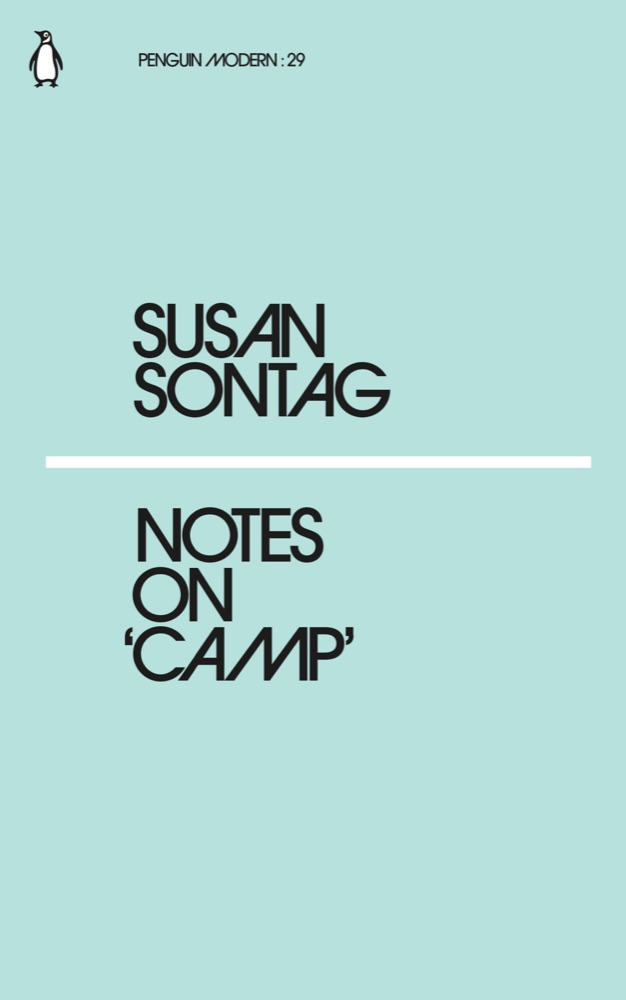
'The ultimate Camp statement: it's good because it's awful.'
These two classic essays were the first works of criticism to break down the boundaries between 'high' and 'low' culture, and made Susan Sontag a literary sensation.
Penguin Modern: fifty new books celebrating the pioneering spirit of the iconic Penguin Modern Classics series, with each one offering a concentrated hit of its contemporary, international flavour. Here are authors ranging from Kathy Acker to James Baldwin, Truman Capote to Stanislaw Lem and George Orwell to Stevie Smith; essays radical and inspiring; poems moving and disturbing; stories surreal and fabulous; taking us from the deep South to modern Japan, New York's underground scene to the farthest reaches of outerspace.
Book details
- First published
- 1964
- Author
- Susan Sontag
- Genre
- Nonfiction
- Goodreads rating
- 3.97 (10k ratings)
Keep reading
 The Magic Mountain
 Both Flesh and Not: Essays
 Consider the Lobster and Other Essays
 Another Roadside Attraction
 The Wave in the Mind: Talks and Essays on the Writer, the Reader and the Imagination
 Hitch-22: A Memoir
 Monsters: A Fan's Dilemma
 A Supposedly Fun Thing I'll Never Do Again: Essays and Arguments
 What's Wrong with the World
 Flaubert's Parrot
 Dæmon Voices
 Skinny Legs and All
 How to Read Literature
 Only Dull People Are Brilliant at Breakfast
 The Atrocity Exhibition
 From Dawn to Decadence: 500 Years of Western Cultural Life, 1500 to the Present
 The Shock of the New
 Dear Mr. M
 Villa Incognito
 Illuminations: Essays and Reflections
 Death in Venice and Other Tales
 Mystery and Manners: Occasional Prose
 The Recognitions
 Speedboat
 When I Was a Child I Read Books
 Creation Lake
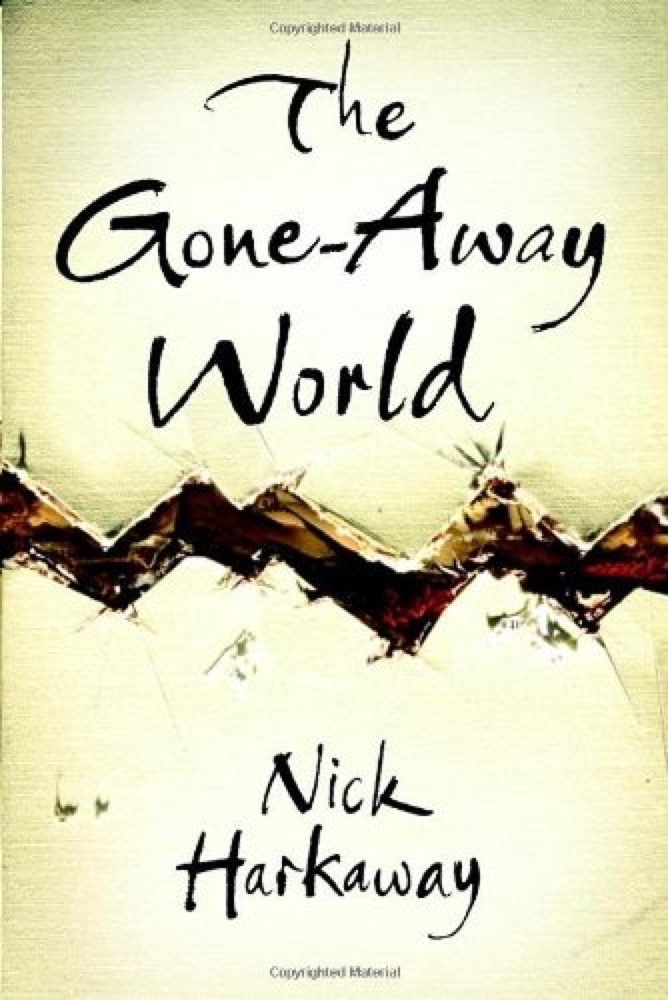 The Gone-Away World
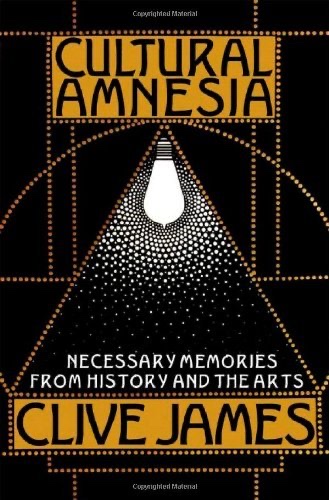 Cultural Amnesia: Necessary Memories from History and the Arts
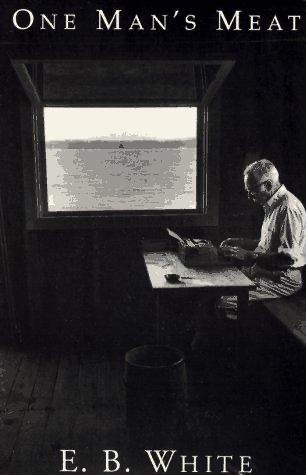 One Man's Meat
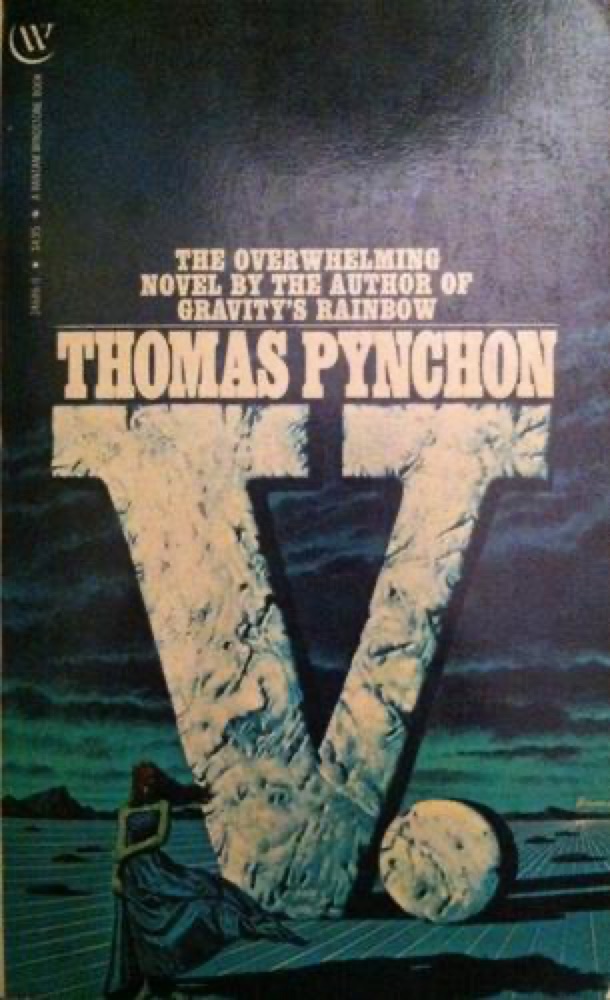 V.
V.
 Ayoade on Top
 The Names
 Eyeless in Gaza
 The Summer Without Men
 By Nightfall
 Human, All Too Human
 The Fry Chronicles
 Surprised by Joy: The Shape of My Early Life
 Wampeters, Foma and Granfalloons
 Death in the Afternoon
 A Collection of Essays
 Ilustrado
 The Fran Lebowitz Reader
 Point Counter Point
 Sixty Stories
 The Braindead Megaphone
 The Picture of Dorian Gray
 Lanark
 How Proust Can Change Your Life
 The Will to Power
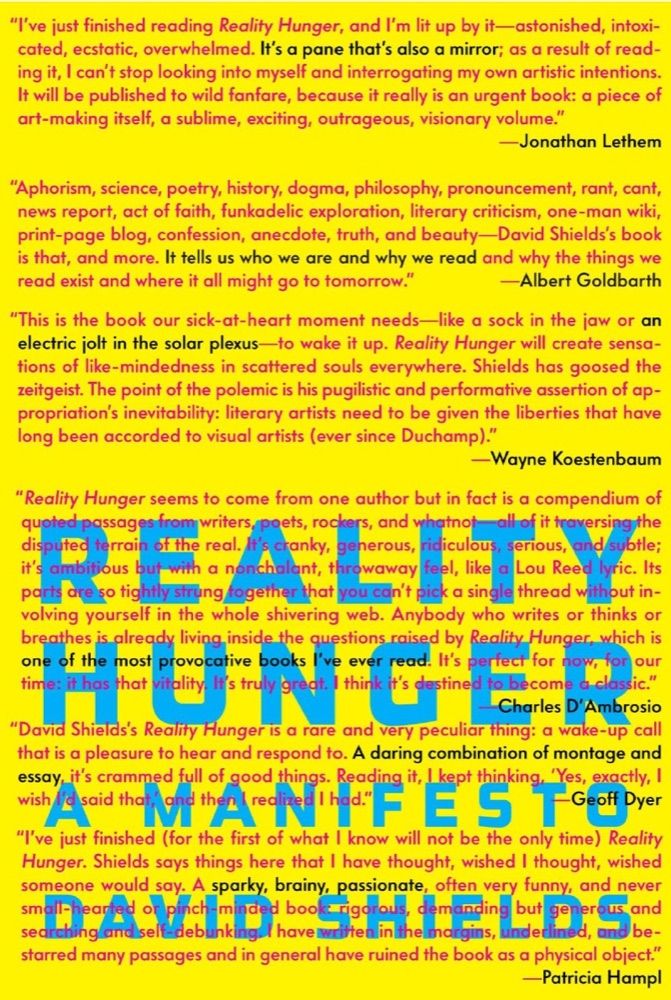 Reality Hunger: A Manifesto
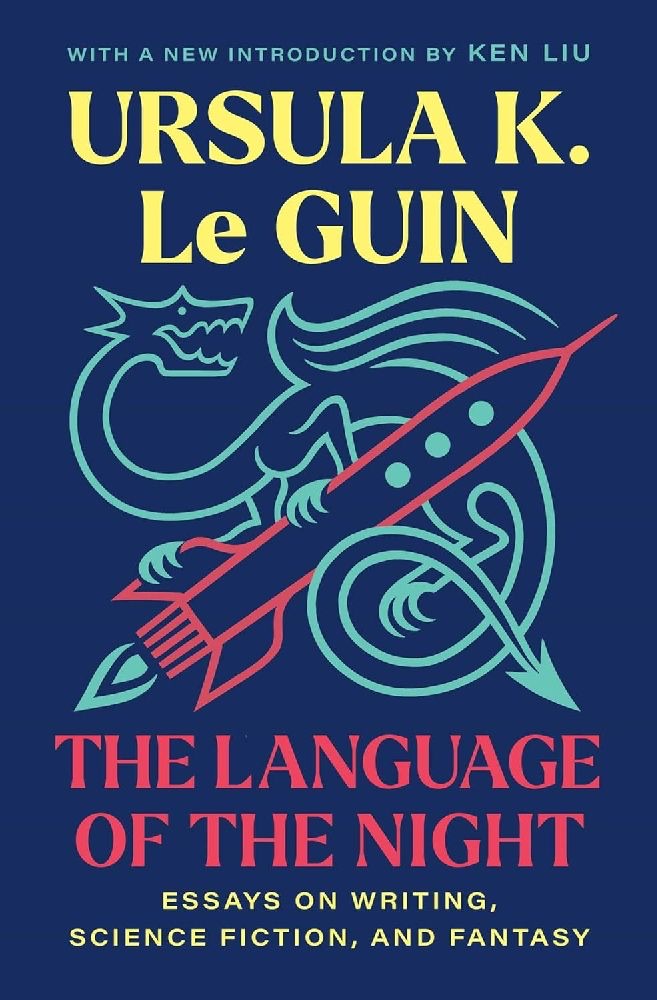 The Language of the Night: Essays on Writing, Science Fiction, and Fantasy
 Heretics
 Selected Non-Fictions
 White
White
 One Way Street And Other Writings
 Mao II
 Eating the Dinosaur
 Danse Macabre