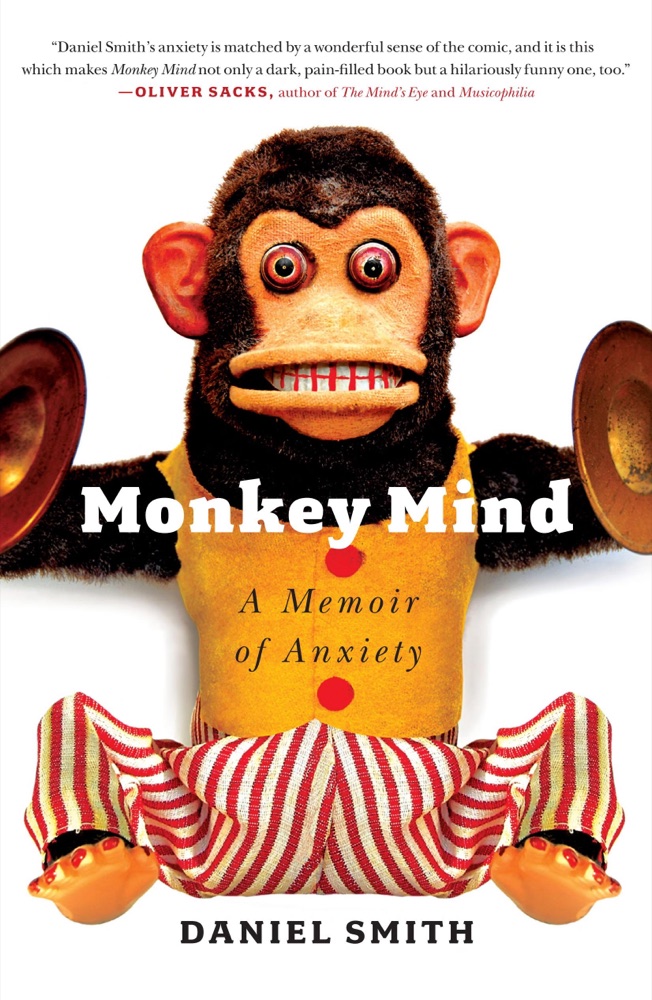
 First, We Make the Beast Beautiful: A New Story About Anxiety
Quotes from the Book
Freedom is anxiety's petri dish. If routine blunts anxiety, freedom incubates it. Freedom says, "Even if you don't want to make choices, you have to, and you can never be sure you have chosen correctly." Freedom says, "Even not to choose is to choose." Freedom says, "So long as you are aware of your freedom, you are going to experience the discomfort that freedom brings." Freedom says, "You're on your own. Deal with it.
16
Guilt at least has a purpose; it tells us we’ve violated some ethical code. Ditto for remorse. Those feelings are educational; they manufacture wisdom. But regret—regret is useless.
9
This is why therapists go to such lengths to urge their anxious patients away from intellectualization: The first step toward peace is disarmament.
9
The bargain was this: Admit the anxiety as an essential part of yourself and in exchange that anxiety will be converted into energy, unstable but manageable. Stop with the self-flagellating and become yourself, with scars and tics.
8
First, contrary to popular belief, Buddhists can actually be very anxious people. That’s often why they become Buddhists in the first place. Buddhism was made for the anxious like Christianity was made for the downtrodden or AA for the addicted. Its entire purpose is to foster equanimity, to tame excesses of thought and emotion. The Buddhists have a great term for these excesses. They refer to them as the condition of “monkey mind.” A person in the throes of monkey mind suffers from a consciousness whose constituent parts will not stop bouncing from skull-side to skull-side, which keep flipping and jumping and flinging feces at the walls and swinging from loose neurons like howlers from vines. Buddhist practices are designed explicitly to collar these monkeys of the mind and bring them down to earth—to pacify them. Is it any wonder that Buddhism has had such tremendous success in the bastions of American nervousness, on the West Coast and in the New York metro area?
7
The hard work, you discover over the years, is in learning to discern between correct and incorrect anxiety, between the anxiety that’s trying to warn you about a real danger and the anxiety that’s nothing more than a lying, sadistic, unrepentant bully in your head. The hard work is in learning to step back and analyze the data dispassionately.
6
I felt so skinless at times! Things hit me so hard!
6
A typical line of thought went something like this: I am anxious. The anxiety makes it impossible to concentrate. Because it is impossible to concentrate, I will make an unforgivable mistake at work. Because I will make an unforgivable mistake at work, I will be fired. Because I will be fired, I will not be able to pay my rent. Because I will not be able to pay my rent, I will be forced to have sex for money in an alley behind Fenway Park. Because I will be forced to have sex for money in an alley behind Fenway Park, I will contract HIV. Because I will contract HIV, I will develop full-blown AIDS. Because I will develop full-blown AIDS, I will die disgraced and alone.
4
There is no such thing as a good decision and a bad decision. There are only decisions. Make them, fuck up, enjoy, repeat.
3
If this all sounds melodramatic, well that, too, isn’t a bad metaphor for anxiety—as a kind of drama queen of the mind. If you have ever been friends with a drama queen you know how taxing it can be. To have one in your head is enough to make you comatose.
3
Anxiety compels a person to think, but it is the type of thinking that gives thinking a bad name: solipsistic, self-eviscerating, unremitting, vicious.
3
And what nags me about this is that the source of my anxiety was exactly what Kierkegaard says the source of anxiety is, and what he praised in direct proportion to the volume any person possesses: possibility. The awareness that life is a series of choices any one of which could be either aggrandizing or disastrous. That this happens to be true I have no trouble signing on to. Any who has lived past the age of ten knows that even piddling actions can wind up having big consequences, and that even when you are super-conscious of your behaviors you can't know how things are going to turn out in the short- or the long-run. That's the drama of it all. On the one hand, your very existence means you can and will change things in your life and others. On the other hand, you aren't God, so everything is always going to be drenched in uncertainty and doubt.
3
Learning to address concerns methodically, with reference to logic and empirical evidence, is one of the most useful things an anxious person can do.
2
Yet I also felt, for the first time, truly and sincerely pissed. It was enough already. Enough! I’d reached that point that comes in the life of most anxiety sufferers when, fed up by the constant waking torture, dejected and buckled but not yet crushed, they at last turn to their anxiety, to themselves, and say, “Listen here: Fuck you. Fuck you! I am sick and fucking tired of this bullshit. I refuse to let you win. I am not going to take it anymore. You are ruining my fucking life and you MUST FUCKING DIE!” Unfortunately, this approach rarely solves the problem. Anxiety doesn’t bend to absolutism. You have to take a subtler, more reasoned approach. But that doesn’t mean anger is totally unhelpful. Being pissed off is a strong cocktail for the will. It stiffens the spine. It strengthens resolve. It makes a person less willing to run away from the anxiety and more willing to walk into it, which you’re going to have to do, ultimately, if you don’t want to end up a complete agoraphobic. Anger breeds defiance, and defiance is inspiriting. It’s good to refuse to give in to anxiety. You just have to know how much you can take.
2
Freud was of the opinion that in fear a person is responding to a specific and immediate threat to physical safety while in anxiety a person is responding to a threat that is objectless, directionless, and located somewhere far off in the future—ruination, for example, or humiliation, or decay.
2
...Anxiety and panic happen to be mundane phenomena, i.e., even when they are caused by extraordinary things like war and rape, they tend to occur when things are ordinary and predictable and relatively stable, against a backdrop of normal, everyday experience. This, of course, is one of the features of anxiety and panic that make them suck so bad.
2
Singin' In the Rain might get you through an anxious week or two, but it won't get you through an anxious life. For that you need either a brain transplant (the only procedure of its kind, it has been said, in which it is better to be a donor than a recipient), a fully stocked bomb shelter, or a thorough adjustment of your perspective on existential risk and reward.
2
Like most clichés, it is fundamentally true that the anxious, the melancholy, the manic, and the obsessed are more likely to become therapists than other people.
1
One of the things anxiety educates you in is how deeply physical thought can be, how concrete. In anxiety, there is no time to luxuriate in abstractions. It’s just you and your mind, which has fists and is using them. It may be dualistic and logically untenable to posit the situation as You v. Head; it may not make sense philosophically. But in the throes of anxiety? In the cognitive shit? There’s really no other way to think about what’s going on.
1
He isn’t trying to transform himself into something different; he’s trying to transform someone different back into himself.
1
Even the imperative to make choice after choice without clear guidance - allegedly the most nerve-wracking part of the profession - isn't exclusive to writing.
1
It's like I've had a stroke. Do you think I've had a stroke?" "I don't think you've had a stroke." "But how do you know? How can you be sure I haven't had a stroke?" "What are the symptoms of a stroke?" "I don't know. Look them up. Look them up on line." "OK. Hold on...OK. Here it is. Do you have trouble speaking?" "I have trouble speaking intelligently.
1
YOU ARE HUMAN! YOU ARE FALLIBLE! YOU WILL ENJOY LIFE MUCH MORE IF YOU ACCEPT—NO, EMBRACE —THE FACT THAT THERE IS NO SUCH THING AS A GOOD DECISION AND A BAD DECISION. THERE ARE ONLY DECISIONS. MAKE THEM, FUCK UP, ENJOY, REPEAT.
Later, before we hugged good-bye, I asked my mother if she would mind if I wrote about her. She didn't hesitate a moment. "I don't give a shit. I'm old! I'm tired! I work too much!" The first of these claims is relative, the second hard to believe. In her late sixties, my mother has more energy than most college students I've met. She has more energy than most squirrels I've met. My brother Scott and I have a nickname for her: "Hurricane Marilyn." We use the nickname when we catch sight of her climbing out of her Prius just before a visit to one of our homes. We watch her cross the street, arms flailing, keys and receipts and gifts for the grandchildren spilling from multiple bags, a fast-moving storm front of narration and complaint and anecdote and fervent family affection--a Jewish mother of the first order-- and we shout, "Batten the hatches, everyone! Hurricane Marilyn's about to make landfall!
The problem of anxiety isn't that the organism responds to threats by near-instantly powering up. That's clearly a good thing, species-survival-wise. It's that sometimes the organism starts seeing threats too readily.
This is the trouble with origin hunting. There are so many origins.
My mother took the measure of what could be built with the material she'd been given, and she built it.
But a child is a sensitive instrument. You can hide the factual truth from a child, but you can't blanket influence. Your agitation will out, and over time it will mod your child's temperament as surely as water wear at rock.
If you're afraid of heights, lean over a railing. If you're afraid of germs, lick a floor. But what do you do if your greatest fear is of being afraid?
Watch on YouTube
About Daniel B. Smith
About the book
In the insightful narrative tradition of Oliver Sacks, Monkey Mind is an uplifting, smart, and very funny memoir of life with anxiety—America’s most common psychological complaint.
Daniel Smith’s Monkey Mind is the stunning articulation of what it is like to live with anxiety. As he travels through anxiety’s demonic layers, Smith defangs the disorder with great humor and evocatively expresses its self-destructive absurdities and painful internal coherence. Aaron Beck, the most influential doctor in modern psychotherapy, says that “Monkey Mind does for anxiety what William Styron’s Darkness Visible did for depression.” Neurologist and bestselling writer Oliver Sacks says, “I read Monkey Mind with admiration for its bravery and clarity….I broke out into explosive laughter again and again.” Here, finally, comes relief and recognition to all those who want someone to put what they feel, o
Book details
- First published
- 2012
- Author
- Daniel B. Smith
- Genre
- Nonfiction
- Goodreads rating
- 3.25 (8k ratings)
Keep reading
First, We Make the Beast Beautiful: A New Story About Anxiety
 My Age of Anxiety: Fear, Hope, Dread, and the Search for Peace of Mind
 Hardcore Self Help: F**k Anxiety
 The Dance of Fear: Rising Above Anxiety, Fear, and Shame to Be Your Best and Bravest Self
 Unfuck Your Brain: Using Science to Get Over Anxiety, Depression, Anger, Freak-Outs, and Triggers
 Good Morning, Monster: A Therapist Shares Five Heroic Stories of Emotional Recovery
 Why Zebras Don't Get Ulcers
 The Worry Trick: How Your Brain Tricks You Into Expecting the Worst and What You Can Do About It
 The Antidote: Happiness for People Who Can't Stand Positive Thinking
 Why Has Nobody Told Me This Before?
 Notes on a Nervous Planet
 When Things Fall Apart: Heart Advice for Difficult Times
 It's Not Always Depression: Working the Change Triangle to Listen to the Body, Discover Core Emotions, and Connect to Your Authentic Self
 The Center Cannot Hold: My Journey Through Madness
 Riding the Elephant: A Memoir of Altercations, Humiliations, Hallucinations, and Observations
 Letting Go: The Pathway To Surrender
 Hyperbole and a Half: Unfortunate Situations, Flawed Coping Mechanisms, Mayhem, and Other Things That Happened
 Feeling Good: The New Mood Therapy
 When the Body Says No: The Cost of Hidden Stress
 Under Rose-Tainted Skies
 The Upward Spiral: Using Neuroscience to Reverse the Course of Depression, One Small Change at a Time
 The New Psycho-Cybernetics: The Original Science of Self-Improvement and Success That Has Changed the Lives of 30 Million People
![[Don't] Call Me Crazy](/i/book/g/b2/dont-call-me-crazy.jpg) [Don't] Call Me Crazy
[Don't] Call Me Crazy
 An Unquiet Mind: A Memoir of Moods and Madness
 Becoming Bulletproof: Protect Yourself, Read People, Influence Situations, and Live Fearlessly
 OCD Love Story
 Fear of Flying
 Infinite Jest
 How We Decide
 Attempting Normal
 Suspect
 The Color of Everything: A Journey to Quiet the Chaos Within
 Just Like Someone Without Mental Illness Only More So
 Maybe You Should Talk to Someone: A Therapist, Her Therapist, and Our Lives Revealed
 Living Beautifully with Uncertainty and Change
![It's Not OK to Feel Blue [and other lies]](/i/book/g/ed/its-not-ok-to-feel-blue-and-other-lies.jpg) It's Not OK to Feel Blue [and other lies]
It's Not OK to Feel Blue [and other lies]
 Atlas of the Heart: Mapping Meaningful Connection and the Language of Human Experience
 Man's Search for Himself
 How to Stay Sane
 All Is Not Forgotten
 Radical Honesty : How to Transform Your Life by Telling the Truth
 Reasons to Stay Alive
 Meditation for Fidgety Skeptics: A 10% Happier How-To Book
 Burnout: The Secret to Unlocking the Stress Cycle
 The Perfectionist's Guide to Losing Control: A Path to Peace and Power
 The Man Who Couldn't Stop
 The Comfort Book
 The Laws of Human Nature
 12 Rules for Life: An Antidote to Chaos
 Drive Your Plow Over the Bones of the Dead
 Your Erroneous Zones: Step-By-Step Advice for Escaping the Trap of Negative Thinking and Taking Control of Your Life
 The Wisdom of Insecurity: A Message for an Age of Anxiety
 F**k It: The Ultimate Spiritual Way
 The Dice Man
 How to Stop Worrying and Start Living
 Everything Is F*cked: A Book About Hope
 The Boy Who Was Raised as a Dog: And Other Stories from a Child Psychiatrist's Notebook
 Social Intelligence: The New Science of Human Relationships
 I'm Fine...And Other Lies