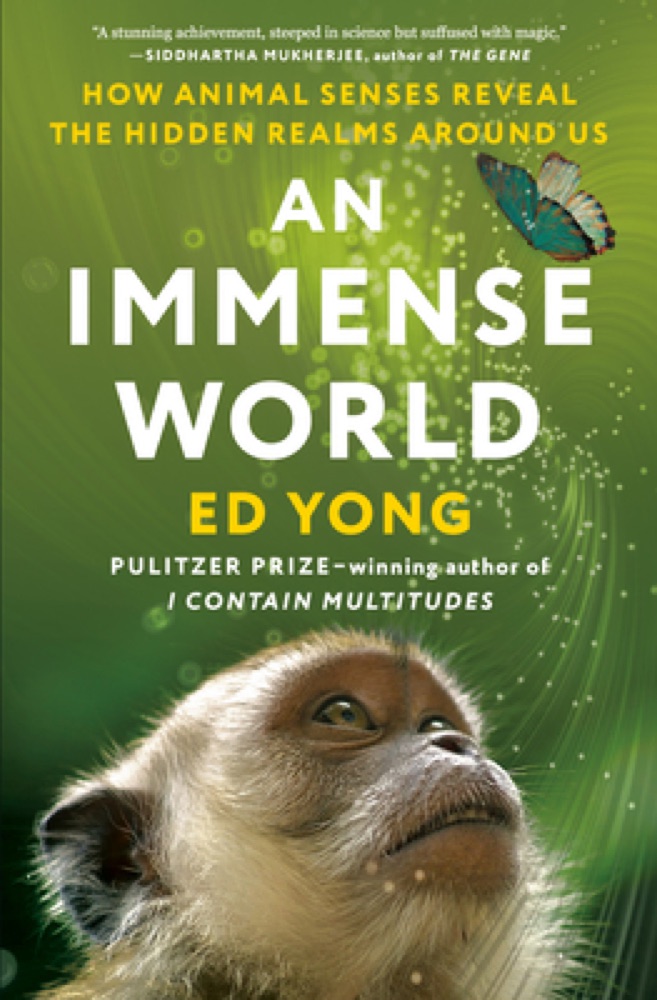

 A Natural History of the Senses
Quotes from the Book
It tells us that all is not as it seems and that everything we experience is but a filtered version of everything that we could experience.
25
The majesty of nature is not restricted to canyons and mountains. It can be found in the wilds of perception--the sensory spaces that lie outside our Umwelt and within those of other animals. To perceive the world through other senses is to find splendor in familiarity and the sacred in the mundane. Wonders exist in a backyard garden, where bees take the measure of a flower’s electric fields, leafhoppers send vibrational melodies through the stems of plants, and birds behold the hidden palates of rurples and grurples...Wilderness is not distant. We are continually immersed in it. It is there for us to imagine, to savor and to protect.
23
A scientist's data are influenced by the questions she asks, which are steered by her imagination, which is delimited by her senses. The boundaries of our own Umwelt corral our ability to understand the Umwelten of others.
18
To perceive the world through other senses is to find splendor in familiarity, and the sacred in the mundane.
16
Earth teems with sights and textures, sounds and vibrations, smells and tastes, electric and magnetic fields. But every animal can only tap into a small fraction of realities fullness. Each is enclosed within its own unique sensory bubble, perceiving but a tiny silver of an immense world.
12
A moth will never know what a zebra finch hears in its song, a zebra finch will never feel the electric buzz of a black ghost knifefish, a knifefish will never see through the eyes of a mantis shrimp, a mantis shrimp will never smell the way a dog can, and a dog will never understand what it is to be a bat. We will never fully do any of these things either, but we are the only animal that can try.
11
Dogs have a facial muscle that can raise their inner eyebrows, giving them a soulful, plaintive expression. This muscle doesn’t exist in wolves. It’s the result of centuries of domestication, in which dog faces were inadvertently reshaped to look a bit more like ours. Those faces are now easier to read, and better at triggering a nurturing response.
9
Senses that seem paranormal to us only appear this way because we are so limited and so painfully unaware of our limitations.
7
By giving in to our preconceptions, we miss what might be right in front of us. And sometimes what we miss is breathtaking.
6
This concept is intuitive, and yet when we watch extremophiles, from emperor penguins braving the Antarctic chill to camels trekking over scorching sands, it’s easy to think that they are suffering throughout their lives. We admire them not just for their physiological resilience but also for their psychological fortitude. We project our senses onto theirs and assume that they’d be in discomfort because we’d be in discomfort. But their senses are tuned to the temperatures in which they live. A camel likely isn’t distressed by the baking sun, and penguins probably don’t mind huddling through an Antarctic storm. Let the storm rage on. The cold doesn’t bother them, anyway.
6
The quote is often taken as an appeal to embrace the supernatural. I see it rather as a call to better understand the natural. Senses that seem paranormal to us only appear this way because we are so limited and so painfully unaware of our limitations.
6
There is a wonderful word for this sensory bubble—Umwelt. It was defined and popularized by the Baltic-German zoologist Jakob von Uexküll in 1909. Umwelt comes from the German word for “environment,” but Uexküll didn’t use it simply to refer to an animal’s surroundings. Instead, an Umwelt is specifically the part of those surroundings that an animal can sense and experience—its perceptual world. Like the occupants of our imaginary room, a multitude of creatures could be standing in the same physical space and have completely different Umwelten. A tick, questing for mammalian blood, cares about body heat, the touch of hair, and the odor of butyric acid that emanates from skin. These three things constitute its Umwelt. Trees of green, red roses too, skies of blue, and clouds of white—these are not part of its wonderful world. The tick doesn’t willfully ignore them. It simply cannot sense them and doesn’t know they exist.
6
And thanks to the unfortunate persistence of dualism—the outdated belief that the mind and body are separate—people often equate subjective with woolly, and psychological with imagined.
5
We only have a rough sense of the sense that senses roughness.
4
our intuitions will be our biggest liabilities, and our imaginations will be our greatest assets.
4
But personal responsibility cannot compensate for societal irresponsibility. To truly make a dent in sensory pollution, bigger steps are needed.
4
The umwelt concept can feel restrictive, because it implies that every creature is trapped within the house of its senses, but to me, the idea is wonderfully expansive. It tells us that all is not as it seems, and that everything we experience is but a filtered version of everything that we could experience. It reminds us that there is light in darkness, noise in silence, richness in nothingness. It hints at flickers of the unfamiliar in the familiar, of the extraordinary in the everyday, of magnificence in mundanity.
4
This smorgasbord of eyes brings with it a dizzying medley of visual Umwelten. Animals might see crisp detail at a distance, or nothing more than blurry blotches of light and shade. They might see perfectly well in what we’d call darkness, or go instantly blind in what we’d call brightness. They might see in what we’d deem slow motion or time-lapse. They might see in two directions at once, or in every direction at once. Their vision might get more or less sensitive over the span of a single day. Their Umwelt might change as they get older. Jakob’s colleague Nate Morehouse has shown that jumping spiders are born with their lifetime’s supply of light-detecting cells, which get bigger and more sensitive with age. “Things would get brighter and brighter,” Morehouse tells me. For a jumping spider, getting older “is like watching the sun rising.
4
how all animals see—using light-sensitive proteins that are actually modified chemical sensors. In a way, we see by smelling light.
4
If you’re slow enough, you’re just part of the background.
3
We are closer than ever to understanding what it is like to be another animal, but we have made it harder than ever for other animals to be.
3
What may be featureless to us, a waste of undifferentiated ocean, is for them rich with distinction and variety, a fissured and wrinkled landscape, dense in patches, thin in others, a rolling olfactory prairie of the desired and the desirable, mottled and unreliable, speckled with life, streaky with pleasures and dangers, marbled and flecked, its riches often hidden and always mobile, but filled with places that are pregnant with life and possibility.
3
Our Umwelt is still limited; it just doesn’t feel that way. To us, it feels all-encompassing. It is all that we know, and so we easily mistake it for all there is to know. This is an illusion, and one that every animal shares.
3
I find these connections profound, in a way that makes me think differently about the act of sensing itself. Sensing can feel passive, as if eyes and other sense organs were intake valves through which animals absorb and receive the stimuli around them. But over time, the simple act of seeing recolors the world. Guided by evolution, eyes are living paintbrushes. Flowers, frogs, fish, feathers, and fruit all show that sight affects what is seen, and that much of what we find beautiful in nature has been shaped by the vision of our fellow animals. Beauty is not only in the eye of the beholder. It arises because of that eye.
3
Even our ability to taste bitter, which warns us of hundreds of potentially toxic compounds, isn’t built to distinguish between them. There’s only one sensation of bitter because you don’t need to know which bitter thing you’re tasting—you just need to know to stop tasting it.
3
Imagine that you’re a mantis shrimp. It is a truth universally acknowledged that you are in want of something to punch.
2
It is all that we know, and so we easily mistake it for all there is to know. This is an illusion, and one that every animal shares.
2
There are animals with eyes on their genitals, ears on their knees, noses on their limbs, and tongues all over their skin. Starfish see with the tips of their arms, and sea urchins with their entire bodies.
2
On this journey through nature’s Umwelten, our intuitions will be our biggest liabilities, and our imaginations will be our greatest assets.
2
Watch on YouTube
About Ed Yong
We have collected 29 quotes from 1 book by Ed Yong on BookQuoters.
More about the author →About the book
A grand tour through the hidden realms of animal senses that will transform the way you perceive the world--from the Pulitzer Prize-winning, New York Times bestselling author of I Contain Multitudes.
The Earth teems with sights and textures, sounds and vibrations, smells and tastes, electric and magnetic fields. But every animal is enclosed within its own unique sensory bubble, perceiving but a tiny sliver of an immense world. This book welcomes us into a previously unfathomable dimension--the world as it is truly perceived by other animals.
We encounter beetles that are drawn to fires, turtles that can track the Earth's magnetic fields, fish that fill rivers with electrical messages, and humans that wield sonar like bats. We discover that a crocodile's scaly face is as sensitive as a lover's fingertips, that the eyes of a giant squid evolved to see sparkling whales, that plants th
Book details
- First published
- 2022
- Author
- Ed Yong
- Genre
- Nonfiction
- Goodreads rating
- 4.46 (38k ratings)
The buzz
- The New York TimesReview in The New York Timesprofessional review (via Book Marks)
- The Washington PostReview in The Washington Postprofessional review (via Book Marks)
- The Wall Street JournalReview in The Wall Street Journalprofessional review (via Book Marks)
- The GuardianReview in The Guardianprofessional review (via Book Marks)
- The Times Literary SupplementReview in The Times Literary Supplementprofessional review (via Book Marks)
- The TimesReview in The Timesprofessional review (via Book Marks)
Keep reading
A Natural History of the Senses
 Beyond Words: What Animals Think and Feel
 Vesper Flights
 Why Fish Don’t Exist: A Story of Loss, Love, and the Hidden Order of Life
 The Mountain in the Sea
 The Case Against Reality: Why Evolution Hid the Truth from Our Eyes
 The Lives of a Cell: Notes of a Biology Watcher
 Vanishing Treasures: A Bestiary of Extraordinary Endangered Creatures
 Inside of a Dog: What Dogs See, Smell, and Know
 The Spell of the Sensuous: Perception and Language in a More-Than-Human World
 Gathering Moss: A Natural and Cultural History of Mosses
 Arctic Dreams
 Drive Your Plow Over the Bones of the Dead
 Incognito: The Secret Lives of the Brain
 The Immense Journey
 Martin Marten
 The Tell-Tale Brain: A Neuroscientist's Quest for What Makes Us Human
 The Forest Unseen: A Year’s Watch in Nature
 The Doors of Perception & Heaven and Hell
 Shadows of Forgotten Ancestors
 Hallucinations
 Blindsight
 Travels
 The Empusium
 The Fifth Science
 The Big Picture: On the Origins of Life, Meaning, and the Universe Itself
 How to Change Your Mind: The New Science of Psychedelics
 The Paper Menagerie and Other Stories
 Bewilderment
 The Abundance
 Phenomenology of Perception
 The Outermost House: A Year of Life on the Great Beach of Cape Cod
 Other Minds
 The Accidental Universe: The World You Thought You Knew
 The Shape of Water
 The Soul of an Octopus: A Surprising Exploration into the Wonder of Consciousness
 In Ascension
 The Master and His Emissary: The Divided Brain and the Making of the Western World
 The Botany of Desire: A Plant's-Eye View of the World
 The Blind Watchmaker: Why the Evidence of Evolution Reveals a Universe Without Design
 The Light Eaters: How the Unseen World of Plant Intelligence Offers a New Understanding of Life on Earth
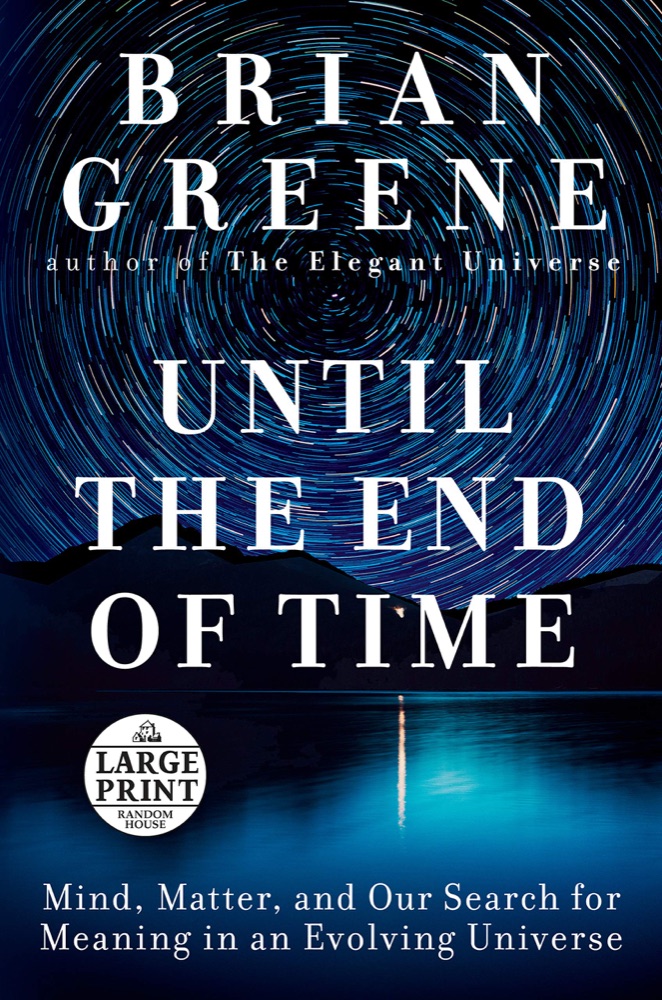 Until the End of Time: Mind, Matter, and Our Search for Meaning in an Evolving Universe
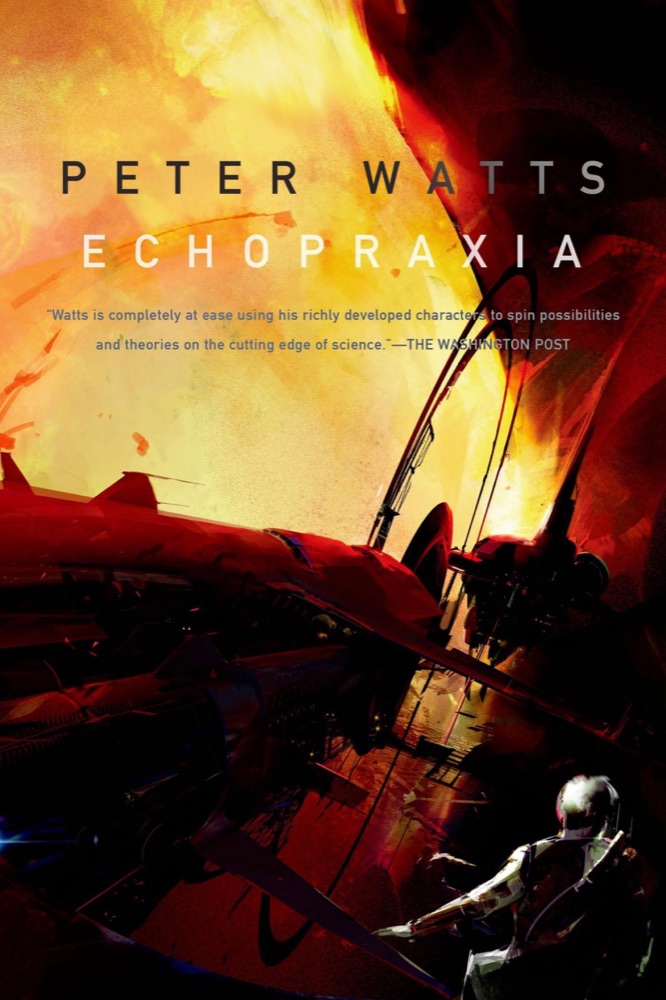 Echopraxia
 Are We Smart Enough to Know How Smart Animals Are?
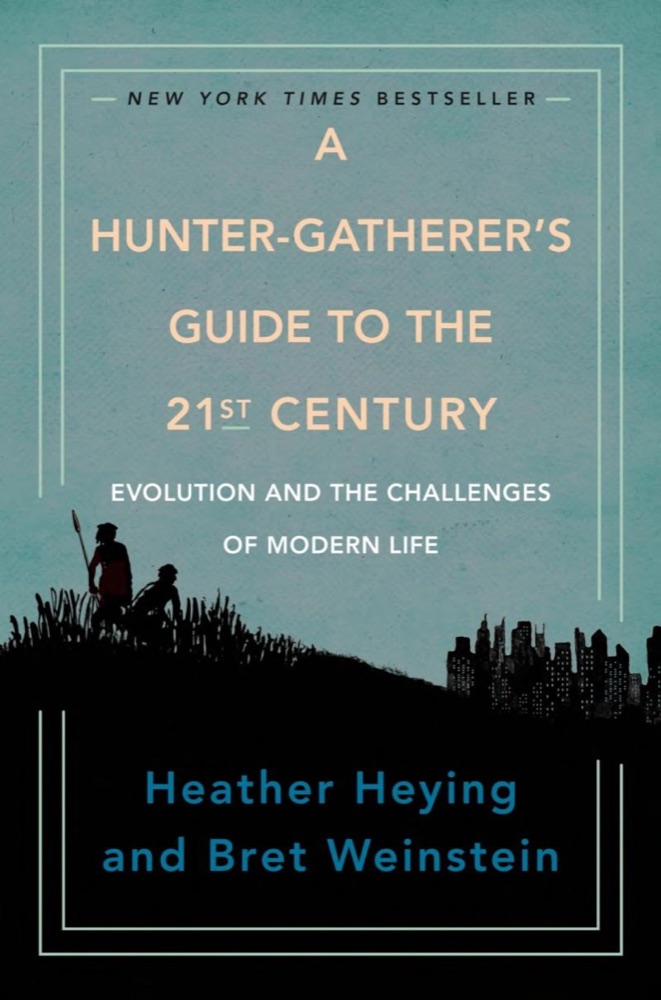 A Hunter-Gatherer's Guide to the 21st Century: Evolution and the Challenges of Modern Life
 Autumn
 The Doors of Perception
 Blue Octavo Notebooks
 Stories of Your Life and Others
 Understanding Media: The Extensions of Man
 The Cosmic Serpent: DNA and the Origins of Knowledge
 The Book: On the Taboo Against Knowing Who You Are
 The Stone Gods
 Teaching a Stone to Talk: Expeditions and Encounters
 Unweaving the Rainbow: Science, Delusion and the Appetite for Wonder
 Figuring
 Acceptance
 The Overstory
 The Biology of Belief: Unleashing the Power of Consciousness, Matter and Miracles
 Smilla's Sense of Snow