
 Necessary Trouble: Growing Up at Midcentury
Quotes from the Book
Look to the past to help create the future. Look to science and to poetry. Combine innovation and interpretation. We need the best of both. And it is universities that best provide them.
12
Yankee private Henry Struble was not only listed as a casualty after Antietam but assigned a grave after his canteen was found in the hands of a dead man he had stopped to help. After the war ended, Struble sent flowers every Memorial Day to decorate his own grave, to honor the unknown soldier it sheltered and perhaps to acknowledge that there but for God’s grace he might lie.
6
Richmond's Mrs. William McFarland. "Let us remember that we belong to that sex which was last at the cross, first at the grave…Let us go now, hand in hand, to the graves of our country’s sons, and as we go let our energies be aroused and our hearts be thrilled by this thought: It is the least thing we can do for our soldiers.
4
Death has no power to change moral qualities,” he insisted in a Decoration Day speech in 1883. “Whatever else I may forget,” the aging abolitionist declared, “I shall never forget the difference between those who fought for liberty and those who fought for slavery.
3
honoring the slain offered women a claim to both prominence and power in the new postwar South. Ensuring the immortality of the fallen and of their memory became a means of perpetuating southern resistance to northern domination and to the reconstruction of southern society.
1
Men, too, wore tokens of mourning, armbands for lost kin, badges and rosettes, like those displayed by Virginia Military Institute cadets and officers for a month after Stonewall Jackson’s death.
1
That fatal bullet went speeding forth Till it reached a town in the distant North Till it reached a house in a sunny street Till it reached a heart that ceased to beat Without a murmur, without a cry …….….….…. And the neighbors wondered that she should die.11 Some grieving survivors did indeed literally perish.
1
The establishment of national and Confederate cemeteries created the Civil War Dead as a category, as a collective that represented something more and something different from the many thousands of individual deaths that it comprised.
The war that freed the slaves established broad claims to rights—for blacks as well as whites, for women as well as men, for both the living and the dead.
What is Death?” had long served as a foundation and central concern of Christian doctrine. Sweet’s answer, “It is the middle point between two lives,
For Whitman, immortality rested, as he wrote in another poem, in mother earth’s absorption of bodies and blood rendered “in unseen essence and odor of surface and grass, centuries hence.
there is no more exemption for nations than for individuals from the just retribution due to flagrant and persistent transgression.” But the Civil War’s “tears and blood,” he believed, “may at last bring us to our senses.
Watch on YouTube
About Drew Gilpin Faust
We have collected 20 quotes from 2 books by Drew Gilpin Faust on BookQuoters.
More about the author →More by Drew Gilpin Faust
Necessary Trouble: Growing Up at Midcentury
About the book
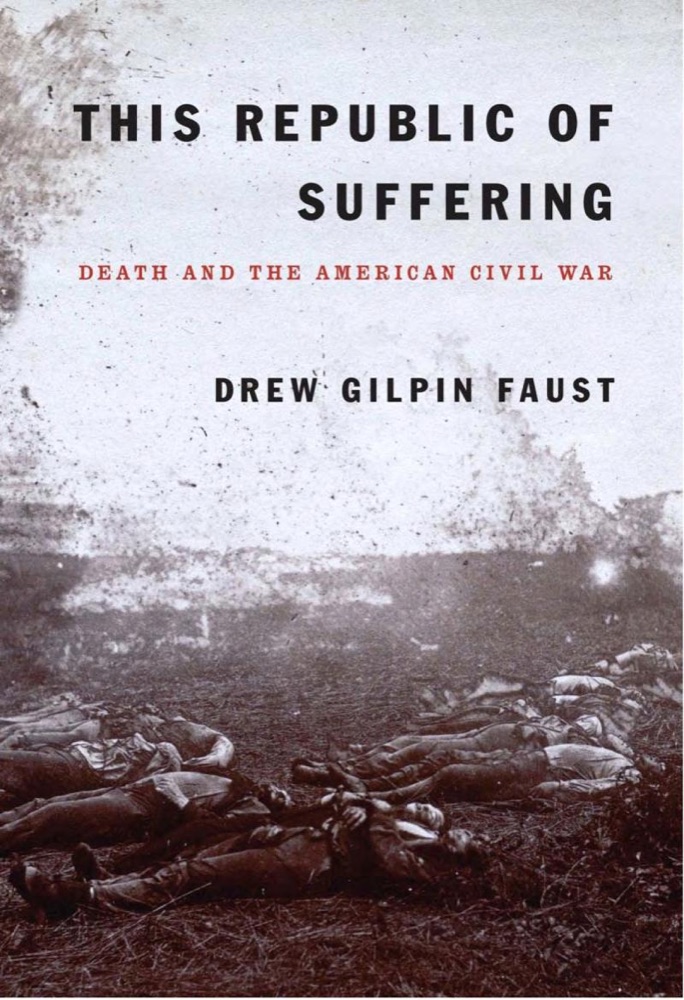
An illuminating study of the American struggle to comprehend the meaning and practicalities of death in the face of the unprecedented carnage of the Civil War. During the war, approximately 620,000 soldiers lost their lives. An equivalent proportion of today's population would be six million. This Republic of Suffering explores the impact of this enormous death toll from every angle: material, political, intellectual, and spiritual.
The eminent historian Drew Gilpin Faust delineates the ways death changed not only individual lives but the life of the nation and its understanding of the rights and responsibilities of citizenship. She describes how survivors mourned and how a deeply religious culture struggled to reconcile the slaughter with its belief in a benevolent God, pondered who should die and under what circumstances, and reconceived its understanding of life after death.
F
Book details
- First published
- 2008
- Author
- Drew Gilpin Faust
- Genre
- History
- Goodreads rating
- 4.04 (8k ratings)
Keep reading
 April 1865: The Month That Saved America
 Battle Cry of Freedom
 These Truths: A History of the United States
 The Wars
 Confederates in the Attic: Dispatches from the Unfinished Civil War
 The Blood of Emmett Till
 The Civil War, Vol. 3: Red River to Appomattox
 American War
 The Widow of the South
 Robert E. Lee and Me: A Southerner's Reckoning with the Myth of the Lost Cause
 Say Nothing: A True Story of Murder and Memory in Northern Ireland
 Four Hundred Souls: A Community History of African America, 1619-2019
 A Fable
 The Killer Angels
 Blood Done Sign My Name: A True Story
 The Gettysburg Address
 The Bone Tree
 The Love Songs of W.E.B. Du Bois
 Mr. Lincoln's Army
 Killing Lincoln: The Shocking Assassination that Changed America Forever
 The Sweetness of Water
 From Here to Eternity: Traveling the World to Find the Good Death
 Stony the Road: Reconstruction, White Supremacy, and the Rise of Jim Crow
 Bury Your Dead
 Last First Snow
 The Undertaker's Assistant
 Speaking Bones
 The Water Dancer
 The Underground Railroad
 Resistance, Rebellion and Death: Essays
 The Small and the Mighty: Twelve Unsung Americans Who Changed the Course of History, from the Founding to the Civil Rights Movement
 The Unvanquished
 The Postcard
 Destiny of the Republic: A Tale of Madness, Medicine and the Murder of a President
 Ghost Soldiers: The Epic Account of World War II's Greatest Rescue Mission
 Varina
 Held
Held
 A Rule Against Murder
 War's Unwomanly Face
 Whiskey When We're Dry
 Those Who Save Us
 The First Salute : View of the American Revolution
 The Book That Broke the World
 Into the Silence: The Great War, Mallory and the Conquest of Everest
 Men We Reaped
 Smoke Gets in Your Eyes: And Other Lessons from the Crematory
 A Thousand Ships
 The Monuments Men: Allied Heroes, Nazi Thieves, and the Greatest Treasure Hunt in History
 Once An Eagle
 Chasing The Light: Writing, Directing, and Surviving Platoon, Midnight Express, Scarface, Salvador, and the Movie Game
 Dust Child
 Dragon Seed
 The Hemingses of Monticello: An American Family
 War Is a Force That Gives Us Meaning
 Black in Blues: How a Color Tells the Story of My People
 Barracoon: The Story of the Last "Black Cargo"
 Deadhouse Gates
 TransAtlantic
 Notes of a Native Son
 How the Word Is Passed: A Reckoning with the History of Slavery Across America