
 The Cold Cold Ground
Quotes from the Book
Claude Lévi-Strauss once observed that, “for the majority of the human species, and for tens of thousands of years, the idea that humanity includes every human being on the face of the earth does not exist at all. The designation stops at the border of each tribe, or linguistic
39
Outrage is conditioned not by the nature of the atrocity but by the affiliation of the victim and the perpetrator. Should the state be accorded more leniency because, legally speaking, it has a monopoly on the legitimate use of force? Or, conversely, should we hold soldiers and cops to a higher standard than paramilitaries?
25
if you could just get people to talk, he believed, the most bitter antagonists could discover common ground.
25
There is a concept in psychology called ‘moral injury,’ notion, distinct from the idea of trauma, that relates to the ways in which ex-soldiers make sense of the socially transgressive things they have done during wartime. Price felt a sharp sense of moral injury: she believed that she had been robbed of any ethical justification for her own conduct.
23
Who should be held accountable for a shared history of violence? It was a question that was dogging Northern Ireland as a whole.
19
Dating back to the Iliad, ancient Egypt and beyond, burial rites have formed a critical function in most human societies. Whether we cremate a loved one or inter her bones, humans possess a deep-set instinct to mark death in some deliberate, ceremonial fashion. Perhaps the cruelest feature of forced disappearance as an instrument of war is that it denies the bereaved any such closure, relegating them to a permanent limbo of uncertainty.
15
The body is a fantastic machine,’ Hughes told Mackers in one of his Boston College interviews, recounting the grueling sequence of a hunger strike. ‘It’ll eat off all the fat tissue first, then it starts eating away at the muscle, to keep your brain alive.’ Long after Hughes and Price called an end to their strikes and attempted to reintegrate into society, the nursed old grudges and endlessly replayed their worst wartime abominations. In a sense, they never stopped devouring themselves.
15
The bomb exploded, killing five people, but not Thatcher. The IRA issued a statement, eloquently capturing the strategic advantage of terrorism: ‘Today we were unlucky, but remember, we only have to be lucky once. You will have to be lucky always.
14
The anthropologist Claude Lévi-Strauss once observed that, “for the majority of the human species, and for tens of thousands of years, the idea that humanity includes every human being on the face of the earth does not exist at all. The designation stops at the border of each tribe, or linguistic group, sometimes even at the edge of a village.
12
the violence intensified, grandiose funerals became routine, with rousing graveside orations and caskets draped in tricolor flags. People took to joking that there was no social life in Belfast anymore, apart from wakes.
12
Indeed, it could occasionally seem that support for the armed struggle was more fervent in Boston or Chicago than it was in Belfast or Derry. The romantic idyll of a revolutionary movement is easier to sustain when there is no danger that one's own family members might get blown to pieces on a trip to the grocery store. Some people in Ireland looked askance at the "plastic Paddies" who urged bloody war in Ulster from the safe distance of America.
11
History says, Don’t hope On this side of the grave But then, once in a lifetime The longed-for tidal wave Of justice can rise up And hope and history rhyme.
9
According to one scholar, the “ideal victim” in the Troubles was someone who was not a combatant, but a passive civilian. To many, Jean McConville was the perfect victim: a widow, a mother of ten. To others, she was not a victim at all, but a combatant by proxy, who courted her own fate. Of course, even if one were to concede, for the sake of argument, that McConville was an informer, there is no moral universe in which her murder and disappearance should be justified. Must it be the case that how one perceives a tragedy will forever depend on where one sits? The anthropologist Claude Lévi-Strauss once observed that, “for the majority of the human species, and for tens of thousands of years, the idea that humanity includes every human being on the face of the earth does not exist at all. The designation stops at the border of each tribe, or linguistic group, sometimes even at the edge of a village.” When it came to the Troubles, a phenomenon known as “whataboutery” took hold. Utter the name Jean McConville and someone would say, What about Bloody Sunday? To which you could say, What about Bloody Friday? To which they could say, What about Pat Finucane? What about the La Mon bombing? What about the Ballymurphy massacre? What about Enniskillen? What about McGurk’s bar? What about. What about. What about.
7
Once, in the summer of 1995, Adams gave a speech at a rally in Belfast. He looked like a politician, in a crisp summer suit, consulting his cue cards. But during a pause in his prepared remarks, someone in the crowd shouted, "Bring back the IRA!" As the audience cheered, Adams chuckled and smiled. Then he leaned into the microphone and said, "They haven't gone away, you know.
7
was rubble and broken glass, what one poet would memorably describe as “Belfast confetti.
7
Think of the armed struggle as the launch of a boat, Hughes said, getting a hundred people to push this boat out. This boat is stuck in the sand, right, and then get them to push the boat out and then the boat sailing off and leaving the hundred people behind, right. That’s the way I feel. The boat is away, sailing on the high seas, with all the luxuries that it brings, and the poor people that launched the boat are left sitting in the muck and the dirt and the shit and the sand, behind.
5
Much of the Irish landscape is dominated by peat bogs; the anaerobic and acidic conditions in the densely packed earth mean that the past in Ireland can be subject to macabre resurrection. Peat cutters occasionally churn up ancient mandibles, clavicles, or entire cadavers that have been preserved for millennia. The bodies date as far back as the Bronze Age, and often show signs of ritual sacrifice and violent death. These victims, cast out of their communities and buried, have surfaced vividly intact, from their hair to their leathery skin. The poet Seamus Heaney, who harvested peat as a boy on his family’s farm, once described the bogs of Ireland as “a landscape that remembered everything that had happened in and to it.
5
But the truth was that most residents still lived in neighborhoods circumscribed by religion, and more than 90 percent of children in Northern Ireland continued to attend segregated elementary schools.
5
if you want to get people to do something for you, you do it with them.
3
Like the revolution's going to wait until I finish my education.
3
He must have known, or at least suspected, that she was herself a member of the IRA, but they would argue, amiably, about politics as if they were a couple of graduate students, rather than adversaries in a bloody guerrilla war. At one point, Corden-Lloyd told her that he would love to come back and see her in ten years' time, 'and we could all tell each other the whole truth.
3
As Dolours struggled in the water, she locked eyes with one attacker, a man with a club, and for the rest of her life she would return to that moment, the way his eyes were glazed with hate. She looked into those eyes and saw nothing.
3
But even if your parents were ardent supporters of the IRA, there were reasons not to tell them that you had joined. If the police or the army broke down the door to interrogate them, the less they knew, the better.
3
It was about the hysteria, the mythmaking, and the misunderstanding that had twisted
3
Boston tapes were supposed to lie untouched, like bottles in a wine cellar, until some future date when the participants were dead and scholars could study their testimony to make sense of the Troubles. Instead the tapes became criminal evidence—and a political weapon. They might be used to prosecute old crimes. But it seems likely, now, that they will never become available to researchers.
2
Have the military wing create as much discontent and deprivation as possible, the more unemployment the better. Then have your political wing feed off the people’s discontent
2
If a spy takes fifty lives but saves some larger number, can that countenance his actions? This kind of logic is seductive, but perilous. You start out running numbers in your head, and pretty soon you are sanctioning mass murder.
2
The members of the abduction team had grown up, married, had families of their own. This was a cruel twist: some of the children could no longer remember what their mother had looked like, apart from the one surviving photo of her, but they still recognized the faces of the people who took her away. Once, Helen took her children to McDonald's and found herself staring at one of the women who she knew had taken her mother. The woman was there with her own family. She shouted at Helen to leave her alone.
2
Hughes recalled Dr. Ross, the kind physician who had tended to him during his hunger strike and brought him fresh water gathered from a mountain spring. Bobby Sands had never trusted Ross. He called him a 'mind manipulator.' But the doctor's kindness had meant a lot to Hughes. Later, he learned that after watching all ten men die in the hunger strike, Dr. Ross had taken his own life, with a shotgun, in 1986.
2
Did you know?
- The title comes from Seamus Heaney's poem 'Whatever You Say, Say Nothing' from his 1975 collection 'North'.
- The book grew out of a New Yorker article Keefe wrote about the murder of Jean McConville.
- It draws heavily on the Belfast Project, an oral-history archive of Troubles participants held at Boston College.
- It was named to The New York Times' list of the 100 Best Books of the 21st Century in 2024.
- An FX limited series adaptation premiered in November 2024.
Watch on YouTube
About Patrick Radden Keefe
Patrick Radden Keefe is an American investigative journalist and staff writer at The New Yorker. He is also the author of books including 'Empire of Pain' (2021), about the Sackler family, and 'Rogues' (2022).
More about the author →About the book
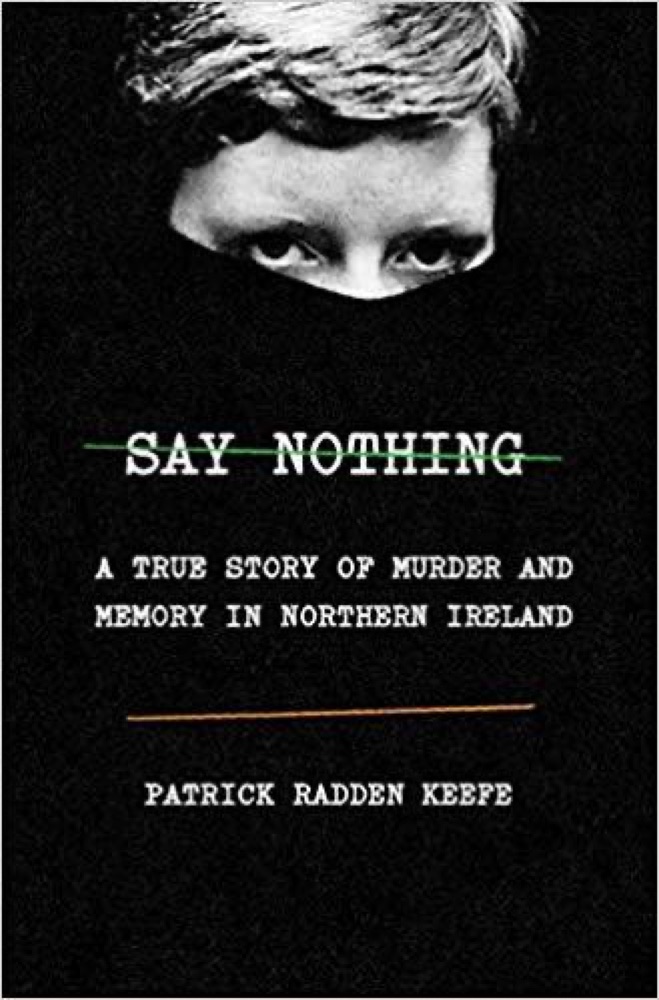
"Say Nothing" is a work of narrative nonfiction that reconstructs the Troubles in Northern Ireland through the 1972 abduction and murder of Jean McConville, a widowed mother of ten who was taken from her Belfast home by the IRA. Using the lives of figures such as IRA activists Dolours and Marian Price, Brendan Hughes, and Sinn Féin leader Gerry Adams, Patrick Radden Keefe traces the conflict from the civil rights movement of the late 1960s through the Provisional IRA's bombing campaign, the 1981 hunger strikes, and the long road to the peace process.
At its core the book is about violence, secrecy, and the weight of memory. Its title comes from a Seamus Heaney poem and evokes the code of silence that governed Belfast's communities. Keefe examines how people who took part in or were touched by the conflict reckon with their pasts decades later, and how the Belfast Project oral history archive collided with politics, loyalty, and the limits of confidentiality.
Widely praised for its reporting and its architectural construction, the book won the 2019 National Book Critics Circle Award for nonfiction and the Orwell Prize for Political Writing, and was named a top book of the year by outlets including The New York Times and The Washington Post. It was later adapted into an FX limited series and ranked among The New York Times' 100 Best Books of the 21st Century.
Book details
- First published
- 2018
- Length
- 513 pages
- Reading time
- 31 hours
- Author
- Patrick Radden Keefe
- Genre
- Nonfiction
- Goodreads rating
- 4.47 (184k ratings)
Critical reception
- Won the 2019 National Book Critics Circle Award for nonfiction and the 2019 Orwell Prize for Political Writing.
- Named one of the top books of 2019 by The New York Times and The Washington Post.
- New York Times critic Jennifer Szalai described the narrative as 'an architectural feat, expertly constructed out of complex and contentious material.'
The buzz
- The New York TimesReview in The New York Timesprofessional review (via Book Marks)
- The Washington PostReview in The Washington Postprofessional review (via Book Marks)
- The Wall Street JournalReview in The Wall Street Journalprofessional review (via Book Marks)
- The AtlanticReview in The Atlanticprofessional review (via Book Marks)
- Los Angeles TimesReview in Los Angeles Timesprofessional review (via Book Marks)
- The Times Literary SupplementReview in The Times Literary Supplementprofessional review (via Book Marks)
Movie & TV adaptations
Keep reading
The Cold Cold Ground
 American War
 Columbine
 Close
Close
 The Postcard
 The Gulag Archipelago 1918-1956
 No Name in the Street
 One Day, Everyone Will Have Always Been Against This
 Border: A Journey to the Edge of Europe
 The Wars
 A Rule Against Murder
 Under the Same Stars
 Assata: An Autobiography
 Edge of Eternity
 Joseph Anton: A Memoir
 The Fountains of Silence
 The Blood of Emmett Till
 Stasiland: Stories from Behind the Berlin Wall
 The Day of the Scorpion
 Persepolis Rising
 The Little Drummer Girl
 The Black Wolf
 An Ordinary Man: An Autobiography
 Blood Done Sign My Name: A True Story
 Apeirogon
 Free: A Child and a Country at the End of History
 Glass Houses
 Creation Lake
 Homegoing
 We Wish to Inform You That Tomorrow We Will Be Killed with Our Families
 The Huntress
 Zinky Boys: Soviet Voices from the Afghanistan War
 They Called Us Enemy
 TransAtlantic
 Why We Can't Wait
 The Will to Battle
 The Invisible Bridge: The Fall of Nixon and the Rise of Reagan
 Radio Free Albemuth
 The Lives of Others
 Thirteen
 The Spy Who Came In from the Cold
 What's Left?
 Green Mars
 Imperial Ambitions: Conversations on the Post-9/11 World
 Varina
 The Bone Tree
 Koba the Dread: Laughter and the Twenty Million
 World War Z: An Oral History of the Zombie War
 Rot & Ruin
 The Association of Small Bombs
 You Can't Be Neutral on a Moving Train: A Personal History of Our Times
 Nemesis
 Helter Skelter: The True Story of the Manson Murders
 Between the World and Me
 Queen of Fire
 A People's History of the United States
 Orient
 A Better World
 Babylon's Ashes
 Girl at War