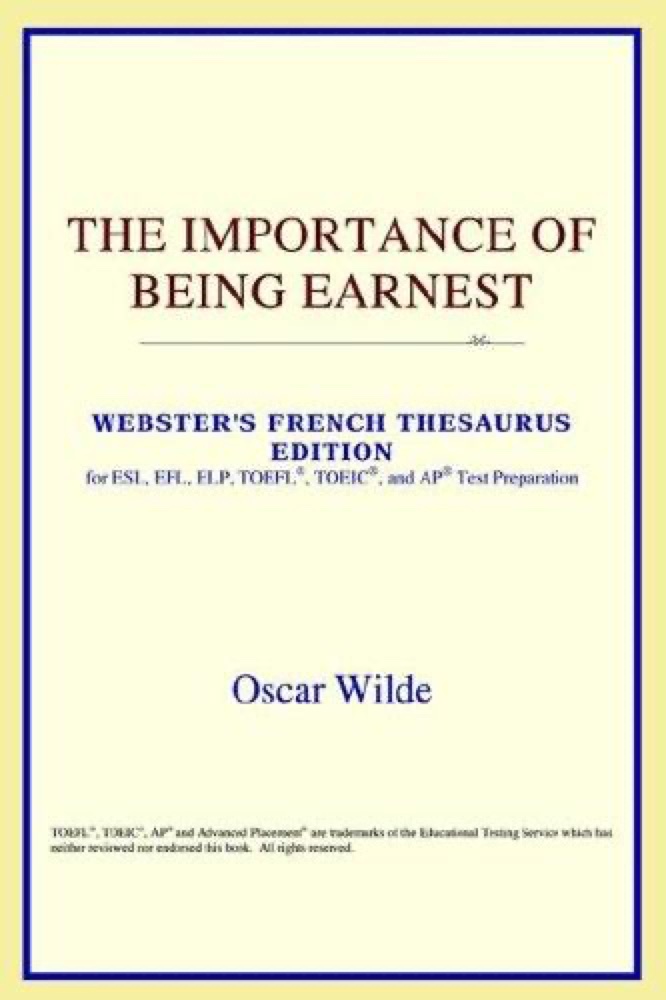
 The Importance of Being Earnest
Quotes from the Book
Art is the most intense mode of individualism that the world has known.
264
A map of the world that does not include Utopia is not worth even glancing at, for it leaves out the one country at which Humanity is always landing. And when Humanity lands there, it looks out, and, seeing a better country, sets sail. Progress is the realisation of Utopias.
197
The things people say of a man do not alter a man. He is what he is. Public opinion is of no value whatsoever. Even if people employ actual violence, they are not to be violent in turn. That would be to fall to the same low level. After all, even in prison, a man can be quite free. His soul can be free. His personality can be untroubled. He can be at peace. And, above all things, they are not to interfere with other people or judge them in any way. Personality is a very mysterious thing. A man cannot always be estimated by what he does. He may keep the law, and yet be worthless. He may break the law, and yet be fine. He may be bad, without ever doing anything bad. He may commit a sin against society, and yet realize through that sin his true perfection.
105
The true perfection of man lies not in what man has, but in what man is.
57
To live is the rarest thing in the world. Most people exist, that is all
48
All authority is quite degrading. It degrades those who exercise it, and degrades those over whom it is exercised. When it is violently, grossly, and cruelly used, it produces a good effect by creating, or at any rate bringing out, the spirit of revolt and individualism that is to kill it. When it is used with a certain amount of kindness, and accompanied by prizes and rewards, it is dreadfully demoralising. People, in that case, are less conscious of the horrible pressure that is being put on them, and so go through their lives in a sort of coarse comfort, like petted animals, without ever realising that they are probably thinking other people's thoughts, living by other people's standards, wearing practically what one may call other people's second-hand clothes, and never being themselves for a single moment.
45
Know thyself' was written over the portal of the antique world. Over the portal of the new world, 'Be thyself' shall be written.
40
Selfishness is not living as one wishes to live. It is asking other people to live as one wishes to live.
39
With the abolition of private property, then, we shall have true, beautiful, healthy Individualism. Nobody will waste his life in accumulating things, and the symbols of things. One will live. To live is the rarest thing in the world. Most people exist, that is all.
38
Sometimes the poor are praised for being thrifty. But to recommend thrift to the poor is both grotesque and insulting. It is like advising a man who is starving to eat less. For a town or country labourer to practise thrift would be absolutely immoral. Man should not be ready to show that he can live like a badly-fed animal. He should decline to live like that, and should either steal or go on the rates, which is considered by many to be a form of stealing.
28
The emotions of man are stirred more quickly than man’s intelligence.
28
Man is complete in himself. When they go into the world, the world will disagree with them. That is inevitable. The world hates Individualism. But that is not to trouble them. They are to be calm and self-centred. If a man takes their cloak, they are to give him their coat, just to show that material things are of no importance. If people abuse them, they are not to answer back. What does it signify? The things people say of a man do not alter a man. He is what he is. Public opinion is of no value whatsoever. Even if people employ actual violence, they are not to be violent in turn. That would be to fall to the same low level. After all, even in prison, a man can be quite free. His soul can be free. His personality can be untroubled. He can be at peace. And, above all things, they are not to interfere with other people or judge them in any way. Personality is a very mysterious thing. A man cannot always be estimated by what he does. He may keep the law, and yet be worthless. He may break the law, and yet be fine. He may be bad, without ever doing anything bad. He may commit a sin against society, and yet realise through that sin his true perfection.
28
The only thing that one really knows about human nature is that it changes. Change is the one quality we can predicate of it. The systems that fail are those that rely on the permanency of human nature, and not on its growth and development.
23
The note of the perfect personality is not rebellion, but peace.
22
There is only one class in the community that thinks more about money than the rich, and that is the poor. The poor can think of nothing else. That is the misery of being poor.
21
For what are called criminals nowadays are not criminals at all. Starvation, and not sin, is the parent of modern crime. That indeed is the reason why our criminals are, as a class, so absolutely uninteresting from any psychological point of view. They are not marvellous Macbeths and terrible Vautrins. They are merely what ordinary, respectable, commonplace people would be if they had not got enough to eat.
19
Just as the worst slave-owners were those who were kind to their slaves, and so prevented the horror of the system being realised by those who suffered from it, and understood by those who contemplated it, so, in the present state of things in England, the people who do most harm are the people who try to do most good.
15
There are three kinds of despots. There is the despot who tyrannizes over the body. There is the despot who tyrannizes over the soul. There is the despot who tyrannizes over the soul and body alike. The first is called the Prince. The second is called the Pope. The third is called the People.
15
the moment that an artist takes notice of what other people want, and tries to supply the demand, he ceases to be an artist, and becomes a dull or an amusing craftsman, an honest or a dishonest tradesman. He has no further claim to be considered as an artist.
14
The systems that fail are those that rely on the permanency of human nature
14
Most personalities have been obliged to be rebels. Half their strength has been wasted in friction.
14
For the recognition of private property has really harmed Individualism, and obscured it, by confusing a man with what he possesses. It has led Individualism entirely astray. It has made gain not growth its aim. So that man thought that the important thing was to have, and did not know that the important thing is to be. The true perfection of man lies, not in what man has, but in what man is.
13
We are often told that the poor are grateful for charity. Some of them are, no doubt, but the best amongst the poor are never grateful. They are ungrateful, discontented, disobedient, and rebellious. They are quite right to be so. Charity they feel to be a ridiculously inadequate mode of partial restitution, or a sentimental dole, usually accompanied by some impertinent attempt on the part of the sentimentalist to tyrannise over their private lives. Why should they be grateful for the crumbs that fall from the rich man’s table? They should be seated at the board, and are beginning to know it.
12
To recommend thrift to the poor is both grotesque and insulting. It is like advising a man who is starving to eat less.
12
To call an artist morbid because he deals with morbidity as his subject-matter is as silly as if one called Shakespeare mad because he wrote ‘King Lear.
12
The fact is, that the public have an insatiable curiosity to know everything, except what is worth knowing.
12
The best amongst the poor are never grateful. They are ungrateful, discontented, disobedient, and rebellious. They are quite right to be so.
11
The arts that have escaped [uniformity] best are the arts in which the public take no interest. Poetry is an instance of what I mean. We have been able to have fine poetry in England because the public do not read it, and consequently do not influence it.
10
The fact is, that civilisation requires slaves. The Greeks were quite right there. Unless there are slaves to do the ugly, horrible, uninteresting work, culture and contemplation become almost impossible. Human slavery is wrong, insecure, and demoralising. On mechanical slavery, on the slavery of the machine, the future of the world depends.
10
It is immoral to use private property in order to alleviate the horrible evils that result from the institution of private property.
10
Watch on YouTube
About Oscar Wilde
We have collected 488 quotes from 22 books by Oscar Wilde on BookQuoters.
More about the author →More by Oscar Wilde
The Importance of Being Earnest
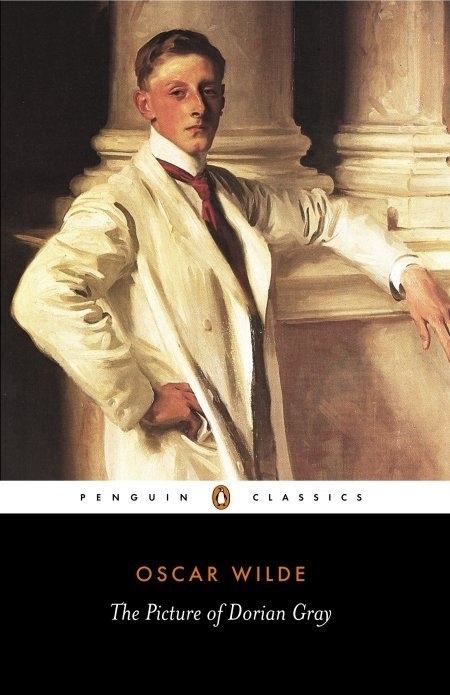 The Picture of Dorian Gray and Other Fantastic Tales
 A Woman of No Importance
 De Profundis
About the book
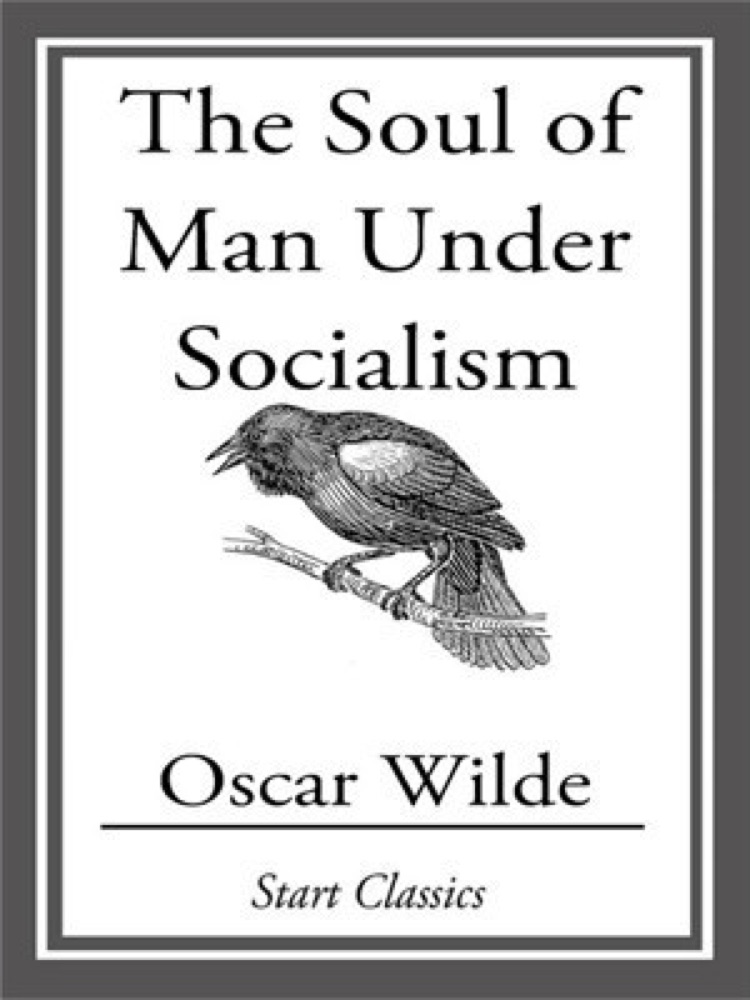
In The Soul of Man under Socialism Oscar Wilde expounds on an anarchist world view. Wilde argues that under capitalism the majority of people spoil their lives by an unhealthy and exaggerated altruism-are forced, indeed, so to spoil them: instead of realizing their true talents, they waste their time solving the social problems caused by capitalism, without taking their common cause away. Thus, caring people seriously and very sentimentally set themselves to the task of remedying the evils that they see in poverty, but their remedies do not cure the disease: they merely prolong it because, the proper aim is to try and reconstruct society on such a basis that poverty will be impossible.
Book details
- First published
- 1891
- Author
- Oscar Wilde
- Genre
- Nonfiction
- Goodreads rating
- 3.92 (7k ratings)
Keep reading
 What's Wrong with the World
 In Praise of Idleness and Other Essays
 Humankind: A Hopeful History
 Heretics
 The Will to Power
 Life at the Bottom: The Worldview That Makes the Underclass
 Utopia
 Walden Two
 The Sane Society
 Human, All Too Human
 Daybreak: Thoughts on the Prejudices of Morality
 The Theory of Moral Sentiments
 Human Action: A Treatise on Economics
 The Wisdom of Life
 Discourse on the Origin of Inequality
 Reflections on the Revolution in France
 The Blank Slate: The Modern Denial of Human Nature
 Emile or On Education
 The Dispossessed
 The Human Condition
 From Dawn to Decadence: 500 Years of Western Cultural Life, 1500 to the Present
 Civilized to Death: What Was Lost on the Way to Modernity
 The People of the Abyss
 A Calendar of Wisdom: Daily Thoughts to Nourish the Soul
 Minima Moralia: Reflections on a Damaged Life
 On Liberty
 Civil Disobedience and Other Essays
 The Abolition of Man
 Brave New World Revisited
 Freedom
 Enlightenment Now: The Case for Reason, Science, Humanism, and Progress
 The Art of the Commonplace: The Agrarian Essays
 Utilitarianism
 Life Without Principle
 Justice: What's the Right Thing to Do?
 The Discovery of India
 Straw Dogs: Thoughts on Humans and Other Animals
 The Virtue of Selfishness: A New Concept of Egoism
 The Road to Serfdom
 Rights of Man
 The Nicomachean Ethics
 The Constitution of Liberty
 The Undiscovered Self
 Capitalism: The Unknown Ideal
 God Emperor of Dune
 Politics
 How to Be Perfect: The Correct Answer to Every Moral Question
 The Rebel: An Essay on Man in Revolt
 The Laws of Plato
 Rules for Radicals: A Pragmatic Primer for Realistic Radicals
 Erewhon
 Man and Superman
 Point Counter Point
 The Man Without Qualities
 The Iron Heel
 Escape from Freedom
 Lila: An Inquiry Into Morals
 The Age of Absurdity: Why Modern Life makes it Hard to be Happy
 Persian Letters
 Sapiens: A Brief History of Humankind