
 Deep Work: Rules for Focused Success in a Distracted World
Quotes from the Book
We've become so used to the idea that the only reward for getting better is moving toward higher income and increased responsibilities that we forget that the fruits of pursuing quality can also be harvested in the form of a more sustainable lifestyle.
17
To work without change or rest all year would have seemed unusual to most of our ancestors. Seasonality was deeply integrated into the human experience.
12
This is what ultimately matters: where you end up, not the speed at which you get there, or the number of people you impress with your jittery busyness along the way.
8
The key to meaningful work is in the decision to keep returning to the efforts you find important. Not in getting everything right every time.
7
Deciding what not to do is as important as deciding what to do,
5
This philosophy rejects busyness, seeing overload as an obstacle to producing results that matter, not a badge of pride.
5
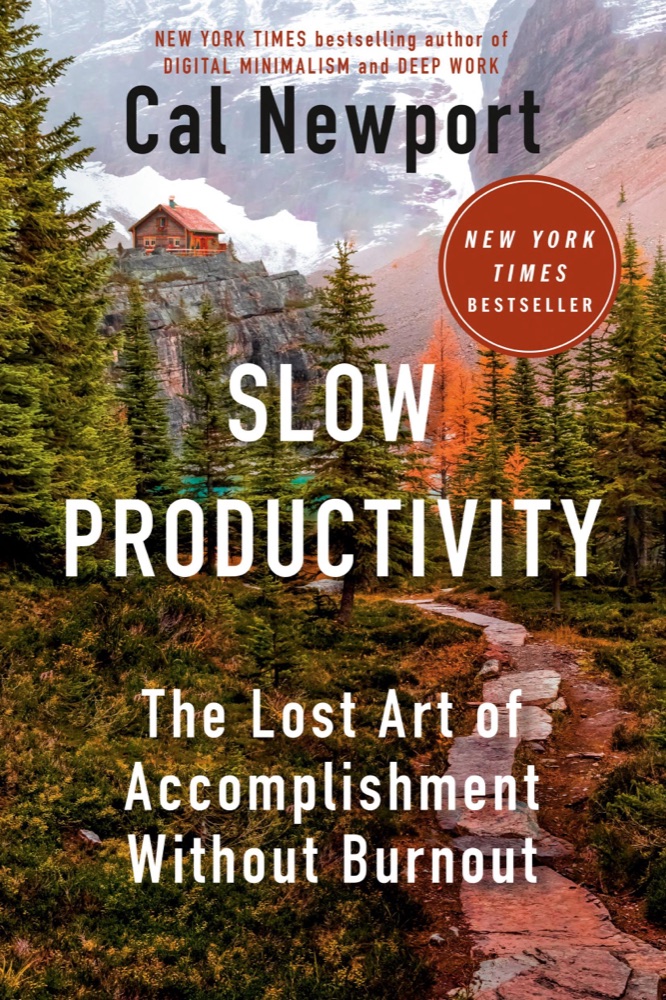
SLOW PRODUCTIVITY A philosophy for organizing knowledge work efforts in a sustainable and meaningful manner, based on the following three principles: 1. Do fewer things. 2. Work at a natural pace. 3. Obsess over quality.
4
In knowledge work, when you agree to a new commitment, be it a minor task or a large project, it brings with it a certain amount of ongoing administrative overhead: back-and-forth email threads needed to gather information, for example, or meetings scheduled to synchronize with your collaborators. This overhead tax activates as soon as you take on a new responsibility. As your to-do list grows, so does the total amount of overhead tax you’re paying. Because the number of hours in the day is fixed, these administrative chores will take more and more time away from your core work, slowing down the rate at which these objectives are accomplished. At moderate workloads, this effect might be frustrating: a general sense that completing your work is taking longer than it should. As your workload increases, however, the overhead tax you’re paying will eventually pass a tipping point, beyond which logistical efforts will devour so much of your schedule that you cannot complete old tasks fast enough to keep up with the new. This feedback loop can quickly spiral out of control, pushing your workload higher and higher until you find yourself losing your entire day to overhead activities: meeting after meeting conducted against a background hum of unceasing email and chat. Eventually the only solution becomes to push actual work into ad hoc sessions added after hours—in the evenings and early mornings, or over the weekend—in a desperate attempt to avoid a full collapse of all useful output. You’re as busy as you’ve ever been, and yet hardly get anything done.
4
In most cases, people don’t measure the productivity of knowledge workers and when we do, we do it in really silly ways, like how many papers do academics produce, regardless of quality.
4
There exists a myth that it’s hard to say no, whether to someone else or to your own ambition. The reality is that saying no isn’t so bad if you have hard evidence that it’s the only reasonable answer.
3
The key is to obtain a proportional balance. Hard leads to fun. The more hardness you face, the more fun you will enjoy soon after.
2
PRINCIPLE #3: OBSESS OVER QUALITY Obsess over the quality of what you produce, even if this means missing opportunities in the short term. Leverage the value of these results to gain more and more freedom in your efforts over the long term.
2
For all of our complaining about the term, knowledge workers have no agreed-upon definition of what ‘productivity’ even means.
2
The relentless overload that’s wearing us down is generated by a belief that ‘good’ work requires increasing busyness—faster responses to email and chats, more meetings, more tasks, more hours.
2
If we haven’t notably advanced our academic specialty, no amount of to-do list martyrdom can save us.
2
This lesson, that doing less can enable better results, defies our contemporary bias toward activity, based on the belief that doing more keeps our options open and generates more opportunities for reward.
2
The marketplace doesn't care about your personal interest in slowing down. If you want more control over your schedule, you need something to offer in return. More often than not, your best source of leverage will be your own abilities.
1
My goal is to offer a more humane and sustainable way to integrate professional efforts into a life well-lived. To embrace slow productivity, in other words, is to reorient your work to be a source of meaning instead of overwhelm, while still maintaining the ability to produce valuable output.
1
Give yourself enough time to produce something great, but not unlimited time. Focus on creating something good enough to catch the attention of those whose taste you care about, but relieve yourself of the need to forge a masterpiece. Progress is what matters. Not perfection.
1
But recognize that a practitioner of slow productivity cannot afford to spend nothing.
1
It seems like the benefits of technology have created the ability to stack more into our day and onto our schedules than we have the capacity to handle while maintaining a level of quality which makes the things worth doing.
1
I want to rescue knowledge work from its increasingly untenable freneticism and rebuild it into something more sustainable and humane.
1
Wouldn’t it be nice to have a job like that where you didn’t have to worry about being productive?
1
To lack confidence at the outset seems rational to me. It doesn’t matter that something you’ve done before worked out well. Your last piece is never going to write your next one for you.
1
PSEUDO-PRODUCTIVITY The use of visible activity as the primary means of approximating actual productive effort.
Watch on YouTube
About Cal Newport
We have collected 92 quotes from 4 books by Cal Newport on BookQuoters.
More about the author →More by Cal Newport
Deep Work: Rules for Focused Success in a Distracted World
 A World Without Email: Reimagining Work in an Age of Communication Overload
 How to Become a Straight-A Student
About the book
Do fewer things. Work at a natural pace. Obsess over quality.
From the New York Times bestselling author of Digital Minimalism and Deep Work, a groundbreaking philosophy for pursuing meaningful accomplishment while avoiding overload.
Our current definition of “productivity” is broken. It pushes us to treat busyness as a proxy for useful effort, leading to impossibly lengthy task lists and ceaseless meetings. We’re overwhelmed by all we have to do and on the edge of burnout, left to decide between giving into soul-sapping hustle culture or rejecting ambition altogether. But are these really our only choices?
Long before the arrival of pinging inboxes and clogged schedules, history’s most creative and impactful philosophers, scientists, artists, and writers mastered the art of producing valuable work with staying power. In this timely and provocative book, Cal Newport harnesses th
Book details
- First published
- 2024
- Author
- Cal Newport
- Genre
- Nonfiction
- Goodreads rating
- 3.67 (26k ratings)
The buzz
- The New York TimesReview in The New York Timesprofessional review (via Book Marks)
- The Wall Street JournalReview in The Wall Street Journalprofessional review (via Book Marks)
- The TimesReview in The Timesprofessional review (via Book Marks)
- FtReview in Ftprofessional review (via Book Marks)
Keep reading
 The Productivity Project: Accomplishing More by Managing Your Time, Attention, and Energy
 Free to Focus: A Total Productivity System to Achieve More by Doing Less
Deep Work: Rules for Focused Success in a Distracted World
Free to Focus: A Total Productivity System to Achieve More by Doing Less
Deep Work: Rules for Focused Success in a Distracted World
 The Accidental Creative: How to Be Brilliant at a Moment's Notice
 Ready for Anything: 52 Productivity Principles for Getting Things Done
 Drive: The Surprising Truth About What Motivates Us
 Getting Things Done: The Art of Stress-Free Productivity
 The 4-Hour Workweek
 The Bullet Journal Method: Track Your Past, Order Your Present, Plan Your Future
 I Didn't Do the Thing Today: Letting Go of Productivity Guilt
 Make Time: How to Focus on What Matters Every Day
 The PARA Method: Simplify, Organize, and Master Your Digital Life
 Smarter Faster Better: The Secrets of Being Productive in Life and Business
 Eat That Frog! 21 Great Ways to Stop Procrastinating and Get More Done in Less Time
 Grit: The Power of Passion and Perseverance
 Essentialism: The Disciplined Pursuit of Less
 The Practice: Shipping Creative Work
A World Without Email: Reimagining Work in an Age of Communication Overload
The Practice: Shipping Creative Work
A World Without Email: Reimagining Work in an Age of Communication Overload
 Making Ideas Happen: Overcoming the Obstacles Between Vision and Reality
 Creativity, Inc.: Overcoming the Unseen Forces That Stand in the Way of True Inspiration
 The 80/20 Principle: The Secret to Achieving More with Less
 Four Thousand Weeks: Time Management for Mortals
 First Things First
 Getting There: A Book of Mentors
 Overwhelmed: Work, Love, and Play When No One Has the Time
 Atomic Habits: An Easy & Proven Way to Build Good Habits & Break Bad Ones
 Rework
 How to ADHD: An Insider's Guide to Working with Your Brain
 Hyperfocus: How to Be More Productive in a World of Distraction
 A Mind for Numbers: How to Excel at Math and Science
 Principles: Life and Work
 Antifragile: Things That Gain from Disorder
 The Art of Impossible: A Peak Performance Primer
 Do Over: Rescue Monday, Reinvent Your Work, and Never Get Stuck
 Peopleware: Productive Projects and Teams
 Measure What Matters
 The Happiness of Pursuit: Finding the Quest That Will Bring Purpose to Your Life
 Better Than Before: Mastering the Habits of Our Everyday Lives
 The Practicing Mind: Bringing Discipline and Focus into Your Life
 The 12 Week Year
 High Performance Habits: How Extraordinary People Become That Way
 EntreLeadership: 20 Years of Practical Business Wisdom from the Trenches
 How Will You Measure Your Life?
 7 Strategies for Wealth & Happiness: Power Ideas from America's Foremost Business Philosopher
 The Now Habit: A Strategic Program for Overcoming Procrastination and Enjoying Guilt-Free Play
 The Power Of Less: The Fine Art of Limiting Yourself to the Essential
 How to Fail at Almost Everything and Still Win Big: Kind of the Story of My Life
 The Dip: A Little Book That Teaches You When to Quit (and When to Stick)
 The Effective Executive: The Definitive Guide to Getting the Right Things Done
 Barking Up the Wrong Tree: The Surprising Science Behind Why Everything You Know About Success Is (Mostly) Wrong
 Hit Refresh: The Quest to Rediscover Microsoft's Soul and Imagine a Better Future for Everyone
 Finding Flow: The Psychology of Engagement with Everyday Life
 Daily Rituals: How Artists Work
 Shop Class as Soulcraft: An Inquiry Into the Value of Work
 Linchpin: Are You Indispensable?
 The Lazy Genius Way: Embrace What Matters, Ditch What Doesn't, and Get Stuff Done
 Early Retirement Extreme: A Philosophical and Practical Guide to Financial Independence
 Crazy Busy: A (Mercifully) Short Book about a (Really) Big Problem