 The Bullet Journal Method: Track Your Past, Order Your Present, Plan Your Future
Quotes from the Book
We often ask ourselves where the time goes, and no one really knows. But for things to be worthwhile, for making good times, for things to be timeless, we have to allow them to take the time they take. This doesn’t mean that we have to make them perfect, or wait for the perfect moment, or be perfectly optimized. The fruits of our labor might not reveal themselves in a day—some days it can look like we didn’t do anything at all—but the knowledge we put in the bank is priceless. So trust the timing of things—trust the timing of your life.
4
So much of what we are trying to achieve in our days is bound to the idea that we can optimize things to the point of perfection.
2
When we conflate productivity with worthiness, what we do is never enough. We can always do more, and there is always more to do.
2
When we tie who we are to what we do, we can get stuck in an 'if only' spiral -- we might say we are a runner, for example, but then shame ourselves when we don't manage to run every day. We make the mistake of labeling ourselves as nouns, when we really are verbs -- we are not a runner, but rather a person who runs; we're not a writer, but a person who writes. Our sense of self doesn't have to be bundled up with whether we did the thing today -- because we are not the things we do.
2
Perhaps it’s not about squeezing more into our days, but removing what breaks our attention. Whether it’s meetings, to-do lists, or social media, we can scatter seemingly harmless interruptions in our day that take longer to recuperate from than we might anticipate. We might schedule a coffee meeting that’s only
2
The two may be interlinked: time and attention are our two most precious resources, and both happen to be how we spend our love.
2
Familiar with this feeling, journalist Anne Helen Petersen described the phenomenon as “errand paralysis” in her conversation-shifting BuzzFeed article “How Millennials Became the Burnout Generation.” “Why can’t I get this mundane stuff done?” she asked. “Because I’m burned out. Why am I burned out? Because I’ve internalized the idea that I should be working all the time. Why have I internalized that idea? Because everything and everyone in my life has reinforced it—explicitly and implicitly—since I was young.
2
We make the mistake of labeling ourselves as nouns, when we are really verbs—we are not a runner, but rather a person who runs; we’re not a writer, but a person who writes. Our sense of self doesn’t have to be bundled up with whether we did the thing today—because we are not the things we do.
2
The pandemic has shaken up our days in varying ways, but one thing it has taught many of us is that we are always more adrift than we think. In our obsession with doing, we can overlook that life has a way of intervening in our plans for a productive day: distractions come to the fore, things fall through, responsibilities arise unexpectedly, and our minds and bodies don’t always cooperate with our expectations.
2
The curiosity to learn, to be interested, to be kind is how we find the extraordinary in the ordinary. We so often overlook the ordinary, or want to rid it from our days. We multitask; we outsource; we turn to life hacks to avoid the mundane; we project a shimmering version of our lives to others. But behind the scenes, the ordinary will always remain -- and it can be where we connect to our curiosity and wonder.
1
We can't be perfectly balanced as we navigate the pendulum swing of our days--we can only wobble toward what we need.
1
mental, sensory, creative, emotional, social, and spiritual. We can determine the rest we need by looking at where we are using most of our energy in the day. Perhaps rest for you is getting more sleep. Or maybe it is walking in nature, a morning of solitude, playing an instrument, or watching the clouds pass by. I rather like going to a local grocer’s to unhurriedly wander the aisles of fruits and vegetables and return home to make a soup—for someone else, of course, this might be the opposite of restful. Giving yourself permission to rest in the way you need it can be the very thing that allows you to discover more opportunities to shape your day rather than having busyness shape it for you. Taking
1
In her TED Talk “The Real Reason We Are Tired and What to Do About It,” Dr. Saundra Dalton-Smith talks about how we have incorrectly combined the concepts of sleep and rest, when sleep is simply one of the seven types of rest we need: physical,
1
Slowing down to rest isn’t a moral failing—it’s essential to help us recharge and reflect. As Hugh Mackay told me, being human is an undeniably demanding business
1
There is no end point to our days while we are living in them. Once we arrive at the end of one, we find ourselves at the starting point of another - what happens in the middle is what we call life.
1
When we think about everything we have to do, we can feel weary before we even begin. Other times, we might get through our to-do list, only to find there’s more waiting at the bottom of it.
This scarcity of free time can contribute to productivity pressure: we have so little discretionary time available that we feel we must not waste it. Fulfilling but nonessential activities start to feel like a waste of time.
Perhaps what’s most corrosive to our ability to feel good about the day is when we keep trying to do so much in a day that we only disappoint ourselves. Expectations are like tiny promises in our days that can knock us over. If we are more realistic about our expectations, we are more likely to keep the promises we make to ourselves and feel good about the things we did do.
Creating the ideal routine can, rather ironically, be the very thing that lands us in a rut. A thing that was providing momentum starts to feel tired, the pursuit of improving ourselves makes us feel exhausted, the chasing of better becomes boring.
For some of us, when things fall through the net and we don’t stick to our ideal routine - because of bosses, because of kids, because of a sunny afternoon, because of life - we enter the “if only” spiral. Instead of inspecting the precarious structure we’ve tried to assemble, we might draft another new routine - perhaps one that is even more elaborate or strict - and convince ourselves that it’s toppleproof.
When we don’t meet the high standard of productivity we set for ourselves, we feel bad - overlooking the fact that the benchmark was out of reach to begin with.
There will be days like this. Days that aren’t our day. Days we don’t seize. Days when we wished to accomplish more. Days that blur in bitsy errands. Days that get derailed. Days when we worry about all that will be stacked onto tomorrow. Days when we’re convinced everyone else is having a better day.
Our ambitions for the future can make us busier in the present, so we long for a sense of balance that’s unattainable or fleeting, or we add expectations to the day that will only leave us disappointed.
It can be a rare gift we give ourselves when we learn something just for ourselves—that’s learning driven by curiosity, not by our desire for success or status.
Here I am, a person, on this planet, in this solar system, in this galaxy we call the Milky Way, in the company of a limitless number of other galaxies. I am but a speck, on a speck, on a speck, on a speck—why agonize over what I did or didn’t do when it doesn’t matter as much as matter itself?
Creativity doesn’t follow a perfectly consistent schedule, and being the creative bunch of day artists we are, perhaps neither should we.
We become so stifled by the pressure of being productive that we sometimes don’t do anything at all.
Curiosity is what allows us to see that the most ordinary fact about our lives is already rather extraordinary -- we're here. We're living. We may not be sure why, but we're going about our days anyway, and that's rather remarkable.
We live in a society that tends to measure our value based on what we do, how hard we work, and the results of our actions. But our value doesn't live in the accolades we receive, or in the number of followers we have on social media -- it lives in us.
When we strip away the judgment of what we did or didn't do, we can embrace the day for what it is -- an empty canvas. We might not have the same privileges, the same resources, the same available hours in the day as somebody else, and our canvas will not look the same as theirs. But regardless of our life circumstances, each of us is given a day, and within it there is always something, however small, we can experiment with.
Watch on YouTube
About Madeleine Dore
About the book
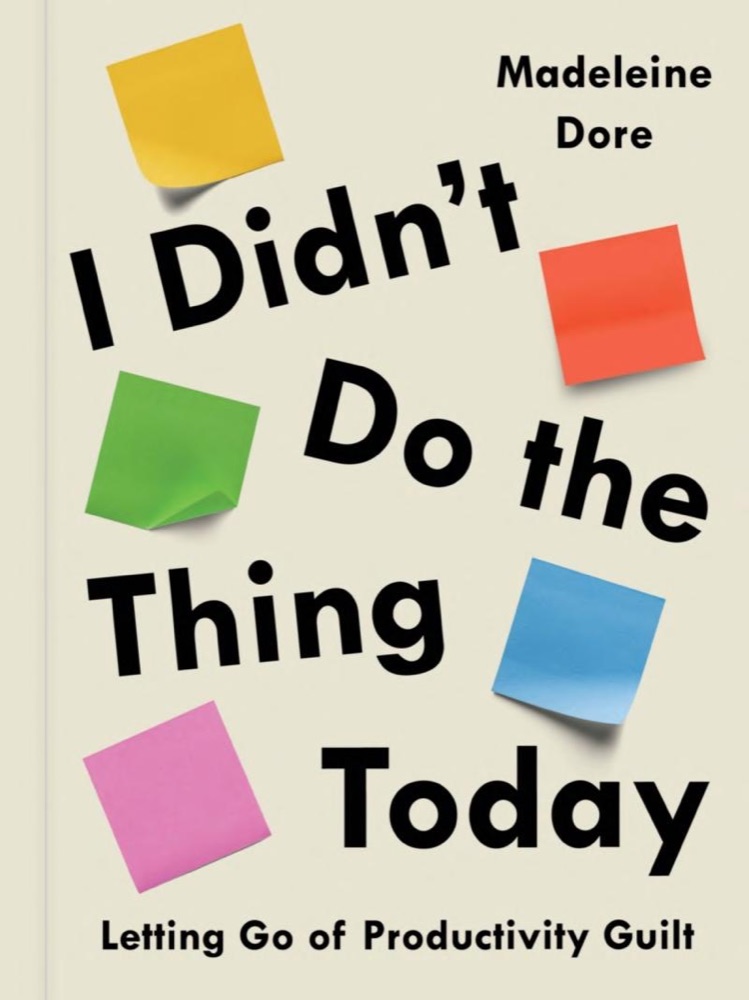
How to release productivity guilt and embrace the hidden values in our daily lives.
Any given day brings a never-ending list of things to do. There’s the work thing, the catch-up thing, the laundry thing, the creative thing, the exercise thing, the family thing, the thing we don’t want to do, and the thing we’ve been putting off, despite it being the most important thing. Even on days when we get a lot done, the thing left undone can leave us feeling guilty, anxious, or disappointed.
After five years of searching for the secret to productivity, Madeleine Dore discovered there isn’t one. Instead, we’re being set up to fail. I Didn’t Do the Thing Today is the inspiring call to take productivity off its pedestal—by dismantling our comparison to others, aspirational routines, and the unrealistic notions of what can be done in a day, we can finally embrace the joyful messiness and unpredict
Book details
- First published
- 2022
- Author
- Madeleine Dore
- Genre
- Nonfiction
- Goodreads rating
- 3.57 (3k ratings)
Keep reading
The Bullet Journal Method: Track Your Past, Order Your Present, Plan Your Future
 Better Than Before: Mastering the Habits of Our Everyday Lives
 Four Thousand Weeks: Time Management for Mortals
 Make Time: How to Focus on What Matters Every Day
 Overwhelmed: Work, Love, and Play When No One Has the Time
 How to Be Here: A Guide to Creating a Life Worth Living
 How to ADHD: An Insider's Guide to Working with Your Brain
 Ready for Anything: 52 Productivity Principles for Getting Things Done
 Crazy Busy: A (Mercifully) Short Book about a (Really) Big Problem
 Finding Flow: The Psychology of Engagement with Everyday Life
 To Hell with the Hustle
 Notes on a Nervous Planet
 First, We Make the Beast Beautiful: A New Story About Anxiety
 Getting Things Done: The Art of Stress-Free Productivity
 Essentialism: The Disciplined Pursuit of Less
 The Productivity Project: Accomplishing More by Managing Your Time, Attention, and Energy
 Slow Productivity: The Lost Art of Accomplishment Without Burnout
 Burnout: The Secret to Unlocking the Stress Cycle
 The Accidental Creative: How to Be Brilliant at a Moment's Notice
 Happier at Home: Kiss More, Jump More, Abandon a Project, Read Samuel Johnson, and My Other Experiments in the Practice of Everyday Life
 The Lazy Genius Way: Embrace What Matters, Ditch What Doesn't, and Get Stuff Done
 First Things First
 Outer Order, Inner Calm: Declutter & Organize to Make More Room for Happiness
 The Practicing Mind: Bringing Discipline and Focus into Your Life
 Thrive: The Third Metric to Redefining Success and Creating a Life of Well-Being, Wisdom, and Wonder
 The Perfectionist's Guide to Losing Control: A Path to Peace and Power
 I Miss You When I Blink: Essays
 101 Essays That Will Change The Way You Think
 Don't Sweat the Small Stuff ... and it's all small stuff: Simple Ways to Keep the Little Things from Taking Over Your Life
 Smarter Faster Better: The Secrets of Being Productive in Life and Business
 The Happiness of Pursuit: Finding the Quest That Will Bring Purpose to Your Life
 Stillness Is the Key
 The Now Habit: A Strategic Program for Overcoming Procrastination and Enjoying Guilt-Free Play
 The Common Rule: Habits of Purpose for an Age of Distraction
 Why Has Nobody Told Me This Before?
 Tribe Of Mentors: Transformative Wisdom From Icons and Innovators to Help You Navigate Life's Challenges
 Procrastination: Why You Do It, What To Do About It
 How to Keep House While Drowning
 Present Over Perfect: Leaving Behind Frantic for a Simpler, More Soulful Way of Living
 The 7 Habits of Highly Effective People: Personal Workbook
 Grit: The Power of Passion and Perseverance
 Creativity: Flow and the Psychology of Discovery and Invention
 Slow: Simple Living for a Frantic World
 Simple Abundance: A Daybook of Comfort of Joy
 Flow: The Psychology of Optimal Experience
 Hyperfocus: How to Be More Productive in a World of Distraction
 Solving the Procrastination Puzzle: A Concise Guide to Strategies for Change
 The 5 AM Club: Own Your Morning. Elevate Your Life
 Drive: The Surprising Truth About What Motivates Us
 What If This Were Enough?: Essays
 More Than Enough: Claiming Space for Who You Are
 The Obstacle Is the Way: The Timeless Art of Turning Trials into Triumph
 Awaken The Giant Within
 Mastery
 7 Strategies for Wealth & Happiness: Power Ideas from America's Foremost Business Philosopher
 The Happiness Advantage: The Seven Principles of Positive Psychology That Fuel Success and Performance at Work
 Greenlights
 The Language of Letting Go: Daily Meditations on Codependency
 I Guess I Haven't Learned That Yet: Discovering New Ways of Living When the Old Ways Stop Working