
 The Ancestor's Tale: A Pilgrimage to the Dawn of Evolution
Quotes from the Book
We are all atheists about most of the gods that humanity has ever believed in. Some of us just go one god further.
There is something infantile in the presumption that somebody else has a responsibility to give your life meaning and point… The truly adult view, by contrast, is that our life is as meaningful, as full and as wonderful as we choose to make it.
More generally, as I shall repeat in Chapter 8, one of the truly bad effects of religion is that it teaches us that it is a virtue to be satisfied with not understanding.
Do not indoctrinate your children. Teach them how to think for themselves, how to evaluate evidence, and how to disagree with you.
Let children learn about different faiths, let them notice their incompatibility, and let them draw their own conclusions about the consequences of that incompatibility. As for whether they are ‘valid,’ let them make up their own minds when they are old enough to do so.
Do you really mean to tell me the only reason you try to be good is to gain God's approval and reward, or to avoid his disapproval and punishment? That's not morality, that's just sucking up, apple-polishing, looking over your shoulder at the great surveillance camera in the sky, or the still small wiretap inside your head, monitoring your every move, even your every base though.
Faith can be very very dangerous, and deliberately to implant it into the vulnerable mind of an innocent child is a grievous wrong.
I am thrilled to be alive at time when humanity is pushing against the limits of understanding. Even better, we may eventually discover that there are no limits.
Indeed, organizing atheists has been compared to herding cats, because they tend to think independently and will not conform to authority. But a good first step would be to build up a critical mass of those willing to 'come out,' thereby encouraging others to do so. Even if they can't be herded, cats in sufficient numbers can make a lot of noise and they cannot be ignored.
The only watchmaker is the blind forces of physics.
Peter Sutcliffe, the Yorkshire Ripper, distinctly heard the voice of Jesus telling him to kill women, and he was locked up for life. George W. Bush says that God told him to invade Iraq (a pity God didn't vouchsafe him a revelation that there were no weapons of mass destruction).
Isaac Asimov's remark about the infantilism of pseudoscience is just as applicable to religion: 'Inspect every piece of pseudoscience and you will find a security blanket, a thumb to suck, a skirt to hold.' It is astonishing, moreover, how many people are unable to understand that 'X is comforting' does not imply 'X is true'.
I mean it as a compliment when I say that you could almost define a philosopher as someone who won't take common sense for an answer.
[God is] a vindictive bloodthirsty ethnic cleanser , a misogynistic, homophobic racist, an infanticidal, genocidal, phillicidal, pestilential, megalomaniacal, sadomasochistic, capriciously malevolent bully.
If all the evidence in the universe turned in favour of creationism, I would be the first to admit it, and I would immediately change my mind. As things stand, however, all available evidence (and there is a vast amount of it) favours evolution.
Creationists eagerly seek a gap in present-day knowledge or understanding. If an apparent gap is found, it is assumed that God, by default, must fill it.
Let us remind ourselves of the terminology. A theist believes in a supernatural intelligence who, in addition to his main work of creating the universe in the first place, is still around to oversee and influence the subsequent fate of his initial creation. In many theistic belief systems, the deity is intimately involved in human affairs. He answers prayers; forgives or punishes sins; intervenes in the world by performing miracles; frets about good and bad deeds, and knows when we do them (or even think about doing them). A deist, too, believes in a supernatural intelligence, but one whose activities were confined to setting up the laws that govern the universe in the first place. The deist God never intervenes thereafter, and certainly has no specific interest in human affairs. Pantheists don't believe in a supernatural God at all, but use the word God as a non-supernatural synonym for Nature, or for the Universe, or for the lawfulness that governs its workings. Deists differ from theists in that their God does not answer prayers, is not interested in sins or confessions, does not read our thoughts and does not intervene with capricious miracles. Deists differ from pantheists in that the deist God is some kind of cosmic intelligence, rather than the pantheist's metaphoric or poetic synonym for the laws of the universe. Pantheism is sexed-up atheism. Deism is watered-down theism.
A god who is capable of sending intelligible signals to millions of people simultaneously, and of receiving messages from all of them simultaneously, cannot be, whatever else he might be, simple. Such Bandwidth!
Indeed, organizing atheists has been compared to herding cats, because they tend to think independently and will not conform to authority.
The truly adult view [...] is that our life is as meaningful, as full and as wonderful as we choose to make it. And we can make it very wonderful indeed.
Though the details differ across the world, no known culture lacks some version of the time-consuming, wealth consuming, hostility provoking rituals, the anti-factual, counter-productive fantasies of religion.
Jesus was not content to derive his ethics from the scriptures of his upbringing. He explicitly departed from them. [...] Since a principal thesis of this chapter is that we do not, and should not, derive our morals from scripture, Jesus has to be honoured as a model for that very thesis.
The atheist view is correspondingly life-affirming and life-enhancing, while at the same time never being tainted with self-delusion, wishful thinking, or the whingeing self-pity of those who feel that life owes them something.
Did you know?
- The book reached number four on the New York Times Hardcover Non-Fiction bestseller list in December 2006.
- It has been translated into more than thirty languages.
- Dawkins won Author of the Year at the 2007 British Book Awards, an award widely linked to the book's success.
- Dawkins coined and popularized the term "meme" decades earlier in "The Selfish Gene," a concept he draws on when discussing the spread of religion.
- The book is often grouped with works by Sam Harris, Daniel Dennett and Christopher Hitchens as part of the "New Atheism" movement.
About Richard Dawkins
Richard Dawkins is a British evolutionary biologist and author, best known for popularizing the gene-centered view of evolution in "The Selfish Gene" (1976). A former Oxford professor for the public understanding of science, he is one of the world's most prominent atheists and science communicators.
More about the author →More by Richard Dawkins
The Ancestor's Tale: A Pilgrimage to the Dawn of Evolution
 The Blind Watchmaker: Why the Evidence of Evolution Reveals a Universe Without Design
 The Selfish Gene
 The Magic of Reality: How We Know What's Really True
About the book
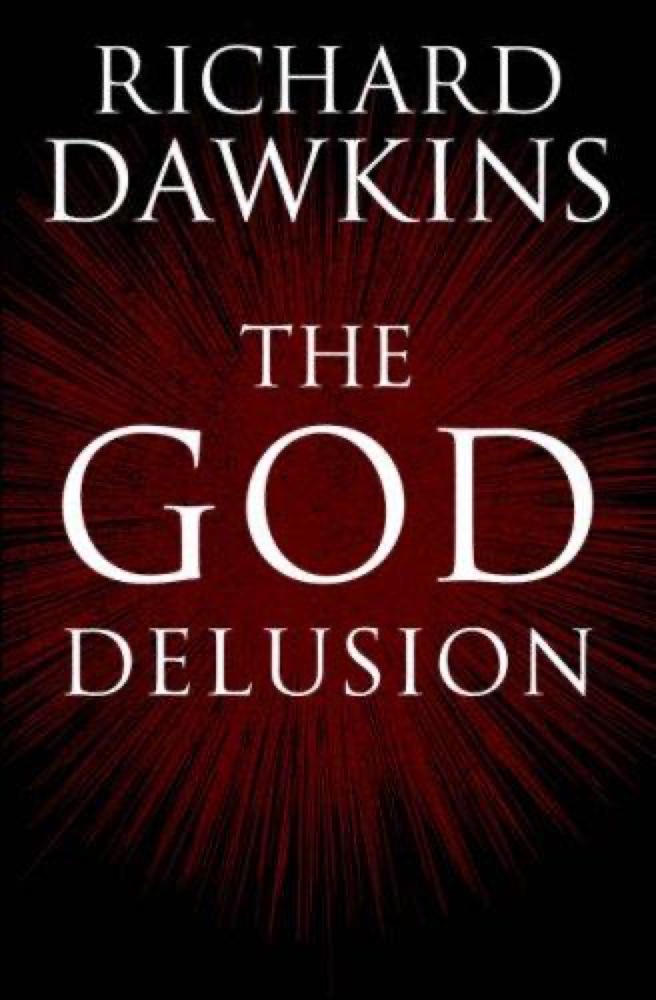
"The God Delusion" is Richard Dawkins's sustained argument that belief in a supernatural creator is not merely mistaken but qualifies, in his words, as a delusion. Working from the position that the existence of God is a scientific hypothesis about the universe, Dawkins examines and rejects the classic philosophical arguments for a deity, contends that a designed cosmos is far less probable than one shaped by natural selection, and maintains that atheists can lead full, moral and meaningful lives.
Across the book Dawkins ranges over the roots of religion, the origins of morality, and the case that ethical behavior does not depend on faith but can be explained through evolution and culture. He is sharply critical of the harm he attributes to organized religion, from sectarian conflict to what he calls the indoctrination of children, and he argues that labeling a child with a parent's religion is itself a kind of abuse. Throughout, he presses the idea that atheism is a stance of intellectual independence rather than deprivation.
Published at the height of the "New Atheism" moment, the book became an international bestseller, reaching number four on the New York Times non-fiction list and being translated into dozens of languages. It provoked wide debate and numerous rebuttals from theologians and philosophers, and it helped make Dawkins one of the most prominent public advocates for secularism and science.
Book details
- First published
- 2006
- Length
- 464 pages
- Reading time
- 8 hours
- Author
- Richard Dawkins
- Genre
- Philosophy
- Goodreads rating
- 3.90 (287k ratings) →
If you liked this, read…
- 1God Is Not GreatChristopher Hitchens's polemic against religion, a companion piece of New Atheism.
- 2The Selfish GeneDawkins's own landmark on evolution that underpins many arguments here.
- 3Breaking the SpellDaniel Dennett examines religion as a natural phenomenon to be studied scientifically.
- 4The End of FaithSam Harris makes a parallel case against religious belief and its social costs.
Keep reading
 The Portable Atheist: Essential Readings for the Nonbeliever
 Letter to a Christian Nation
 god is Not Great: How Religion Poisons Everything
 Breaking the Spell: Religion as a Natural Phenomenon
 Why I Am Not a Christian and Other Essays on Religion and Related Subjects
 The End of Faith: Religion, Terror, and the Future of Reason
 The Age of Reason
 The Parafaith War
 I Don't Have Enough Faith to Be an Atheist
 A History of God: The 4,000-Year Quest of Judaism, Christianity, and Islam
 Outgrowing God: A Beginner’s Guide to Atheism
 The Sign
 Miracles: What They Are, Why They Happen, and How They Can Change Your Life
 The Reason for God: Belief in an Age of Skepticism
 The Knowledge of the Holy
 The Rage Against God: How Atheism Led Me to Faith
 Children of God
 Reasonable Faith
 The Varieties of Scientific Experience: A Personal View of the Search for God
 The Case for God
 Tactics: A Game Plan for Discussing Your Christian Convictions
 God, No! Signs You May Already Be an Atheist and Other Magical Tales
 Finding God in the Waves: How I Lost My Faith and Found It Again Through Science
 Why I Am An Atheist: An Autobiographical Discourse
 The Varieties of Religious Experience
 The Devil's Advocate
 The Future of an Illusion
 Religion for Atheists: A Non-Believer's Guide to the Uses of Religion
 The World's Last Night: And Other Essays
 Why There Is No God: Simple Responses to 20 Common Arguments for the Existence of God
 What's So Great About Christianity
 Living with a Wild God: A Nonbeliever's Search for the Truth about Everything
 The Language of God: A Scientist Presents Evidence for Belief
 God in Search of Man: A Philosophy of Judaism
 The Bible Jesus Read
 The Perennial Philosophy
 The Gospel of the Flying Spaghetti Monster
 Heretics
 Orthodoxy
 I Am America
 My Bright Abyss: Meditation of a Modern Believer
 The Gay Science
 Man Seeks God: My Flirtations with the Divine
 God's Debris: A Thought Experiment
 36 Arguments for the Existence of God: A Work of Fiction
 Holy Envy: Finding God in the Faith of Others
 The Story of My Experiments With Truth
 A Little History of Religion
 The Explicit Gospel
 The Moral Landscape: How Science Can Determine Human Values
 The Case for Faith: A Journalist Investigates the Toughest Objections to Christianity
 Philosophical Dictionary
 Island
 Demons
 Velvet Elvis: Repainting the Christian Faith
 Letters from the Earth: Uncensored Writings
 The Everlasting Man
 Small Gods
 The Crucible of Doubt: Reflections On the Quest for Faith