
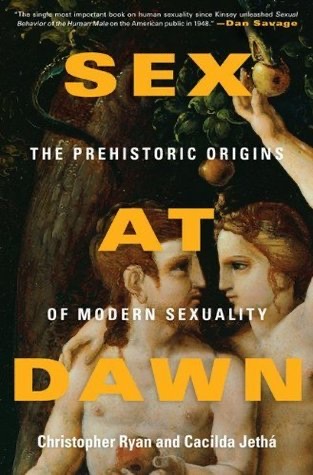
 Sex at Dawn: The Prehistoric Origins of Modern Sexuality
Quotes from the Book
When you're going in the wrong direction, progress is the last thing you need.
9
Man is an animal suspended in a web of significance that he himself has spun. —Max Weber
9
many of us have been convinced that we carry the darkness within us, in our selfish genes. “It is simply human nature,” we’re told, “to rape and kill and enslave—and anyone who thinks otherwise is a foolish romantic.” This messaging not only offends our decency and dignity, it insults our intelligence. The depiction of human nature embedded in the NPP isn’t science; it’s a marketing campaign for the status quo.
7
Upon his first encounters with the native people he “discovered” in the West Indies, Columbus was struck by their kindness, generosity, and physical beauty. In a letter to the king and queen of Spain, he explained: “They are very simple and honest and exceedingly liberal with all they have, none of them refusing anything he may possess when he is asked for it. They exhibit great love toward all others in preference to themselves.” In his own journals, he was even more complimentary: “They are the best people in the world and above all the gentlest—without knowledge of what is evil—nor do they murder or steal… they love their neighbors as themselves and they have the sweetest talk in the world… always laughing.” A few pages on, in one of the most chilling pivots in recorded history, Columbus wrote: “They would make fine servants. With fifty men we could subjugate them all and make them do whatever we want.
4
The NPP insists that we venerate the crooks, rapists, and pillagers credulous historians have repackaged as “founders,” “conquerors,” and “civilizers.” We erect statues and consecrate tombs to commemorate their difference-making. But in fact, most of these monuments memorialize the dark deeds of unhinged lunatics driven by rampant ego and raving greed.
3
There is hope; though not for us. —Franz Kafka
2
The rats that were trapped alone in cages opted to get high as much as possible, but the rats with interesting lives (community, space, toys) tried the drugged water once or twice, and then stayed away from it. The rats with lives worth living had little interest in the escapism the drugs offered. Overall, they consumed less than a quarter of the drugged water the isolated rats did. None overdosed or ignored food until they starved.
2
The depiction of human nature embedded in the NPP isn't science; it's a marketing campaign for the status quo. The politics of perpetual fear is corrosive to our well-being and our innate capacities for cooperation, community, and kindness. Fear of terrorists, fear of running out of money, fear of getting old, fear of strangers, fear of death, fear of sharks, fear of being hit by lightning, fear of fear itself. It keeps us quiet and complacent in our supposedly protective cages.
2
Once we accept that all human beings are, in fact, equally human, it becomes clear that human nature offers little to help explain systematic cruelties common to civilizations but rare or nonexistent among foragers (subjugation of women, slavery, extreme disparities in wealth, and so on).
2
People who say the system works work for the system. —Russell Brand
1
Civilization is like a hole our clever species dug and then promptly fell into.
1
Recall your own rage when trapped behind distracted idiots texting in traffic or wedged between smelly, snoring strangers in economy class while someone’s demon spawn is kicking the back of your seat. Is your hostility an expression of human nature—or is it perhaps better understood as a minor facet of human nature magnified by the unnatural conditions you’re trapped in?
1
The popularity and persistence of scientific narratives often have more to do with how well they support dominant mythologies than with scientific veracity.
1
Poverty… is a most necessary and indispensable ingredient in society, without which nations and communities could not exist in a state of civilization. It is the lot of man. It is the source of wealth, since without poverty, there could be no labour; there could be no riches, no refinement, no comfort, and no benefit to those who may be possessed of wealth.
stuck in a job that scorches the soul but that we can’t afford to quit, so we buy expensive toys to mask the pain, thereby making the job even harder to quit?
We rush impetuously into novelty, driven by a mounting sense of insufficiency, dissatisfaction, and restlessness. We no longer live on what we have, but on promises, no longer in the light of the present day, but in the darkness of the future, which, we expect, will at last bring a proper sunrise. We refuse to recognize that everything better is purchased at the price of something worse.
The Nixon campaign in 1968, and the Nixon White House after that, had two enemies: the antiwar left and black people. You understand what I’m saying? We knew we couldn’t make it illegal to be either against the war or black, but by getting the public to associate the hippies with marijuana and blacks with heroin, and then criminalizing both heavily, we could disrupt those communities. We could arrest their leaders, raid their homes, break up their meetings, and vilify them night after night on the evening news. Did we know we were lying about the drugs? Of course we did.
was to question the racial superiority of Europeans and the fundamental legitimacy of colonialism and the will of the Christian God as interpreted by men with vast armies at their disposal.
Watch on YouTube
About Christopher Ryan
We have collected 48 quotes from 2 books by Christopher Ryan on BookQuoters.
More about the author →More by Christopher Ryan
Sex at Dawn: The Prehistoric Origins of Modern Sexuality
About the book
Progress, the basic illusion of our age, is exhausted. Kids typically no longer expect their lives to be better than their parents’ were. Dystopian scenarios loom ever larger in public consciousness as fisheries collapse, CO2 levels rise, and clouds of radioactive steam billow from “fail-safe” nuclear plants that failed. Despite the technological marvels of our age—or perhaps because of them—these are dark days.
As comedian Louis C.K. put it, “Everything’s amazing, but nobody’s happy.” Even for the most fortunate among us, material abundance comes at a very high price. Facebook is a hollow replacement for face time. We produce more food than ever, but hunger and malnutrition are standard in most of the world while the rest of us stuff ourselves quite literally to death. Despair darkens ever more lives as rates of clinical depression and suicide continue their grim climb in the develo
Book details
- First published
- 2018
- Author
- Christopher Ryan
- Genre
- Nonfiction
- Goodreads rating
- 4.12 (5k ratings)
Keep reading
 Humankind: A Hopeful History
 Endgame, Vol. 1: The Problem of Civilization
 Sapiens: A Brief History of Humankind
 A Short History of Progress
 A Language Older Than Words
 The Ministry for the Future
 Enlightenment Now: The Case for Reason, Science, Humanism, and Progress
 Homo Deus: A History of Tomorrow
 Straw Dogs: Thoughts on Humans and Other Animals
 The Blank Slate: The Modern Denial of Human Nature
 The State of the Art
 The Culture of Make Believe
 God Emperor of Dune
 The Fifth Science
 The Log from the Sea of Cortez
 Ishmael: An Adventure of the Mind and Spirit
 What's Our Problem?: A Self-Help Book for Societies
 Creation Lake
 Brave New World Revisited
 Villa Incognito
 The Soul of Man Under Socialism
 Genesis
 What's Wrong with the World
 Too Like the Lightning
 Green Mars
 The Western Lands
 Heretics
 Devolution: A Firsthand Account of the Rainier Sasquatch Massacre
 World War Z: An Oral History of the Zombie War
 The Will to Power
 The Book of Joan
 Walden Two
 The Shockwave Rider
 The Futurological Congress: From the Memoirs of Ijon Tichy
 The Fall of Babel
 Why Fish Don’t Exist: A Story of Loss, Love, and the Hidden Order of Life
 Blackfish City
 The Wizard and the Prophet: Two Remarkable Scientists and Their Dueling Visions to Shape Tomorrow's World
 Billions & Billions: Thoughts on Life and Death at the Brink of the Millennium
 Daybreak: Thoughts on the Prejudices of Morality
 The Social Conquest of Earth
 Shadows of Forgotten Ancestors
 Empire of Illusion: The End of Literacy and the Triumph of Spectacle
 Human, All Too Human
 The Lost World
 21 Lessons for the 21st Century
 The Atlantis Gene
 The Golden House
 Hocus Pocus
 Revolution
 The Conspiracy Against the Human Race
 Parable of the Talents
 The Mountain in the Sea
 Sea of Rust
 The Midwich Cuckoos
 Beyond Civilization: Humanity's Next Great Adventure
 In Praise of Idleness and Other Essays
 The Committed
 Point Counter Point
 Small Is Beautiful: Economics as if People Mattered