

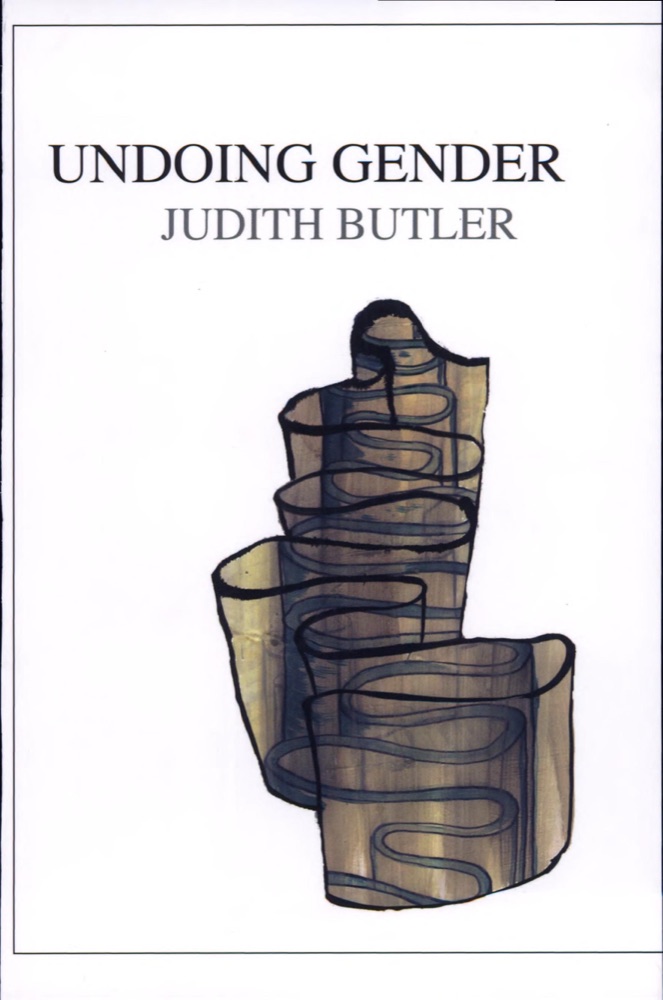
 Undoing Gender
Quotes from the Book
If Lacan presumes that female homosexuality issues from a disappointed heterosexuality, as observation is said to show, could it not be equally clear to the observer that heterosexuality issues from a disappointed homosexuality?
118
As a result, gender is not to culture as sex is to nature; gender is also the discursive/cultural means by which “sexed nature” or “a natural sex” is produced and established as “prediscursive,” prior to culture, a politically neutral surface on which culture acts
59
To operate within the matrix of power is not the same as to replicate uncritically relations of domination.
58
There is no reason to assume that gender also ought to remain as two. The presumption of a binary gender system implicitly retains the belief in a mimetic relation of gender to sex whereby gender mirrors sex or is otherwise restricted by it.
28
...laughter emerges in the realization that all along the original was derived.
27
If there is something right in Beauvoir's claim that one is born, but rather becomes a woman, it follows that woman itself is a term in process, a becoming, a constructing that cannot rightfully be said to originate or to end. As an ongoing discursive practice, it is open to intervention and resignification.
25
If the immutable character of sex is contested, perhaps this construct called ‘sex’ is as culturally constructed as gender; indeed, perhaps it was always already gender, with the consequence that the distinction between sex and gender turns out to be no distinction at all.
23
The effect of gender is produced through the stylization of the body and, hence, must be understood as the mundane way in which bodily gestures, movements, and styles of various kinds constitute the illusion of an abiding gendered self. This formulation moves the conception of gender off the ground of a substantial model of identity to one that requires a conception of gender as a constituted social temporality.
22
a phenomenon that gave rise to my first critical insight into the subtle ruse of power: the prevailing law threatened one with trouble, all to keep one out of trouble. Hence, I concluded that trouble is inevitable and the task, how best to make it, what best way to be in it.
20
The effort to identify the enemy as singular in form is a reverse-discourse that uncritically mimics the strategy of the oppressor instead of offering a different set of terms.
15
If gender attributes and acts, the various ways in which a body shows or produces its cultural signification, are performative, then there is no preexisting identity by which an act or attribute might be measured; there would be no true or false, real or distorted acts of gender, and the postulation of a true gender identity would be revealed as a regulatory fiction.That gender reality is created through sustained social performances means that the very notions of an essential sex and a true or abiding masculinity or femininity are also constituted as part of the strategy that conceals gender’s performative character and the performative possibilities for proliferating gender configurations outside the restricting frames of masculinist domination and compulsory heterosexuality.
13
Do we need recourse to a happier state before the law in order to maintain that contemporary gender relations and the punitive production of gender identities are oppressive?
12
That the power regimes of heterosexism and phallogocentrism seek to augment themselves through a constant repetition of their logic, their metaphysic, and their naturalized ontologies does not imply that repetition itself ought to be stopped—as if it could be. If repetition is bound to persist as the mechanism of the cultural reproduction of identities, then the crucial question emerges: What kind of subversive repetition might call into question the regulatory practice of identity itself?
11
Learning the rules that govern intelligible speech is an inculcation into normalized language, where the price of not conforming is the loss of intelligibility itself.
11
Irigaray remarks in such a vein that "the masquerade... is what women do... in order to participate in man's desire, but at the cost of giving up their own".
9
Destruction is thus always restoration—that is, the destruction of a set of categories that introduce artificial divisions into an otherwise unified ontology.
5
We can understand this conclusion to be the necessary result of a heterosexualized and masculine observational point of view that takes lesbian sexuality to be a refusal of sexuality per se only because sexuality is presumed to be heterosexual, and the observer, here constructed as the heterosexual male, is clearly being refused.
5
The dogged effort to “denaturalize” gender in this text emerges, I think, from a strong desire both to counter the normative violence implied by ideal morphologies of sex and to uproot the pervasive assumptions about natural or presumptive heterosexuality that are informed by ordinary and academic discourses on sexuality. The writing of this denaturalization was not done simply out of a desire to play with language or prescribe theatrical antics in the place of “real” politics, as some critics have conjectured (as if theatre and politics are always distinct). It was done from a desire to live, to make life possible, and to rethink the possible as such.
5
Although some lesbians argue that butches have nothing to do with “being a man,” others insist that their butchness is or was only a route to a desired status as a man. These paradoxes have surely proliferated in recent years, offering evidence of a kind of gender trouble that the text itself did not anticipate.
4
The anticipation of an authoritative disclosure of meaning is the means by which that authority is attributed and installed: the anticipation conjures its object.
3
This utopian notion of a sexuality freed from heterosexual constructs, a sexuality beyond "sex", failed to acknowledge the ways in which power relations continue to construct sexuality for women even within the terms of a "liberated" sexuality for women even within the terms of a "liberated" heterosexuality or lesbianism.
3
The exclusion of those who fail to conform to unspoken normative requirements of the subject.
3
The mobilization of identity categories for the purposes of politicization always remain threatened by the prospect of identity becoming an instrument of the power one opposes.
2
the subtle ruse of power: the prevailing law threatened one with trouble, even put one in trouble, all to keep one out of trouble. Hence, I concluded that trouble is inevitable and the task, how best to make it, what best way to be in it. As
2
Perhaps also part of what dialogic understanding entails is the acceptance of divergence, breakage, splinter, and fragmentation as part of the often tortuous process of democratisation.
1
As feminism has sought to become integrally related to struggles against racial and colonialist oppression, it has become increasingly important to resist the colonizing epistemological strategy that would subordinate different configurations of domination under the rubric of a transcultural notion of patriarchy.
1
For power to be withdrawn, power itself would have to be understood as the retractable operation of volition; indeed, the heterosexual contract would be understood to be sustained through a series of choices, just as the social contract in Locke or Rousseau is understood to presuppose the rational choice or deliberate will of those it is said to govern. If power is not reduced to volition, however, and the classical liberal and existential model of freedom is refused, then power relations can be understood, as I think they ought to be, as constraining and constituting the very possibilities of volition. Hence, power can neither be withdrawn nor refused, but only redeployed.
1
Wittig appears to take issue with genitally organized sexuality per se and to call for an alternative economy of pleasures which would both contest the construction of female subjectivity marked by women’s supposedly distinctive reproductive function.
1
It seems that every text has more sources than it can reconstruct within its own terms.
1
Watch on YouTube
About Judith Butler
We have collected 44 quotes from 2 books by Judith Butler on BookQuoters.
More about the author →More by Judith Butler
Undoing Gender
About the book
Since its publication in 1990, Gender Trouble has become one of the key works of contemporary feminist theory, and an essential work for anyone interested in the study of gender, queer theory, or the politics of sexuality in culture. This is the text where Judith Butler began to advance the ideas that would go on to take life as "performativity theory," as well as some of the first articulations of the possibility for subversive gender practices, and she writes in her preface to the 10th anniversary edition released in 1999 that one point of Gender Trouble was "not to prescribe a new gendered way of life [...] but to open up the field of possibility for gender [...]" Widely taught, and widely debated, Gender Trouble continues to offer a powerful critique of heteronormativity and of the function of gender in the modern world.
Book details
- First published
- 1989
- Author
- Judith Butler
- Genre
- Nonfiction
- Goodreads rating
- 4.04 (20k ratings)
Keep reading
Undoing Gender
 Sexual Politics
 The History of Sexuality, Volume 1: An Introduction
 Living a Feminist Life
 Material Girls: Why Reality Matters for Feminism
 The Argonauts
 The Straight Mind: And Other Essays
 The Right to Sex: Feminism in the Twenty-First Century
 Trans: When Ideology Meets Reality
 The Madness of Crowds: Gender, Race and Identity
 Literary Theory: An Introduction
 The Second Sex
 The Dialectic of Sex: The Case for Feminist Revolution
 Anti-Oedipus: Capitalism and Schizophrenia
 Cynical Theories: How Activist Scholarship Made Everything about Race, Gender, and Identity—and Why This Harms Everybody
 Against White Feminism: Notes on Disruption
 The Mother of All Questions
 Of Woman Born: Motherhood as Experience and Institution
 The Female Eunuch
 Feminist Theory: From Margin to Center
 Sexual Personae: Art and Decadence from Nefertiti to Emily Dickinson
 The Creation of Patriarchy
 Truth and Method
 Maps of Meaning: The Architecture of Belief
 Whose Story Is This? Old Conflicts, New Chapters
 This Bridge Called My Back: Writings by Radical Women of Color
 After Virtue
 Whipping Girl: A Transsexual Woman on Sexism and the Scapegoating of Femininity
 How to Suppress Women's Writing
 Unspeakable Things: Sex, Lies and Revolution
 Trick Mirror: Reflections on Self-Delusion
 From Dawn to Decadence: 500 Years of Western Cultural Life, 1500 to the Present
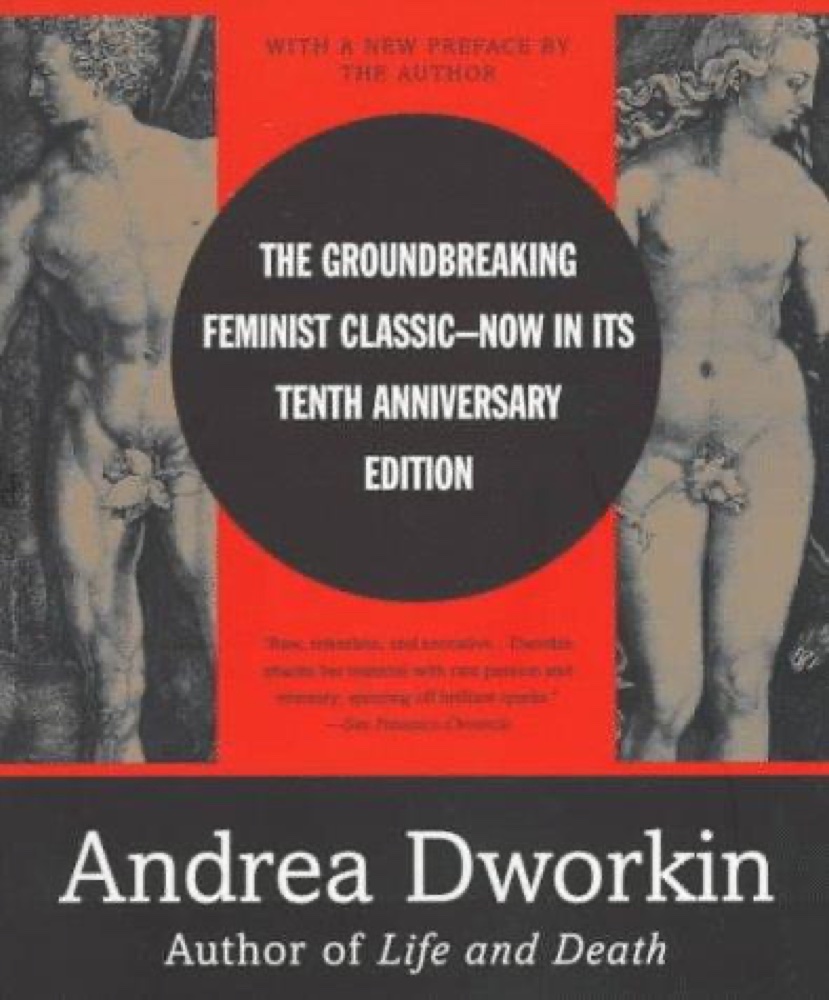 Intercourse
 The Gender Games: The Problem with Men and Women, from Someone Who Has Been Both
 The Archaeology of Knowledge and The Discourse on Language
 The Human Condition
 Redefining Realness: My Path to Womanhood, Identity, Love & So Much More
 Talking Back: Thinking Feminist, Thinking Black
 The Master's Tools Will Never Dismantle the Master's House
 Feminism Is for Everybody: Passionate Politics
 Men Explain Things to Me
 Sister Outsider: Essays and Speeches
 The Blank Slate: The Modern Denial of Human Nature
 Too Fat, Too Slutty, Too Loud: The Rise and Reign of the Unruly Woman
 The Feminine Mystique
 The Subjection of Women
 A Thousand Plateaus: Capitalism and Schizophrenia
 The Summer Without Men
 Dialectic of Enlightenment: Philosophical Fragments
 Doppelganger: A Trip into the Mirror World
 A Hunter-Gatherer's Guide to the 21st Century: Evolution and the Challenges of Modern Life
 Creation Lake
 The Master and His Emissary: The Divided Brain and the Making of the Western World
 The Truth Will Set You Free, But First It Will Piss You Off!: Thoughts on Life, Love, and Rebellion
 Elizabeth Finch
 Opinions: A Decade of Arguments, Criticism, and Minding Other People’s Business
 The Crisis of the Modern World
 Selections from the Prison Notebooks
 Understanding Media: The Extensions of Man