
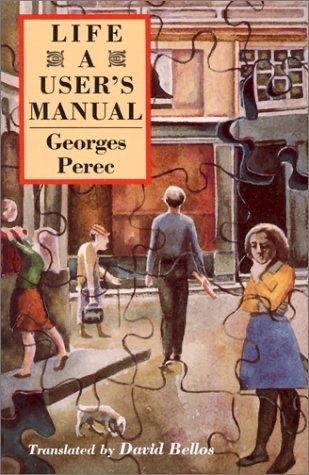
 Life A User's Manual
Quotes from the Book
This is how space begins, with words only, signs traced on the blank page. To describe space: to name it, to trace it, like those portolano-makers who saturated the coastlines with the names of harbours, the names of capes, the names of inlets, until in the end the land was only separated from the sea by a continuous ribbon of text. Is the aleph, that place in Borges from which the entire world is visible simultaneously, anything other than an alphabet?
35
To write: to try meticulously to retain something, to cause something to survive; to wrest a few precise scraps from the void as it grows, to leave somewhere a furrow, a trace, a mark or a few signs.
23
It seems we only sleep well in our own bed.
11
I would like there to exist spaces that are stable, unmoving, intangible, untouched and almost untouchable, unchanging, deep-rooted; places that might be points of reference, of departure, of origin: My birthpalce, the cradle of my family, the house where I may have been born, the tree I may have seen grow (that my father may have planted the day I was born), the attic of my childhood filled with intact memories . . . Such places don't exist, and it's because they do'nt exist that space becomes a question, ceases to be self-evident, ceases to be incorporated, ceases to be appropriated. Space is a doubt: I have constantly to mark it, to designate it, It is never mine, never given to me, I have to conquer it. My spaces are fragile: time is going to wear them away, to destroy them. Nothing will any longer reseble waht was, my memories will betray me, oblivion will infiltrate my memory, I shall look at a few old yellowing photographs with broken edges without recognising them. The words 'Phone directory available within' or 'Snacks served at any hour' will no longer be written up in a semi-circle in white porcelain letter on the window of the little café in the Rue Coquillière. Space melts like sand running through one's fingers. Time bears it away and leaves me only Shapeless shreds: To write: to try meticulously to retain something, to cause something to survive; to wrest a few precise scraps from the void as it grows, to leave somewhere a furrow, a trace, a mark or a few signs. Paris 1973-1974
9
Like the librarians of Babel in Borges’s story, who are looking for the book that will provide them with the key to all the others, we oscillate between the illusion of perfection and the vertigo of the unattainable. In the name of completeness, we would like to believe that a unique order exists that would enable us to accede in knowledge all in one go; in the name of the unattainable, we would like to think that order and disorder are in fact the same word, denoting pure chance. It’s possible also that both are decoys, illusions intended to disguise the erosion of both books and systems. It is no bad thing in any case that between the two our bookshelves should serve from time to time as joggers of the memory, as cat-rests and as lumber-rooms.
9
I would like there to exist places that are stable, unmoving, intangible, untouched and almost untouchable, unchanging, deep-rooted; places that might be points of reference, of departure, of origin: My birthplace, the cradle of my family, the house where I may have been born, the tree I may have seen grow (that my father may have planted the day I was born), the attic of my childhood filled with intact memories… My spaces are fragile: time is going to wear them away, to destroy them. Nothing will any longer resemble what was, my memories will betray me, oblivion will infiltrate my memory, I shall look at a few old yellowing photographs with broken edges without recognising them… Space melts like sand running through one’s fingers. Time bears it away and leaves me only shapeless shreds: To write: To try meticulously to retain something, to cause something to survive; to wrest a few precise scraps from the void as it grows, to leave somewhere a furrow, a trace, a mark or a few signs.
4
What speaks to us, seemingly, is always the big event, the untoward, the extra-ordinary: the front-page splash, the banner headlines....Behind the event there is a scandal, a fissure, a danger, as if life reveals itself only by way of the spectacular, as if what speaks, what is significant, is always abnormal. [But] how should we take account of, question, describe what happens everyday and recurs everyday: the banal, the quotidian, the obvious, the common, the ordinary, the infra-ordinary, the background noise, the habitual? (209-210)
4
To live is to pass from one space to another, while doing your very best not to bump yourself
1
The space of our lives is neither continuous, nor infinite, nor homogeneous or isotropic. But do we know exactly where it breaks off, where it curves, where it disconnects and comes together? We confusedly experience cracks, gaps and points of friction, sometimes vaguely aware that something is stuck, that it breaks loose or collides. Though we seldom seek to learn more about it and more often than not, wander from one spot to another, from one space to another, without measuring, without taking into account or considering the course of space. The issue is not to invent space and certainly not to re-invent it (too many well-intentioned individuals are already there to reflect upon our environment...), the problem is rather to question space, or more exactly, to read space; for what we call everydayness is not the obvious, but opacity: a kind of blindness, or deafness, a sort of anesthesia.
Watch on YouTube
About Georges Perec
We have collected 15 quotes from 2 books by Georges Perec on BookQuoters.
More about the author →More by Georges Perec
Life A User's Manual
About the book
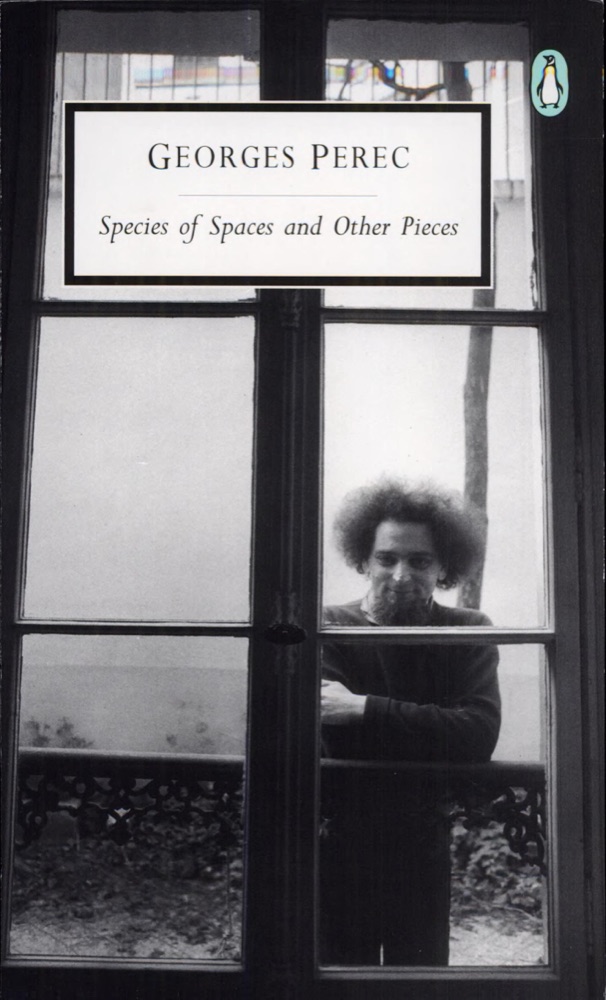
George Perec produced some of the most entertaining and spirited essays of his age, and Species of Spaces and Other Pieces is edited and translated from the French with an introduction by John Sturrock in Penguin Classics.
Georges Perec, author of Life: A User's Manual, was one of the most surprising and enjoyable of all modern French writers. The pieces in this volume show him to be at times playful, more serious at other, but writing always with the lightest of touches. He had the keenest of eyes for the 'infra-ordinary', the things we do every day - eating, sleeping, working - and the places we do them in without giving them a moment's thought. But behind the lightness and humour, there is also the sadness of a French Jewish boy who lost his parents in the Second World War and found comfort in the material world around him, and above all in writing.
This volume contains a select
Book details
- First published
- 1974
- Author
- Georges Perec
- Genre
- Nonfiction
- Goodreads rating
- 4.26 (4k ratings)
Keep reading
 Selected Non-Fictions
 Flights
 The Poetics of Space
 The Book of Form and Emptiness
 The Paper Menagerie and Other Stories
 The Faraway Nearby
 The Practice of Everyday Life
 The Invention of Solitude
 The Abundance
 Autumn
 Speak, Memory
 The Notebooks of Malte Laurids Brigge
 The Names
 In Ascension
 Winter Hours: Prose, Prose Poems, and Poems
 Night Train to Lisbon
 Hourglass: Time, Memory, Marriage
 Illuminations: Essays and Reflections
 Until the End of Time: Mind, Matter, and Our Search for Meaning in an Evolving Universe
 Checkout 19
 Silence: In the Age of Noise
 Winter
 Flatland: A Romance of Many Dimensions
 Labyrinths: Selected Stories and Other Writings
 The Passion According to G.H.
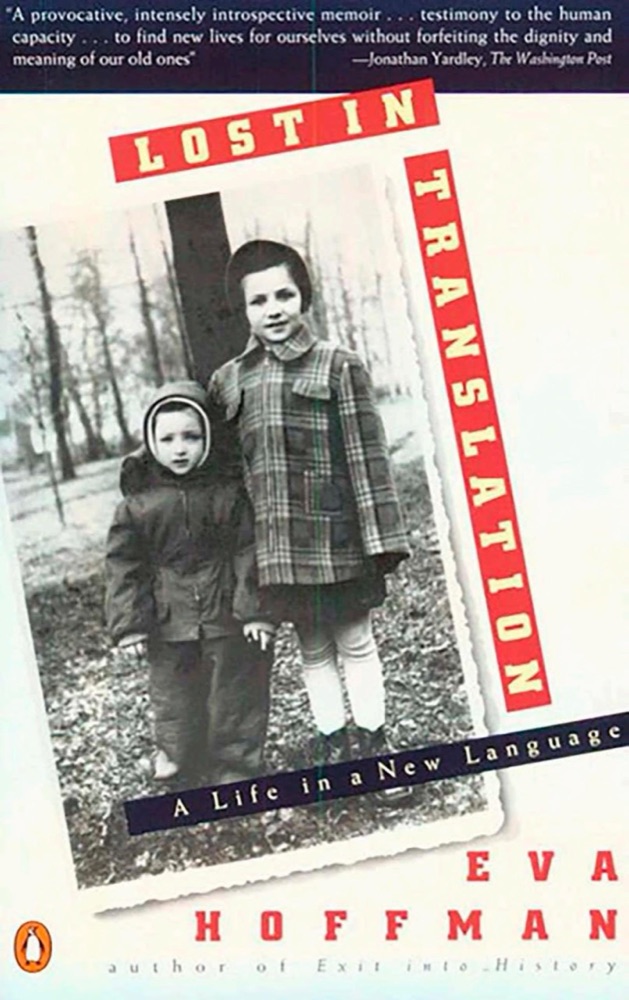 Lost in Translation: A Life in a New Language
 Nutshell
 Teaching a Stone to Talk: Expeditions and Encounters
 At Large and At Small: Familiar Essays
 The Sorrows of an American
 Identity
 The Book of Dreams
 Sputnik Sweetheart
 Lost Children Archive
 A Fisherman of the Inland Sea
 The Island of the Day Before
 The Aleph and Other Stories
 The Stone Gods
 Always Coming Home
 Silence: Lectures and Writings
 Blueberries: Essays Concerning Understanding
 Figuring
 Winter Journal
 To Be Taught, If Fortunate
 The Accidental Universe: The World You Thought You Knew
 On Connection
 Winter
 Sexus
Sexus
 And Our Faces, My Heart, Brief as Photos
 Toward Eternity
 Exhalation
 Phenomenology of Perception
 M Train
 2312
2312
 The Order of Time
 Drive Your Plow Over the Bones of the Dead
 In Search of Lost Time
 To Sleep in a Sea of Stars
 Dear Friend, from My Life I Write to You in Your Life
 One Way Street And Other Writings