
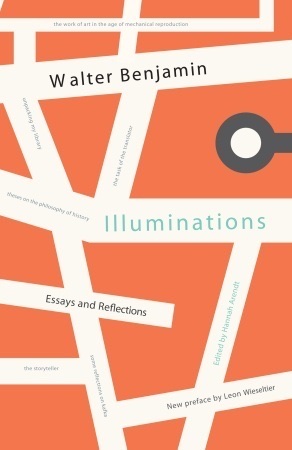
 Illuminations: Essays and Reflections
Quotes from the Book
The concept of progress must be grounded in the idea of catastrophe. That things are "status quo" is the catastrophe. It is not an ever-present possibility but what in each case is given. Thus hell is not something that awaits us, but this life here and now.
28
As long as there is still one beggar around, there will still be myth.
22
Something different is disclosed in the drunkenness of passion: the landscape of the body... These landscapes are traversed by paths which lead sexuality into the world of the inorganic. Fashion itself is only another medium enticing it still more deeply into the universe of matter.
14
Everything remembered, everything thought, all awareness becomes base, frame, pedestal, lock and key of his ownership. Period, region, craft, previous owners - all, for the true collector, merge in each one of his possessions into a magical encyclopaedia whose quintessence is the fate of his object.
12
Historical materialism has every reason to distinguish itself sharply from bourgeois habits of thought. Its founding concept is not progress but actualization.
8
Not architecture alone but all technology is, at certain stages, evidence of a collective dream.
5
That things are "status quo" is the catastrophe.
5
For the materialist historian, every epoch with which he occupies himself is only a fore-history of that which really concerns him. And that is precisely why the appearance of repetition doesn't exist for him in history; because the moments in the course of history which matter most to him become moments of the present through their index as "fore-history," and change their characteristics according to the catastrophic or triumphant determination of that present.
5
Trace and aura. The trace is appearance of a nearness, however far removed the thing that left it behind may be. The aura is appearance of a distance, however close the thing that calls it forth. In the trace, we gain possession of the thing; in the aura, it takes possession of us.
1
For the philosopher, the most interesting thing about fashion is its extraordinary anticipations. It is well known that art will often-for example, in pictures-precede the perceptible reality by years. It was possible to see streets or rooms that shone in all sorts of fiery colours long before technology, by means of illuminated signs and other arrangements, actually set them under such a light. Moreover, the sensitivity of the individual artist to what is to coming certainly far exceeds that of the grande dame. Yet fashion is in much steadier, much more precise contact with the coming thing, thanks to the incomparable nose which the feminine collective has for what lies waiting in the future. Each season brings, in its newest creations, various secret signals of things to come. Whoever understand how to read these semaphores would know in advance not only about new currents in the arts but also about new legal codes, wars and revolutions.-Here, surely lies the greatest charm of fashion, but also the difficulty of making the charming fruitful.
1
These arcades, a recent invention of industrial luxury, are glass-roofed, marble-panelled corridors extending through whole blocks of buildings, whose owners have joined together for such enterprises. Lining both sides of the corridors, which get their light from above, are the most elegant shops, so that the arcade is a city, a world in miniature, in which customers will find everything they need.
1
The realization of dream elements, in the course of waking up, is the paradigm of dialectical thinking. Thus, dialectical thinking is the organ of historical awakening. Every epoch, in fact, not only dreams the one to follow but in dreaming, precipitates its awakening. "It bears its end within itself and unfolds it-as Hegel already noticed-by cunning. With the destabilizing of the market economy, we begin to recognize the monuments of the bourgeoisie as ruins even before they have crumbled.
At the entrance, a mailbox: last opportunity to make some sign to the world one is leaving.
The private individual, who in the office has to deal with reality, needs the domestic interior to sustain him in his illusions. This necessity is all the more pressing since he has no intention of allowing his commercial consideration to impinge on social ones. In the formation of his private environment, both are kept out. From this arises the phantasmagorias of the interior, which, for the private man, represents the universe. In the interior, he brings together the far away and the long ago. His room is a box in the theater of the world.
Watch on YouTube
About Walter Benjamin
We have collected 64 quotes from 3 books by Walter Benjamin on BookQuoters.
More about the author →More by Walter Benjamin
Illuminations: Essays and Reflections
 One Way Street And Other Writings
About the book
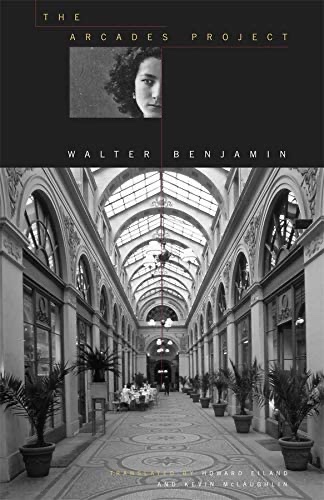
"To great writers," Walter Benjamin once wrote, "finished works weigh lighter than those fragments on which they labor their entire lives." Conceived in Paris in 1927 and still in progress when Benjamin fled the Occupation in 1940, The Arcades Project (in German, Das Passagen-Werk) is a monumental ruin, meticulously constructed over the course of thirteen years--"the theater," as Benjamin called it, "of all my struggles and all my ideas."
Focusing on the arcades of nineteenth-century Paris-glass-roofed rows of shops that were early centers of consumerism--Benjamin presents a montage of quotations from, and reflections on, hundreds of published sources, arranging them in thirty-six categories with descriptive rubrics such as "Fashion," "Boredom," "Dream City," "Photography," "Catacombs," "Advertising," "Prostitution," "Baudelaire," and "Theory of Progress." His central preoccupation is
Book details
- First published
- 1982
- Author
- Walter Benjamin
- Genre
- Philosophy
- Goodreads rating
- 4.45 (3k ratings)
Keep reading
Illuminations: Essays and Reflections
 The Medium is the Massage
 Ghosts of My Life: Writings on Depression, Hauntology and Lost Futures
 Understanding Media: The Extensions of Man
 The Shock of the New
 Irrational Man: A Study in Existential Philosophy
One Way Street And Other Writings
Irrational Man: A Study in Existential Philosophy
One Way Street And Other Writings
 The Poetics of Space
 Labyrinths: Selected Stories and Other Writings
 Simulacra and Simulation
 The Practice of Everyday Life
 The Futurological Congress: From the Memoirs of Ijon Tichy
 America
 From Dawn to Decadence: 500 Years of Western Cultural Life, 1500 to the Present
 Flights
 The World as Will and Representation, Vol 1
 The Atrocity Exhibition
 The Birth of Tragedy
 Towards a New Architecture
 Primeval and Other Times
 Selected Non-Fictions
 Invisible Cities
 The Fifth Science
 The Doors of Perception & Heaven and Hell
 2312
2312
 Distrust That Particular Flavor
 Last and First Men
 The Art of the Novel
 Anti-Oedipus: Capitalism and Schizophrenia
 Underworld
 The Coming Insurrection
 Dialectic of Enlightenment: Philosophical Fragments
 The Occult
 The Invention of Solitude
 The Essays of Ralph Waldo Emerson
 Myths to Live By
 The Castle of Crossed Destinies
 The Order of Things: An Archaeology of the Human Sciences
 The Pleasures and Sorrows of Work
 Gnomon
 The Society of the Spectacle
 Skinny Legs and All
 The Curtain: An Essay in Seven Parts
 The Glass Bead Game
 Selections from the Prison Notebooks
 Eyeless in Gaza
 The Crisis of the Modern World
 Twilight of the Idols/The Anti-Christ
 Mao II
 The Discovery of India
 Genesis
 The Empusium
 The Infernal Desire Machines of Doctor Hoffman
 Moravagine
 The Everlasting Man
 Untimely Meditations
 The Human Condition
 Sculpting in Time
 In the Light of What We Know
 Cultural Amnesia: Necessary Memories from History and the Arts