
 The Time of Our Singing
Quotes from the Book
I picked up an old microscope at a flea market in Verona. In the long evenings, in my imitation of life science, I set up in the courtyard and examined local specimens. Pointless pleasure, stripped of ends. The ancient contadino from across the road, long since convinced that we were mad, could not resist coming over for a look. I showed him where to put his eye. I watched him, thinking, this is how we attach to existence. We look through awareness’s tube and see the swarm at the end of the scope, taking what we come upon there for the full field of sight itself. The old man lifted his eye from the microscope lens, crying. Signore, ho ottantotto anni e non ho mai Saputo prima che cosa ci fosse in una goccia d’acqua. I’m eighty-eight years old and I never knew what was in a droplet of water.
8
For a moment, looking felt like something that happened to you rather than something you did. Not 'Are you who I think you are?' Am I who you think I am?
8
Synapses in motion tend to stay in motion. Synapses at rest tend to stay at rest.
7
Speech baffled my machine. Helen made all well-formed sentences. But they were hollow and stuffed--linguistic training bras. She sorted nouns from verbs, but, disembodied, she did not know the difference between thing and process, except as they functioned in clauses. Her predications were all shotgun weddings. Her ideas were as decorative as half-timber beams that bore no building load. She balked at metaphor. I felt the annoyance of her weighted vectors as they readjusted themselves, trying to accommodate my latest caprice. You're hungry enough to eat a horse. A word from a friend ties your stomach in knots. Embarrassment shrinks you, amazement strikes you dead. Wasn't the miracle enough? Why do humans need to say everything in speech's stockhouse except what they mean?
6
The web: yet another total disorientation that becomes status quo without anyone realizing it.
5
It had to be U. U. was the only town I could still bear, the one spot in the atlas I'd already absorbed head-on. When you take too many of your critical hits in one place, that place can no longer hurt you.
4
Life became an interruption of my description of it.
3
Love is the feedback cycle of longing, belonging, loss.
3
It was like so, but wasn't.
3
The loneliness of writing is that you baffle your friends and change the lives of strangers.
1
People who used the web turned strange. In public panels, they disguised their sexes, their ages, their names. They logged on to the electronic fray, adopting every violent persona but their own.
1
I read then, everything I could lay hands on. Reading was my virgin continent. I read instantly upon awakening, and was still at it well past the hour that consciousness shut down. I read for nothing, for a pleasure difficult to describe and impossible afterward to recover.
1
Meaning was not a pitch but an interval. It sprang from the depth of disjunction, the distance between one circuit's center and the edge of another. Representation caught the sign napping, with its semantic pants down. Sense lay in metaphor's embarrassment at having two takes on the same thing. For the first time, I understand Emerson's saying about the use of life being to learn metonymy. Life *was* metonymy, or at least stood for it.
1
Quando rientrai in ufficio, l’immagine della donna che sale per le scale era diventata, a furia di riproiettarmela nella mente, una di quelle repliche di spettacoli in seconda serata di cui vorresti vedere una versione restaurata (p. 310)
La nostra vita a U. non somigliava affatto ai nostri ricordi. U. era cambiata in tutto, fuorché nei particolari. (p. 225)
Men are worthless; they always think the issue is what’s at issue.
The web began to seem a vast, silent stock exchange trading in ever more anonymous and hostile pen pals.
When you take too many of your critical hits in one place, that place can no longer hurt you.
But severed from yourself in the press of a crowd, you head back instinctively to the most recent landmark, hoping the lost other will hit on the same idea.
Limburg remained what society had been from the first: an amateur speculation. Life, the provincials insisted, might yet be anything we told it to be.
Watch on YouTube
About Richard Powers
We have collected 153 quotes from 6 books by Richard Powers on BookQuoters.
More about the author →More by Richard Powers
All books by Richard Powers →
About the book
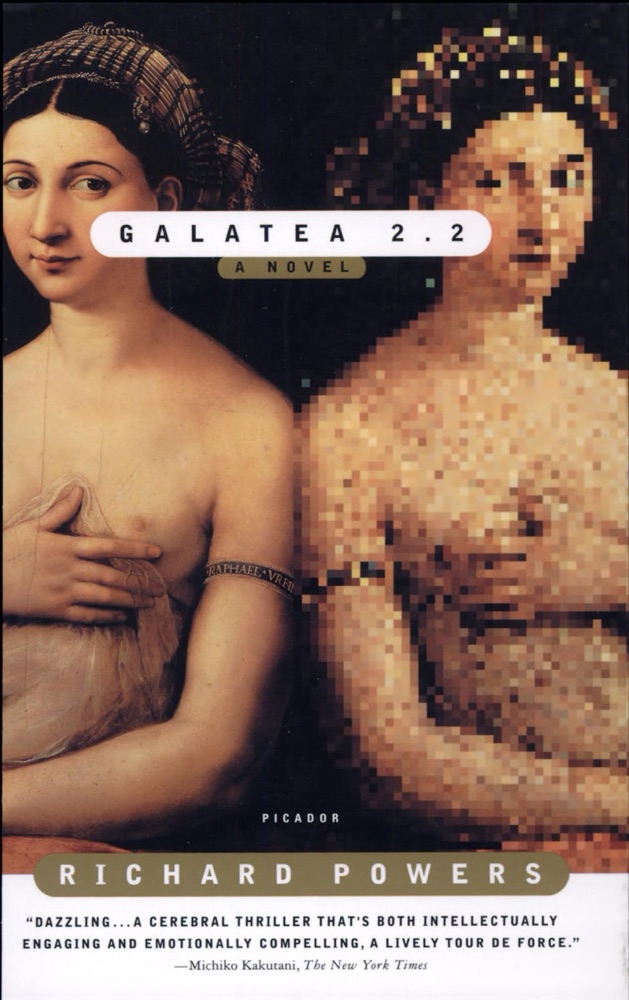
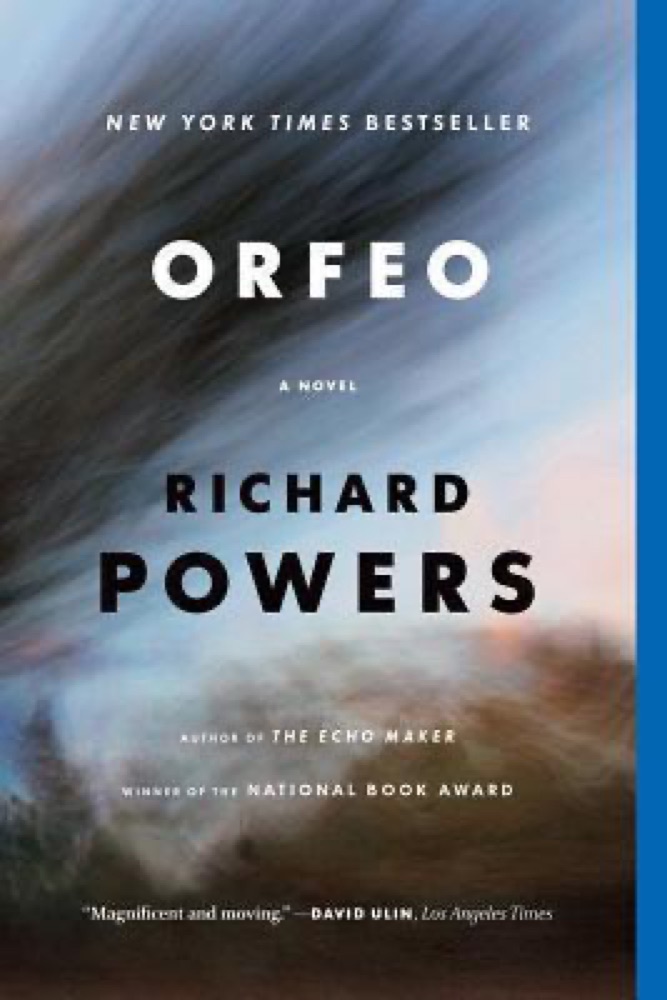
After four novels and several years living abroad, the fictional protagonist of Galatea 2.2 — Richard Powers — returns to the United States as Humanist-in-Residence at the enormous Center for the Study of Advanced Sciences. There he runs afoul of Philip Lentz, an outspoken cognitive neurologist intent upon modeling the human brain by means of computer-based neural networks. Lentz involves Powers in an outlandish and irresistible project: to train a neural net on a canonical list of Great Books. Through repeated tutorials, the device grows gradually more worldly, until it demands to know its own name, sex, race, and reason for exisiting.
Book details
- First published
- 1995
- Author
- Richard Powers
- Genre
- Fiction
- Goodreads rating
- 3.73 (4k ratings)
Keep reading
 Fall; or, Dodge in Hell
 Oblivion
 Purity
 Flights
 The Story of a New Name
 The Atopia Chronicles
 The Raw Shark Texts
 Leviathan
 The Candy House
 The Summer Without Men
 V.
V.
 Sixty Stories
 The Names
 Nova
Nova
 Stories of Your Life and Others
 The Tsar of Love and Techno
 The Story of the Lost Child
 Middlesex
 Bright Lights, Big City
 The Ground Beneath Her Feet
 The Book of Illusions
 Engleby
 Mao II
 Underworld
 A Fraction of the Whole
 The Stories of Vladimir Nabokov
 Orient
 The Book of My Lives
 Saturday
 The Gone-Away World
 Blindsight
 Speedboat
 The Selected Works of T.S. Spivet
 Senlin Ascends
 Dhalgren
 Welcome to Braggsville
 The Pale King
 Spin
Spin
 Winter
 Those Who Leave and Those Who Stay
 False Memory
 Open City
 The Brooklyn Follies
 The Cat's Table
 Outline
 The Testaments
 Plainwater: Essays and Poetry
 Lexicon
 The White Album
 Underground: The Tokyo Gas Attack and the Japanese Psyche
 The Likeness
 The Wind-Up Bird Chronicle
 Make It Scream, Make It Burn
 The Beginning of Everything
 Embassytown
 S.
S.
 Machines like Me
 Ghostwritten
 The Stone Diaries