
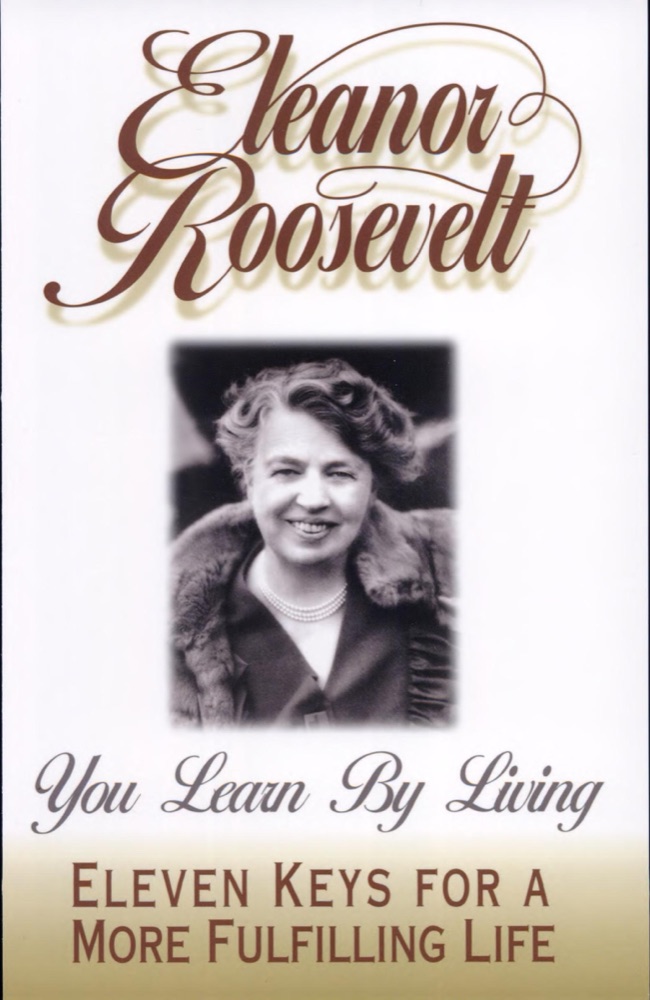
 You Learn by Living: Eleven Keys for a More Fulfilling Life
Quotes from the Book
Do not stop thinking of life as an adventure. You have no security unless you can live bravely, excitingly, imaginatively; unless you can choose a challenge instead of competence.
1.2k
He who learns but does not think is lost. He who thinks but does not learn is in great danger.
52
Understanding is a two-way street.
37
Justice cannot be for one side alone, but must be for both.
34
No matter what you do , some people will criticize you , and if you are entirely sure that you would not be ashamed to explain your action to someone you loved and who loved you , and you are satisfied in your own mind that you are doing right , then you need not worry about criticism nor need you ever explain what you do .
8
About the only value the story of my life may have is to show that one can, even without any particular gifts, overcome obstacles that seem insurmountable if one is willing to face the fact that they must be overcome; that, in spite of timidity and fear, in spite of a lack of special talents, one can find a way to live widely and fully. Perhaps the most important thing that has come out of my life is the discovery that if you prepare yourself at every point as well as you can, with whatever means you may have, however meager they may seem, you will be able to grasp opportunity for broader experience when it appears. Without preparation you cannot do it. The fatal thing is the rejection. Life was meant to be lived, and curiosity must be kept alive. One must never, for whatever reason, turn his back on life.
5
It is, I am afraid, true that frequently various religious groups endeavor to exert pressures and control over different legislative and educational fields. It is the job of all of us to be alert for such infringement of our prerogatives and prevent any such attempts from being successful. Like all our freedoms, this freedom from religious-group pressure must be constantly defended. What seemed to me most deplorable
3
we have one weakness that, considering our political maturity as a nation, is rather immature. We continue to expect the world to be grateful to us and to love us. We are hurt and indignant when we do not receive gratitude and love. Gratitude and love are not to be had for the asking; they are not to be bought. We should not want to think that they are for sale. What we should seek, rather than gratitude or love, is the respect of the world. This we can earn by enlightened justice. But it is rather naïve of us to think that when we are helping people our action is entirely unselfish. It is not. It is not unselfish when we vaccinate the public against smallpox. It is a precautionary measure, but nonetheless good in itself. Other nations are quite aware that when we try to bolster up their economy and strengthen their governments and generally help them to succeed there is a certain amount of self-interest involved.
2
I learned, too, while I was groping for more and more effective ways of trying to cope with community and national and world problems, that you can accomplish a great deal more if you care deeply about what is happening to other people than if you say in apathy or discouragement, “Oh, what can I do? What use is one person? I might as well not bother.” Actually I suppose the caring comes from being able to put yourself in the position of the other person. If you cannot imagine, “This might happen to me,” you are able to say to yourself with indifference, “Who cares?” I think that one of the reasons it is so difficult for us, as a people, to understand other areas of the world is that we cannot put ourselves imaginatively in their place. We have no famine. But if we were actually to see people dying of starvation we would care quite
2
Perhaps the older generation is often to blame with its cautious warning: “Take a job that will give you security, not adventure.” But I say to the young: “Do not stop thinking of life as an adventure. You have no security unless you can live bravely, excitingly, imaginatively; unless you can choose a challenge instead of a competence.
2
Occasionally he took us on a picnic or a camping trip and taught us many valuable lessons. The chief one was to remember that camping was a good way to find out people’s characters. Those who were selfish showed it very soon, in that they wanted the best bed or the best food and did not want to do their share of the work.
2
The more the world speeds up the more it seems necessary that we should learn to pick out of the past the things that we feel were important and beautiful then. One of these things was a quality of tranquillity in people, which you rarely meet today.
2
I learned something which has stood me in good stead many times—the most important thing in any relationship is not what you get but what you give.
2
No one can make you feel inferior without your permission
1
All human beings have failings, all human beings have needs and temptations and stresses. Men and women who live together through long years get to know one another's failings; but they also come to know what is worthy of respect and admiration in those they live with and in themselves. If at the end one can say, "This man used to the limit the powers that God granted him; he was worthy of love and respect and of the sacrifices of many people, made in order that he might achieve what he deemed to be his task," then that life has been lived well and there are no regrets.
1
The royal couple stood on the rear platform of the train as it pulled out and the people who were gathered on the banks of the Hudson suddenly began to sing, "Auld Lang Syne." There was something incredibly moving about the scene—the river in the evenign light, the voices of many people singing this old song, and the train slowly pulling out with the young couple waving good-by. One thought of the clouds that hung over them and the worries they were going to face, and turned away and left the scene with a heavy heart.
1
Nothing we learn in this world is ever wasted and I have come to the conclusion that practically nothing we do ever stands by itself. If it is good, it will serve some good purpose in the futue. If it is evil, it may haunt us and handicap our efforts in unimagined ways.
1
There are two kinds of snobbishness: One is that of the man who has had a good many opportunities and looks down on those who lack them. The other is rarely understood, that of the self-made man who glories in his success in overcoming difficulties and admires greatly people who have achieved the things he considers of importance.
1
he had had an offer for me to do television commercials for an organization that sold margarine. “I know this isn’t the kind of thing you had in mind,” he pointed out, “but if a conservative firm feels that you can sell their
1
We no longer have merely domestic issues. Perhaps the best illustration of this is the question I am asked everywhere in the world: “We hear you Americans pay to keep land out of production because there is too much to eat. Is there no better way to use your ability to produce food than to get rid of it?” This is a home question; it is literally of vital moment to the millions of starving in the world who look to us. I do not see how we can retain world leadership and yet continue to handle our problems as though they concerned us alone; they concern the world. We feel that a surplus of food is only an embarrassment. We solve it as though only we were concerned. But think of the hungry people and their bitterness as the food that could save their lives is plowed under. To say they think it highly unfair is to put it mildly. We have never put our best brains to work on the ways we can produce to the maximum, give our farmers a better income, and still employ our surpluses in a way to solve the pressing needs of the world, without upsetting our economy or that of friendly nations who might fear we were giving food to markets they are accustomed to selling to.
1
the toe of an enormous and heroic
1
One curious feature about political reform is that so many people feel it is “disloyal” to attempt to rectify the abuses in one’s own party. And yet it is obvious that political morality is dependent upon the awakened conscience and private morality of the voters. Such “disloyalty” is simply an evidence of loyalty to principle.
1
Many of the boys I saw in hospitals are now leading happy and useful lives, but they carry with them, day after day, the results of the war. If we do not achieve the ends for which they sacrificed—a peaceful world in which there exists freedom from fear of both aggression and want—we have failed.
1
If people only realized what a war goes on in a child’s mind and heart in a situation of this kind, I think they would try to explain more than they do,
1
A real picture of any human being is interesting in itself, and it is especially interesting when we can follow the play of other personalities upon that human being and perhaps get a picture of a group of people and of the influence on them of the period in which they lived.
1
one must learn to look on whatever happens as part of one’s education and make it serve a good purpose.
In addition, the fact that he can never have a personal loyalty greater than that to the nation sometimes makes it seem as though he were disloyal to his friends; but a man holding the office of President of the United States must think first of what he considers the greatest good of the people and the country.
One of the most interesting and peculiar visitors was Alexander Woollcott, who came to the White House in January and spent four days with us. I doubt if it would have been possible to have had Mr. Woollcott as one’s guest very long in any ordinary household, because he required a good many things that the ordinary household could not easily provide. For instance, he wanted coffee at all hours, and he invited guests for meals in his bedroom or in a sitting room where he could be alone with them. My work and my engagements kept me away from the house a good part of the time, but late one afternoon I returned just as he was leaving for an engagement. As I came in the door he said: “Welcome, Mrs. Roosevelt, come right in. I am delighted to see you. Make yourself at home.
Finally the King and Queen arrived and I met them at the door and took them to their rooms. In a short time they were dressed and down in the library. As the King approached my husband and the cocktail table, my husband said, “My mother does not approve of cocktails and thinks you should have a cup of tea.” The King answered, “Neither does my mother,” and took a cocktail.
In 1937, about the time he brought Jimmy to Washington, Franklin became much troubled over the decisions that the Supreme Court was rendering. His advisers were divided, some of them feeling that it was unwise to have any change made in the Court. Franklin felt that if it was going to be possible to pass progressive legislation only to have it declared unconstitutional by the Supreme Court, no progress could be made. He also felt that people became too conservative as they grew older and that they should not be allowed to continue indefinitely to wield great power.
Watch on YouTube
About Eleanor Roosevelt
We have collected 60 quotes from 2 books by Eleanor Roosevelt on BookQuoters.
More about the author →More by Eleanor Roosevelt
You Learn by Living: Eleven Keys for a More Fulfilling Life
About the book
The long and eventful life of Eleanor Roosevelt (1884–1962) was full of rich experiences and courageous actions. The niece of Theodore Roosevelt, she married a distant relative and Columbia University law student named Franklin Delano Roosevelt; he gradually ascended throughout the world of New York politics to reach the U.S. presidency in 1932. Throughout his three terms, Eleanor Roosevelt was not only intimately involved in FDR’s personal and political life, but led women’s organizations and youth movements and fought for consumer welfare, civil rights, and improved housing. During World War II she traveled with her husband to meet leaders of many powerful nations; after his death in 1945 she worked as a UN delegate, chairman of the Commission on Human Rights, newspaper columnist, Democratic party activist, world-traveler, and diplomat. By the end of her life, Eleanor Roosevelt was rec
Book details
- First published
- 1960
- Author
- Eleanor Roosevelt
- Genre
- Nonfiction
- Goodreads rating
- 3.93 (4k ratings)
Keep reading
 A Promised Land
You Learn by Living: Eleven Keys for a More Fulfilling Life
A Promised Land
You Learn by Living: Eleven Keys for a More Fulfilling Life
 My Beloved World
 Parable of the Talents
 Independent Study
 The Hands of the Emperor
 The Lincoln Highway
 You Can't Be Neutral on a Moving Train: A Personal History of Our Times
 Becoming
 The Small and the Mighty: Twelve Unsung Americans Who Changed the Course of History, from the Founding to the Civil Rights Movement
 Varina
 United: Thoughts on Finding Common Ground and Advancing the Common Good
 The Autobiography of Martin Luther King, Jr.
 Anthills of the Savannah
 Hell and Other Destinations: A 21st-Century Memoir
 The Story of My Experiments With Truth
 Gifted Hands: The Ben Carson Story
 Conversations With Myself
 Behold the Dreamers
 The Measure of a Man: A Spiritual Autobiography
 The Blue Sweater: Bridging the Gap Between Rich and Poor in an Interconnected World
 The American Spirit: Who We Are and What We Stand For
 Promises to Keep: On Life and Politics
 The Heart and the Fist: The Education of a Humanitarian, the Making of a Navy SEAL
 Letters and Papers from Prison
 How Do You Live?
 The Sympathizer
 Shortest Way Home: One Mayor's Challenge and a Model for America's Future
 My Own Words
 My Life on the Road
 Across That Bridge: A Vision for Change and the Future of America
 Elizabeth Finch
 Long Walk to Freedom
 Leonard and Hungry Paul
 Up from Slavery
 The Once and Future King
 An Artist of the Floating World
 The Discovery of India
 Mornings on Horseback
 The Cider House Rules
 Essays of E.B. White
 The Way of All Flesh
 Scion of Ikshvaku
 The Jewel in the Crown
 Children of Dune
 The Fall of Babel
 The Rainbow Comes and Goes: A Mother and Son on Life, Love, and Loss
 The Bassoon King: My Life in Art, Faith, and Idiocy
 Wide Awake
 Walden Two
 The Home and the World
 In the Light of What We Know
 Nobody Knows My Name
 The World According to Mister Rogers: Important Things to Remember
 The Source of Self-Regard: Selected Essays, Speeches, and Meditations
 Riding the Elephant: A Memoir of Altercations, Humiliations, Hallucinations, and Observations
 The Truths We Hold: An American Journey
 The Great Mistake
 Shadow of the Hegemon