
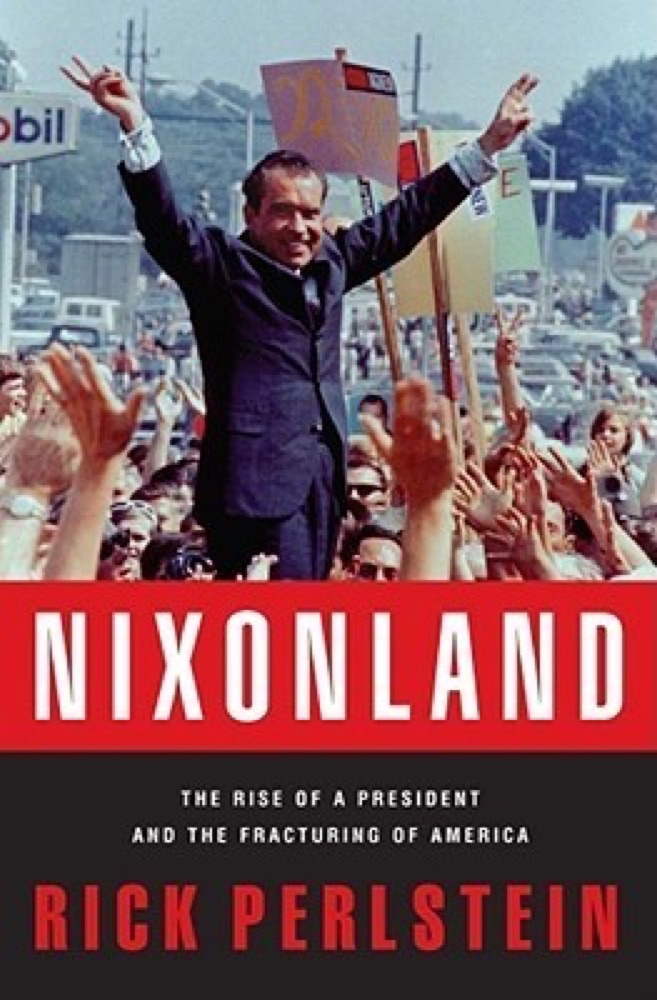
 Nixonland: The Rise of a President and the Fracturing of America
Quotes from the Book
What does sincerity mean if it is chosen as deliberate strategy?
11
Increasingly we confused the pursuit of happiness with the pursuit of pleasure.
4
Besides, he knew something that Chuck Percy, ABC News, the New Yorker, the New York Times, and even the President of the United States did not know: a new conservative-movement political machine was humming just beneath the Establishment’s radar in North Carolina, ready to rewire what people thought they knew about how American politics worked. THE
2
He talks to people's grievances, but he doesn't seem mad. – Elizabeth Drew
2
It was called A Ford, Not a Lincoln, and in it, Richard Reeves described him as “slow, plodding, pedestrian, unimaginative,” “inarticulate,” and “ignorant”—though you didn’t have to take Reeves’s word for it. He also quoted the president’s Grand Rapids pastor: “Gerald Ford is a normal, decent, God-fearing man, but you can say that about a lot of people.
1
Heroes can only thrive where ignorance reduces history to mythology. They. cannot survive the coldly critical temper of modern thought when it is functioning normally, nor can they be worshipped by a generation which has every facility for determining their foibles and analyzing their limitations.
1
One does not hold a conversation with him. One holds a symposium. – Elizabeth Drew
1
To claim the mantle of purity is always a risky business. It just gives an excuse to be disillusioned once your ordinary humidity is exposed.
1
Conservatives felt victimized by a sort of radicalism that, because it graced Middle American classrooms, did not seem radical to most Americans at all.
1
Some days there were more police in schools than students. Rumors spread that armed black marauders would ride through their neighborhoods shooting whites at random; that blacks were carrying knives and razors to school to turn girls’ rooms into rape rooms. So whites started carrying them first.
1
Some in his community were suspicious, too—how convenient that people always managed to almost drown themselves whenever young Reagan was around, and how annoying that he never seemed to shut up about it.
People want to believe. Ronald Reagan was able to make people believe.
It was part of what made Reagan's national prospects seem grand. Because nostalgia was becoming a national cult.
America the Innocent, always searching for the totems of a unity that it can never quite achieve--even, or especially, when its crises of disunity are most pressing. It is one of the structuring stories of our nation. The "return to normalcy" enjoined by Warren Harding after the Great War; the cult of suburban home and hearth after World War II; the union of hearts declaimed by Adams on Boston's Bunker Hill parade ground after the War Between the States.
America had not yet become Reagan’s America. Not yet. Reagan’s America would embrace an almost official cult of optimism—the belief that America could do no wrong. Or, to put it another way, that if America did it, it was by definition not wrong. That would come later. But signs were already pointing in that direction.
Some people think an actor should keep his mouth shut. I think that is wrong. An actor should be careful to know that no group is using him for a selfish purpose, but if he sincerely believes in something he should use his voice.
Haldeman exposed the other side of the Silent Majority rhetorical coin: it welcomed division. It welcomed hate. For if the world was divided between good and evil, hating evil was the appropriate response. And what violations of procedural nicety weren’t permissible in order to vanquish evil?
world run according to the Gospel of Richard Nixon, where good guys were always good no matter what they actually did, bad guys were always and everywhere ontologically evil, and no one will be safe until “ ‘we’ crack down on ‘them,’ occasionally adopting their tactics.
But if you admit to not having the answer to any of the problems facing the nation, why should anyone vote of your for President?” “I believe I am the best qualified to wing it.” But
Failures as people: millions of Americans felt that this description fit them to a T. Seeking a solution, any solution, they eagerly forked over their cash to any huckster who promised release, the quicker and more effortlessly the better: therapies like “bioenergetics” (“The Revolutionary Therapy That Uses the Language of the Body to Heal the Problems of the Mind”); Primal Scream (which held that when patients shrieked in a therapist’s office, childhood trauma could be reexperienced, then released; John Lennon and James Earl Jones were fans); or Transcendental Meditation, which promised that deliverance could come if you merely closed your eyes and chanted a mantra (the “TM” organization sold personal mantras, each supposedly “unique,” to hundreds of thousands of devotees). Or “religions” like the Church Universal and Triumphant, or the Reverend Sun Myung Moon’s Unification Church, or “Scientology”—this last one invented by a science fiction writer, reportedly on a bet. Devotees paid cash to be “audited” by practitioners who claimed the power—if, naturally, you paid for enough sessions—to remove “trauma patterns” accreted over the 75 million years that had passed since Xenu, tyrant of the Galactic Confederacy, deposited billions of people on earth next to volcanoes and detonated hydrogen bombs inside those volcanos, thus scattering harming “body thetans” to attach to the souls of the living, which once unlatched allowed practitioners to cross the “bridge to total freedom” and “unlimited creativity.” Another religion, the story had it, promised “perfect knowledge”—though its adherents’ public meeting was held up several hours because none of them knew how to run the movie projector. Gallup reported that six million Americans had tried TM, five million had twisted themselves into yoga poses, and two million had sampled some sort of Oriental religion. And hundreds of thousands of Americans in eleven cities had plunked down $250 for the privilege being screamed at as “assholes.” “est”—Erhard Seminars Training, named after the only-in-America hustler who invented it, Werner Erhard, originally Jack Rosenberg, a former used-car and encyclopedia salesman who had tried and failed to join the Marines (this was not incidental) at the age of seventeen, and experienced a spiritual rebirth one morning while driving across the Golden Gate Bridge (“I realized that I knew nothing. . . . In the next instant—after I realized that I knew nothing—I realized that I knew everything”)—promised “to transform one’s ability to experience living so that the situations one had been trying to change or had been putting up with, clear up just in the process of life itself,” all that in just sixty hours, courtesy of a for-profit corporation whose president had been general manager of the Coca-Cola Bottling Company of California and a former member of the Harvard Business School faculty. A
Then, on April 7, the bishop for the diocese of the four counties surrounding San Diego, representing some 512,000 Catholics, an activist in the city’s nonsectarian Pro-Life League, announced priests would refuse Holy Communion to any Catholic who “admits publicly” to membership in the National Organization for Women or any other group advocating abortion: “The issue at stake is not only what we do to unborn children but what we do to ourselves by permitting them to be killed.” He called abortion a “serious moral crime” that “ignores God and his love.” NOW proclaimed this year’s Mother’s Day a “Mother’s Day of Outrage”—in response, it said, to the Roman Catholic hierarchy’s “attempt to undermine the right of women to control their own bodies.” The president of Catholics for Free Choice and the Southern California coordinator for NOW’s Human Reproduction Task Force, Jan Gleeson, recently returned from Southeast Asia as an Operation Babylift volunteer, clarified the feminist group’s position: “It opposes compulsory pregnancy and reaffirms a woman’s right to privacy to control her own body as basic to her spiritual, economic, and social well-being.
God might choose his own time, but Reagan had a taste for coming to the rescue.
Do what you are doing. Monastic motto
An anti-politician is hardly an anti-politician once he starts winning and works to close the deal by working to sew up the Establishment.
Chronicling the mid-1970s up session with Gerald Ford's clumsiness, the author quotes a medieval maxim that the king has two bodies. The head of state has a physical body like everyone else, but he also represents the body politic, either reflecting its majesty or its weakness.
Governing is not a hero's profession. It is a profession of compromises.
Congressmen had a use for their very own son of a bitch.
Watch on YouTube
About Rick Perlstein
We have collected 82 quotes from 3 books by Rick Perlstein on BookQuoters.
More about the author →More by Rick Perlstein
Nixonland: The Rise of a President and the Fracturing of America
 Before the Storm: Barry Goldwater and the Unmaking of the American Consensus
About the book
From the bestselling author of Nixonland: a dazzling portrait of America on the verge of a nervous breakdown in the tumultuous political and economic times of the 1970s.In January of 1973 Richard Nixon announced the end of the Vietnam War and prepared for a triumphant second term—until televised Watergate hearings revealed his White House as little better than a mafia den. The next president declared upon Nixon’s resignation “our long national nightmare is over”—but then congressional investigators exposed the CIA for assassinating foreign leaders. The collapse of the South Vietnamese government rendered moot the sacrifice of some 58,000 American lives. The economy was in tatters. And as Americans began thinking about their nation in a new way—as one more nation among nations, no more providential than any other—the pundits declared that from now on successful politicians would be the on
Book details
- First published
- 2014
- Author
- Rick Perlstein
- Genre
- History
- Goodreads rating
- 4.25 (3k ratings)
Keep reading
Nixonland: The Rise of a President and the Fracturing of America
 Radio Free Albemuth
 Executive Orders
 The Audacity of Hope: Thoughts on Reclaiming the American Dream
 It Can't Happen Here
 The Path to Power
 The Great Derangement: A Terrifying True Story of War, Politics, and Religion at the Twilight of the American Empire
 The Autobiography of Eleanor Roosevelt
 The Best and the Brightest
 Burr
Burr
 Arguably: Selected Essays
Before the Storm: Barry Goldwater and the Unmaking of the American Consensus
Arguably: Selected Essays
Before the Storm: Barry Goldwater and the Unmaking of the American Consensus
 A Promised Land
 Hidden History: An Exposé of Modern Crimes, Conspiracies, and Cover-Ups in American Politics
 Behold a Pale Horse
 Truman
 Becoming Madam Secretary
 Edge of Eternity
 Promises to Keep: On Life and Politics
 The Golden House
 Imperial Ambitions: Conversations on the Post-9/11 World
 Unthinkable: Trauma, Truth, and the Trials of American Democracy
 Hocus Pocus
 On Tyranny: Twenty Lessons from the Twentieth Century
 Empire
 Fear and Loathing on the Campaign Trail '72
 Dead Fall
 Shortest Way Home: One Mayor's Challenge and a Model for America's Future
 The Proud Tower: A Portrait of the World Before the War, 1890-1914
 The Rise of Theodore Roosevelt
 The Partly Cloudy Patriot
 Independent Study
 The Last Lion: Winston Spencer Churchill: Alone, 1932-40
 Destiny of the Republic: A Tale of Madness, Medicine and the Murder of a President
 The Mandibles: A Family, 2029–2047
 The Small and the Mighty: Twelve Unsung Americans Who Changed the Course of History, from the Founding to the Civil Rights Movement
 You Can't Be Neutral on a Moving Train: A Personal History of Our Times
 Reamde
 A Higher Loyalty: Truth, Lies, and Leadership
 Killing Kennedy: The End of Camelot
 Winter of the World
 Conspirators' Hierarchy: The Story of the Committee of 300
 Joseph Anton: A Memoir
 One Nation: What We Can All Do to Save America's Future
 The Sympathizer
 No One Left To Lie To: The Values of the Worst Family
 The Soul of America: The Battle for Our Better Angels
 Slough House
 A Full Life: Reflections at Ninety
 One Year After
 Blood Done Sign My Name: A True Story
 The Great Shark Hunt: Strange Tales from a Strange Time
 God Emperor of Dune
 Assassination Vacation
 The Reivers
 The Untold History of The United States
 Fascism: A Warning
 Decision Points
 Apt Pupil
 Heartfire