
 Behave: The Biology of Humans at Our Best and Worst
Quotes from the Book
Because of the distinctive adaptive challenges we face as a species, we require a way to inject controlled doses of chaos into our lives.
3
Intoxication is an antidote to cognitive control, a way to temporarily hamstring that opponent to creativity, cultural openness, and communal bonding.
2
Given that the pre-frontal cortex is a key to our success as a species, consuming any amount of alcohol or other intoxicant seems really stupid.
2
For our purposes, the most important thing to note is that this whole kerfuffle serves as a perfect example of how a failure to consider the functional, social benefits of alcohol can seriously skew public debate on the topic. There is no need to quibble around the margins about HDL levels. The most important thing that neo-Prohibitionists and health authorities alike fail to consider in coming down on the side of total abstinence is that the obvious physiological and psychological costs of alcohol must be weighed against their venerable role as an aid to creativity, contentment, and social solidarity. Once we recognize the functional benefits of intoxication—its role in helping humans to adapt to our extreme ecological niche—the argument that we should strive for a completely dry world is difficult to sustain. We saw in Chapter Three how alcohol and
1
Many are familiar with the so-called French paradox, which has been trumpeted with great fanfare by the wine industry. Despite the expected cardiac disaster that is traditional French cuisine, centered on butter, milk, and foie gras, the French have surprisingly low rates of heart disease. The claim was that at least part of the secret is the amount of wine, particularly red wine, drunk by the French, which appears to compensate for high levels of saturated fat. While the details of the French paradox have been disputed, research does suggest that moderate intake of any alcohol reduces the risk of coronary heart disease, 1 apparently by boosting the level of “good” HDLs. There is also some evidence for the long-term cognitive benefits of moderate alcohol use, including improved function on tasks such as memory or semantic fluency tests, as well as a decreased risk of depression. 2
1
This crucial functional role for alcohol and other intoxicants is slowly gaining wider acceptance in the anthropological community. 131 Proponents of the beer before bread hypotheses rightly emphasize how the increased cohesiveness and scale of intoxicant-using cultures would give them a distinct advantage in competition with other groups, allowing them to cooperate more effectively in work, food production, and warfare. 132 The inexorable pressure of cultural group selection would, in this way, encourage and disseminate the cultural use of intoxicants in the manner that we actually observe in the historical record, and that is completely inconsistent with any hijack or hangover theory of intoxication.
1
The British anthropologist Robin Dunbar represents one exception to the otherwise typical neglect of intoxication. Dunbar and his colleagues see the physiological effects of alcohol, in particular, as a crucial component in social rituals. Specifically, they point to the endorphin release triggered by booze, especially when drinking is combined with music, dance, and ritual, as a crucial factor allowing humans to cooperate on a scale unattainable by our monkey or ape relatives.
1
One such trait is precisely this human ability to ferret out dishonesty. Although we take it for granted that we can immediately tell that that hot dog vendor seems a bit shifty, or that our child is lying about having walked the dog, a chimpanzee would be astounded by our mind-reading capacities—this would all seem like magic to them. Chimps seem capable of rudimentary mind-state signaling,56 but our ability to transmit an enormous bandwidth of thoughts, emotions, and character traits to one another through a slight raise of an eyebrow, tone of voice, or twitch of the mouth is absolutely unmatched in the animal world. It bears all of the hallmarks of being an extreme trait driven by an evolutionary arms race.
1
As the scholar of English literature Marty Roth notes, while modern writers from Eugene O’Neill to Hemingway have explicitly denied the role of alcohol in their art, “this disclaimer, when it comes from a heavy drinker, is more likely to be part of an alcoholic alibi system than a statement of fact.”14 In any case, it is impossible to ignore the fact that an inordinate proportion of writers, poets, artists, and musicians are also heavy users of liquid inspiration, willing to put up with the physical and sometimes financial and personal costs in return for an unleashed mind.
1
If with water you fill up your glasses You’ll never write anything wise But wine is the horse of Parnassus That carries a bard to the skies.
1
awakening’ drinkers to their optimum creative moments…to be intoxicated is to be inspired.”10 It is not uncommon for ancient Chinese poets to have entire series of poems under the rubric, “Written While Drunk,” including this one from the Zhang Yue (667 to 730): Once drunk, my delight knows no limits— Even better than before I’m drunk. My movements, my expressions, all turn into dance, And every word out of my mouth turns into a poem!
1
One of the many gifts attributed to Dionysus by the Greeks was the power of transformation. He could turn himself into an animal, and he was the god who granted the unfortunate King Midas the power to turn anything he touched into gold. As the god of intoxication, he could turn sane people mad. Or, even more impressively, he could transform task-focused, suspicious, aggressive, and fiercely independent primates into relaxed, creative, and trusting social beings. Let’s now look at how, across the world and throughout history, humans have turned to Dionysus for help when confronting the challenge inherent to being a creative, cultural, and communal ape. A
1
In other words, being human requires a careful balancing act between Apollo and Dionysus. We need to be able to tie our shoes, but also be occasionally distracted by the beautiful or interesting or new. Because of the distinctive adaptive challenges we face as a species, we require a way to inject controlled doses of chaos into our lives.74 Apollo, the sober grown-up, can’t be in charge all of the time. Dionysus, like a hapless toddler, may have trouble getting his shoes on, but he sometimes manages to stumble on novel solutions that Apollo would never see.
1
After a glass or two, your attention is narrowed to only the immediate surroundings. You meander unpredictably, more free to follow wherever the conversation might take you. You feel happy and unconcerned about future consequences. Your motor skills are rubbish. On the other hand, if you speak a second language, you might find yourself suddenly a bit more confident and fluent. In other words, you are a child again, with all of the benefits and costs that come with stunting the PFC.
1
The Gospel of Matthew declares, “Truly I tell you, unless you change and become like little children, you will never enter the kingdom of heaven.” An early Chinese Daoist text, the Daodejing or Laozi, compares the perfected sage to an infant or small child, perfectly open and receptive to the world.
1
As countless myths and children’s stories recount, however, childlike playfulness, something we uniquely crave among primates, is eventually lost. We relish some banter with the hot dog vendor, but keep it short because we’re late for work. As adults, the childish drive to meander, examine boogers, and play becomes subordinated to productive routine. Get up, dress, commute, work, eat, sleep, repeat. This is the realm of the PFC, that center of executive control, and it is no accident that its maturation corresponds to an increased ability to stay on task, delay gratification, and subordinate emotions and desires to abstract reason and the achievement of practical goals.
1
As with other childlike traits, human adults remain playful and trusting in a way that looks a lot more like Labradors than adult wolves or chimpanzees. When a grown wolf or a chimp bares its teeth, you’d better run. Humans, even adult humans, are by and large more into chasing balls than establishing dominance. The readiness with which we play with our friends and acquaintances and even strangers is remarkable, even though verbal banter or wordplay tends to gradually displace physical wrestling. When I joke with the hot dog vendor about his pathetic loyalty to the Mets, as evinced by the baseball cap he is wearing, we become very much like two dogs wrestling in a park: My verbal jabs are play-serious, not meant to genuinely wound, and the successful banter establishes an ephemeral but important trust connection in the midst of a busy metropolis. Insult a chimpanzee’s favorite baseball team, on the other hand, and you’re likely to lose an arm. The fact that humans retain into adulthood the complex and sophisticated cognitive machinery required to play, and in fact continue to enjoy playing with others, is a reflection of the profound importance of trust in human affairs.
1
Innovations are always necessarily gradual and incremental, building on the accumulated insights of past humans. We are the cultural animal par excellence, and our ability to share the products of our individual creativity and pass them on to future generations is the key to our ecological dominance.
1
The more the frontal cortex matures, the less flexible our cognition becomes. The PFC, while key for remaining on task and delaying gratification, is the deadly enemy of creativity. It allows us to remain laser-focused on task but blinds us to remote possibilities. Both creativity and learning new associations require a relaxation of cognitive control that allows the mind to wander.
1
A region of the brain becomes mature when it settles down into a lean, functionally well-organized system. A good proxy for neural pruning in the brain is the relative density of gray versus white matter in a given region. Gray matter, the neuron-rich part of the brain that does the bulk of the computational work, decreases in density as a region matures. As gray matter density decreases, the density of white matter—the myelinated axons that transmit information, the outputs of the computational work done by gray matter—increases, resulting in greater efficiency and speed but less flexibility. One way to envision this is to see an immature, gray-matter-rich region as an undeveloped, open field, where one can wander in many directions unconstrained, but not very efficiently. In order to get to that wonderful blackberry bush to harvest some fruit, I have to bushwhack my way through vegetation and ford streams. The gradual replacement of gray matter by white matter reflects the development of this field: As roads are laid and bridges are built, I can move around more easily and quickly, but now I’m going to tend to move only along these established pathways. The new paved road to the blackberry bush makes gathering blackberries much more convenient, but rushing along on the new road I will miss the delicious wild strawberries I would have otherwise stumbled upon in the brush. There is a trade-off between flexibility and efficiency, between discovery and goal achievement.
1
In fact, one of Gopnik’s most important arguments is that this cognitive flexibility and creativity is a design feature of youth. She and her colleagues review evidence that suggests that when it comes to novel learning tasks, the young of many species often outperform their elders.20 This is certainly true of humans.
1
Even in the most low-tech societies, however, humans are completely helpless without tools and the creative insights that generate them. We need creativity simply to function.
1
As the developmental psychologist Alison Gopnik and her colleagues have observed, general intelligence, behavioral flexibility, ability to solve novel problems, and a reliance on learning from others tends to roughly correlate with an extended period of helpless immaturity.13 This relationship is found across a broad range of animals, including birds and mammals, suggesting that it tracks a fundamental evolutionary trade-off between narrow competence and creative flexibility.
1
Humans have adopted such an extreme form of the peak-late strategy because, as a species, we have come to inhabit an equally extreme ecological niche. The main demands imposed upon us by the odd, crowded cave to which we have adapted can be summed up with what I’ll call the Three Cs: we are required to be creative, cultural, and communal. The demands of the Three Cs make us, like the helpless, blind, altricial crow chicks, more vulnerable than robust and less complicated animals. For instance: sharks. You’d never want to put a four-year-old human up against a four-year-old shark. Yet it remains the fact that our weak, mewling infants grow into relative masters of the universe, putting sharks in aquariums, eating their fins in soups, and now, unfortunately, driving them to extinction in many regions of the world.
1
Living in this niche therefore requires both individual and collective creativity, intensive cooperation, a tolerance for strangers and crowds, and a degree of openness and trust that is entirely unmatched among our closest primate relatives. Compared to fiercely individualistic and relentlessly competitive chimpanzees, for instance, we are like goofy, tail-wagging puppies. We are almost painfully docile, desperately in need of affection and social contact, and wildly vulnerable to exploitation. As Sarah Blaffer Hrdy, an anthropologist and primatologist, notes, it is remarkable that hundreds of people will cram themselves shoulder to shoulder into a tiny airplane, obediently fasten their seat belts, eat their packets of stale crackers, watch movies and read magazines and chat politely with their neighbors, and then file peacefully off at the other end. If you packed a similar number of chimpanzees onto a plane, what you’d end up with at the other end is a long metal tube full of blood and dismembered body parts.6 Humans are powerful in groups precisely because we are weak as individuals, pathetically eager to connect with one another, and utterly dependent on the group for survival.
1
Banquets and religious rituals centered on kimchee and yogurt would provide all of the proposed benefits of alcohol with none of the costs. Spirits should be perfectly happy with some nice, nutritious pickles instead of a poisonous, bitter beverage. Yet no culture on the planet offers pickles to the ancestors, and the world has yet to see the rise of a teetotaling, kimchee-based super civilization. This strongly suggests that there is something special about alcohol, and more to the function of intoxication, than we have realized.
1
This is even more puzzling than the Asian flushing gene’s failure to sweep through the world. As Tomáš Masaryk saw clearly, a culture that spends entire evenings consuming liquid neurotoxins—created at great expense and to the detriment of nutritious food production—should be at an enormous disadvantage compared to cultural groups that eschew intoxicants altogether. Such groups exist, and have for quite some time. Perhaps the most salient example is the Islamic world, which produced Ibn Fadlan. Prohibition was not a feature of the earliest period of Islam, but according to one hadith, or tradition, it was the consequence of a particular dinner at which companions of Mohammed became too inebriated to properly say their prayers. In any case, by the end of the Prophetic era in 632 CE, a complete ban on alcohol was settled Islamic law. It cannot be denied that, in the cultural evolution game, Islam has been extremely successful.
1
55 The expansion of cultures can also be tracked by following the waft of alcohol. Commenting on the settling of the American frontier, Mark Twain famously characterized whiskey as the “earliest pioneer of civilization,” ahead of the railway, newspaper, and missionary.56 By far the most technologically advanced and valuable artifacts found in early European settlements in the New World were copper stills, imported at great cost and worth more than their weight in gold.57 As the writer Michael Pollan has argued, Johnny Appleseed, whom American mythology now portrays as intent on spreading the gift of wholesome, vitamin-filled apples to hungry settlers, was in fact “the American Dionysus,” bringing badly needed alcohol to the frontier. Johnny’s apples, so desperately sought out by American homesteaders, were not meant to be eaten at the table, but rather used to make cider and “applejack” liquor.
1
The great power of adopting a scientific approach to human behavior is the ability to unmask deep puzzles about human existence that otherwise hide in plain sight. Once we begin to think deeply and systematically about the antiquity, ubiquity, and power of our taste for intoxicants, the standard stories suggesting it’s some sort of evolutionary accident become difficult to take seriously. Considering the enormous costs of intoxication, which humans have been paying for many thousands of years, we would expect genetic evolution to work toward eliminating any accidental taste for alcohol from our motivational system as quickly as possible. If ethanol happens to pick our neurological pleasure lock, evolution should call in a locksmith.
1
It must grace the festivity of the wedding; it must enliven the gloom of the funeral. It must cheer the intercourse of friends and enlighten the fatigue of labor. Success deserves a treat and disappointment needs it. The busy drink because they are busy; the idle because they have nothing else to do. The farmer must drink because his work is hard; the mechanic because his employment is sedentary and dull. It is warm, men drink to be cool; it is cool, they drink to be warm.
1
Watch on YouTube
About Edward Slingerland
We have collected 30 quotes from 1 book by Edward Slingerland on BookQuoters.
More about the author →About the book
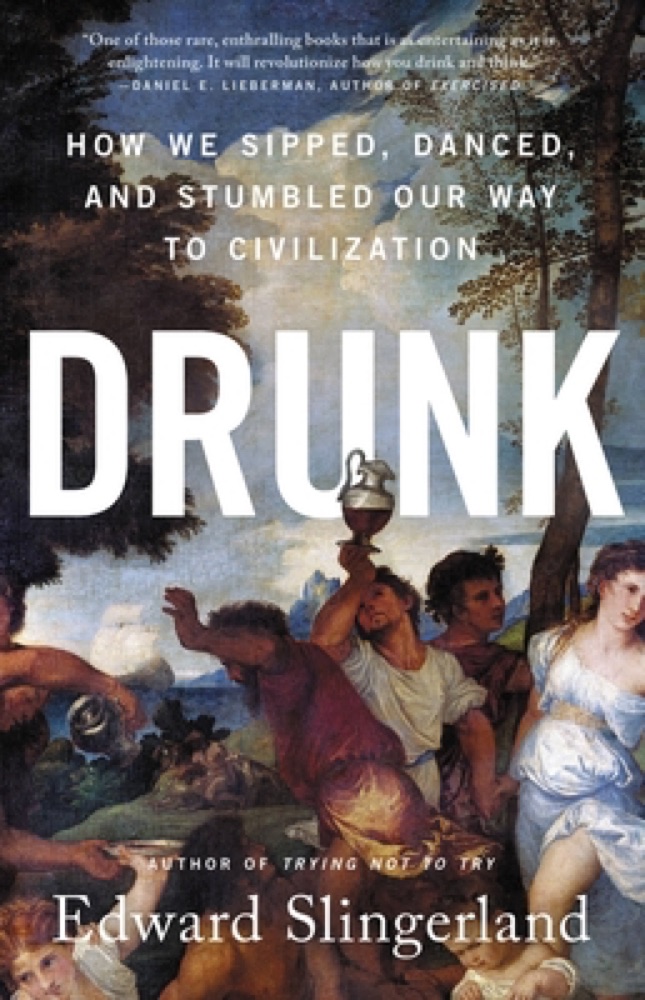
Drunk elegantly cuts through the tangle of urban legends and anecdotal impressions that surround our notions of intoxication to provide the first rigorous, scientifically-grounded explanation for our love of alcohol. Drawing on evidence from archaeology, history, cognitive neuroscience, psychopharmacology, social psychology, literature, and genetics, Slingerland shows that our taste for chemical intoxicants is not an evolutionary mistake, as we are so often told. In fact, intoxication helps solve a number of distinctively human challenges: enhancing creativity, alleviating stress, building trust, and pulling off the miracle of getting fiercely tribal primates to cooperate with strangers. Our desire to get drunk, along with the individual and social benefits provided by drunkenness, played a crucial role in sparking the rise of the first large-scale societies. We would not have civilizati
Book details
- First published
- 2021
- Author
- Edward Slingerland
- Genre
- History
- Goodreads rating
- 3.81 (3k ratings)
The buzz
- The New York TimesReview in The New York Timesprofessional review (via Book Marks)
- The Wall Street JournalReview in The Wall Street Journalprofessional review (via Book Marks)
- Kirkus ReviewsReview in Kirkus Reviewsprofessional review (via Book Marks)
- Publishers WeeklyReview in Publishers Weeklyprofessional review (via Book Marks)
- New York Journal of BooksReview in New York Journal of Booksprofessional review (via Book Marks)
- BooklistReview in Booklistprofessional review (via Book Marks)
Keep reading
Behave: The Biology of Humans at Our Best and Worst
 The Tell-Tale Brain: A Neuroscientist's Quest for What Makes Us Human
 Dragons of Eden: Speculations on the Evolution of Human Intelligence
 The Social Animal: The Hidden Sources of Love, Character, and Achievement
 Good Reasons for Bad Feelings: Insights from the Frontier of Evolutionary Psychiatry
 A Hunter-Gatherer's Guide to the 21st Century: Evolution and the Challenges of Modern Life
 The Social Conquest of Earth
 Scarcity Brain: Fix Your Craving Mindset and Rewire Your Habits to Thrive with Enough
 The Unexpected Joy of Being Sober
 Food of the Gods: The Search for the Original Tree of Knowledge
 Sapiens: A Brief History of Humankind
 The Log from the Sea of Cortez
 A Language Older Than Words
 How the Mind Works
 The Botany of Desire: A Plant's-Eye View of the World
 The Brain That Changes Itself: Stories of Personal Triumph from the Frontiers of Brain Science
 Shadows of Forgotten Ancestors
 Why We Get Sick: The New Science of Darwinian Medicine
 The Moral Animal: Why We Are the Way We Are - The New Science of Evolutionary Psychology
 The Elephant in the Brain: Hidden Motives in Everyday Life
 Homo Deus: A History of Tomorrow
 Psych: The Story of the Human Mind
 Successful Aging: A Neuroscientist Explores the Power and Potential of Our Lives
 Are We Smart Enough to Know How Smart Animals Are?
 The Future of the Mind: The Scientific Quest to Understand, Enhance, and Empower the Mind
 Maps of Meaning: The Architecture of Belief
 How to Change Your Mind: The New Science of Psychedelics
 The Tale of the Dueling Neurosurgeons: The History of the Human Brain as Revealed by True Stories of Trauma, Madness, and Recovery
 A User's Guide to the Brain: Perception, Attention, and the Four Theaters of the Brain
 Emotional Design: Why We Love (or Hate) Everyday Things
 Echopraxia
 The Blank Slate: The Modern Denial of Human Nature
 Humankind: A Hopeful History
 Descartes' Error: Emotion, Reason and the Human Brain
 Civilized to Death: What Was Lost on the Way to Modernity
 The Lost World
 Antifragile: Things That Gain from Disorder
 The Story of the Human Body: Evolution, Health, and Disease
 Villa Incognito
 The World Peace Diet
 Dopamine Nation: Finding Balance in the Age of Indulgence
 On Human Nature
 From Bacteria to Bach and Back: The Evolution of Minds
 A General Theory of Love
 What's Our Problem?: A Self-Help Book for Societies
 Creativity: Flow and the Psychology of Discovery and Invention
 The Happiness Hypothesis: Finding Modern Truth in Ancient Wisdom
 The Song of the Cell: An Exploration of Medicine and the New Human
 Black Box Thinking: Why Some People Never Learn from Their Mistakes - But Some Do
 In the Realm of Hungry Ghosts: Close Encounters with Addiction
 The Rise of Superman: Decoding the Science of Ultimate Human Performance
 The Mountain in the Sea
 The Art of Impossible: A Peak Performance Primer
 What Doesn't Kill Us: How Freezing Water, Extreme Altitude, and Environmental Conditioning Will Renew Our Lost Evolutionary Strength
 Endgame, Vol. 1: The Problem of Civilization
 The Gene: An Intimate History
 Natural Causes: An Epidemic of Wellness, the Certainty of Dying, and Killing Ourselves to Live Longer
 Social Intelligence: The New Science of Human Relationships
 The Mating Mind: How Sexual Choice Shaped the Evolution of Human Nature
 The Master and His Emissary: The Divided Brain and the Making of the Western World