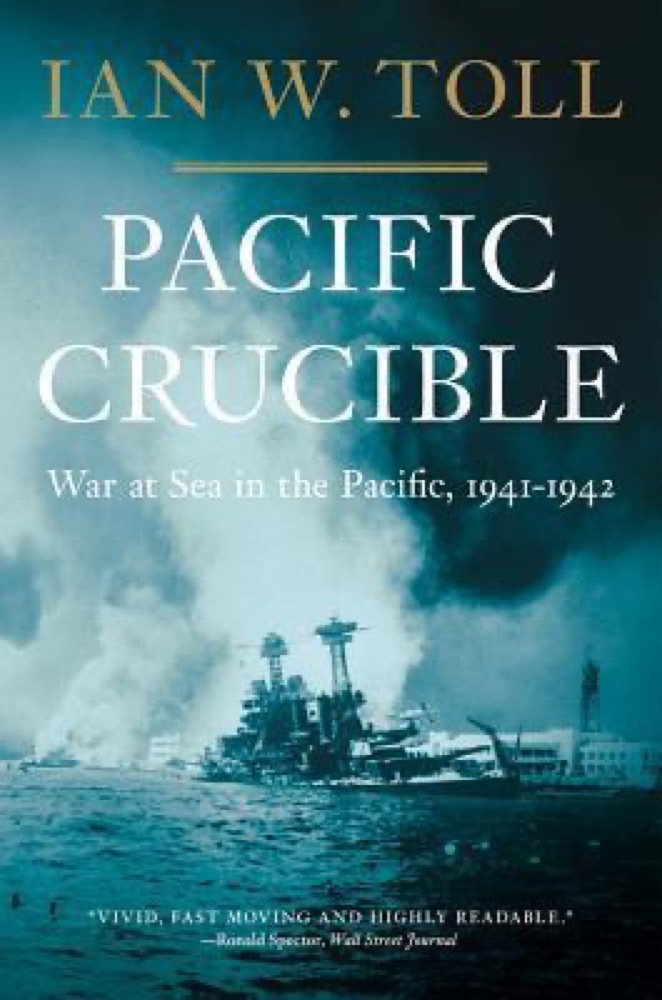
 Pacific Crucible: War at Sea in the Pacific, 1941-1942
Quotes from the Book
Nagumo was suddenly on his own. At this crucial time, the cost of his failure to learn the complicated factors that played into carrier operations suddenly exploded. Now, when every minute counted, it was too late to learn the complexities involved in loading different munitions on different types of planes on the hangar deck, too late to learn how the planes were organized and spotted on the flight decks, too late to learn the flight capabilities of his different types of planes, and far too late to know how to integrate all those factors into a fast-moving and efficient operation with the planes and ordnance available at that moment. Commander Genda, his brilliant operations officer, couldn’t make the decisions for him now. It was all up to Nagumo. At 0730 on June 4, 1942, years of shipbuilding, training, and strategic planning had all come to this moment. Teams of highly trained pilots, flight deck personnel, mechanics, and hundreds of other sailors were ready and awaiting his command. The entire course of the battle, of the Combined Fleet, and even perhaps of Japan were going to bear the results of his decisions, then and there.
159
TF-16 returned to Pearl Harbor on May 26 in good order, with one huge exception: Admiral Halsey, the sixty-year-old commander, arrived back completely exhausted and ill. After six months of intense underway operations, culminating in the fruitless 7000-mile mission across the Pacific to the Coral Sea and back, Halsey had lost twenty pounds and had contracted a serious case of dermatitis. Nimitz took one look at him and sent him straight to the Pearl Harbor hospital. The Navy’s most experienced and highly regarded carrier force commander would sit out the Battle of Midway. The ultimate sea warrior, Halsey would watch from his hospital window as the two task forces departed Pearl Harbor for Midway.
81
As night fell, Yamamoto, aboard the huge battleship Yamato, steamed eastward at full speed into the night. Far ahead the destroyers went to flank speed to search for the US carriers. Lookouts, with the best night-vision binoculars in the world, swept the night horizon where the very dark sky meets the black ocean. The faintest shape, the tiniest pinprick of light, would show there was something out there, like the superstructure of a ship over the horizon. There was nothing.
76
Yamamoto was considered, both in Japan and the United States, as intelligent, capable, aggressive, and dangerous. Motivated by his skill as a poker player and casino gambler, he was continually calculating odds on an endless variety of options. He played bridge and chess better than most good players. Like most powerful leaders he was articulate and persuasive, and once in a position of power he pushed his agenda relentlessly. Whether he would push his odds successfully in the Pacific remained to be seen.
69
Before the first streaks of light at dawn on December 7, 275 miles north of Oahu, the six (Japanese) carriers of the Striking Force turned into the southeast wind. Pounding into heavy swells at high speed, the carriers pitched severely with thunderous impact. The wind, surging seas, and roar of warming aircraft engines made communications possible only by hand signals and handheld signal lamps. Salt spray reached the high flight decks, and Commander Fuchida, the group leader, was very concerned about the conditions for launching planes. If this had been a training exercise the launch might have been delayed until conditions improved. However, this was not an exercise, and there would be no delay.
68
The isolationists argued that if the US had stayed out of the Great War - or, as it later became known, World War I - there never would have been a World War II. By 1917 the warring protagonists - Britain, France, Germany, Austria, and others - had suffered millions of casualties and were exhausted. The German populace was starving. The isolationists believed that a resolution was inevitable without the US involvement that resulted in 116,000 dead fathers, brothers and sons. They argued that if the United States had stayed out of the Great War, no one would ever have heard of Adolf Hitler.
67
In 1941, as the United States faced the threat of another horrific war, President Franklin D. Roosevelt was leading the nation from a wheelchair. Struck down by polio at age thirty-nine, he rehabilitated and marshaled himself, despite severe pain, to press on with his career in politics. Eleven years later, delivering his message of confidence and optimism, he was elected President of the United States.
67
Yamamoto sensed a feeling of culmination about the huge success of the first strike, and the same incisive intuition that guided his brilliant moves at the gaming tables told him what the next move on the bridge of Akagi would be. In (Vice Admiral) Nagumo he knew his man. Nagumo had never been committed to the Pearl Harbor mission. He had not been Yamamoto’s choice to command the Striking Force; his assignment was the decision of the Navy Ministry in Tokyo, based on seniority. While the exultation of the officers and sailors on his staff swirled around him, Yamamoto sat quietly. Finally, he fixed a steely gaze on his chief of staff, and in a low, intense voice: “Admiral Nagumo is going to withdraw.
64
During the Fireside Chats, half the country tuned in on their radios, and it was said that on hot summer nights when people had their windows open, one could walk through the residential downtown of a large city and hardly miss a word.
64
Back in Washington, alone in the late afternoon of December 7, a chastened Franklin Roosevelt considered the situation. He may have wondered how things had gone so terribly wrong. But what might have been was now hindsight—the United States was at war and was in it to win. He spoke quietly to his secretary, Grace Tully. “Sit down, Grace. I’m going before Congress tomorrow. I’d like to dictate my message. It will be short.
62
Roosevelt was a genius at mass communications, and his speechwriters deferred to his reviews of their drafts, not so much because he was the president, but because when a text required the perfect word, the exquisite or incisive phrase, or exactly the right tone, he was the best. And when it came to delivery, he had no peer.
59
Former corporal Hitler, decorated for his service on the front lines of the Great War, may have believed he knew more about waging war than the Prussian generals. His successes as an infantryman, terrorist, diplomatic bully, and military victor in early 1940 had made him supremely confident. But, in reality, he was out of his depth. He already had failed to easily capture the British Expeditionary Force at Dunkirk in May, 1940 and failed again a few months later in the Battle of Britain despite superior air power. Understanding the enormous potential of a comprehensive geopolitical strategy, such as the Quadripartite Entente, was beyond his capabilities and destroyed by his hatreds. While Germany was still powerful, the misjudgments in 1940 and the failure to conquer Russia in 1941 were taking a toll. Largely unrecognized at the time, the odds were beginning to shift away from Hitler.
57
Unfortunately, much of the important information Ambassador Grew sent to Washington was largely overlooked or ignored, and dialogue between Washington and Tokyo was strained. This state of affairs is indicated by Grew’s cable on July 10, 1941, in which he pointed out that he had to go to the British ambassador in Tokyo, Sir Robert Craigie, to find out about discussions between the State Department and the Japanese ambassador in Washington. This occurred because the State Department kept the British ambassador in Washington abreast of events, who promptly informed the foreign secretary in London, who in turn informed their ambassador in Tokyo. Sir Robert then kindly passed the information to Ambassador Grew.
50
It is unfortunate that peace negotiations could not have been initiated after the Midway battle, but the state of human development did not, and probably still does not, allow for any such approach.
Flying at more than twice their speed, the Zeros made repeated passes over the attackers, doing wingovers and loops to double back over their targets. The Devastators launched a few slow torpedoes to no effect.
The Pacific Fleet fliers were not as experienced as the Japanese, but Spruance had confidence in their bravery, skill, and judgment. He was not a carrier admiral or even a flier, but he knew that the fundamental axiom of carrier warfare was to make the first attack.
Chinese. In failing to maintain that policy, he failed in his duty as Secretary of State and failed in his loyalty to the United States. After his ineptitude was later realized, he would be described by Roosevelt as “that old fool, Hull.
Stimson recorded in his diary, “The question was how we are going to maneuver them into firing the first shot without allowing too much danger to ourselves.”147 Instead of redoubling his efforts to achieve an immediate diplomatic resolution, Stimson was accepting war as inevitable.
on November 17, Hull received a telegram from Ambassador Grew “emphasizing [the] need for guarding against sudden military or naval actions by Japan in areas not at present involved in the China conflict.” Grew added that security had become so tight in Japan that “military and naval observation is almost literally restricted to what can be seen with our own eyes, which is negligible.”131 Supported by Acheson and his asset freeze, and despite Grew’s warnings, Hull still thought that the Japanese would back down.
The previously agreed message that would be sent to the Striking Force commander to proceed with the attack on Pearl Harbor was “Climb Mount Niitaka.
The failure of the United States to move ahead with the meeting with Prince Konoe inevitably conveyed to him and his associates the unfortunate impression that our Government was merely playing for time and had no real intention to come to an agreement with Japan. It was this impression which finally brought about the fall of Prince Konoye’s cabinet.
Further, within each armed service there were moderates, who saw the need for diplomacy to avoid a war with the United States, and hardliners, who believed the power of the samurai fighting spirit would overcome any material and resource imbalance.
this quash by Hull constituted a reversal of progress and lowered the prospect of a peaceful resolution between Japan and the United States.
Returning to Tokyo, Institute members concluded that Japan might win some initial battles, but it could not prevail in a long war against the United States. The United States had an industrial capacity twenty times that of Japan.
Harbor. In a message to Secretary of State Hull on January 27, 1941, he reported: A member of the Embassy staff . . . had heard from many quarters, including a Japanese one, that a surprise mass attack on Pearl Harbor was planned by the Japanese military forces in case of “trouble” between Japan and the United States.56 In the monthly chronological report to Hull on the same date, Grew wrote, There is a lot of talk around town to the effect that the Japanese, in case of a break with the United States, are planning to go all out in a surprise mass attack on Pearl Harbor. I rather guess that the boys in Hawaii are not precisely asleep.
Matsuoka pointed out that there were no objections to the United States and Great Britain taking over territories, such as Panama and Egypt, respectively, and for those countries to criticize Japan for its actions in Manchuria was no different.
Powerful elements in the Japanese armed forces were preoccupied with a perceived conspiracy against Japan, the ABCD coalition: Americans in the Philippines, the British in Malaya, the Chinese to their south and west, and the Dutch in the East Indies, plus the French in Indochina and the Russians to the north. All these colonies and countries formed a perimeter around Japan, and the government used this threat of encirclement to mobilize support in the populace. Their perception of being forced into a weaker position by the Five Power Treaty and being surrounded created anxiety within some elements of the Japanese naval establishment and the government generally.
Watch on YouTube
About Dale A. Jenkins
We have collected 27 quotes from 1 book by Dale A. Jenkins on BookQuoters.
More about the author →About the book
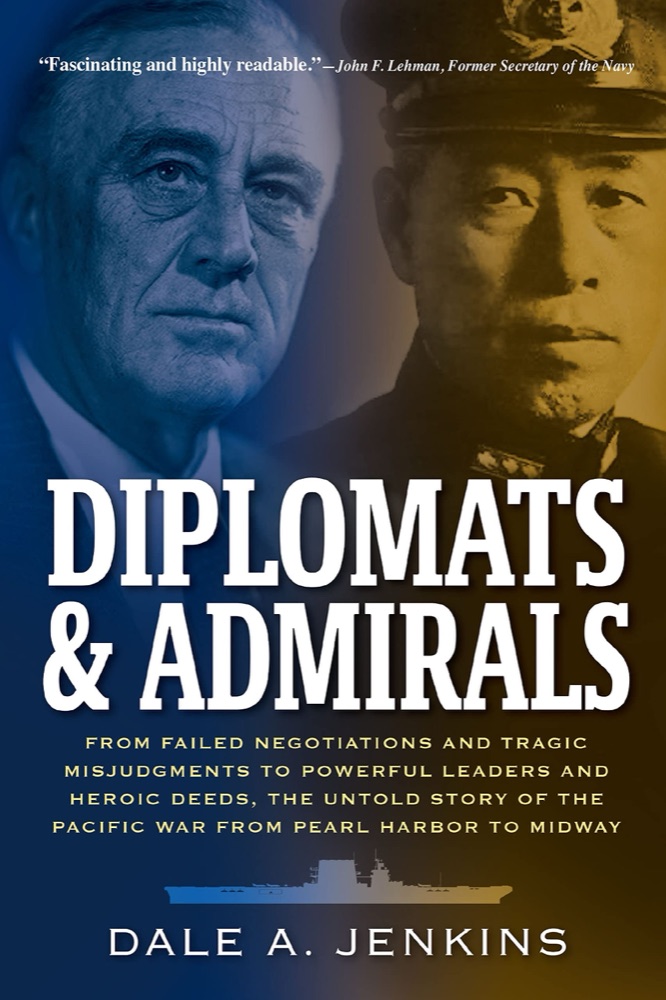
WAS THE JAPANESE ATTACK ON PEARL HARBOR INEVITABLE?
It’s November 1941. Japan and the US are teetering on a knife-edge as leaders on both sides of the Pacific strive to prevent war between them. But failed diplomacy, foiled negotiations, and possible duplicity in the Roosevelt administration thwart their attempts.
Drawing on now-declassified original documents, Diplomats & Admirals reveals the inside story of one fateful year, including:
• How the hidden agendas of powerful civilian and military leaders pushed the two nations toward war • The miscommunications, misjudgments, and blunders that doomed efforts at peace • China’s role in the US ultimatum that triggered the attack on Pearl Harbor • Why the carrier-to-carrier showdown at Coral Sea proved a fatal mistake for Japan • How courageous US navy pilots snatched victory from defeat at the Battle of Midway
The defini
Book details
- First published
- 2022
- Author
- Dale A. Jenkins
- Genre
- History
- Goodreads rating
- 4.30 (5k ratings)
Keep reading
Pacific Crucible: War at Sea in the Pacific, 1941-1942
 The Admirals: Nimitz, Halsey, Leahy, and King—the Five-Star Admirals Who Won the War at Sea
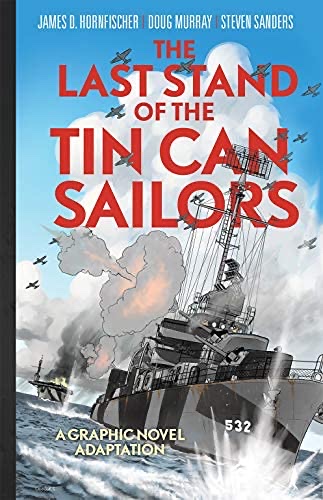 The Last Stand of the Tin Can Sailors: The Extraordinary World War II Story of the U.S. Navy's Finest Hour
 Flyboys: A True Story of Courage
 The Coldest Winter: America and the Korean War
 Stilwell and the American Experience in China, 1911-45
 Facing the Mountain: A True Story of Japanese American Heroes in World War II
 Dead Wake: The Last Crossing of the Lusitania
 The Guns of August
 The Second World War
 The Guns at Last Light: The War in Western Europe, 1944-1945
 The Splendid and the Vile: A Saga of Churchill, Family, and Defiance During the Blitz
 Closing the Ring
 The Winds of War
 The First Salute : View of the American Revolution
 This Kind of War: A Study in Unpreparedness
 The Path Between the Seas: The Creation of the Panama Canal, 1870-1914
 Citizens of London: The Americans who Stood with Britain in its Darkest, Finest Hour
 The Winter Fortress: The Epic Mission to Sabotage Hitler's Atomic Bomb
 An Army at Dawn: The War in North Africa, 1942-1943
 Precipice
 The Untold History of The United States
 Fallout: The Hiroshima Cover-up and the Reporter Who Revealed It to the World
 The Last Lion: Winston Spencer Churchill: Alone, 1932-40
 The Greatest Generation
 The Last Lion 3: Winston Spencer Churchill: Defender of the Realm, 1940-1965
 The Day of Battle: The War in Sicily and Italy, 1943-1944
 Truman
 The Best and the Brightest
 Executive Orders
 Imperial Ambitions: Conversations on the Post-9/11 World
 A Full Life: Reflections at Ninety
 Vietnam: An Epic Tragedy, 1945-1975
 Winter of the World
 The River of Doubt: Theodore Roosevelt's Darkest Journey
 The Civil War, Vol. 3: Red River to Appomattox
 The Monuments Men: Allied Heroes, Nazi Thieves, and the Greatest Treasure Hunt in History
 Fall of Giants
 Berlin Diary: The Journal of a Foreign Correspondent 1934-1941
 War Is a Racket
 The Next Decade: Where We've Been . . . and Where We're Going
 Agent Zigzag: A True Story of Nazi Espionage, Love, and Betrayal
 Drift
Drift
 One Minute to Midnight: Kennedy, Khrushchev and Castro on the Brink of Nuclear War
 Epitaph for a Spy
 Memoirs of General W.T. Sherman
 The Rape of Nanking
 Ripple
 The Pentagon's Brain
 Mr. Lincoln's Army
 The Final Days
 D-Day, June 6, 1944: The Battle for the Normandy Beaches
 With the Old Breed: At Peleliu and Okinawa
 The Wager: A Tale of Shipwreck, Mutiny and Murder
 Nuclear War: A Scenario
 The Rise of Theodore Roosevelt
 Upheaval: Turning Points for Nations in Crisis
 The Girls of Atomic City: The Untold Story of the Women Who Helped Win World War II
 Band of Brothers: E Company, 506th Regiment, 101st Airborne from Normandy to Hitler's Eagle's Nest