
 The Second World War
Quotes from the Book
As the Nobel laureate Elie Wiesel warned years ago, to forget a holocaust is to kill twice.
Almost all people have this potential for evil, which would be unleashed only under certain dangerous social circumstances.
The Rape of Nanking did not penetrate the world consciousness in the same manner as the Holocaust or Hiroshima because the victims themselves had remained silent.
Looking back upon millennia of history, it appears clear that no race or culture has monopoly on wartime cruelty. The veneer of civilization seems to be exceedingly thin – one that can be easily stripped away, especially by the stresses of war.
The heroic efforts of the Americans and Europeans during this period are so numerous (their diaries run for thousands of pages) that it is impossible to narrate all of their deeds here.
In 1996 I began an investigation into the life of John Rabe and eventually unearthed thousands of pages of diaries that he and other Nazis kept during the Rape. These diaries led me to conclude that John Rabe was “the Oskar Schindler of China.
Perhaps the most fascinating character to emerge from the history of the Rape of Nanking is the German businessman John Rabe. To most of the Chinese in the city, he was a hero, “the living Buddha of Nanking,” the legendary head of the International Safety Zone who saved hundreds of thousands of Chinese lives.
Apparently some quirk in human nature allows even the most unspeakable acts of evil to become banal within minutes, provided only that they occur far enough away to pose no personal threat.
17
on the famous Lord Acton line: “Power kills, and absolute power kills absolutely.
9
In Japan censorship is practiced not only by the government when it tampers with textbooks but by the media, which police themselves.
7
So sickening was the spectacle that even the Nazis in the city were horrified, one proclaiming the massacre to be the work of “bestial machinery.
5
Some even tried to use opium to commit suicide, swallowing large doses as poison. Others turned to crime to support their addiction, causing a wave of banditry to sweep through Nanking. After making conditions ripe for banditry in Nanking, the Japanese used the epidemic of crimes to justify their occupation, preaching the need for imperial law and order.
4
There are several important lessons to be learned from Nanking, and one is that civilization itself is tissue-thin.
3
If you are struck by a bus, someone may steal your purse or wallet while you lie injured, but many more will come to your aid, trying to save your precious life. One person will call 911, and another will race down the street to alert a police officer on his or her beat. Someone else will take off his coat, fold it, and place it under your head, so that if these are indeed your last moments of life you will die in the small but real comfort of knowing that someone cared about you.
3
The suicide risk for mental health patients goes up during changes in medication.
3
recent response to the atrocities in Bosnia-Herzegovina and Rwanda: while thousands have died almost unbelievably cruel deaths, the entire world has watched CNN and wrung its hands.
3
history have noted that the sheer concentration of power in government is lethal—that only a sense of absolute unchecked power can make atrocities like the Rape of Nanking possible.
3
The Ministry interfered with Ienaga’s attempts to document the Nanking massacre for schoolchildren. For example, in his textbook manuscript Ienaga wrote: “Immediately after the occupation of Nanking, the Japanese Army killed numerous Chinese soldiers and citizens. This incident came to be known as the Nanking Massacre.” The examiner commented: “Readers might interpret this description as meaning that the Japanese Army unilaterally massacred Chinese immediately after the occupation. This passage should be revised so that it is not interpreted in such a way.
3
And maps can really point to places Where life is evil now: Nanking; Dachau. —WILLIAM C. KIRBY, Professor of Modern Chinese History and Chairman of the Department of History,
3
Power kills, and absolute power kills absolutely.” The less restraint on power within a government, Rummel found, the more likely that government will act on the whims or psychologically generated darker impulses of its leaders to wage war on foreign governments.
2
This pervasive sense of danger has discouraged many serious scholars from visiting Japanese archives to conduct their research on the subject; indeed, I was told in Nanking that the People’s Republic of China rarely permits its scholars to journey to Japan for fear of jeopardizing their physical safety.
2
But every answer suggests a new question, and I now wondered why the victims of this crime had not screamed out for justice. Or if they had indeed cried out, why had their anguish not been recognized? It soon became clear to me that the custodian of the curtain of silence was politics. The People’s Republic of China, the Republic of China, and even the United States had all contributed to the historical neglect of this event for reasons deeply rooted in the cold war. After the 1949 Communist revolution in China, neither the People’s Republic of China nor the Republic of China demanded wartime reparations from Japan (as Israel had from Germany) because the two governments were competing for Japanese trade and political recognition.
2
He was not the only one; a total of seven Japanese class A war criminals, including Japanese Foreign Minister Hirota Koki, were judged guilty by the IMTFE and later hanged at the Sugamo Prison in Tokyo.
2
In a sixty-page report released in June 1938, Smythe concluded that the 120 air raids that Nanking experienced and the four-day siege of the city did only 1 percent of the damage inflicted by the Japanese army after it entered Nanking.
2
Weary of fire, weary of bombardment, and weary of siege, scattered groups of Chinese actually rushed out to welcome the Japanese invaders as they thundered into the city with their tanks, artillery, and trucks. Some people hung Japanese flags from their windows while others even cheered the Japanese columns as they marched through the south and west gates of the city.
2
To a man who came from a military culture in which pilots were given swords instead of parachutes, and in which suicide was infinitely preferable to capture, it was incomprehensible that the Chinese would not fight an enemy to the death.
2
It was funny yet pitiable when I imagined how they gathered whatever white cloth they could find, attached it to a dead twig, and marched forward just to surrender,
2
television in virtually every living room. Apparently some quirk in human nature allows even the most unspeakable acts of evil to become banal within minutes, provided only that they occur far enough away to pose no personal threat.
1
Watch on YouTube
About Iris Chang
We have collected 28 quotes from 1 book by Iris Chang on BookQuoters.
More about the author →About the book
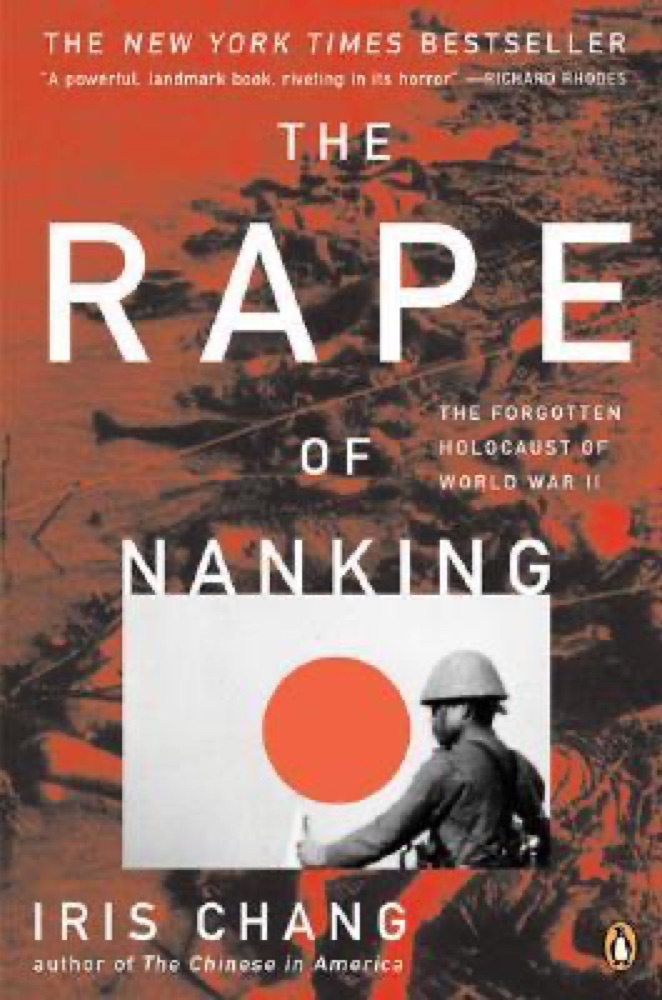
In December 1937, the Japanese army invaded the ancient city of Nanking, systematically raping, torturing, and murdering more than 300,000 Chinese civilians.
This book tells the story from three perspectives: of the Japanese soldiers who performed it, of the Chinese civilians who endured it, and of a group of Europeans and Americans who refused to abandon the city and were able to create a safety zone that saved many.
Book details
- First published
- 1997
- Author
- Iris Chang
- Genre
- History
- Goodreads rating
- 4.25 (57k ratings)
Keep reading
The Second World War
 Auschwitz: A Doctor's Eyewitness Account
 Bloodlands: Europe Between Hitler and Stalin
 Modern Times: The World from the Twenties to the Nineties
 Eichmann in Jerusalem: A Report on the Banality of Evil
 Fallout: The Hiroshima Cover-up and the Reporter Who Revealed It to the World
 The Light of Days: The Untold Story of Women Resistance Fighters in Hitler's Ghettos
 Flyboys: A True Story of Courage
 The Devil of Nanking
 On Killing: The Psychological Cost of Learning to Kill in War and Society
 They Called Us Enemy
 Koba the Dread: Laughter and the Twenty Million
 American Shaolin: Flying Kicks, Buddhist Monks, and the Legend of Iron Crotch: An Odyssey in the New China
 The Untold History of The United States
 We Wish to Inform You That Tomorrow We Will Be Killed with Our Families
 Facing the Mountain: A True Story of Japanese American Heroes in World War II
 Homage to Catalonia
 The Betrayal of Anne Frank: A Cold Case Investigation
 The Forgotten Highlander: My Incredible Story of Survival During the War in the Far East
 Life and Death in Shanghai
 The Aquariums of Pyongyang: Ten Years in the North Korean Gulag
 The Girl with Seven Names: A North Korean Defector’s Story
 Nothing to Envy: Ordinary Lives in North Korea
 The Association of Small Bombs
 Defying Hitler
 This Kind of War: A Study in Unpreparedness
 The Jakarta Method: Washington's Anticommunist Crusade and the Mass Murder Program that Shaped Our World
 Ghost Soldiers: The Epic Account of World War II's Greatest Rescue Mission
 Pachinko
 An Ordinary Man: An Autobiography
 The Rise and Fall of the Third Reich: A History of Nazi Germany
 Escape from Camp 14: One Man's Remarkable Odyssey from North Korea to Freedom in the West
 Agent Zigzag: A True Story of Nazi Espionage, Love, and Betrayal
 Say Nothing: A True Story of Murder and Memory in Northern Ireland
 The Last Lion: Winston Spencer Churchill: Alone, 1932-40
 The Gulag Archipelago 1918-1956
 One Day, Everyone Will Have Always Been Against This
 The Coldest Winter: America and the Korean War
 The Black Wolf
 Victory City
 Japan's Infamous Unit 731: First-hand Accounts of Japan's Wartime Human Experimentation Program
 United States of Japan
 American War
 Under the Same Stars
 The Origins of Totalitarianism
 No Name in the Street
 Closing the Ring
 The Drowned and the Saved
 Stasiland: Stories from Behind the Berlin Wall
 Imperial Ambitions: Conversations on the Post-9/11 World
 People of the Lie: The Hope for Healing Human Evil
 A Distant Mirror: The Calamitous 14th Century
 Berlin Diary: The Journal of a Foreign Correspondent 1934-1941
 King Leopold's Ghost
 The Third Reich at War
 Riding the Iron Rooster: By Train Through China
 The Librarian of Burned Books
 Fall of Giants
 They Thought They Were Free: The Germans 1933-45
 In the Garden of Beasts: Love, Terror, and an American Family in Hitler's Berlin