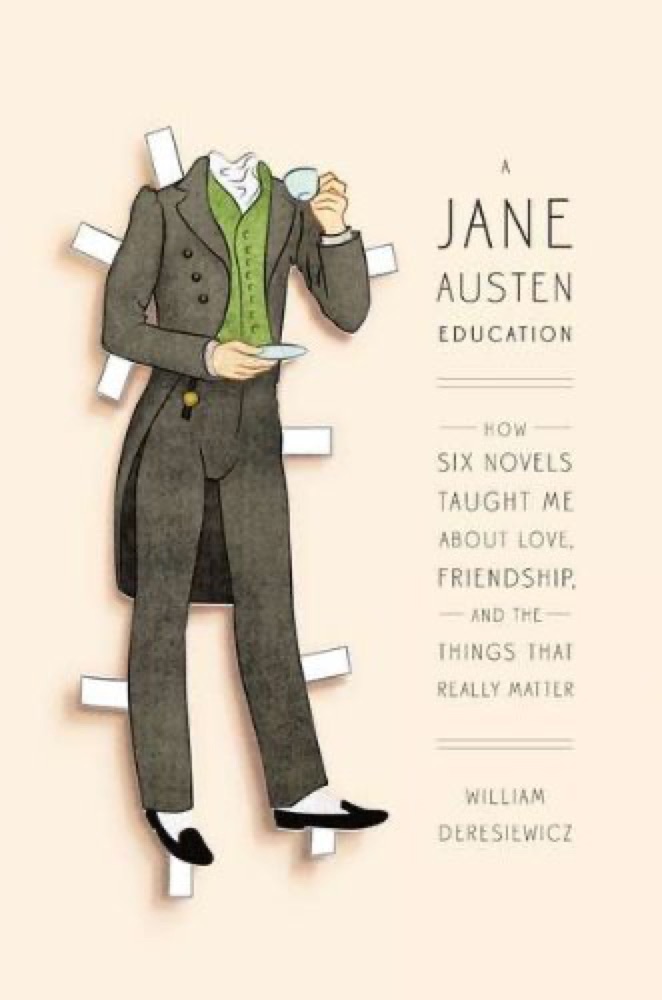

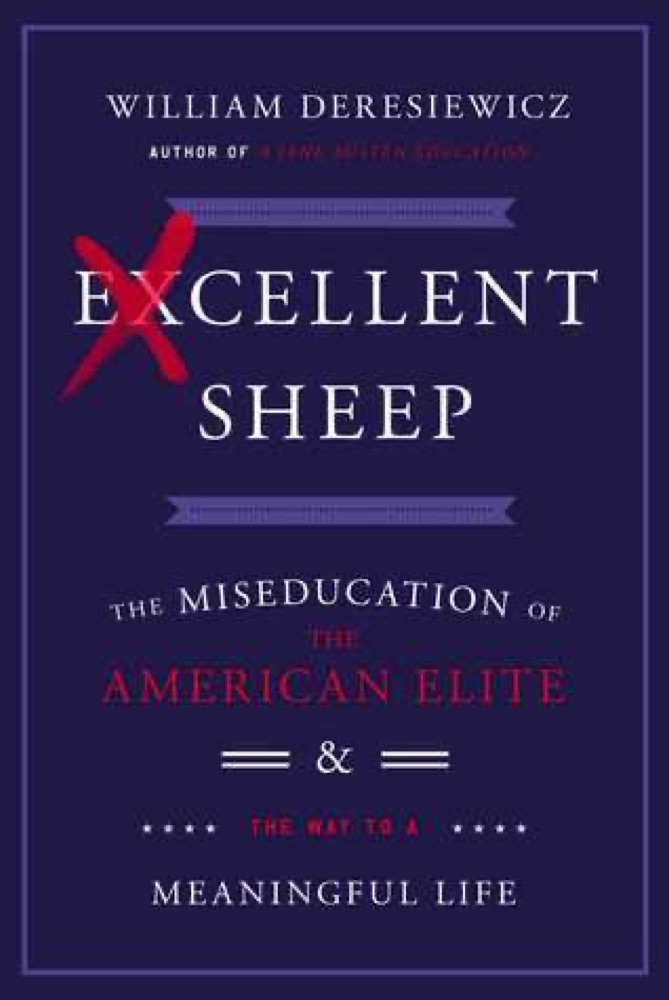
 Excellent Sheep: The Miseducation of the American Elite and the Way to a Meaningful Life
Quotes from the Book
There's no doubt about it: fun people are fun. But I finally learned that there is something more important, in the people you know, than whether they are fun. Thinking about those friends who had given me so much pleasure but who had also caused me so much pain, thinking about that bright, cruel world to which they'd introduced me, I saw that there's a better way to value people. Not as fun or not fun, or stylish or not stylish, but as warm or cold, generous or selfish. People who think about others and people who don't. People who know how to listen, and people who only know how to talk.
29
...Novels--which, after all, are training grounds for responding to the world, imaginative sanctuaries in which to hone and test our ethical judgments and choices.
6
Jane Austen’s life may have seemed uneventful compared to her aunt’s or cousin’s or brothers’, or indeed, compared to just about anyone’s. Her genius began with the recognition that such lives as hers were very eventful indeed—that every life is eventful, if only you know how to look at it. She did not think that her existence was quiet or trivial or boring; she thought it was delightful and enthralling, and she wanted us to see that our own are, too.
4
Austen, I realized, had not been writing about everyday things because she couldn’t think of anything else to talk about. She had been writing about them because she wanted to show how important they really are.
4
Her genius began with the recognition that such lives as hers were very eventful indeed—that every life is eventful, if only you know how to look at it. She did not think that her existence was quiet or trivial or boring; she thought it was delightful and enthralling, and she wanted us to see that our own are, too. She understood that what fills our days should fill our hearts, and what fills our hearts should fill our novels. If
2
I sentimenti sono anche il modo primo di conoscere un romanzo; e i romanzi sono il terreno di prova per conoscere il mondo, santuari dell'immaginazione dove affinare e mettere alla prova i nostri valori, le nostre scelte. I sentimenti sono lo strumento di lavoro dei romanzieri, i colori della loro tavolozza.
2
Love, for Austen, isn't about remaining forever Young. It's about becoming an adult.
1
what does it mean to identify with a literary character? I thought I knew, but did I really? Does it simply mean putting yourself in their place? Obviously not. Or approving of their actions? But we’re happy to identify with bad characters, given the right encouragement. No, the best I could come up with was that it seemed to be a kind of in-between state—you’re somehow them and not them at the same time—that can’t exactly be put into words.
1
As Virginia Woolf, Jane Austen’s most perceptive reader, had the heroine in Mrs. Dalloway reflect, “it was very, very dangerous to live even one day.” Not because life is so perilous, but because it is so momentous.
Austen taught me a new kind of moral seriousness—taught me what moral seriousness really means. It means taking responsibility for the little world, not the big one. It means taking responsibility for yourself.
Her youth had passed without distinction, and her middle of life was devoted to the care of a failing mother, and the endeavour to make a small income go as far as possible. And yet she was a happy woman. . . . She loved every body, was interested in every body’s happiness, quicksighted to every body’s merits; thought herself a most fortunate creature, and surrounded with blessings.
Emma was always looking in the wrong direction. Her heart was in the right place—that was what ultimately made me forgive her, and, finally, what saved her—but her busy brain led her astray. While she plotted her schemes and dreamed her dreams, her “daily happiness” was right there in front of her, in “affairs, arrangements, perplexities, and pleasures”—the hourly ordinary, in all its granular specificity.
Austen was asking us to pay attention to the things we usually miss or don’t accord enough esteem, in novels or in life. Those small, “trivial,” everyday things, the things that happen hour by hour to the people in our lives: what your nephew said, what your friend heard, what your neighbor did. That, she was telling us, is what the fabric of our years really consists of. That is what life is really about.
Watch on YouTube
About William Deresiewicz
We have collected 43 quotes from 2 books by William Deresiewicz on BookQuoters.
More about the author →More by William Deresiewicz
Excellent Sheep: The Miseducation of the American Elite and the Way to a Meaningful Life
About the book
Before Jane Austen, William Deresiewicz was a very different young man. A sullen and arrogant graduate student, he never thought Austen would have anything to offer him. Then he read Emma—and everything changed.
In this unique and lyrical book, Deresiewicz weaves the misadventures of Austen’s characters with his own youthful follies, demonstrating the power of the great novelist’s teachings—and how, for Austen, growing up and making mistakes are one and the same. Honest, erudite, and deeply moving, A Jane Austen Education is the story of one man’s discovery of the world outside himself.
Book details
- First published
- 2011
- Author
- William Deresiewicz
- Genre
- Nonfiction
- Goodreads rating
- 3.84 (4k ratings)
Keep reading
 The Jane Austen Book Club
 The Jane Austen Society
 My Life in Middlemarch
 The Life of Charlotte Brontë
 The Uncommon Appeal of Clouds
 NW
NW
 The Weight of Ink
 Reading Lolita in Tehran: A Memoir in Books
 These Precious Days: Essays
 This Is the Story of a Happy Marriage
 Agatha Christie: An Autobiography
 The Marriage Plot
 The Fraud
 How Proust Can Change Your Life
 Monday or Tuesday
 A Circle of Quiet
 Flaubert's Parrot
 Experience
 Always Remember: Ben's Story
 Tolstoy and the Purple Chair: My Year of Magical Reading
 Welcome to the Hyunam-Dong Bookshop
 The Portrait of a Lady
 Somewhere Towards the End
 The Common Reader
 The Manticore
 The Madwoman Upstairs
 Pure Colour
 Tess of the D'Urbervilles
 The Socrates Express: In Search of Life Lessons from Dead Philosophers
 Why Be Happy When You Could Be Normal?
 On Reading Well: Finding the Good Life through Great Books
 The Good Soldier
 Childhood, Boyhood, Youth
 The Storied Life of A.J. Fikry
 The Song of the Lark
 Rite of Passage
 Anthropology of an American Girl
 Northanger Abbey
 Lady Jayne Disappears
 The Great Mistake
 The Children's Book
 Asymmetry
 Simply Love
 Too Much Happiness: Stories
 Only Dull People Are Brilliant at Breakfast
 Night and Day
 Summertime
 Lean Your Loneliness Slowly Against Mine
 Lectures on Literature
 The Longest Journey
 The Post-Birthday World
 Dear Mr. Knightley
 Once Upon a Wardrobe
 Cakes and Ale
 Journal of a Solitude
 The Three-Cornered World
 Conversations on Love
 The Rabbit Back Literature Society
 A Novel Bookstore
 Knife: Meditations After an Attempted Murder