
 This is Vegan Propaganda
Quotes from the Book
It's just the way things are. Take a moment to consider this statement. Really think about it. We send one species to the butcher and give our love and kindness to another apparently for no reason other than because it's the way things are. When our attitudes and behaviors towards animals are so inconsistent, and this inconsistency is so unexamined, we can safely say we have been fed absurdities. It is absurd that we eat pigs and love dogs and don't even know why. Many of us spend long minutes in the aisle of the drugstore mulling over what toothpaste to buy. Yet most of don't spend any time at all thinking about what species of animal we eat and why. Our choices as consumers drive an industry that kills ten billion animals per year in the United States alone. If we choose to support this industry and the best reason we can come up with is because it's the way things are, clearly something is amiss. What could cause an entire society of people to check their thinking caps at the door--and to not even realize they're doing so? Though this question is quite complex, the answer is quite simple: carnism.
77
To identify with others is to see something of yourself in them and to see something of them in yourself--even if the only thing you identify with is the desire to be free from suffering.
69
Think about it: virtually every atrocity in the history of humankind was enabled by a populace that turned away from a reality that seemed too painful to face, while virtually every revolution for peace and justice has been made possibly by a group of people who chose to bear witness and demanded that others bear witness as well.
63
Often, vegan advocates assume that a person's defensiveness is the result of selfishness or apathy, when in fact it is much more likely the result of systematic and intensive social conditioning.
54
We love dogs and eat cows not because dogs and cows are fundamentally different--cows, like dogs, have feelings, preferences, and consciousness--but because our perception of them is different.
46
Most of us believe that eating meat is natural because humans have hunted and consumed animals for millennia. And it is true that we have been eating meat as part of an omnivorous diet for at least two million years (though for the majority of this time our diet was still primarily vegetarian). But to be fair, we must acknowledge that infanticide, murder, rape, and cannibalism are at least as old as meat eating, and are therefore arguably as 'natural'--and yet we don't invoke the history of these acts as justification for them. As with other acts of violence, when it comes to eating meat, we must differentiate between natural and justifiable.
42
The path of the norm is the path of least resistance; it is the route we take when we're on auto-pilot and don't even realize we're following a course of action that we haven't consciously chosen. Most people who eat meat have no idea that they're behaving in accordance with the tenets of a system that has defined many of their values, preferences, and behaviors. What they call 'free choice' is, in fact, the result of a narrowly obstructed set of options that have been chosen for them. They don't realize, for instance, that they have been taught to value human life so far above certain forms of nonhuman life that it seems appropriate for their taste preferences to supersede other species' preference for survival.
34
But why must the system go to such lengths to block our empathy? Why all the psychological acrobatics? The answer is simple: because we care about animals, and we don't want them to suffer. And because we eat them. Our values and behaviors are incongruent, and this incongruence causes us a certain degree of moral discomfort. In order to alleviate this discomfort, we have three choices: we can change our values to match our behaviors, we can change our behaviors to match our values, or we can change our perception of our behaviors so that they appear to match our values. It is around this third option that our schema of meat is shaped. As long as we neither value unnecessary animal suffering nor stop eating animals, our schema will distort our perceptions of animals and the meat we eat, so that we feel comfortable enough to consume them. And the system that constructs our schema of meat equips us with the means by which to do this.
29
Becoming aware of the intense suffering of billions of animals, and of our own participation in that suffering, can bring up painful emotions: sorrow and grief for the animals; anger at the injustice and deception of the system; despair at the enormity of the problem; fear that trusted authorities and institutions are, in fact, untrustworthy; and guilt for having contributed to the problem. Bearing witness means choosing to suffer. Indeed, empathy is literally 'feeling with.' Choosing to suffer is particularly difficult in a culture that is addicted to comfort--a culture that teaches that pain should be avoided whenever possible and that ignorance is bliss. We can reduce our resistance to witnessing by valuing authenticity over personal pleasure, and integration over ignorance.
24
There is a vast mythology surrounding meat, but all the myths are in one way or another related to what I refer to as the Three Ns of Justification: eating meat is normal, natural, and necessary. The Three Ns have been invoked to justify all exploitative systems, from African slavery to the Nazi Holocaust. When an ideology is in its prime, these myths rarely come under scrutiny. However, when the system finally collapses, the Three Ns are recognized as ludicrous.
21
Yet on some level we do know the truth. We know that meat production is a messy business, but we choose not to know just how messy it is. We know that meat comes from an animal, but we choose not to connect the dots. And often, we eat animals and choose not to know we're even making a choice. Violent ideologies are structured so that it is not only possible, but inevitable, that we are aware of an unpleasant truth on one level while being oblivious to it on another. Common to all violent ideologies is this phenomenon of knowing without knowing.
19
As with any violent ideology, the populace must be shielded from direct exposure to the victims of the system, lest they begin questioning the system or their participation in it. This truth speaks for itself: why else would the meat industry go to such lengths to keep its practices invisible?
17
Violent ideologies speak their own language; core concepts are translated to maintain the system while appearing to support the people. Under carnism, for instance, democracy has become defined as having the freedom to choose among products that sicken our bodies and pollute our planet, rather than the freedom to eat our food and breathe our air without the risk of being poisoned. But violent ideologies are inherently undemocratic, as they rely on deception, secrecy, concentrated power, and coercion--all practices that are incompatible with a free society. While the larger system, or nation, may appear democratic, the violent system within it is not. This is one reason we don't recognize violent ideologies that exist within seemingly democratic systems; we simply aren't thinking to look for them.
16
If you walked into your local convenience store and bought a package of cigars, you would notice that it carries a label warning of the potential dangers of cigar smoke. Yet research suggests that cigar smoking poses a hazard only to moderate to heavy cigar smokers, who comprise less than 1 percent of the adult population. More than 97 percent of American adults, however, eat animal foods, and despite much research demonstrating the connection between the consumption of animal products and disease, we are not warned of these dangers.
15
It is impossible to exercise free will as long as we are operating from within the system. Free will requires consciousness, and our pervasive and deep-seated patterns of thought are unconscious; they are outside of our awareness and therefore outside of our control. While we remain in the system, we see the world through the eyes of carnism. And as long as we look through eyes other than our own, we will be living in accordance to a truth that is not of our own choosing. We must step outside the system to find our lost empathy and make choices that reflect what we truly feel and believe, rather than what we've been taught to feel and believe.
15
The carnistic schema, which twists information so that nonsense seems to make perfect sense, also explains why we fail to see the absurdities of the system. Consider, for instance, advertising campaigns in which a pig dances joyfully over the fire pit where he or she is to be barbecued, or chickens wear aprons while beseeching the viewer to eat them. And consider the Veterinarian's Oath of the American Veterinary Medical Association, 'I solemnly swear to use my...skills for the...relief of animal suffering,' in light of the fact that the vast majority of veterinarians eat animals simply because they like the way meat tastes. Or think about how poeple won't replace their hamburgers with veggie burgers, even if the flavor is identical, because they claim that, if they try hard enough, they can detect a subtle difference in texture. Only when we deconstruct the carnistic schema can we see the absurdity of placing our preference for a flawless re-creation of a textural norm over the lives and deaths of billions of others.
15
Have you ever noticed that, though we breed, raise, and kill ten billion animals per year, most of us never see even a single part of the process of meat production?
12
The ten billion animals that are killed every year for meat and the virulent consequences of contemporary animal agricultural practices remain conspicuously absent from public discourse. How often have you seen media exposés on the violent treatment of farm animals and the corrupt practices of carnistic industry? Compare this with the amount of coverage afforded fluctuating gas prices or Hollywood fashion blunders. Most of us are more outraged over having to pay five cents more for a gallon of gas than over the fact that billions of animals, millions of humans, and the entire ecosystem are systematically exploited by an industry that profits from such gratuitous violence. And most of us know more about what the stars wore to the Oscars than we do about the animals we eat.
12
The most effective way to distort reality is to deny it; if we tell ourselves there isn't a problem, then we never have to worry about what to do about it. And the most effective way to deny a reality is to make it invisible.
11
In much of the industrialized world, we eat meat not because we have to; we eat meat because we choose to. We don't need meat to survive or even to be healthy; millions of healthy and long-lived vegetarians have proven this point. We eat animals simply because it's what we've always done, and because we like the way they taste. Most of us eat animals because it's just the way things are.
11
We send one species to the butcher and give our love and kindness to another apparently for no reason other than because it's the way things are. When our attitudes and behaviors toward animals are so inconsistent, and this inconsistency is so unexamined, we can safely say we have been fed absurdities.
10
When an invisible ideology guides our beliefs and behaviors, we become casualties of a system that has stolen our freedom to think for ourselves and to act accordingly.
9
Another myth of necessity is that killing is an economic imperative. While an economic motive has driven many violent ideologies--the economy of the New World was largely buttressed by slavery, and the plundering of gold and other assests as well as the unpaid labor of Nazi victims financed the German war machine--that doesn't mean the economy would collapse were the killing to cease. It is far more likely that the economic status quo would break down; the carnistic-corporate power structure, rather than the citizenry, would suffer were carnism abolished.
9
Many of us spend long minutes in the aisle of the drugstore mulling over what toothpaste to buy. Yet most of us don't spend any time at all thinking about what species of animal we eat and why. Our choices as consumers drive an industry that kills ten billion* animals per year in the United States alone. If we choose to support this industry and the best reason we can come up with is because it's the way things are, clearly something is amiss.
7
Our values and behaviors are incongruent, and this incongruence causes us a certain degree of moral discomfort. In order to alleviate this discomfort, we have three choices: we can change our values to match our behaviors, we can change our behaviors to match our values, or we can change our perception of our behaviors so that they appear to match our values.
7
Mahatma Gandhi once said, “The greatness of a nation can be judged by the way its animals are treated.
6
Carnism is the belief system in which eating certain animals is considered ethical and appropriate.
6
The story of how shit got in our meat is the story of one of the central characteristics of carnism, and of other violent ideologies: the system depends on a constituency of indirect victims, inadvertent victims who not only suffer the consequences of the system, but who also help that system by unwittingly participating in their own victimization. The system creates such victims by appearing to be something it is not, so that we feel safe when we are at risk and free when we have been coerced. The story of how shit got in our meat is the story of the human casualties of carnism.
6
We are the collateral damage of carnism; we pay for it with our health, our environment, and our taxes - $7.64 billion a year, to be exact.
4
Why is it that we love our companion animals so much, animals that we call “pets,” and get so much deep human value from those relationships, but then we turn around and call other animals “dinner,” and by virtue of that semantic distinction feel entitled to treat those animals with any manner of cruelty as long as it lowers the price per pound?
4
Watch on YouTube
About Melanie Joy
We have collected 30 quotes from 1 book by Melanie Joy on BookQuoters.
More about the author →About the book
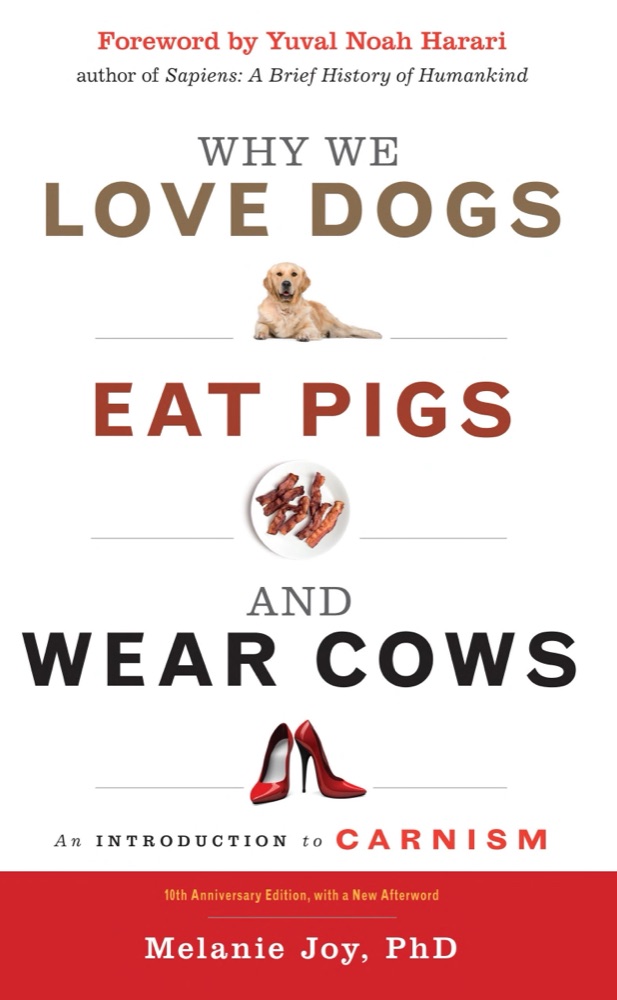
An Introduction to Carnism.
“An important and groundbreaking contribution to the struggle for the welfare of animals.” — Yuval Harari, New York Times best-selling author of Sapiens: A Brief History of Humankind
“An absorbing examination of why humans feel affection and compassion for certain animals but are callous to the suffering of others.” — Publishers Weekly
Why We Love Dogs, Eat Pigs, and Wear Cows offers an absorbing look at what social psychologist Melanie Joy calls carnism, the belief system that conditions us to eat certain animals when we would never dream of eating others. Carnism causes extensive animal suffering and global injustice, and it drives us to act against our own interests and the interests of others without fully realizing what we are doing. Becoming aware of what carnism is and how it functions is vital to personal empowerment and social transformation,
Book details
- First published
- 2009
- Author
- Melanie Joy
- Genre
- Nonfiction
- Goodreads rating
- 4.10 (7k ratings)
Keep reading
This is Vegan Propaganda
 The World Peace Diet
 Eating Animals
 Animal Liberation
 The Omnivore's Dilemma: A Natural History of Four Meals
 The Vegetarian Myth: Food, Justice, and Sustainability
 Endgame, Vol. 1: The Problem of Civilization
 Some We Love, Some We Hate, Some We Eat: Why It's So Hard to Think Straight About Animals
 A Language Older Than Words
 Practical Ethics
 The Blank Slate: The Modern Denial of Human Nature
 Straw Dogs: Thoughts on Humans and Other Animals
 Sapiens: A Brief History of Humankind
 The Culture of Make Believe
 A Hunter-Gatherer's Guide to the 21st Century: Evolution and the Challenges of Modern Life
 The One-Straw Revolution
 Bringing it to the Table: On Farming and Food
 Everything I Want To Do Is Illegal: War Stories from the Local Food Front
 Folks, This Ain't Normal: A Farmer's Advice for Happier Hens, Healthier People, and a Better World
 The Moral Animal: Why We Are the Way We Are - The New Science of Evolutionary Psychology
 Humankind: A Hopeful History
 Beyond Words: What Animals Think and Feel
 The Righteous Mind: Why Good People Are Divided by Politics and Religion
 The Art of the Commonplace: The Agrarian Essays
 The Better Angels of Our Nature: Why Violence Has Declined
 Holy Cow
 The Moral Landscape: How Science Can Determine Human Values
 On Human Nature
 Civilized to Death: What Was Lost on the Way to Modernity
 When Elephants Weep: The Emotional Lives of Animals
 The Lives of Animals
 The Social Conquest of Earth
 Moral Tribes: Emotion, Reason, and the Gap Between Us and Them
 Natural Causes: An Epidemic of Wellness, the Certainty of Dying, and Killing Ourselves to Live Longer
 Psych: The Story of the Human Mind
 The Elephant in the Brain: Hidden Motives in Everyday Life
 Homo Deus: A History of Tomorrow
 In Defense of Food: An Eater's Manifesto
 Cannibalism: A Perfectly Natural History
 Animals Make Us Human: Creating the Best Life for Animals
 The Conspiracy Against the Human Race
 Enlightenment Now: The Case for Reason, Science, Humanism, and Progress
 Tender Is the Flesh
 Brave New World Revisited
 Shadows of Forgotten Ancestors
 Regenesis: Feeding the World Without Devouring the Planet
 Food of the Gods: The Search for the Original Tree of Knowledge
 21 Lessons for the 21st Century
 The Sane Society
 Drive Your Plow Over the Bones of the Dead
 Breaking the Spell: Religion as a Natural Phenomenon
 Mama's Last Hug: Animal Emotions and What They Tell Us about Ourselves
 Consider the Lobster and Other Essays
 The Abolition of Man
 The Age of Empathy: Nature's Lessons for a Kinder Society
 What's Our Problem?: A Self-Help Book for Societies
 The Log from the Sea of Cortez
 I Am America
 A Mind Spread Out on the Ground
 Holy Bible: ESV Bible