
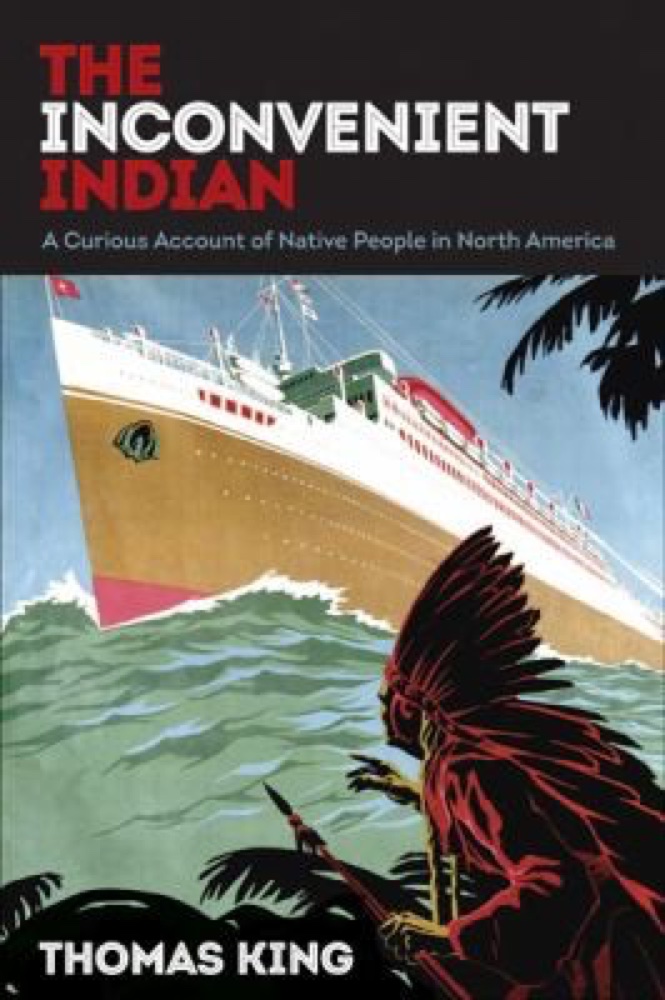
 The Inconvenient Indian: A Curious Account of Native People in North America
Quotes from the Book
you have to be careful with the stories you tell. And you have to watch out for the stories that you are told.
44
The truth about stories is that that's all we are.
19
Stories are wondrous things. And they are dangerous.
12
What if the creation story in Genesis had featured a flawed deity who was understanding and sympathetic rather than autocratic and rigid? Someone who, in the process of creation, found herself lost from time to time and in need of advice, someone who was willing to accept a little help with the more difficult decisions? What if the animals had decided on their own names? What if Adam and Eve had simply been admonished for their foolishness? I love you, God could have said, but I’m not happy with your behaviour. Let’s talk this over. Try to do better next time. What kind of a world might we have created with that kind of story?
2
Would it have made a difference? This is the question we always ask after we have given up.
2
Perhaps we shouldn't be displeased with the 'environmental ethics' we have or the 'business ethics' or the 'political ethics' or any of the myriad of other codes of conduct suggested by our actions. After all, we've created them. We've created the stories that allow them to exist and flourish. They didn't come out of nowhere. They didn't arrive from another planet.
2
What about human beings? said the animals. Do you think we need human beings? Why not? said the Twins. And as quick as they could the right-handed Twin created women, and the left-handed Twin created men. They don't look too bright, said the animals. We hope they won't be a problem. Don't worry, said the Twins, you guys are going to get along just fine.
2
And cranky old Jacques Derrida notwithstanding, we do love our dichotomies.
2
So it’s lucky for me that literary analysis is not about proof, only persuasion. In our cynical world, where suspicion is a necessity, insisting that something is true is not nearly as powerful as suggesting that something might be true.
1
Once a story is told, it cannot be called back. Once told, it is loose in the world.
1
What the camera allows you to do is to invent, to create. That's really what photographs are. Not records of moments, but rather imaginative acts.
For once a story is told, it cannot be called back. Once told, it is loose in the world.
Watch on YouTube
About Thomas King
We have collected 35 quotes from 2 books by Thomas King on BookQuoters.
More about the author →More by Thomas King
The Inconvenient Indian: A Curious Account of Native People in North America
About the book
"Stories are wondrous things. And they are dangerous." In The Truth About Stories, Native novelist and scholar Thomas King explores how stories shape who we are and how we understand and interact with other people. From creation stories to personal experiences, historical anecdotes to social injustices, racist propaganda to works of contemporary Native literature, King probes Native culture's deep ties to storytelling. With wry humor, King deftly weaves events from his own life as a child in California, an academic in Canada, and a Native North American with a wide-ranging discussion of stories told by and about Indians. So many stories have been told about Indians, King comments, that "there is no reason for the Indian to be real. The Indian simply has to exist in our imaginations." That imaginative Indian that North Americans hold dear has been challenged by Native writers - N. Scott M
Book details
- First published
- 2003
- Author
- Thomas King
- Genre
- Nonfiction
- Goodreads rating
- 4.33 (4k ratings)
Keep reading
 Dæmon Voices
 The View from the Cheap Seats: Selected Nonfiction
 The Unlikely Escape of Uriah Heep
 Stories: All-New Tales
 The Language of the Night: Essays on Writing, Science Fiction, and Fantasy
 Two Years Eight Months and Twenty-Eight Nights
 Gnomon
 The Library of the Unwritten
 Mystery and Manners: Occasional Prose
 The Very Best of Charles de Lint
 Burning Questions: Essays and Occasional Pieces, 2004 to 2021
 The Archive of Alternate Endings
 Story: Substance, Structure, Style, and the Principles of Screenwriting
 Tales from Earthsea
 The Wave in the Mind: Talks and Essays on the Writer, the Reader and the Imagination
 The Neverending Story
 The Hakawati
 A Million Miles in a Thousand Years: What I Learned While Editing My Life
 The Thirteenth Tale
 Fragile Things: Short Fictions and Wonders
 Thrust
 How to Read Literature Like a Professor
 What the Dog Saw and Other Adventures
 How to Read Literature
 Haroun and the Sea of Stories
 The Book That Broke the World
 The Book of Form and Emptiness
 Thistlefoot
 Too Like the Lightning
 The Science of Storytelling
 In Other Worlds: SF and the Human Imagination
 The Book That Wouldn’t Burn
 Arm of the Sphinx
 Eating the Dinosaur
 The Braindead Megaphone
 Genesis
 And Then I Woke Up
 Consider This: Moments in My Writing Life After Which Everything Was Different
 Flaubert's Parrot
 When Women Were Dragons
 Everything Sad Is Untrue
 Afterworlds
 Once Upon a Wardrobe
 The Wolf Gift
 Wired for Story: The Writer's Guide to Using Brain Science to Hook Readers from the Very First Sentence
 Haunted
 A Practical Guide to Conquering the World
 Lighthousekeeping
 Toward Eternity
 Golden State
 Arcadia
 The Wrong End of the Telescope
 A Slip of the Keyboard: Collected Non-Fiction
 Experimental Film
 Wampeters, Foma and Granfalloons
 The Stone Gods
 The Ogress and the Orphans
 The Paper Menagerie and Other Stories
 The Geek Feminist Revolution
 The Triggering Town: Lectures and Essays on Poetry and Writing