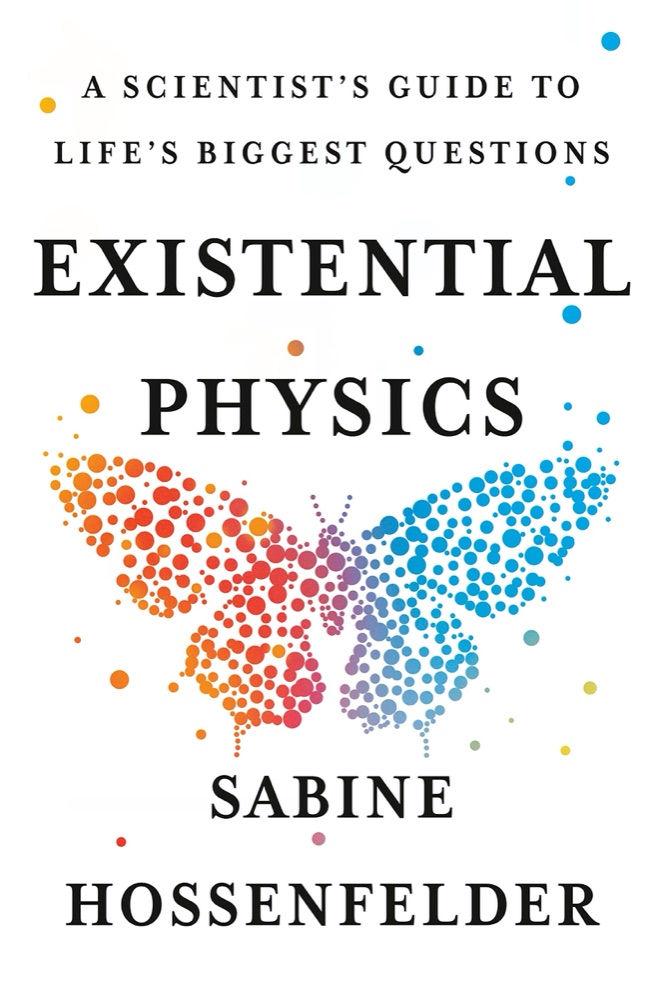

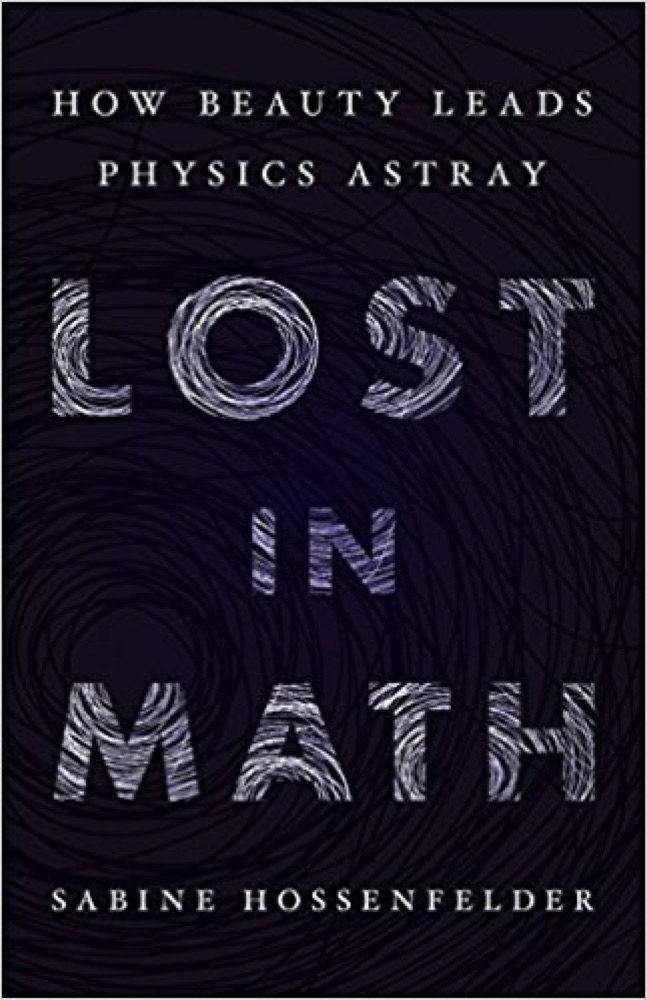
 Lost in Math: How Beauty Leads Physics Astray
Quotes from the Book
Sometimes the only scientific answer we can give is “We don’t know.
18
All the hypotheses about the early universe . . . are pure speculation. They're modern creation myths written in the language of mathematics.
7
For 97 percent of all Wikipedia articles, if you click on the first link and repeat this in each subsequent article, you will eventually get to an entry about philosophy. Philosophy is where our knowledge ends,
5
I quite like the idea that we live in a computer simulation. It gives me hope that things will be better on the next level.
3
I don't know if the universe has a purpose, but I would say that there is something more to it, in the sense that the presence of conscious beings is probably something deeper, not just not random. [quoting Roger Penrose]
3
There are no exact metaphors, not for quantum mechanics and not for anything else, because if they were exact, they wouldn't be metaphors.
2
According to the currently established laws of nature, the future, the present, and the past all exist in the same way. That's because, regardless of what you mean by 'exist', there is nothing in these laws that distinguishes one moment of time from any other. The past, therefore, exists in just the same way as the present. While the situation is not entirely settled, it seems that the laws of nature preserve information entirely, so all the details that make up you and the story of your grandmother's life are immortal.
1
Today I think they don't teach the principle of least action in school because then everybody would go and study physics.
1
If your belief conflicts with empirically confirmed knowledge, then you are not seeking meaning; you are delusional.
1
Sometimes the only scientific answer we can give is 'We don't know.
1
Instead of thinking of ourselves as selecting possible futures, I suggest we remain curious about what's to come and strive to learn more about ourselves and the universe we inhabit.
1
However, they implicitly assume that mathematics itself is timeless, that mathematical truth is eternal, and that logic doesn’t change. This is an assumption that cannot be proved, because what would you prove it true with? It’s one of the usually unstated articles of faith that our scientific inquiry is based on.
1
If you say “holism,” I hear “bullshit.
So it’s not that consciousness causes the reduction of the wave function but that the reduction of the wave function plays a role in consciousness?
One is that counting microstates and comparing their numbers becomes tricky if a theory has infinitely many microstates, and that’s the case for all continuous-field theories. It is possible to define entropy in those cases, but whether it’s still a meaningful quantity is questionable. It’s generally a bad idea to compare infinity to infinity, because the outcome depends on just how you define the comparison, so any conclusion you draw from such an exercise becomes physically ambiguous.
Physicists should take note that the universal laws they have found might only scratch the surface of so-for-unrecognized complexity. While my colleages think they are closing in on a final answer, I think we've just begun to understand the question.
When Sean Carroll summed up his compatibilist stance with “free will is as real as a baseball,” he should have added “and equally free.
But it doesn’t prime people just to question free will; it primes them for fatalism—the idea that it doesn’t matter what you do.
Our thirst for knowledge is ubiquitous, in both individuals and societies. We want to understand, partly because understanding is useful, but also, I think, out of a primary need to make sense of ourselves and our place in this world.
Popular-science news about quantum mechanics is to me as baffling as it is frustrating. Hand me an equation, and I can deal with it. But if you tell me that quantum mechanics allows one to separate a cat from its grin or that an experiment shows "an irreconcilable mismatch between the friends and the Wigners," I'll back out of the room quietly before anyone demands I explain this mess. I have suffered through countless well-intended introductions to quantum mechanics featuring quantum shoes, quantum coins, quantum boxes, and entire zoos of quantum animals that went in and out of those boxes. If you actually understand those explanations, I salute you, because if I hadn't known already how quantum mechanics works, I still wouldn't know.
While entanglement is indeed nonlocal, it is still created locally.
Watch on YouTube
About Sabine Hossenfelder
We have collected 39 quotes from 2 books by Sabine Hossenfelder on BookQuoters.
More about the author →More by Sabine Hossenfelder
Lost in Math: How Beauty Leads Physics Astray
About the book
A NEW YORK TIMES BESTSELLER
“An informed and entertaining guide to what science can and cannot tell us.” — The Wall Street Journal
“Stimulating . . . encourage[s] readers to push past well-trod assumptions […] and have fun doing so.” — Science Magazine
From renowned physicist and creator of the YouTube series “Science without the Gobbledygook,” a book that takes a no-nonsense approach to life’s biggest questions, and wrestles with what physics really says about the human condition
Not only can we not currently explain the origin of the universe, it is questionable we will ever be able to explain it. The notion that there are universes within particles, or that particles are conscious, is ascientific, as is the hypothesis that our universe is a computer simulation. On the other hand, the idea that the universe itself is conscious is difficult to rule out entirely.
Accord
Book details
- First published
- 2022
- Author
- Sabine Hossenfelder
- Genre
- Nonfiction
- Goodreads rating
- 3.88 (3k ratings)
The buzz
- The Wall Street JournalReview in The Wall Street Journalprofessional review (via Book Marks)
- Kirkus ReviewsReview in Kirkus Reviewsprofessional review (via Book Marks)
- Publishers WeeklyReview in Publishers Weeklyprofessional review (via Book Marks)
- LibraryjournalReview in Libraryjournalprofessional review (via Book Marks)
- BooklistReview in Booklistprofessional review (via Book Marks)
Keep reading
 Our Mathematical Universe: My Quest for the Ultimate Nature of Reality
 A Universe from Nothing: Why There Is Something Rather Than Nothing
 Helgoland: Making Sense of the Quantum Revolution
 The Big Picture: On the Origins of Life, Meaning, and the Universe Itself
 Why Does the World Exist?: An Existential Detective Story
 The Grand Design
 From Eternity to Here: The Quest for the Ultimate Theory of Time
 The Meaning of It All: Thoughts of a Citizen-Scientist
 A Brief History of Time
 Black Holes and Baby Universes and Other Essays
 Astrophysics for People in a Hurry
 The Accidental Universe: The World You Thought You Knew
 Parallel Worlds: A Journey Through Creation, Higher Dimensions, and the Future of the Cosmos
 The Pleasure of Finding Things Out: The Best Short Works of Richard P. Feynman
 The World According to Physics
 The Varieties of Scientific Experience: A Personal View of the Search for God
 The End of Everything
 What Does It All Mean? A Very Short Introduction to Philosophy
 The Case for a Creator: A Journalist Investigates Scientific Evidence That Points Toward God
 Death by Black Hole: And Other Cosmic Quandaries
 But What If We're Wrong? Thinking About the Present As If It Were the Past
 A Briefer History of Time
 What Is Real?: The Unfinished Quest for the Meaning of Quantum Physics
 Until the End of Time: Mind, Matter, and Our Search for Meaning in an Evolving Universe
 The Case Against Reality: Why Evolution Hid the Truth from Our Eyes
 The Character of Physical Law
 Metaphysics
 The Fabric of the Cosmos: Space, Time, and the Texture of Reality
 The Magic of Reality: How We Know What's Really True
 The Feynman Lectures on Physics
 The End of Time: The Next Revolution in Our Understanding of the Universe
 Freedom Evolves
 Gödel, Escher, Bach: An Eternal Golden Braid
 The Blind Watchmaker: Why the Evidence of Evolution Reveals a Universe Without Design
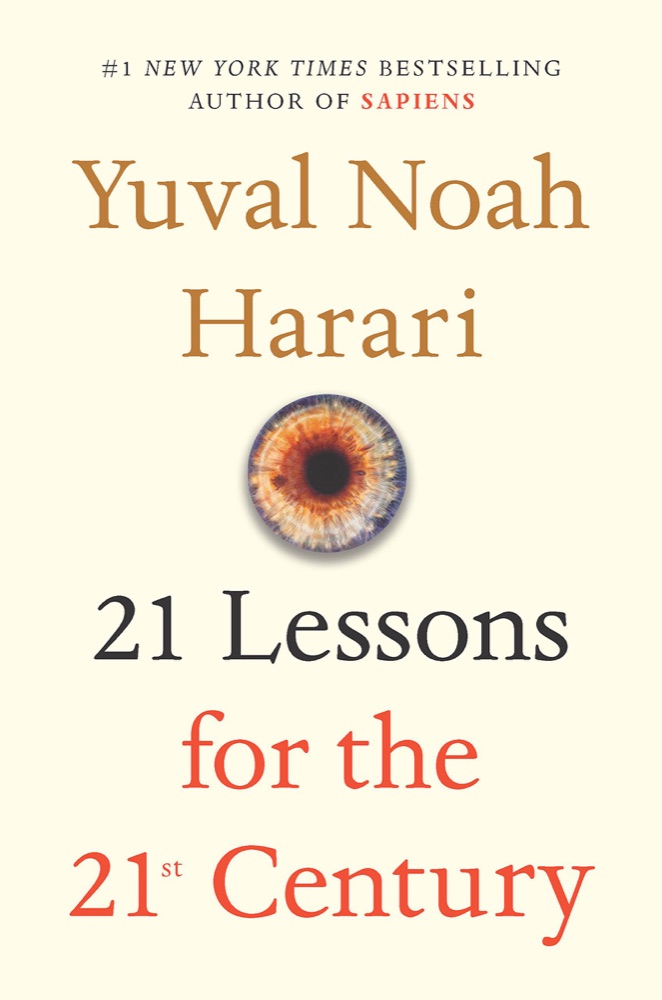 21 Lessons for the 21st Century
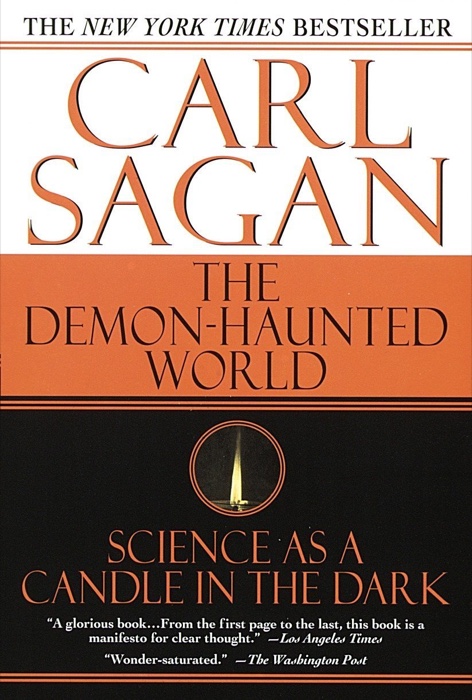 The Demon-Haunted World: Science as a Candle in the Dark
 The Elegant Universe: Superstrings, Hidden Dimensions, and the Quest for the Ultimate Theory
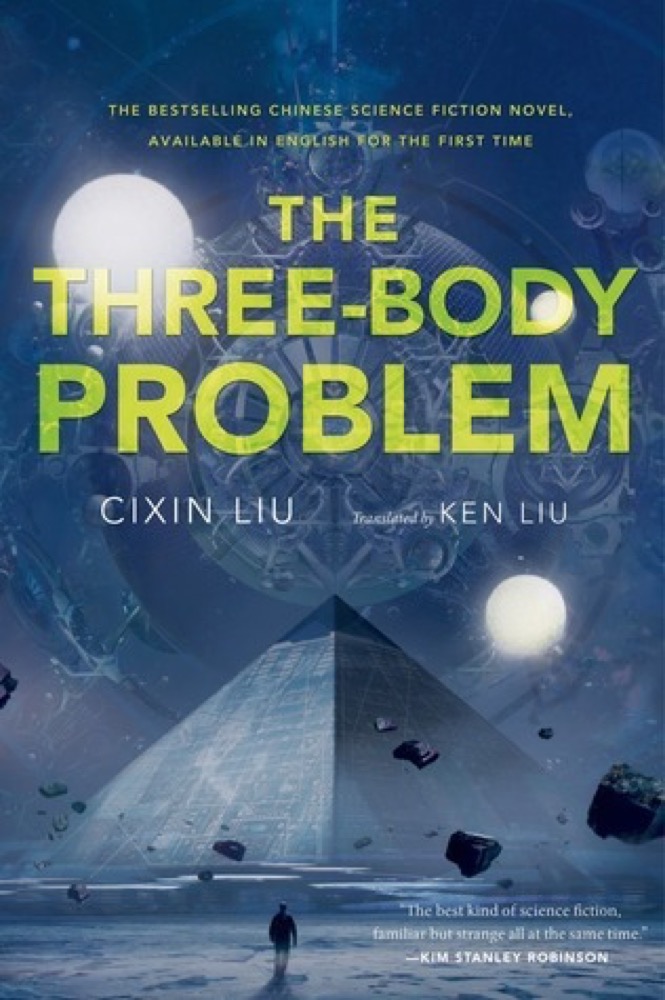 The Three-Body Problem
 13 Things That Don't Make Sense: The Most Baffling Scientific Mysteries of Our Time
 Consilience: The Unity of Knowledge
 Six Easy Pieces: Essentials of Physics By Its Most Brilliant Teacher
 Exhalation
 The Tell-Tale Brain: A Neuroscientist's Quest for What Makes Us Human
 Spook: Science Tackles the Afterlife
 God's Debris: A Thought Experiment
 Rationality: From AI to Zombies
 Brief Answers to the Big Questions
 Living with a Wild God: A Nonbeliever's Search for the Truth about Everything
Lost in Math: How Beauty Leads Physics Astray
Living with a Wild God: A Nonbeliever's Search for the Truth about Everything
Lost in Math: How Beauty Leads Physics Astray
 Echopraxia
 The Universe in a Single Atom: The Convergence of Science and Spirituality
 Jurassic Park
 Tractatus Logico-Philosophicus
 Chaos: Making a New Science
 A Devil's Chaplain: Reflections on Hope, Lies, Science, and Love
 Darwin's Dangerous Idea: Evolution and the Meanings of Life
 How the Mind Works
 There Is a God: How the World's Most Notorious Atheist Changed His Mind