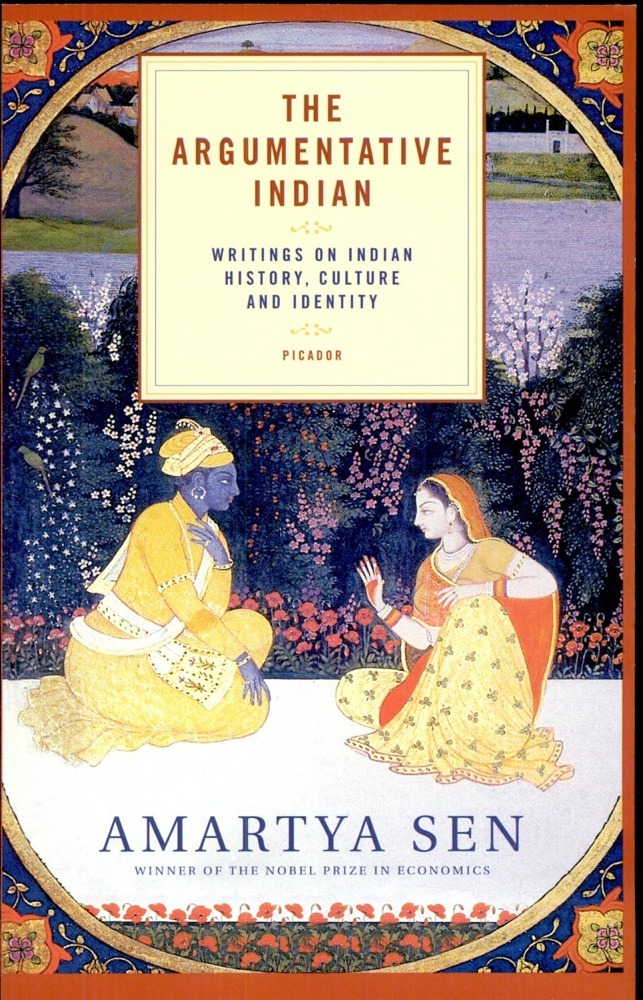
 The Argumentative Indian: Writings on Indian History, Culture and Identity
Quotes from the Book
The increasing tendency towards seeing people in terms of one dominant ‘identity’ (‘this is your duty as an American’, ‘you must commit these acts as a Muslim’, or ‘as a Chinese you should give priority to this national engagement’) is not only an imposition of an external and arbitrary priority, but also the denial of an important liberty of a person who can decide on their respective loyalties to different groups (to all of which he or she belongs).
61
The notion of human right builds on our shared humanity. These rights are not derived from the citizenship of any country, or the membership of any nation, but are presumed to be claims or entitlements of every human being. They differ, therefore, from constitutionally created rights guaranteed for specific people.
15
If a theory of justice is to guide reasoned choice of policies, strategies or institutions, then the identification of fully just social arrangements is neither necessary nor sufficient.
7
To conclude this discussion, assessment of justice demands engagement with the 'eyes of mankind', first, because we may variously identify with the others elsewhere and not just with our local community; second, because our choices and actions may affect the lives of others far as well as near; and third,because what they see from their respective perspective of history and geography may help us to overcome our own parochialism.
2
To understand the world is never a matter of simply recording our immediate perceptions. Understanding inescapably involves reasoning. We have to 'read' what we feel and seem to see, and ask what those perceptions indicate and how we may take them into account without being overwhelmed by them. One issue relates to the reliability of our feelings and impressions. A sense of injustice could serve as a signal that moves us, but a signal does demand critical examination, and there has to be some scrutiny of the soundness of a conclusion based mainly on signals...We also have to ask what kinds of reasoning should count in the assessment of ethical and political concepts such as justice and injustice.
Watch on YouTube
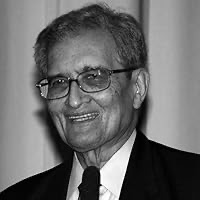
About Amartya Sen
We have collected 34 quotes from 2 books by Amartya Sen on BookQuoters.
More about the author →More by Amartya Sen
The Argumentative Indian: Writings on Indian History, Culture and Identity
About the book
Social justice: an ideal, forever beyond our grasp; or one of many practical possibilities? More than a matter of intellectual discourse, the idea of justice plays a real role in how--and how well--people live. And in this book the distinguished scholar Amartya Sen offers a powerful critique of the theory of social justice that, in its grip on social and political thinking, has long left practical realities far behind.
The transcendental theory of justice, the subject of Sen's analysis, flourished in the Enlightenment and has proponents among some of the most distinguished philosophers of our day; it is concerned with identifying perfectly just social arrangements, defining the nature of the perfectly just society. The approach Sen favors, on the other hand, focuses on the comparative judgments of what is "more" or "less" just, and on the comparative merits of the different societies
Book details
- First published
- 2009
- Author
- Amartya Sen
- Genre
- Philosophy
- Goodreads rating
- 4.02 (2k ratings)
Keep reading
 A Theory of Justice
 Justice: What's the Right Thing to Do?
 Identity: The Demand for Dignity and the Politics of Resentment
 The Chomsky-Foucault Debate: On Human Nature
 After Virtue
 A Conflict of Visions: Ideological Origins of Political Struggles
 The Constitution of Liberty
 Cynical Theories: How Activist Scholarship Made Everything about Race, Gender, and Identity—and Why This Harms Everybody
 Doing Justice: A Prosecutor's Thoughts on Crime, Punishment, and the Rule of Law
 A People's History of the United States
 The Righteous Mind: Why Good People Are Divided by Politics and Religion
 Anarchy, State, and Utopia
 The Fatal Conceit: The Errors of Socialism
 Elite Capture: How the Powerful Took Over Identity Politics
 The Madness of Crowds: Gender, Race and Identity
 Elements of the Philosophy of Right
 Enlightenment Now: The Case for Reason, Science, Humanism, and Progress
 United: Thoughts on Finding Common Ground and Advancing the Common Good
 You Can't Be Neutral on a Moving Train: A Personal History of Our Times
 On Liberty and Other Essays
 What White People Can Do Next: From Allyship to Coalition – An Empowering Guide to Interrogating Whiteness and Creating Justice
 Truth and Method
 Capitalism: The Unknown Ideal
 Beyond Religion: Ethics for a Whole World
 This Is What Inequality Looks Like
 The Dawn of Everything: A New History of Humanity
 The Blank Slate: The Modern Denial of Human Nature
 The Moral Landscape: How Science Can Determine Human Values
The Argumentative Indian: Writings on Indian History, Culture and Identity
The Moral Landscape: How Science Can Determine Human Values
The Argumentative Indian: Writings on Indian History, Culture and Identity
 Across That Bridge: A Vision for Change and the Future of America
 The Road to Serfdom
 World Order
 The End of History and the Last Man
 Not for Profit: Why Democracy Needs the Humanities
 Political Theology: Four Chapters on the Concept of Sovereignty
 Undoing Gender
 The Essential Chomsky
 Pedagogy of the Oppressed
 What Unites Us: Reflections on Patriotism
 Ill Fares the Land
 Chomsky On Anarchism
 A Theology of Liberation
 On the Other Side of Freedom: The Case for Hope
 Black Rednecks and White Liberals
 On Liberty
 Practical Ethics
 The Source of Self-Regard: Selected Essays, Speeches, and Meditations
 Think: A Compelling Introduction to Philosophy
 Rights of Man
 Parasitic Mind: How Infectious Ideas Are Killing Common Sense
 The Sane Society
 Where Do We Go from Here: Chaos or Community?
 Pathologies of Power: Health, Human Rights, and the New War on the Poor
 We Gon' Be Alright: Notes on Race and Resegregation
 The Machiavellians: Defenders of Freedom
 The Open Society and Its Enemies - Volume One: The Spell of Plato
 The Person You Mean to Be: How Good People Fight Bias
 The War on the West: An Instant NYT Bestselling History of the Modern World
 How Should We Then Live? The Rise and Decline of Western Thought and Culture
 White Like Me: Reflections On Race From A Privileged Son