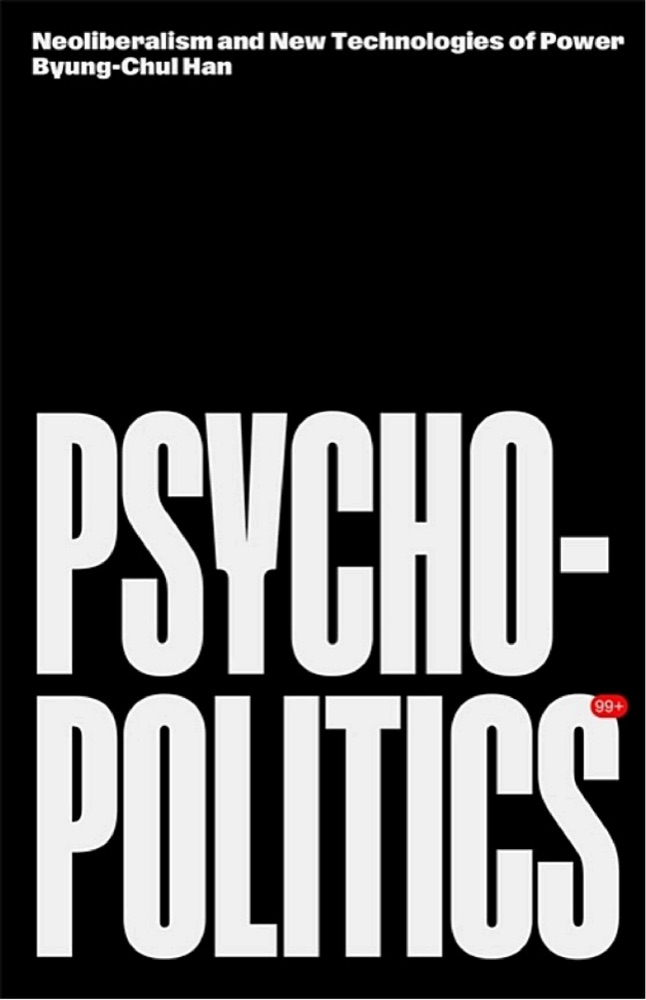

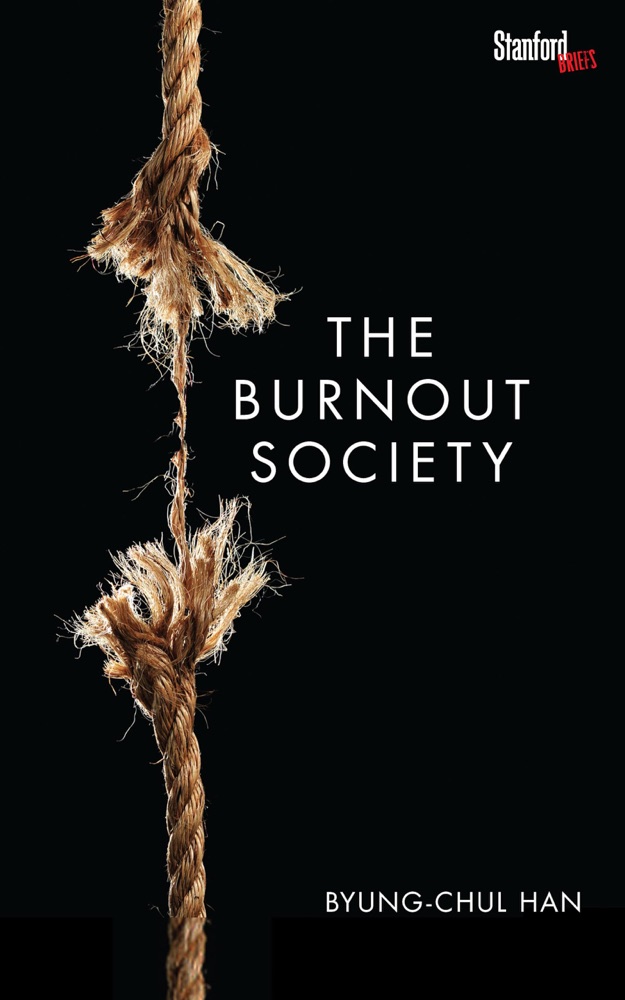
 The Burnout Society
Quotes from the Book
Neoliberalism makes citizens into consumers. The freedom of the citizen yields to the passivity of the consumer. As consumers, today’s voters have no real interest in politics –in actively shaping the community. They possess neither the will nor the ability to participate in communal, political action. They react only passively to politics: grumbling and complaining, as consumers do about a commodity or service they do not like. Politicians and parties follow this logic of consumption too. They have to ‘deliver’. In the process, they become nothing more than suppliers; their task is to satisfy voters who are consumers or customers.
90
Now, under the neoliberal regime of auto-exploitation, people are turning their aggression against themselves. This auto-aggressivity means that the exploited are not inclined to revolution so much as depression
24
Quien fracasa en la sociedad neoliberal del rendimiento se hace a sí mismo responsable y se avergüenza, en lugar de poner en duda a la sociedad o al sistema. En esto consiste la especial inteligencia del régimen neoliberal.
18
As the entrepreneur of its own self, the neoliberal subject has no capacity for relationships with others that might be free of purpose. Nor do entrepreneurs know what purpose-free friendship would even look like.
16
Big Data has announced the end of the person who possesses free will.
12
Neoliberalism represents a highly efficient, indeed an intelligent, system for exploiting freedom. Everything that belongs to practices and expressive forms of liberty –emotion, play and communication –comes to be exploited.
11
La dominación aumenta su eficacia al delegar a cada uno la vigilancia. El me gusta es el amén digital. Cuando hacemos clic en el botón de me gusta nos sometemos a un entramado de dominación. El smartphone no es solo un eficiente aparato de vigilancia, sino también un confesionario móvil. Facebook es la iglesia, la sinagoga global (literalmente, la congregación) de lo digital.
11
The idiot is a modern-day heretic. Etymologically, heresy means ‘choice’. Thus, the heretic is one who commands free choice·, the courage to deviate from orthodoxy. As a heretic, the idiot represents a figure of resistance opposing the violence of consensus. The idiot preserves the magic of the outsider. Today, in fight of increasingly coercive conformism, it is more urgent than ever to heighten heretical consciousness.
5
As a mutant form of capitalism, neoliberalism transforms workers into entrepreneurs. It is not communist revolution that is now abolishing the allo-exploited working class - instead, neoliberalism is in the course of doing so. Today, everyone is an auto-exploiting labourer in his or her own enterprise. People are now master and slave in one. Even class struggle has transformed into an inner struggle against oneself.
5
Hoy creemos que no somos un sujeto sometido, sino un proyecto libre que constantemente se replantea y se reinventa. Este tránsito del sujeto al proyecto va acompañado de la sensación de libertad. Pues bien, el propio proyecto se muestra como una figura de coacción, incluso como una forma eficiente de subjetivación y de sometimiento. El yo como proyecto, que cree haberse liberado de las coacciones externas y de las coerciones ajenas, se somete a coacciones internas y a coerciones propias en forma de una coacción al rendimiento y la optimización.
4
People who fail in the neoliberal achievement-society see themselves as responsible for their lot and feel shame instead of questioning society or the system. Herein lies the particular intelligence defining the neoliberal regime: no resistance to the system can emerge in the first place. In contrast, when allo-exploitation prevails, the exploited are still able to show solidarity and unite against those who exploit them. Such is the logic on which Marx’s idea of a ‘dictatorship of the proletariat’ is based. However, this vision presupposes that relations of repression and domination hold. Now, under the neoliberal regime of auto-exploitation, people are turning their aggression against themselves. This auto-aggressivity means that the exploited are not inclined to revolution so much as depression.
3
Today, we do not deem ourselves subjugated subjects, but rather projects·, always refashioning and reinventing ourselves. A sense of freedom attends passing from the state of subject to that of project. All the same, this projection amounts to a form of compulsion and constraint - indeed, to a more efficient kind of subjeçtivation and subjugation. As a project deeming itself free of external and alien limitations, the I is now subjugating itself to internal limitations and self-constraints, which are taking the form of compulsive achievement and optimization.
3
Neoliberal psychopolitics seduces the soul; it preempts it in lieu of opposing it. It carefully protocols desires, needs and wishes instead of ‘depatterning’ them. By means of calculated prognoses, it anticipates actions – and acts ahead of them instead of cancelling them out. Neoliberal psychopolitics is SmartPolitics: it seeks to please and fulfil, not to repress.
3
The neoliberal imperative of self-optimization serves only to promote perfect functioning within the system. Inhibitions, points of weakness and mistakes are to be therapeutically eliminated in order to enhance efficiency and performance. In turn, everything is made comparable and measurable and subjected to the logic of the market. It is not concern for the good life that drives self-optimization. Rather, self-optimization follows from systemic constraints - from the logic of quantifying success on the market.
2
People who fail in the neoliberal archievement-society see themselves as responsible for their lot and feel shame instead of questioning society or the system.
2
Initially, the internet was celebrated as a medium of boundless liberty.... As it turned out, such euphoria was an illusion. Today, unbounded freedom and communication are switching over into total control and surveillance. More and more, social media resemble digital panoptic.... Secrets, foreigners, and otherness represent impediments to unbounded communication. Communication goes faster when it is smoothed out--that is when thresholds, walls, and gaps are removed. This also means stripping people of interiority, which blocks and slows down communication.... The negativity of otherness or foreignness is de-interiorized and transformed into the positivity of communicable and consumable difference: "diversity".... The dispositive of transparency has the further consequence of promoting total conformity.... It is as if everyone were watching over everyone else--even before intelligent agencies or secret services have stepped in to supervise and steer. Invisible moderators smooth out communication and calibrate it to what is generally understood and accepted. Such primary, intrinsic surveillance proves much more problematic than the secondary, extrinsic surveillance undertaken by secret services and spying agencies.
2
Digital temporality belongs to the undead.
2
As consumers, today’s voters have no real interest in politics – in actively shaping the community. They possess neither the will nor the ability to participate in communal, political action. They react only passively to politics: grumbling and complaining, as consumers do about a commodity or service they do not like.
2
The violence of positivity is just as destructive as the violence of negativity.
1
Countless self-management workshops, motivational retreats, and seminars on personality or mental training promise boundless self-optimization and heightened efficiency. They are steered by neoliberal techniques of domination, which aim to capitalize not just on working time but on the person themselves.
1
...Statistics and Big Data lie worlds apart. Big Data provides the means for establishing not just an individual but a collective psychogram-perhaps even the psychogram of the unconscious self. As such, it may yet shine a light into the depth of the psyche and exploit the unconscious entirely.
1
In contemporary American self-help literature, the magic word is healing. The term refers to self-optimization that is supposed to therapeutically eliminate any and all functional weakness or mental obstacle in the name of efficiency and performance. Yet perpetual self-optimization, which coincides point-for-point with the optimization of the system, is proving destructive. It is leading to mental collapse. Self-optimization, it turns out, amounts to total self-exploitation. The neoliberal ideology of self-optimization displays religious - indeed, fanatical - traits. It entails a new form of subjectivation. Endlessly working at self-improvement resembles the self-examination and self-monitoring of Protestantism, which represents a technology of subjectivation and domination in its own right. Now, instead of searching out sins, one hunts down negative thoughts. The ego grapples with itself as an enemy. Today, even fundamentalist preachers act like managers and motivational trainers, proclaiming the new Gospel of limitless achievement and optimization.
1
Under neoliberalism, the technology of power takes on a subtle form. It does not lay hold of individuals directly. Instead, it ensures that individuals act on themselves so that power relations are interiorized - and then interpreted as freedom. Self-optimization and submission, freedom and exploitation, fall into one.
1
Today’s crisis of freedom stems from the fact that the operative technology of power does not negate or repress freedom so much as exploit it. Free choice {Wahl) is eliminated to make way for a free selection (Auswahl) from among the items on offer. Smart power with a liberal, friendly appearance - power that stimulates and seduces - is more compelling than power that imposes, threatens and decrees. Its signal and seal is the Like button. Now, people subjugate themselves to domination by consuming and communicating - and they click Like all the while. Neoliberalism is the capitalism of ‘Like.’ It is fundamentally different from nineteenth-century capitalism, which operated by means of disciplinary constraints and prohibitions. Smart power reads and appraises our conscious and unconscious thoughts. It places its stock in voluntary self organization and self-optimization. As such, it has no need to overcome resistance. Mastery of this sort requires no great expenditure of energy or violence. It simply happens. The capitalism of Like should come with a warning label: Protect me from what I want.
1
To be sure, power can express itself as violence or repression. But it is not based on force. Power need not exclude, prohibit or censor. Not does it stand opposed to freedom. Indeed, power can even use freedom to its own ends. Only in its negative form does power manifest itself as a violence that says "no’ by shattering the will and annulling freedom. Today, power is assuming increasingly permissive forms. In its permissivity - indeed, in its friendliness - power is shedding its negativity and presenting itself as freedom.
1
Watch on YouTube
About Byung-Chul Han
We have collected 69 quotes from 3 books by Byung-Chul Han on BookQuoters.
More about the author →More by Byung-Chul Han
The Burnout Society
 The Scent of Time: A Philosophical Essay on the Art of Lingering
About the book
Exploring how neoliberalism has discovered the productive force of the psycheByung-Chul Han, a star of German philosophy, continues his passionate critique of neoliberalism, trenchantly describing a regime of technological domination that, in contrast to Foucault’s biopower, has discovered the productive force of the psyche. In the course of discussing all the facets of neoliberal psychopolitics fueling our contemporary crisis of freedom, Han elaborates an analytical framework that provides an original theory of Big Data and a lucid phenomenology of emotion. But this provocative essay proposes counter models too, presenting a wealth of ideas and surprising alternatives at every turn.
Book details
- First published
- 2014
- Author
- Byung-Chul Han
- Genre
- Philosophy
- Goodreads rating
- 4.07 (8k ratings)
Keep reading
 First As Tragedy, Then As Farce
 Capitalist Realism: Is There No Alternative?
 One-Dimensional Man: Studies in the Ideology of Advanced Industrial Society
The Burnout Society
One-Dimensional Man: Studies in the Ideology of Advanced Industrial Society
The Burnout Society
 Chomsky On Anarchism
 Anti-Oedipus: Capitalism and Schizophrenia
 The Coming Insurrection
 Ghosts of My Life: Writings on Depression, Hauntology and Lost Futures
 Empire of Illusion: The End of Literacy and the Triumph of Spectacle
 The Utopia of Rules: On Technology, Stupidity, and the Secret Joys of Bureaucracy
 What's Our Problem?: A Self-Help Book for Societies
 Pedagogy of the Oppressed
 Endgame, Vol. 1: The Problem of Civilization
 The Culture of Narcissism: American Life in An Age of Diminishing Expectations
 Talking to My Daughter About the Economy: or, How Capitalism Works—and How It Fails
 Brave New World Revisited
 Liberalism: The Classical Tradition
 Vulture Capitalism: Corporate Crimes, Backdoor Bailouts, and the Death of Freedom
 America: The Farewell Tour
 On Freedom: Four Songs of Care and Constraint
 Why Marx Was Right
 You Are Not a Gadget
 Brave New World / Brave New World Revisited
 In Praise of Idleness and Other Essays
 Capitalism, Socialism and Democracy
 Revolution
 Homo Deus: A History of Tomorrow
 Human Action: A Treatise on Economics
 Elite Capture: How the Powerful Took Over Identity Politics
 Trick Mirror: Reflections on Self-Delusion
 Dialectic of Enlightenment: Philosophical Fragments
 Power vs. Force
 The Sane Society
 Four Futures: Life After Capitalism
 On Freedom
 The Road to Serfdom
 The Culture Industry
 Death of the Liberal Class
 Escape from Freedom
 The Age of Absurdity: Why Modern Life makes it Hard to be Happy
 The Ego and Its Own
 Understanding Media: The Extensions of Man
 Saving Time: Discovering a Life Beyond the Clock
 The Great Transformation: The Political and Economic Origins of Our Time
 Shop Class as Soulcraft: An Inquiry Into the Value of Work
 Literary Theory: An Introduction
 Capitalism: The Unknown Ideal
 The Blank Slate: The Modern Denial of Human Nature
 The Freedom Manifesto
 Walden Two
 Sedated: How Modern Capitalism Created our Mental Health Crisis
 The View From Flyover Country: Essays by Sarah Kendzior
 Food of the Gods: The Search for the Original Tree of Knowledge
 Doppelganger: A Trip into the Mirror World
 The Reactionary Mind: Conservatism from Edmund Burke to Sarah Palin
 Socialism: An Economic and Sociological Analysis
 Bright-Sided: How the Relentless Promotion of Positive Thinking Has Undermined America
 The Soul of Man Under Socialism
 Conspirators' Hierarchy: The Story of the Committee of 300
 The Art of the Commonplace: The Agrarian Essays