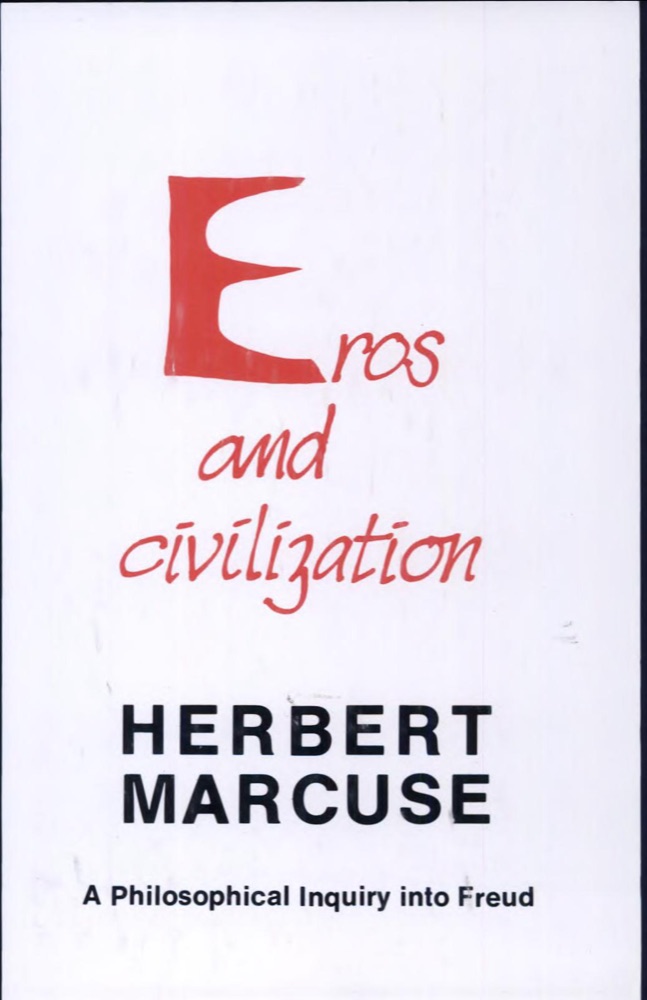
 Eros and Civilization: A Philosophical Inquiry into Freud
Quotes from the Book
If the worker and his boss enjoy the same television program and visit the same resort places, if the typist is as attractively made up as the daughter of her employer, if the Negro owns a Cadillac, if they all read the same newspaper, then this assimilation indicates not the disappearance of classes, but the extent to which the needs and satisfactions that serve the preservation of the Establishment are shared by the underlying population.
By virtue of the way it has organized its technological base, contemporary industrial society tends to be totalitarian. For "totalitarian" is not only a terroristic political coordination of society, but also a non-terroristic economic-technical coordination which operates through the manipulation of needs by vested interests.
One-dimensional thought is systematically promoted by the makers of politics and their purveyors of mass information. Their universe of discourse is populated by self-validating hypotheses which, incessantly and monopolistically repeated, become hyponotic definitions of dictations.
Remembrance of the past may give rise to dangerous insights, and the established society seems to be apprehensive of the subversive contents of memory.
Free election of masters does not abolish the masters or the slaves. Free
Technology serves to institute new, more effective, and more pleasant forms of social control and social cohesion. The totalitarian tendency of these controls seems to assert itself in still another sense—by spreading to the less developed and even to the pre-industrial areas of the world, and by creating similarities in the development of capitalism and communism.
Political freedom would mean liberation of the individuals from politics over which they have no effective control. Similarly,
Our society distinguishes itself by conquering the centrifugal social forces with Technology rather than Terror, on the dual basis of an overwhelming efficiency and an increasing standard of living.
We may distinguish both true and false needs. “False” are those which are superimposed upon the individual by particular social interests in his repression: the needs which perpetuate toil, aggressiveness, misery, and injustice. Their satisfaction might be most gratifying to the individual, but this happiness is not a condition which has to be maintained and protected if it serves to arrest the development of the ability (his own and others) to recognize the disease of the whole and grasp the chances of curing the disease. The result then is euphoria in unhappiness. Most of the prevailing needs to relax, to have fun, to behave and consume in accordance with the advertisements, to love and hate what others love and hate, belong to this category of false needs.
The distinguishing feature of advanced industrial society is its effective suffocation of those needs which demand liberation—liberation also from that which is tolerable and rewarding and comfortable—while it sustains and absolves the destructive power and repressive function of the affluent society. Here, the social controls exact the overwhelming need for the production and consumption of waste; the need for stupefying work where it is no longer a real necessity; the need for modes of relaxation which soothe and prolong this stupefication; the need for maintaining such deceptive liberties as free competition at administered prices, a free press which censors itself, free choice between brands and gadgets.
[…] en esta totalidad apenas es ya posible la distinción conceptual entre los negocios y la política, el beneficio y el prestigio, las necesidades y la publicidad. Se exporta un “modo de vida”, o se exporta a sí mismo en la dinámica de la totalidad. Con el capital, los ordenadores y el saber-vivir, llegan los restantes “valores”: relaciones libidinosas con la mercancía, con los artefactos motorizados agresivos, con la estética falsa del supermercado.
For Marcuse, the distinguishing features of a human being are free and creative subjectivity. If in one’s economic and social life one is administered by a technical labor apparatus and conforms to dominant social norms, one is losing one’s potentialities of self-determination and individuality. Alienated from the powers of being-a-self, one-dimensional man thus becomes an object of administration and conformity.
For “totalitarian” is not only a terroristic political coordination of society, but also a nonterroristic economic-technical coordination which operates through the manipulation of needs by vested interests. It
The range of choice open to the individual is not the decisive factor in determining the degree of human freedom, but what can be chosen and what is chosen by the individual. The
His argument is that the system’s much lauded economic, political, and social freedoms, formerly a source of social progress, lose their progressive function and become subtle instruments of domination which serve to keep individuals in bondage to the system that they strengthen and perpetuate. For example, economic freedom to sell one’s labor power in order to compete on the labor market submits the individual to the slavery of an irrational economic system; political freedom to vote for generally indistinguishable representatives of the same system is but a delusive ratification of a nondemocratic political system; intellectual freedom of expression is ineffectual when the media either co-opt and defuse, or distort and suppress, oppositional ideas, and when the image-makers shape public opinion so that it is hostile or immune to oppositional thought and action. Marcuse
For "totalitarian" is not only a terroristic political coordination of society, but also a non-terroristic economic-technical coordination which operates through the manipulation of needs by vested interests.
C'è qualcosa di più nel nome astratto (bellezza, libertà) rispetto alle qualità (bello, libero) attribuite a persone, cose o condizioni particolari. L'universale sostantivo allude a qualità che sorpassano ogni esperienza particolare ma persistono nella mente, non come una finzione della immaginazione e neppure come possibilità più logiche, bensì come il materiale di cui consiste il nostro mondo.
Watch on YouTube
About Herbert Marcuse
We have collected 25 quotes from 2 books by Herbert Marcuse on BookQuoters.
More about the author →More by Herbert Marcuse
Eros and Civilization: A Philosophical Inquiry into Freud
Book details
- Author
- Herbert Marcuse
- Genre
- Philosophy
- Goodreads rating
- 3.98 (8k ratings) →
Keep reading
 The Road to Serfdom
 Chomsky On Anarchism
 Capitalism: The Unknown Ideal
 Socialism: An Economic and Sociological Analysis
 Brave New World Revisited
 The Constitution of Liberty
 Human Action: A Treatise on Economics
 The Utopia of Rules: On Technology, Stupidity, and the Secret Joys of Bureaucracy
 First As Tragedy, Then As Farce
 Capitalism and Freedom
 The Sane Society
 Liberalism: The Classical Tradition
 Capitalism, Socialism and Democracy
 Socialism: Utopian and Scientific
 Seeing Like a State: How Certain Schemes to Improve the Human Condition Have Failed
 What Kind of Creatures Are We?
 The Great Transformation: The Political and Economic Origins of Our Time
 Four Futures: Life After Capitalism
 The Society of the Spectacle
 The End of History and the Last Man
 The Origins of Totalitarianism
 Escape from Freedom
 Why Marx Was Right
 Pedagogy of the Oppressed
 Psychopolitics: Neoliberalism and New Technologies of Power
 Anti-Oedipus: Capitalism and Schizophrenia
 The Accursed Share: An Essay on General Economy, Volume I: Consumption
 The Fatal Conceit: The Errors of Socialism
 Walden Two
 Small Is Beautiful: Economics as if People Mattered
 The Power of the Powerless
 Ameritopia: The Unmaking of America
 From Dawn to Decadence: 500 Years of Western Cultural Life, 1500 to the Present
 Conspirators' Hierarchy: The Story of the Committee of 300
 Behold a Pale Horse
 Anarchy, State, and Utopia
 In Praise of Idleness and Other Essays
 On Freedom
 The Machiavellians: Defenders of Freedom
 The Communist Manifesto
 Capital
 Selections from the Prison Notebooks
 Ill Fares the Land
 Democracy in America
 Reflections on the Revolution in France
 The Soul of Man Under Socialism
 Revolution
 The Culture of Narcissism: American Life in An Age of Diminishing Expectations
 The Undiscovered Self
 Political Theology: Four Chapters on the Concept of Sovereignty
 The Coming Insurrection
 Empire of Illusion: The End of Literacy and the Triumph of Spectacle
 Politics
 Death of the Liberal Class
 A Conflict of Visions: Ideological Origins of Political Struggles
 Economic & Philosophic Manuscripts of 1844
 The Lessons of History
 The Evolution of Everything: How New Ideas Emerge
 The Human Condition
 The Revolt of the Masses