
 Why Marx Was Right
Quotes from the Book
Geniuses and prophets do not usually excel in professional learning, and their originality, if any, is often due precisely to the fact that they do not.
48
In one important sense, Marxism is a religion. To the believer it presents, first, a system of ultimate ends that embody the meaning of life and are absolute standards by which to judge events and actions; and, secondly, a guide to those ends which implies a plan of salvation and the indication of the evil from which mankind, or a chosen section of mankind, is to be saved.
17
This civilization is rapidly passing away, however. Let us rejoice or else lament the fact as much as everyone of us likes; but do not let us shut our eyes to it.
13
Capitalism Survive?—I have tried to show that a socialist form of society will inevitably emerge from an equally inevitable decomposition of capitalist society.
9
Please do not think that I am accusing socialists of insincerity or that I wish to hold them up to scorn either as bad democrats or as unprincipled schemers and opportunists. I fully believe, in spite of the childish Machiavellism in which some of their prophets indulge, that fundamentally most of them always have been as sincere in their professions as any other men. Besides, I do not believe in insincerity in social strife, for people always come to think what they want to think and what they incessantly profess. As regards democracy, socialist parties are presumably no more opportunists than are any others; they simply espouse democracy if, as, and when it serves their ideals and interests and not otherwise. Lest readers should be shocked and think so immoral a view worthy only of the most callous of political practitioners, ...
9
Nothing should be more obvious than that the business organism cannot function according to design when its most important “parameters of action”—wages, prices, interest—are transferred to the political sphere and there dealt with according to the requirements of the political game or, which sometimes is more serious still, according to the ideas of some planners.
7
However, whether favorable or unfavorable, value judgments about capitalist performance are of little interest. For mankind is not free to choose. This is not only because the mass of people are not in a position to compare alternatives rationally and always accept what they are being told. There is a much deeper reason for it. Things economic and social move by their own momentum and the ensuing situations compel individuals and groups to behave in certain ways whatever they may wish to do—not indeed by destroying their freedom of choice but by shaping the choosing mentalities and by narrowing the list of possibilities from which to choose.
7
Social structures, types and attitudes are coins that do not readily melt. Once they are formed they persist, possibly for centuries, and since different structures and types display different degrees of this ability to survive, we almost always find that actual group and national behavior more or less departs from what we should expect it to be if we tried to infer it from the dominant forms of the productive process.
7
As a matter of practical necessity, socialist democracy may eventually turn out to be more of a sham than capitalist democracy ever was. In any case, that democracy will not mean increased personal freedom.
6
The public mind has by now so thoroughly grown out of humor with it as to make condemnation of capitalism and all its works a foregone conclusion---almost a requirement of the etiquette of discussion.
5
Can capitalism survive? No. I do not think it can. But this opinion of mine, like that of every other economist who has pronounced upon the subject, is in itself completely uninteresting. What counts in any attempt at social prognosis is not the Yes or No that sums up the facts and arguments which lead up to it but those facts and arguments themselves.
4
Every socialist wishes to revolutionize society from the economic angle and all the blessings he expects are to come through a change in economic institutions. This of course implies a theory about social causation—the theory that the economic pattern is the really operative element in the sum total of the phenomena that we call society.
4
We always plan too much and always think too little. We resent a call to thinking and hate unfamiliar argument that does not tally with what we already believe or would like to believe.
3
To begin with, convinced socialists will derive satisfaction from the mere fact of living in a socialist society.4 Socialist bread may well taste sweeter to them than capitalist bread simply because it is socialist bread, and it would do so even if they found mice in it.
3
In order to identify himself with the capitalist system, the unemployed of today would have completely to forget his personal fate and the politician of today his personal ambition. The long-run interests of society are so entirely lodged with the upper strata of bourgeois society that it is perfectly natural for people to look upon them as the interests of that class only. For the masses, it is the short-run view that counts. Like Louis XV, they feel après nous le deluge, and from the standpoint of individualist utilitarianism they are of course being perfectly rational if they feel like that.
3
But in capitalist reality as distinguished from its textbook picture, it is not that kind of competition which counts but the competition from the new commodity, the new technology, the new source of supply, the new type of organization (the largest-scale unit of control for instance)—competition which commands a decisive cost or quality advantage and which strikes not at the margins of the profits and the outputs of the existing firms but at their foundations and their very lives.
2
Whether a free lance or a party executive or a civil servant, the individual socialist looks upon the advent of socialism, naïvely but naturally, as synonymous with his advent to power. Socialization means to him that “we” are going to take over. Displacement of existing managements is an important, perhaps the most important, part of the show. And I confess that in conversing with militant socialists I have often felt some doubt as to whether some or. even most of them would care for a socialist régime, however perfect in other respects, if it were to be run by other people.
2
Analysis, whether economic or other, never yields more than a statement about the tendencies present in an observable pattern. And these never tell us what will happen to the pattern but only what would happen if they continued to act as they have been acting in the time interval covered by our observation and if no other factors intruded. “Inevitability” or “necessity” can never mean more than this.
1
The masses have not always felt themselves to be frustrated and exploited. But the intellectuals that formulated their views for them have always told them that they were, without necessarily meaning by it anything precise.
1
Capitalism does not merely mean that the housewife may influence production by her choice between peas and beans; or that plant managers have some voice in deciding what and how to produce: it means a scheme of values, an attitude toward life, a civilization—the civilization of inequality and of the family fortune.
1
The exaggeration of the definiteness and importance of the dividing line between the capitalist class in that sense and the proletariat was surpassed only by the exaggeration of the antagonism between them. To any mind not warped by the habit of fingering the Marxian rosary it should be obvious that their relation is, in normal times, primarily one of cooperation and that any theory to the contrary must draw largely on pathological cases for verification. In social life, antagonism and synagogism are of course both ubiquitous and in fact inseparable except in the rarest of cases. But I am almost tempted to say that there was, if anything, less of absolute nonsense in the old harmonistic view—full of nonsense though that was too—than in the Marxian construction of the impassable gulf between tool owners and tool users. Again, however, he had no choice, not because he wanted to arrive at revolutionary results—these he could have derived just as well from dozens of other possible schemata—but because of the requirements of his own analysis. If class struggle was the subject matter of history and also the means of bringing about the socialist dawn, and if there had to be just those two classes, then their relation had to be antagonistic on principle or else the force in his system of social dynamics would have been lost.
1
And it is only characteristic of such processes of canonization that there is, between the true meaning of Marx’s message and bolshevist practice and ideology, at least as great a gulf as there was between the religion of humble Galileans and the practice and ideology of the princes of the church or the warlords of the Middle Ages.
But if the monastery gave birth to the intellectual of the medieval world, it was capitalism that let him loose and presented him with the printing press.
For, first, it is an error to believe that political attack arises primarily from grievance and that it can be turned by justification. Political criticism cannot be met effectively by rational argument. From the fact that the criticism of the capitalist order proceeds from a critical attitude of mind, i.e., from an attitude which spurns allegiance to extra-rational values, it does not follow that rational refutation will be accepted. Such refutation may tear the rational garb of attack but can never reach the extra-rational driving power that always lurks behind it.
Aggressors will work themselves up into a state of rationalizing hostility1—aggressors always do.
Of the industrialist and merchant the opposite is true. There is surely no trace of any mystic glamour about him which is what counts in the ruling of men. The stock exchange is a poor substitute for the Holy Grail. We have seen that the industrialist and merchant, as far as they are entrepreneurs, also fill a function of leadership. But economic leadership of this type does not readily expand, like the medieval lord’s military leadership, into the leadership of nations. On the contrary, the ledger and the cost calculation absorb and confine.
On the one hand, our inherited sense of duty, deprived of its traditional basis, becomes focused in utilitarian ideas about the betterment of mankind which, quite illogically to be sure, seem to withstand rationalist criticism better than, say, the fear of God does.
This process is independent of any particular garb, hence also of the capitalistic garb, of economic activity. So is the profit motive and self-interest. Pre-capitalist man is in fact no less “grabbing” than capitalist man. Peasant serfs for instance or warrior lords assert their self-interest with a brutal energy all their own. But capitalism develops rationality and adds a new edge to it in two interconnected ways.
As far as that goes, those economists who predict a “flop” on this ground simply do what unfortunately economists have always been prone to do: as once they worried the public, on quite inadequate grounds, with the economic dangers of excessive numbers of mouths to feed,6 so they worry it now, on no better grounds, with the economic dangers of deficiencies.
Watch on YouTube
About Joseph A. Schumpeter
We have collected 29 quotes from 1 book by Joseph A. Schumpeter on BookQuoters.
More about the author →About the book
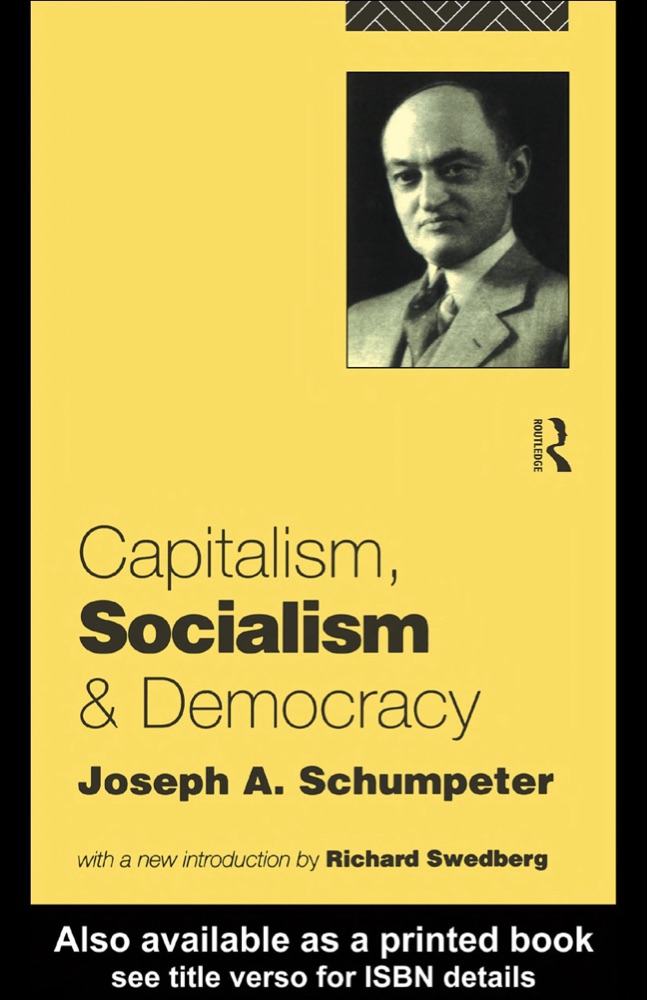
Capitalism, Socialism and Democracy remains one of the greatest works of social theory written this century. When it first appeared the New English Weekly predicted that 'for the next five to ten years it will cetainly remain a work with which no one who professes any degree of information on sociology or economics can afford to be unacquainted.' Fifty years on, this prediction seems a little understated.
Why has the work endured so well? Schumpeter's contention that the seeds of capitalism's decline were internal, and his equal and opposite hostility to centralist socialism have perplexed, engaged and infuriated readers since the book's publication. By refusing to become an advocate for either position Schumpeter was able both to make his own great and original contribution and to clear the way for a more balanced consideration of the most important social movements of his and our ti
Book details
- First published
- 1942
- Author
- Joseph A. Schumpeter
- Genre
- Nonfiction
- Goodreads rating
- 3.99 (3k ratings)
Keep reading
Why Marx Was Right
 Socialism: An Economic and Sociological Analysis
 Human Action: A Treatise on Economics
 The Road to Serfdom
 The Fatal Conceit: The Errors of Socialism
 Marx: A Very Short Introduction
 First As Tragedy, Then As Farce
 Chomsky On Anarchism
 Capitalist Realism: Is There No Alternative?
 Capitalism: The Unknown Ideal
 Capital
 Ill Fares the Land
 Vulture Capitalism: Corporate Crimes, Backdoor Bailouts, and the Death of Freedom
 Socialism: Utopian and Scientific
 Blackshirts and Reds: Rational Fascism and the Overthrow of Communism
 Four Futures: Life After Capitalism
 The Constitution of Liberty
 The Revolution Betrayed
 The Great Transformation: The Political and Economic Origins of Our Time
 The Iron Heel
 The End of History and the Last Man
 The Communist Manifesto
 Capitalism and Freedom
 Occupy
 Brave New World Revisited
 Talking to My Daughter About the Economy: or, How Capitalism Works—and How It Fails
 Small Is Beautiful: Economics as if People Mattered
 The Machiavellians: Defenders of Freedom
 The Coming Insurrection
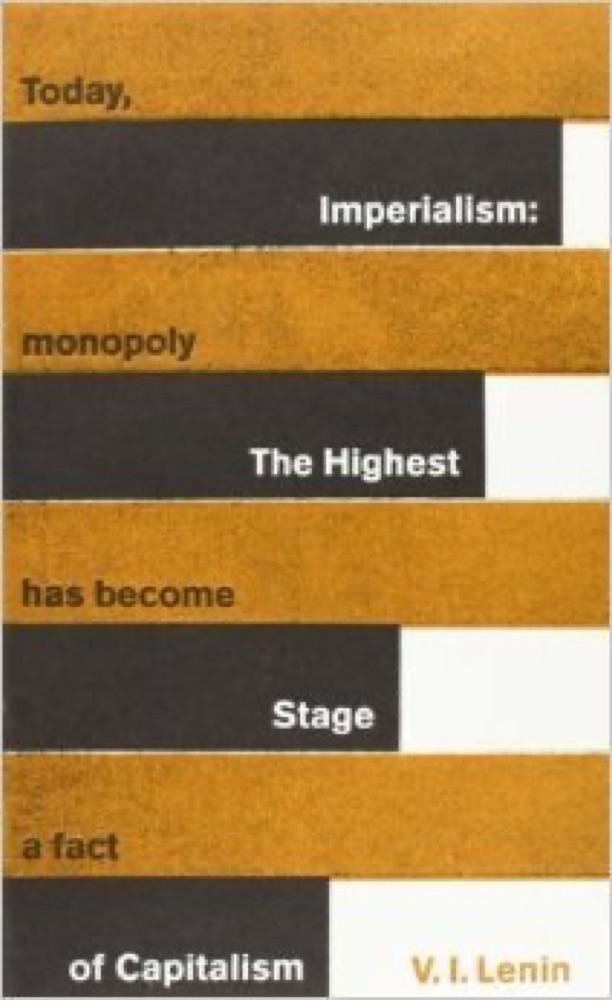 Imperialism: The Highest Stage of Capitalism
 In Praise of Idleness and Other Essays
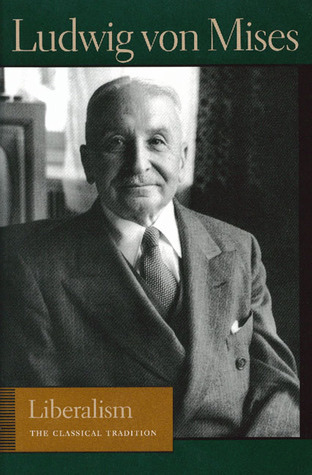 Liberalism: The Classical Tradition
 Socialism Is Dead! Long Live Socialism!: The Marx Code—Socialism with a Human Face: A New World Order
 One-Dimensional Man: Studies in the Ideology of Advanced Industrial Society
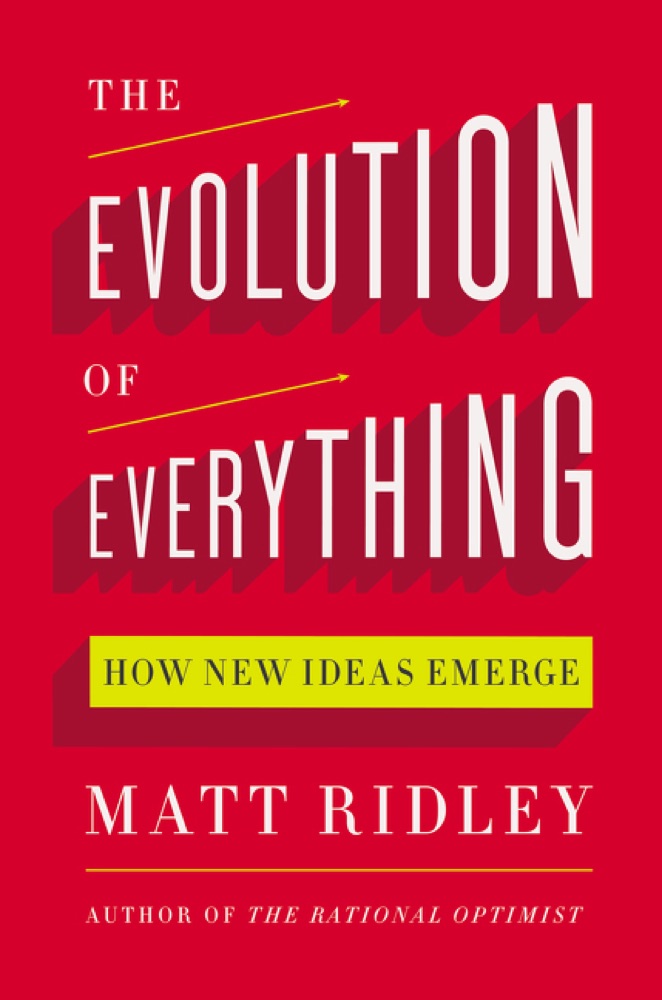 The Evolution of Everything: How New Ideas Emerge
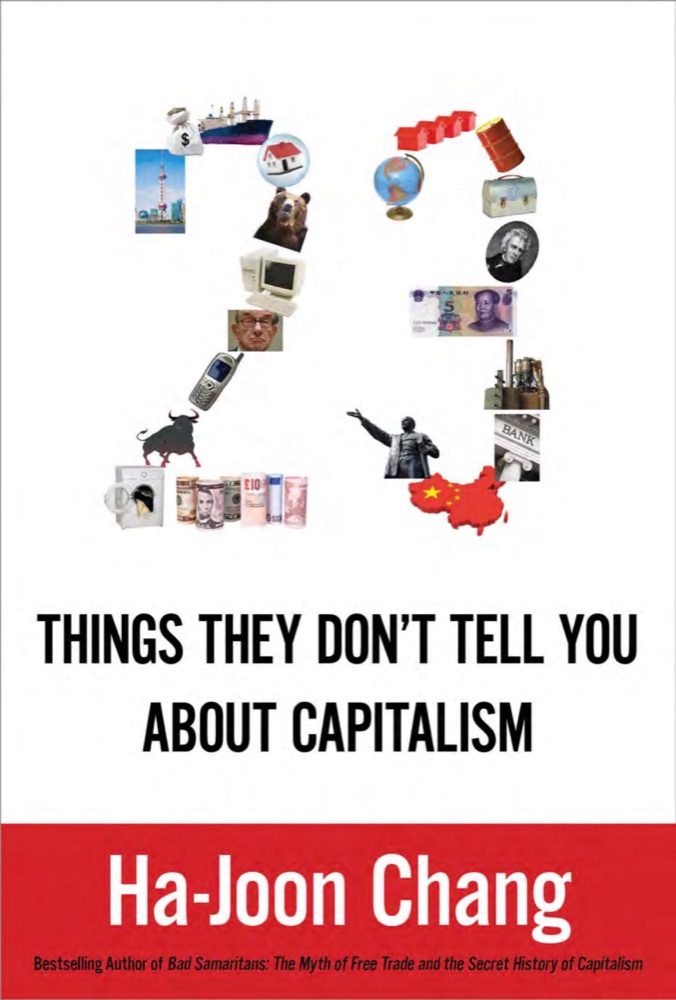 23 Things They Don't Tell You About Capitalism
 The Utopia of Rules: On Technology, Stupidity, and the Secret Joys of Bureaucracy
 The Shock Doctrine: The Rise of Disaster Capitalism
 Economics in One Lesson
 The Myth of the Rational Voter: Why Democracies Choose Bad Policies
 Conspirators' Hierarchy: The Story of the Committee of 300
 Death of the Liberal Class
 Power Systems: Conversations on Global Democratic Uprisings and the New Challenges to U.S. Empire
 The Protestant Ethic and the Spirit of Capitalism
 Capital and Ideology
 Seeing Like a State: How Certain Schemes to Improve the Human Condition Have Failed
 The General Theory of Employment, Interest, and Money
 Marx for Beginners
 A Short History of Progress
 Capital in the Twenty-First Century
 The Soul of Man Under Socialism
 Blue Mars
 Endgame, Vol. 1: The Problem of Civilization
 Reflections on the Revolution in France
 From Dawn to Decadence: 500 Years of Western Cultural Life, 1500 to the Present
 Sex, Economy, Freedom, and Community: Eight Essays
 Economic & Philosophic Manuscripts of 1844
 The Lessons of History
 Walden Two
 Selections from the Prison Notebooks