 Independent Study
Quotes from the Book
Ethical leaders do not run from criticism, especially self-criticism, and they don’t hide from uncomfortable questions. They welcome them.
41
I know I can be wrong, even when I am certain I am right. Listening to others who disagree with me and are willing to criticize me is essential to piercing the seduction of certainty.
40
Whenever I speak to young people, I suggest they do something that might seem a little odd: Close your eyes, I say. Sit there, and imagine you are at the end of your life. From that vantage point, the smoke of striving for recognition and wealth is cleared. Houses, cars, awards on the wall? Who cares? You are about to die. Who do you want to have been? I tell them that I hope some of them decide to have been people who used their abilities to help those who needed it—the weak, the struggling, the frightened, the bullied. Standing for something. Making a difference. That is true wealth.
36
Evil has an ordinary face. It laughs, it cries, it deflects, it rationalizes, it makes great pasta.
32
Doubt, I’ve learned, is wisdom. And the older I get, the less I know for certain. Those leaders who never think they are wrong, who never question their judgments or perspectives, are a danger to the organizations and people they lead. In some cases, they are a danger to the nation and the world.
28
The easy, casual lies—those are a very dangerous thing. They open up the path to the bigger lies, in more important places, where the consequences aren’t so harmless.
22
Everyone lies at some point in their life. The important questions are where, about what, and how often?
17
The Constitution and the rule of law are not partisan political tools. Lady Justice wears a blindfold. She is not supposed to peek out to see how her political master wishes her to weigh a matter.
16
But forest fires, as painful as they can be, bring growth. They spur growth that was impossible before the fire, when old trees crowded out new plants on the forest floor. In the midst of this fire, I already see new life—young people engaged as never before, and the media, the courts, academics, nonprofits, and all other parts of civil society finding reason to bloom.
15
Effective leaders almost never need to yell. The leader will have created an environment where disappointing him causes his people to be disappointed in themselves. Guilt and affection are far more powerful motivators than fear. The great coaches of team sports are almost always people who simply need to say, in a quiet voice, “That wasn’t our best, now was it?” and his players melt. They love this man, know he loves them, and will work tirelessly not to disappoint him. People are drawn to this kind of leader, as I was drawn all those years ago to Harry Howell, the grocer. A leader who screams at his employees or belittles them will not attract and retain great talent over the long term.
14
Intelligence is the ability to solve a problem, to decipher a riddle, to master a set of facts. Judgment is the ability to orbit a problem or a set of facts and see it as it might be seen through other eyes, by observers with different biases, motives, and backgrounds. It is also the ability to take a set of facts and move it in place and time—perhaps to a hearing room or a courtroom, months or years in the future—or to the newsroom of a major publication or the boardroom of a competitor. Intelligence is the ability to collect and report what the documents and witnesses say; judgment is the ability to say what those same facts mean and what effect they will have on other audiences.
13
Speaking uphill takes courage. It takes overcoming a universal human affliction—the impostor complex. All of us labor, to one degree or another, under the belief that if other people really knew us, if they knew us the way we know ourselves, they would think less of us. That’s the impostor complex—the fear that by showing ourselves we will be exposed as the flawed person we are. If you don’t have this, in some measure, you are an incredible jerk and should stop reading immediately.
12
We all have a tendency to surrender our moral authority to “the group,” to still our own voices and assume that the group will handle whatever difficult issue we face. We imagine that the group is making thoughtful decisions, and if the crowd is moving in a certain direction, we follow, as if the group is some moral entity larger than ourselves. In the face of the herd, our tendency is to go quiet and let the group’s brain and soul handle things. Of course, the group has no brain or soul separate from each of ours. But by imagining that the group has these centers, we abdicate responsibility, which allows all groups to be hijacked by the loudest voice, the person who knows how brainless groups really are and uses that to his advantage.
11
As strange as it might sound, there is a certain freedom in being totally screwed, in knowing you will be attacked no matter what you do.
11
Imagine supporting a leader who, as he finished his time at the helm, told us that, although he didn’t do anything intentionally wrong, he is sure he made many mistakes, prays his mistakes haven’t hurt people, and hopes we will forgive and forget the times when he was incompetent. That weakling would be run out of town on a rail. But America’s first president said exactly that in his farewell to the country in 1796.
11
In that moment, something hit me: It’s just us. I always thought that in this place there would be somebody better, but it’s just this group of people—including me—trying to figure stuff out. I didn’t mean that as an insult to any of the participants, who were talented people. But we were just people, ordinary people in extraordinary roles in challenging times. I’m not sure what I had expected, but I met the top of the pyramid and it was just us, which was both comforting and a bit frightening.
11
the doorframes were about six feet, seven inches high. To navigate, I would discreetly bob my head down as if nodding to an unseen companion as I walked. I had no idea how finely calibrated my ducking was until I got new soles and heels on a pair of dress shoes during the George W. Bush administration. Apparently, this refurbished footwear made me about a half-inch taller than usual. Rushing so as not to be late to a Situation Room meeting with the president, I did the usual bob and smacked my head so hard that I rocked backward, stunned. A Secret Service agent asked me if I was okay. I said yes, and continued walking, stars in my eyes. As I sat at the table with the president and his national security team, I began to feel liquid on my scalp and realized I was bleeding. So I did the obvious thing: I kept tilting my head in different directions to keep the running blood inside my hairline. Heaven only knows what President Bush thought was wrong with me, but he never saw my blood.
11
Ethical leaders choose a higher loyalty to those core values over their own personal gain.
10
There is meaning and purpose in not surrendering in the face of loss, but instead working to bind up wounds, ease pain, and spare others what you have seen.
9
one of the most powerful and disconcerting forces in human nature—confirmation bias. Our brains have evolved to crave information consistent with what we already believe. We seek out and focus on facts and arguments that support our beliefs. More worrisome, when we are trapped in confirmation bias, we may not consciously perceive facts that challenge us, that are inconsistent with what we have already concluded. In a complicated, changing, and integrated world, our confirmation bias makes us very difficult people. We simply can’t change our minds.
9
Guilt and affection are far more powerful motivators than fear.
7
Those leaders who never think they are wrong, who never question their judgments or perspectives, are a danger to the organizations and people they lead.
7
All of us labor, to one degree or another, under the belief that if other people really knew us, if they knew us the way we know ourselves, they would think less of us. That’s the impostor complex—the fear that by showing ourselves we will be exposed as the flawed person we are. If you don’t have this, in some measure, you are an incredible jerk and should stop reading immediately.
7
there is no such thing as negative feedback or positive feedback; there is only accurate feedback,
6
I was preoccupied about keeping a healthy distance from Trump. So I figured out which way the president would likely enter the room and mingled my way to the opposite end, by the windows looking over the South Lawn toward the Washington Monument. I couldn’t get farther away without climbing out of the window, an option that would begin to look more appealing as time went by.
6
True listening is actually that period of silence and allowing someone’s words to reach your conscious brain, but it also includes something else that’s a little weird: with your posture, your face, and your sounds, you signal to someone, “I want what you have, I need to know what you know, and I want you to keep telling me the things you’re telling me.
6
I AM WRITING IN A time of great anxiety in my country. I understand the anxiety, but also believe America is going to be fine. I choose to see opportunity as well as danger. Donald Trump’s presidency threatens much of what is good in this nation. We all bear responsibility for the deeply flawed choices put before voters during the 2016 election, and our country is paying a high price: this president is unethical, and untethered to truth and institutional values. His leadership is transactional, ego driven, and about personal loyalty. We are fortunate some ethical leaders have chosen to serve and to stay at senior levels of government, but they cannot prevent all of the damage from the forest fire that is the Trump presidency. Their task is to try to contain it. I see many so-called conservative commentators, including some faith leaders, focusing on favorable policy initiatives or court appointments to justify their acceptance of this damage, while deemphasizing the impact of this president on basic norms and ethics. That strikes me as both hypocritical and morally wrong. The hypocrisy is evident if you simply switch the names and imagine that a President Hillary Clinton had conducted herself in a similar fashion in office. I’ve said this earlier but it’s worth repeating: close your eyes and imagine these same voices if President Hillary Clinton had told the FBI director, “I hope you will let it go,” about the investigation of a senior aide, or told casual, easily disprovable lies nearly every day and then demanded we believe them. The hypocrisy is so thick as to almost be darkly funny. I say this as someone who has worked in law enforcement for most of my life, and served presidents of both parties. What is happening now is not normal. It is not fake news. It is not okay.
5
All of us struggle to realize something Patrice spent years telling me, as I took on one position or another: "It's not about you, dear." She often needed to remind me that, whatever people were feeling-happy, sad, frightened, or confused-it was unlikely it had anything to do with me. They had received a gift, or lost a friend, or gotten a medical test result, or couldn't understand why their love wasn't calling them back. It was all about their lives, their troubles, their hopes and dreams. Not mine. The nature of human existence makes it hard for us-or at least for me-to come to that understanding naturally. After all, I can only experience the world through me. That tempts all of us to believe everything we think, everything we hear, everything we see, is all about us. I think we all do this. But a leader constantly has to train him- or herself to think otherwise. This is an important insight for a leader, in two respects. First, it allows you to relax a bit, secure in the knowledge that you aren't that important. Second, knowing people aren't focused on you should drive you to try to imagine what they are focused on. I see this as the heart of emotional intelligence, the ability to imagine the feelings and perspective of another "me". Some seem to be born with a larger initial deposit of emotional intelligence, but all of us can develop it with practice.
5
Speaking candidly to a peer requires us to risk exposure. Speaking uphill to a leader is scarier. Speaking to the top leader of the organization is scarier still. And in a paramilitary organization of many layers like the FBI, dominated for its first half-century by a single person, J. Edgar Hoover, the hill is mighty steep. And it is harder than that, because getting the speakers to overcome their impostor complex is only half the answer. The leaders must also overcome their own impostor complex—their fear of being less than perfect.
4
Getting problems, pain, hopes, and doubts out on the table so we can talk honestly about them and work to improve is the best way to lead. By acknowledging our issues, we have the best chance of resolving them in a healthy way. Buried pain never gets better with age. And by remembering and being open and truthful about our mistakes, we reduce the chance we will repeat them.
4
Watch on YouTube
About James B. Comey
About the book
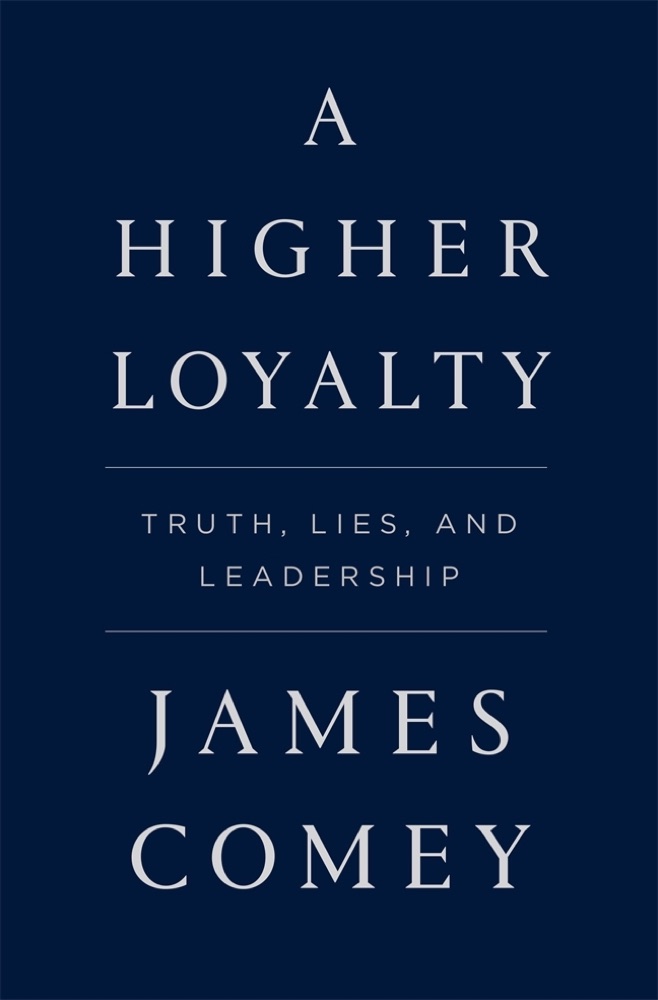
In his book, former FBI director James Comey shares his never-before-told experiences from some of the highest-stakes situations of his career in the past two decades of American government, exploring what good, ethical leadership looks like, and how it drives sound decisions. His journey provides an unprecedented entry into the corridors of power, and a remarkable lesson in what makes an effective leader.Mr. Comey served as director of the FBI from 2013 to 2017, appointed to the post by President Barack Obama. He previously served as U.S. attorney for the Southern District of New York, and the U.S. deputy attorney general in the administration of President George W. Bush. From prosecuting the Mafia and Martha Stewart to helping change the Bush administration's policies on torture and electronic surveillance, overseeing the Hillary Clinton e-mail investigation as well as ties between the
Book details
- First published
- 2018
- Author
- James B. Comey
- Genre
- Nonfiction
- Goodreads rating
- 4.09 (50k ratings)
The buzz
- The New York TimesReview in The New York Timesprofessional review (via Book Marks)
- The Washington PostReview in The Washington Postprofessional review (via Book Marks)
- The GuardianReview in The Guardianprofessional review (via Book Marks)
- NPRReview in NPRprofessional review (via Book Marks)
- Publishers WeeklyReview in Publishers Weeklyprofessional review (via Book Marks)
- LA Review of BooksReview in LA Review of Booksprofessional review (via Book Marks)
Keep reading
Independent Study
 Dare to Lead
 Doing Justice: A Prosecutor's Thoughts on Crime, Punishment, and the Rule of Law
 It Worked for Me: In Life and Leadership
 A Promised Land
 Leadership on the Line: Staying Alive through the Dangers of Leading
 Lead from the Outside: How to Build Your Future and Make Real Change
 The Autobiography of Eleanor Roosevelt
 Riding the Elephant: A Memoir of Altercations, Humiliations, Hallucinations, and Observations
 Mistakes Were Made (But Not by Me): Why We Justify Foolish Beliefs, Bad Decisions, and Hurtful Acts
 The Ride of a Lifetime: Lessons Learned from 15 Years as CEO of the Walt Disney Company
 The Truths We Hold: An American Journey
 Radical Honesty : How to Transform Your Life by Telling the Truth
 Hell and Other Destinations: A 21st-Century Memoir
 The Leader Who Had No Title: A Modern Fable on Real Success in Business and in Life
 The Art of Thinking Clearly
 Surrender: 40 Songs, One Story
 The Laws of Human Nature
 QBQ! The Question Behind the Question: Practicing Personal Accountability in Work and in Life
 Scion of Ikshvaku
 Shortest Way Home: One Mayor's Challenge and a Model for America's Future
 My Beloved World
 12 Rules for Life: An Antidote to Chaos
 Radical Candor: Be a Kickass Boss Without Losing Your Humanity
 Children of Dune
 The Lucifer Effect: Understanding How Good People Turn Evil
 Gifted Hands: The Ben Carson Story
 Promises to Keep: On Life and Politics
 Letters to a Young Contrarian
 Parable of the Talents
 United: Thoughts on Finding Common Ground and Advancing the Common Good
 The Elephant in the Brain: Hidden Motives in Everyday Life
 God Emperor of Dune
 One Nation: What We Can All Do to Save America's Future
 Rationality: From AI to Zombies
 What Happened
 The Gift of Fear: Survival Signals That Protect Us from Violence
 Hunters of Dune
 Chapterhouse: Dune
 Becoming
 Leaders Eat Last: Why Some Teams Pull Together and Others Don't
 My Government Means to Kill Me
 The 360 Degree Leader: Developing Your Influence from Anywhere in the Organization
 The Fall of Babel
 Skin in the Game: The Hidden Asymmetries in Daily Life
 Becoming Bulletproof: Protect Yourself, Read People, Influence Situations, and Live Fearlessly
 The Will of the Many
 The Threat: How the FBI Protects America in the Age of Terror and Trump
 The Intern's Handbook
 Bright-Sided: How the Relentless Promotion of Positive Thinking Has Undermined America
 The 7 Habits Of Highly Effective Teens
 Professional Troublemaker: The Fear-Fighter Manual
 You Can't Be Neutral on a Moving Train: A Personal History of Our Times
 My Life on the Road
 High Conflict: Why We Get Trapped and How We Get Out
 Crucial Conversations: Tools for Talking When Stakes are High
 A Naked Singularity
 Humankind: A Hopeful History
 What's Our Problem?: A Self-Help Book for Societies