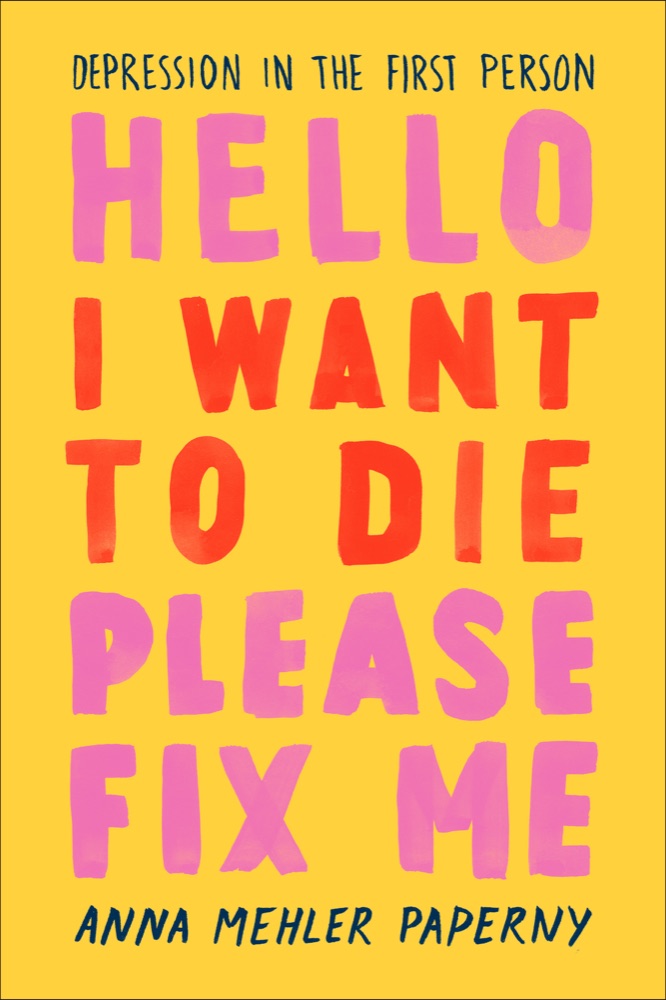
 Hello I Want to Die Please Fix Me: Depression in the First Person
Quotes from the Book
The ultimate message of this book is terrifying: you may not know your own children, and, worse yet, your children may be unknowable to you. The stranger you fear may be your own son or daughter.
28
We teach our kids the importance of good dental care, proper nutrition, and financial responsibility. How many of us teach our children to monitor their own brain health, or know how to do it ourselves?
21
Have patience with everything that remains unsolved in your heart,” Rainer Maria Rilke writes in his fourth letter to a young poet. “Try to love the questions themselves, like locked rooms and like books written in a foreign language. Do not now look for the answers. They cannot now be given to you because you could not live them. It is a question of experiencing everything. At present you need to live the question. Perhaps you will gradually, without even noticing it, find yourself experiencing the answer, some distant day.
21
A suicidal person is someone who is unable to tolerate their suffering any longer. Even if she does not really want to die, she knows death will end that suffering once and for all.
13
Asking “why” only makes us feel hopeless. Asking “how” points the way forward, and shows us what we must do.
11
life is full of suffering, and this is mine. I know it would have been better for the world if Dylan had never been born. But I believe it would not have been better for me.
11
Asking 'why' only makes us feel hopeless. Asking 'how' points the way forward, and shows us what we must do
7
I failed to understand as a parent until it was too late: that anyone can be suffering and in need of expert care, regardless of how they act, what they say, or who they are. Those who are suffering can appear for all the world to be doing well, their private pain masked by accomplishments and triumphs.
5
It’s widely acknowledged among those who grieve that the second year is often worse than the first. The first year, you’re trying to adjust to the newness of the suffering, and to get through the days. It’s during the second year that you realize you’ve lost sight of the shoreline. There’s nothing but emptiness ahead and behind, a vast loneliness stretching out as far as you can see. This, you realize, is permanent. There will be no turning back.
5
As a mother, this was the most difficult prayer I had ever spoken in the silence of my thoughts, but in that instant I knew the greatest mercy I could pray for was not my son’s safety, but for his death.
5
Even after more than ten years as a suicide prevention activist, I still find those numbers—and the general public’s ignorance about them—staggering. I taught Dylan, as I had taught his brother before him, to protect himself from lightning strikes, snakebites, and hypothermia. I taught him to floss, to wear sunscreen, and the importance of checking his blind spot twice. As he became a teenager, I talked as openly as I could about the dangers of drinking and drug use, and I educated him about safe and ethical sexual behavior. It never crossed my mind that the gravest danger Dylan faced would not come from an external source at all, but from within himself. In
4
Some parents damage their children, but that does not mean that all troubled children have incompetent parents. In
4
A faraway look—I have heard suicidologist Thomas Joiner refer to it as “the thousand-yard stare”—is a warning sign for imminent suicide, and one often missed.
3
A 2001 study of adolescent school shooters, prompted in part by the massacre at Columbine High School, resulted in two interesting findings. The first is that 25 percent of the thirty-four teenage shooters they looked at participated in pairs. This is different from adult rampage killers, who most often act alone. Dr. Reid Meloy, a forensic psychologist and expert on targeted violence and threat assessment, authored the study. He told me that these deadly dyads mean it’s absolutely critical for parents to pay attention to the dynamics between kids and their friends. The second finding from his study: typically, one of the two kids was a psychopath, and the other one suggestible, dependent, and depressed.
3
commonly, though, a disturbed teenager will be unpleasant: aggressive, belligerent, obnoxious, irritable, hostile, lazy, whiny, untrustworthy, sometimes with poor personal hygiene. But the fact that they’re so difficult, so dedicated to pushing us away, does not mean they do not need help. In fact, these traits may be signals that they do.
3
The list of things I would have done differently if I had known more is long. Those are my failures. But what I have learned implies the need for a broader call to action, a comprehensive overview of what should be in place to stop not only tragedies like the one committed by my son but the hidden suffering of any child.
3
When it comes to brain health issues, many of our children are as vulnerable today as children a hundred years ago were to infectious diseases. Far
3
Second, and far more powerfully, we want to believe that parents create criminals because in supposing that, we reassure ourselves that in our own house, where we are not doing such wrong things, we do not risk this calamity. I
3
Suicide is ugly. It’s wreathed in disgrace. It screams to the world that a person’s life ended in failure. Most people don’t even want to hear about it. As a culture, we believe that people who die by suicide are weak, that they lack willpower, that they’ve taken “the coward’s way out.” We believe that they are selfish, and have acted aggressively. If they cared about their families/spouses/work, they would have found a way to think themselves out of the spiral they were in.
2
I would ask him to forgive me, for being his mother and never knowing what was going on inside his head, for not being able to help him, for not being the person that he could confide in.” When
2
Of course it would be easier to help depressed teens if they were nicer to be around, or more communicative about their thoughts. If only they looked like the kids in the pamphlets do: clean-cut and attractive, staring out a rainy window with a wistful expression, chin propped on a fist! More commonly, though, a disturbed teenager will be unpleasant: aggressive, belligerent, obnoxious, irritable, hostile, lazy, whiny, untrustworthy, sometimes with poor personal hygiene. But the fact that they’re so difficult, so dedicated to pushing us away, does not mean they do not need help. In fact, these traits may be signals that they do.
1
Indeed, I would not achieve the integration I sought until I found two nutrients essential to so many survivors. First, I found community and then I found a way to contribute.
1
I didn't know until a year later that Marilyn Manson had canceled concert dates in our area out of respect, or that the NRA did not cancel their annual meeting, held at a hotel fifteen miles away from the school, just ten days after the shootings.
1
People refer to the fog of war, and I am sure something similar applies to my situation. If I hadn't kept a running record of the days, weeks, and years, the fog would have swallowed too much of the story for me to provide a reliable account.
1
I’ve learned two important things. One, that there are many good, kind people out there. And two, there are many people who have suffered greatly and who keep going with strength and courage. These are the ones who can eventually support others. I hope I can be of use to someone some day.
1
The symptoms of intense grief—memory loss, attention deficit, emotional fragility, incapacitating fatigue—are surprisingly similar to those resulting from traumatic brain injury.
1
At her funeral, my siblings and I referred to her as the North Star, a tribute to her unerring gift for helping us to find our bearings in life even in the most turbulent of circumstances
1
If you hurt your knee, you wouldn’t wait until you couldn’t walk before seeking help. You’d ice the joint, elevate it, skip your workouts—and then, if you didn’t see any improvement after a couple of days, you’d make an appointment with an orthopedist. Unfortunately, most people don’t turn to a mental health professional for help until they’re in real crisis. Nobody expects to heal their knees themselves, using self-discipline and gumption. Because of stigma, though, we do expect to be able to think our way out of the pain in our minds.
1
It can be hard to differentiate between someone who is genuinely getting out of a cycle of depression, and someone who feels relief because they know they’re going to die.
1
A resigned Dylan tried to comfort a horrified newcomer to the group: “You get used to it. It happens all the time.” It
1
Watch on YouTube
About Sue Klebold
We have collected 30 quotes from 1 book by Sue Klebold on BookQuoters.
More about the author →About the book
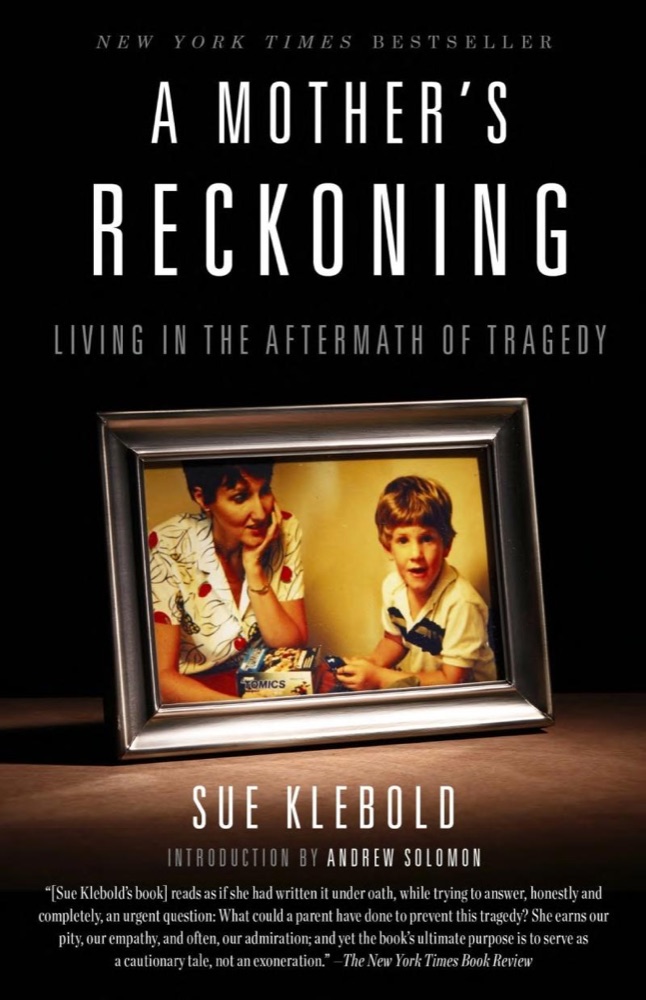
On April 20, 1999, Eric Harris and Dylan Klebold walked into Columbine High School in Littleton, Colorado. Over the course of minutes, they would kill twelve students and a teacher and wound twenty-four others before taking their own lives.
For the last sixteen years, Sue Klebold, Dylan’s mother, has lived with the indescribable grief and shame of that day. How could her child, the promising young man she had loved and raised, be responsible for such horror? And how, as his mother, had she not known something was wrong? Were there subtle signs she had missed? What, if anything, could she have done differently?
These are questions that Klebold has grappled with every day since the Columbine tragedy. In A Mother’s Reckoning, she chronicles with unflinching honesty her journey as a mother trying to come to terms with the incomprehensible. In the hope that the insights and understandin
Book details
- First published
- 2016
- Author
- Sue Klebold
- Genre
- Nonfiction
- Goodreads rating
- 4.14 (48k ratings)
The buzz
- The New York TimesReview in The New York Timesprofessional review (via Book Marks)
- The Washington PostReview in The Washington Postprofessional review (via Book Marks)
- The GuardianReview in The Guardianprofessional review (via Book Marks)
- Los Angeles TimesReview in Los Angeles Timesprofessional review (via Book Marks)
- SlateReview in Slateprofessional review (via Book Marks)
- The Boston GlobeReview in The Boston Globeprofessional review (via Book Marks)
Keep reading
Hello I Want to Die Please Fix Me: Depression in the First Person
 The Summer Children
 One Step Too Far
 Beautiful Boy: A Father's Journey Through His Son's Addiction
 Columbine
 Women We Buried, Women We Burned: A Memoir
 Paperweight
 All Is Not Forgotten
 They Call Her Dirty Sally
 The Five Stages of Andrew Brawley
 The Quiet Room: A Journey Out of the Torment of Madness
 Life Will Be the Death of Me: . . . and you too!
 In The Blood
 Scenes from My Life: A Memoir
 Option B: Facing Adversity, Building Resilience, and Finding Joy
 Night Falls Fast: Understanding Suicide
 Imagine Me Gone
 Hold Tight
 The Art of Starving
 Get Me Out of Here: My Recovery from Borderline Personality Disorder
 I Have Some Questions for You
 Leaving Isn't the Hardest Thing
 The Cheerleaders
 The First Time She Drowned
 Suspect
 Just Like Someone Without Mental Illness Only More So
 Between Two Kingdoms: A Memoir of a Life Interrupted
 My Story
 Special Topics in Calamity Physics
 All My Puny Sorrows
 In Shock: My Journey from Death to Recovery and the Redemptive Power of Hope
 Beartown
 10 Minutes 38 Seconds in This Strange World
 Grief Is for People
 Riding the Elephant: A Memoir of Altercations, Humiliations, Hallucinations, and Observations
 Men We Reaped
 The Shock of the Fall
 The Center Cannot Hold: My Journey Through Madness
 What I'd Rather Not Think About
 My Name Is Mahtob: The Story that Began the Global Phenomenon Not Without My Daughter Continues
 Bright Young Women
 Shoot the Damn Dog: A Memoir of Depression
 Any Ordinary Day
 Loud in the House of Myself: Memoir of a Strange Girl
 A Fatal Grace
 The Apocalypse of Elena Mendoza
 Things in Nature Merely Grow
 Long Bright River
 What Is the What
 Dead Stop
 Dust & Decay
 Patron Saints of Nothing
 In the Miso Soup
 Piercing: A Novel
 Bettyville: A Memoir
 Some Assembly Required: A Journal of My Son's First Son
 Counting the Cost
 They Can't Kill Us Until They Kill Us: Essays
 Broken Harbor