
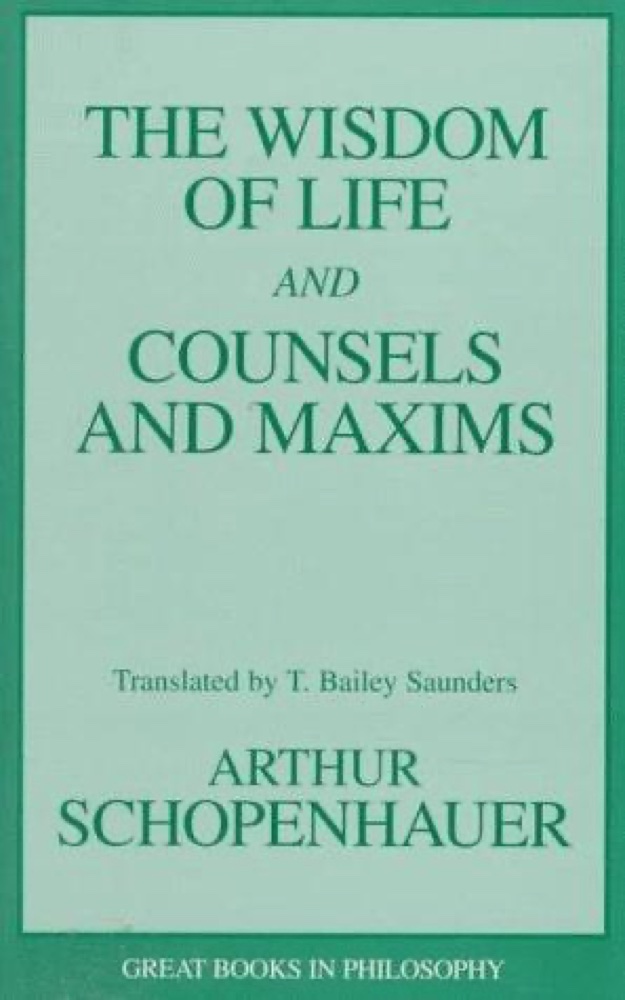
 The Wisdom of Life
Quotes from the Book
The best consolation in misfortune or affliction of any kind will be the thought of other people who are in a still worse plight than yourself; and this is a form of consolation open to every one. But what an awful fate this means for mankind as a whole! We are like lambs in a field, disporting themselves under the eye of the butcher, who chooses out first one and then another for his prey.
82
The life of an individual is a constant struggle, and not merely a metaphorical one against want or boredom, but also an actual struggle against other people. He discovers adversaries everywhere, lives in continual conflict and dies with sword in hand.
52
Today it is bad, and day by day it will get worse―until at last the worst of all arrives.
52
If the immediate and direct purpose of our life is not suffering then our existence is the most ill-adapted to its purpose in the world.
42
Life presents itself first and foremost as a task: the task of maintaining itself, the task of earning one's living. If this task is accomplished, what has been gained is a burden, and there then appears a second task: that of doing something with it so as to ward off boredom, which hovers over every secure life like a bird of prey. Thus the first task is to gain something and the second to become unconscious of what has been gained, which is otherwise a burden.
39
As a reliable compass for orientating yourself in life nothing is more useful than to accustom yourself to regarding this world as a place of atonement, a sort of penal colony. When you have done this you will order your expectations of life according to the nature of things and no longer regard the calamities, sufferings, torments and miseries of life as something irregular and not to be expected but will find them entirely in order, well knowing that each of us is here being punished for his existence and each in his own particular way. This outlook will enable us to view the so-called imperfections of the majority of men, i.e., their moral and intellectual shortcomings and the facial appearance resulting therefrom, without surprise and certainly without indignation: for we shall always bear in mind where we are and consequently regard every man first and foremost as a being who exists only as a consequence of his culpability and whose life is an expiation of the crime of being born.
33
A precondition for reading good books is not reading bad ones: for life is short.
33
When you consider how great and immediate is the problem of existence, this ambiguous, tormented, fleeting, dream-like existence - so great and so immediate that as soon as you are aware of it, it overshadows and obscures all other problems and aims; and when you then see how men, with a few rare exceptions, have no clear awareness of this problem, indeed seem not to be conscious of it at all, but concern themselves with anything rather than this problem, and live on taking thought only for the day and for the hardly longer span of their own individual future, either expressly refusing to consider this problem or contenting themselves with some system of popular metaphysics..
25
Intellect is a magnitude of intensity, not a magnitude of extension: which is why in this respect one man can confidently take on ten thousand, and a thousand fools do not make one wise man.
18
People who pass their lives in reading and acquire their wisdom from books are like those who learn about a country from travel descriptions: they can impart information about a great number of things, but at bottom they possess no connected, clear, thorough knowledge of what the country is like. On the other hand, people who pass their lives in thinking are like those who have visited the country themselves: they alone are really familiar with it, possess connected knowledge of it and are truly at home in it.
17
For the longer to have had to rack your brains for something the more firmly will is stay once you have got it.
10
Our life is to be regarded as a loan received from death, with sleep as the daily interest on this loan.
10
In the first place, no man is happy but strives his whole life long after a supposed happiness which he seldom attains, and even if he does it is only to be disappointed with it.
10
You can also look upon our life as an episode unprofitably disturbing the blessed calm of nothingness.
10
He who truly thinks for himself is like a monarch, in that he recognizes no one over him. His judgements, like the decisions of a monarch, arise directly from his own absolute power. He no more accepts authorities than a monarch does orders, and he acknowledges the validity of nothing he has not himself confirmed.
9
The nobler and more perfect a thing is, the later and more slowly does it mature.
9
Every moment of our life belongs to the present only for a moment; then it belongs for ever to the past.
9
Pleasure and well-being is negative and suffering positive, the happiness of a given life is not to be measured according to the joys and pleasures it contains but according to the absence of the positive element, the absence of suffering.
9
Payment and reserved copyright are at bottom the ruin of literature. Only he who writes entirely for the sake of what he has to say writes anything worth writing. It is as if there were a curse on money: every writer writes badly as soon as he starts writing for gain.
8
The greatest wisdom consists in enjoying the present and making this enjoyment the goal of life, because the present is all that is real and everything else merely imaginary. But you could just as well call this mode of life the greatest folly: for that which in a moment ceases to exist, which vanishes as completely as a dream, cannot be worth any serious effort.
8
If you try to imagine as nearly as you can what an amount of misery, pain, and suffering of every kind the sun shines upon in its course, you will admit that it would be much better if on the earth as little as on the moon the sun were able to call forth the phenomena of life; and if, here as there, the surface were still in a crystalline state".
7
There is no happiness on earth to compare with that which a beautiful and fruitful mind finds in a propitious hour within itself.
7
You can know only what you have thought about.
7
We take no pleasure in existence except when we are striving after something.
7
... with man sexual gratification is tied to a very obstinate selectivity which is sometimes intensified into a more or less passionate love. Thus sexuality becomes for man a source of brief pleasure and protracted suffering.
6
The true work of art leads us from that which exists only once and never again, i.e. the individual, to that which exists perpetually and time and time again in innumerable manifestations, the pure form or Idea; but the waxwork figure appears to present the individual itself, that is to say that which exists only once and never again, but without that which lends value to such a fleeting existence, without life. That is why the waxwork evokes a feeling of horror: it produces the effect of a rigid corpse.
6
One can even say that we require at all times a certain quantity of care or sorrow or want, as a ship requires ballast, in order to keep on a straight course.
6
You can apply yourself voluntarily to reading and learning, but you cannot really apply yourself to thinking: thinking have to be kindled, as a fire is by a draught, and kept going by some kind of interest in its object, which may be an objective interest or merely a subjective one.
5
It is just this characteristic way in which the brute gives itself up entirely to the present moment that contributes so much to the delight we take in our domestic pets. They are the present moment personified, and in some respects they make us feel the value of every hour that is free from trouble and annoyance, which we, with our thoughts and preoccupations, mostly disregard.
5
... everyone desires to achieve old age, that is to say a condition in which one can say: "Today is bad, and day by day it will get worse - until at last the worst of all arrives.
4
Watch on YouTube
About Arthur Schopenhauer
We have collected 106 quotes from 4 books by Arthur Schopenhauer on BookQuoters.
More about the author →More by Arthur Schopenhauer
About the book
A collection of essays by Schopenhauer on the perception of the importance of art, morality and self awareness in a blind struggle against a Godless, meaningless world radically transformed our understanding of the individual and remains a searing vision of the human condition.
Book details
- First published
- 1850
- Author
- Arthur Schopenhauer
- Genre
- Philosophy
- Goodreads rating
- 3.86 (3k ratings)
Keep reading
 The World as Will and Representation, Vol 1
The Wisdom of Life
The World as Will and Representation, Vol 1
The Wisdom of Life
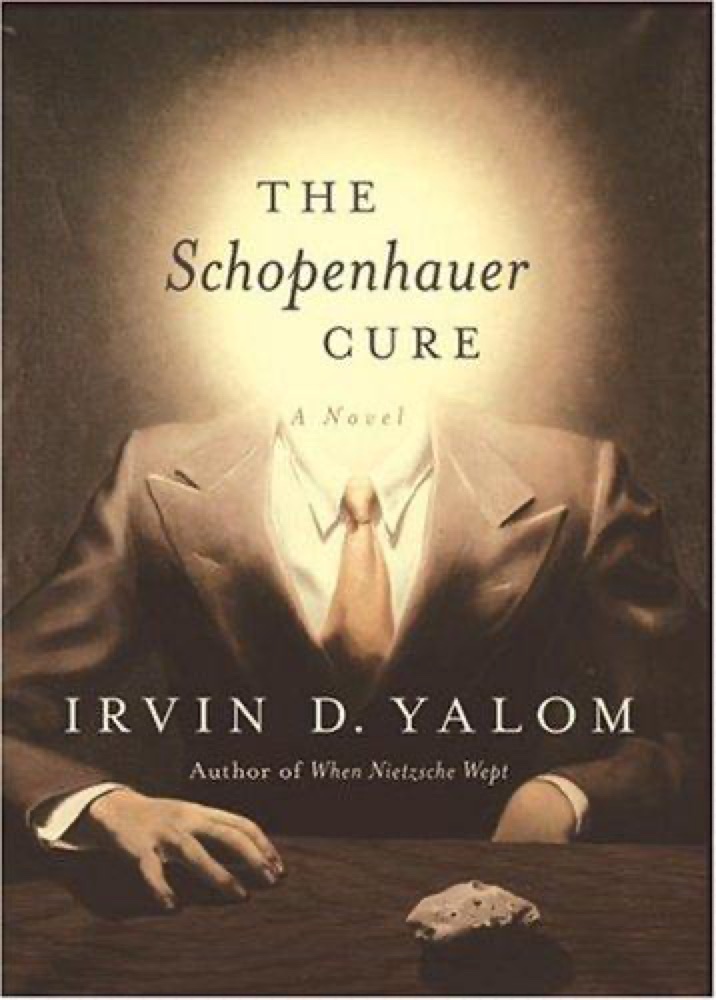 The Schopenhauer Cure
 Man's Search for Meaning
 The Consolations of Philosophy
 Untimely Meditations
 The Myth of Sisyphus and Other Essays
 The Ethics of Ambiguity
 In Search of Lost Time
 The Consolation of Philosophy
 Aphorisms on Love and Hate
 The Myth of Sisyphus
 Human, All Too Human
 Point Counter Point
 The Conspiracy Against the Human Race
 The Man Without Qualities
 Hiking with Nietzsche: On Becoming Who You Are
 The Magic Mountain
 The Doors of Perception & Heaven and Hell
 Modern Man in Search of a Soul
 Only Dull People Are Brilliant at Breakfast
 When Nietzsche Wept
 The Varieties of Religious Experience
 The Wisdom of Insecurity: A Message for an Age of Anxiety
 A Cup of Sake Beneath the Cherry Trees
 Pensées
 Correction
 The Essential Writings of Ralph Waldo Emerson
 Daniel Deronda
 How to See Yourself As You Really Are
 Immortality
 The Count of Monte Cristo
 Ethics
 Six Characters in Search of an Author
 The Intellectual Life: Its Spirit, Conditions, Methods
 Finding Flow: The Psychology of Engagement with Everyday Life
 The Book: On the Taboo Against Knowing Who You Are
 If You Meet the Buddha on the Road, Kill Him! The Pilgrimage of Psychotherapy Patients
 Thoughts in Solitude
 Eyeless in Gaza
 Happiness: A Guide to Developing Life's Most Important Skill
 The Socrates Express: In Search of Life Lessons from Dead Philosophers
 On the Heights of Despair
 The Idiot
 The Denial of Death
 Gravity and Grace
 The Common Reader
 The Conquest of Happiness
 A Calendar of Wisdom: Daily Thoughts to Nourish the Soul
 Emile or On Education
 Ethics for the New Millennium
 Complete Works of Oscar Wilde
 The Children of Men
 How to Live: A Life of Montaigne in One Question and Twenty Attempts at an Answer
 Letters from a Stoic
 Nothing to Be Frightened Of
 The Story of Philosophy: The Lives and Opinions of the World's Greatest Philosophers
 The Republic
 The Sickness Unto Death: A Christian Psychological Exposition for Upbuilding and Awakening