
 Twilight of the Idols/The Anti-Christ
Quotes from the Book
Man is said to be a reasoning animal. I do not know why he has not been defined as an affective or feeling animal. Perhaps that which differentiates him from other animals is feeling rather than reason. More often I have seen a cat reason than laugh or weep. Perhaps it weeps or laughs inwardly — but then perhaps, also inwardly, the crab resolves equations of the second degree.
72
Warmth, warmth, more warmth! For we are dying of cold and not darkness. It is not the night that kills, but the frost.
33
Our life is a hope which is continually converting itself into memory and memory in its turn begets hope.
25
Yes, yes, I see it all! — an enormous social activity, a mighty civilization, a profuseness of science, of art, of industry, of morality, and afterwords, when we have filled the world with industrial marvels, with great factories, with roads, museums and libraries, we shall fall exhausted at the foot of it all, and it will subsist — for whom? Was man made for science or was science made for man?
22
And usually [the philosopher] philosophizes either in order to resign himself to life, or to seek some finality in it, or to distract himself and forget his griefs, or for pastime and amusement.
21
The truth is that reason is the enemy of life.
17
Man is perishing. That may be, and if it is nothingness that awaits us let us so act that it will be an unjust fate.
17
Consciousness (conscientia) is participated knowledge, is co-feeling, and co-feeling is com-passion. Love personalizes all that it loves. Only by personalizing it can we fall in love with an idea. And when love is so great and so vital, so strong and so overflowing, that it loves everything, then it personalizes everything and discovers that the total All, that the Universe, is also a person possessing a Consciousness, a Consciousness which in its turn suffers, pities, and loves, and therefore is consciousness. And this Consciousness of the Universe, which a love, personalizing all that it loves, discovers, is what we call God.
13
A pedant who beheld Solon weeping for the death of a son said to him, ‘Why do you weep thus, if weeping avails nothing?’ And the sage answered him, ‘Precisely for that reason—because it does not avail.
10
There is no true love save in suffering, and in this world we have to choose either love, which is suffering, or happiness. And love leads us to no other happiness than that of love itself and its tragic consolation of uncertain hope. The moment love becomes happy and satisfied, it no longer desires and it is no longer love. The satisfied, the happy, do not love; they fall asleep in habit, near neighbor to annihilation. To fall into a habit is to begin to cease to be. We are the more—that is the more divine—the greater our capacity for suffering, or rather, for anguish.
9
The chiefest sanctity of a temple is that it is a place to which men go to weep in common.
7
And in touching your own nothingness, in not feeling your permanent base, in not reaching your own infinity, still less your own eternity, you will have a whole-hearted pity for yourself, and you will burn with a sorrowful love for yourself--a love that will consume your so-called self-love, which is merely a species of sensual self-delectation, the self-enjoyment, as it were, of the flesh of your soul.
5
To say that everything is idea or that everything is spirit, is the same as saying that everything is matter or that everything is energy, for if everything is idea or spirit, just as my consciousness is, it is not plain why the diamond should not endure for ever, if my consciousness, because it is idea or spirit, endures forever.
5
And the supreme beauty is that of tragedy. The consciousness that everything passes away, that we ourselves pass away, and that everything that is ours and everything that environs us passes away, fills us with anguish, and this anguish itself reveals to us the consolation of that which does not pass away, of the eternal, of the beautiful.
4
¿Que sueño...? Dejadme soñar; si ese sueño es mi vida, no me despertéis de él. Creo
2
I will not resign from life; I must be dismissed.
1
I am a man; no other man do I deem a stranger.
1
El hombre es un fin, no un medio. La civilización toda se endereza al hombre, a cada hombre, a cada yo. ¿O qué es ese ídolo, llámese Humanidad o como se llamare, a que se han de sacrificar todos y cada uno de los hombres? Porque
1
Según te adentras en ti mismo y en ti mismo ahondas, vas descubriendo tu propia inanidad, que no eres todo lo que eres, que no eres lo que quisieras ser, que no eres, en fin, más que nonada.
Contra las acusaciones de egocentrismo, se defendió diciendo que lo que él quería no era ni más ni menos que lo anhelado por todos: “¿Egoísmo, decís? Nada hay más universal que lo individual, pues lo que es de cada uno lo es de todos”.
(to enjoy the flesh of one's own soul).
«Parece difícil probar con la mera luz de la razón la inmortalidad del alma. Los argumentos en favor de ella se derivan comúnmente de tópicos metafísicos, morales o físicos. Pero es en realidad el Evangelio, y sólo el Evangelio, el que ha traído a luz la vida y la inmortalidad».
«Sufro yo a tu costa / Dios no existente, pues si Tú existieras / existiría yo también de veras».
sí, hijo mío, no puedes probar que yo, que contigo hablo, no eres tú que hablas contigo mismo, porque nada digno de probarse puede ser probado ni des-probado, por lo cual sé prudente, agárrate siempre a la parte más soleada de la duda y trepa a la Fe allende las formas de la Fe!». Sí, acaso, como dice el sabio, nada digno de probarse puede ser probado ni des-probado, for nothing worthy proving can be proven, nor yet disproven; pero ¿podemos contener a ese instinto que lleva al hombre a querer conocer y sobre
Watch on YouTube
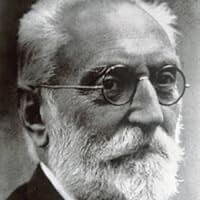
About Miguel de Unamuno
We have collected 24 quotes from 1 book by Miguel de Unamuno on BookQuoters.
More about the author →About the book
To the mentality that assumes, more or less consciously, that we must of necessity find a solution to every problem, belongs the argument based on the disastrous consequences of a thing. Take any book of apologetics-that is to say, of theological advocacy-and you will see how many times you will meet with this phrase-"the disastrous consequences of this doctrine." Now the disastrous consequences of a doctrine prove at most that the doctrine is disastrous, but not that it is false, for there is no proof that the true is necessarily that which suits us best. -from "The Rationalist Dissolution" This is the masterpiece of Miguel de Unamuno, a member of the group of Spanish intellectuals and philosophers known as the "Generation of '98," and a writer whose work dramatically influenced a wide range of 20th-century literature. His down-to-earth demeanor and no-nonsense outlook makes this 1921 b
Book details
- First published
- 1912
- Author
- Miguel de Unamuno
- Genre
- Philosophy
- Goodreads rating
- 4.03 (3k ratings)
Keep reading
Twilight of the Idols/The Anti-Christ
 Conversations with God: An Uncommon Dialogue, Book 1
 The Myth of Sisyphus
 On the Heights of Despair
 Soul Mountain
 De Profundis and Other Writings
 Six Characters in Search of an Author
 De Profundis
 Tears and Saints
 The Gay Science
 The Brothers Karamazov
 The Sickness Unto Death: A Christian Psychological Exposition for Upbuilding and Awakening
 Demons
 Man's Search for Ultimate Meaning
 The Myth of Sisyphus and Other Essays
 Immortality
 The Portable Nietzsche
 The Star Diaries
 Moravagine
 Either/Or: A Fragment of Life
 The World as Will and Representation, Vol 1
 A Confession
 A Short History of Decay
 The Varieties of Religious Experience
 Creatures of a Day: And Other Tales of Psychotherapy
 The Island of the Day Before
 The Consolation of Philosophy
 Memories, Dreams, Reflections
 The Red Book: Liber Novus
 Orthodoxy
 The Schopenhauer Cure
 The Passion According to G.H.
 Flight To Arras
 Phaedo
 When Nietzsche Wept
 Eyeless in Gaza
 The Setting Sun
 The Ethics of Ambiguity
 Pensées
 The Aleph and Other Stories
 The Fall
 Correction
 Gravity and Grace
 The Ego and Its Own
 The Perennial Philosophy
 Life of Pi
 Greek Lessons
 Point Counter Point
 Demian
 Man's Search for Meaning
 The Story of My Experiments With Truth
 Zeno's Conscience
 The Zürau Aphorisms
 Foe
Foe
 The Magus
 Man and His Symbols
 Love and Will
 Embers
 On the Suffering of the World
 No Exit and Three Other Plays