
 H is for Hawk
Quotes from the Book
Autumn teaches us that fruition is also death; that ripeness is a form of decay. The willows, having stood for so long near water, begin to rust. Leaves are verbs that conjugate the seasons.
56
True solace is finding none, which is to say, it is everywhere.
36
Everything in nature invites us constantly to be what we are. We are often like rivers: careless and forceful, timid and dangerous, lucid and muddied, eddying, gleaming, still.
34
The truest art I would strive for in any work would be to give the page the same qualities as earth: weather would land on it harshly; light would elucidate the most difficult truths; wind would sweep away obtuse padding.
34
All through autumn we hear a double voice: one says everything is ripe; the other says everything is dying. The paradox is exquisite. We feel what the Japanese call "aware"--an almost untranslatable word meaning something like "beauty tinged with sadness.
27
The toughness I was learning was not a martyred doggedness, a dumb heroism, but the art of accommodation. I thought: to be tough is to be fragile; to be tender is to be truly fierce.
27
The lessons of impermanence taught me this: loss constitutes an odd kind of fullness; despair empties out into an unquenchable appetite for life.
17
From the clayey soil of northern Wyoming is mined bentonite, which is used as filler in candy, gum, and lipstick. We Americans are great on fillers, as if what we have, what we are, is not enough. We have a cultural tendency toward denial, but being affluent, we strangle ourselves with what we can buy. We gave only to look at the houses we build to see how we build *against* space, the way we drink against pain and loneliness. We fill up space as if it were a pie shell, with things whose opacity further obstructs our ability to see what is already there.
17
Instead of the macho, trigger-happy man our culture has perversely wanted him to be, the cowboy is more apt to be convivial, quirky, and softhearted. To be "tough" on a ranch has nothing to do with conquests and displays of power. More often than not, circumstances - like the colt he's riding or an unexpected blizzard - are overpowering him. It's not toughness but "toughing it out" that counts. In other words, this macho, cultural artifact the cowboy has become is simply a man who possesses resilience, patience, and an instinct for survival. "Cowboys are just like a pile of rocks - everything happens to them. They get climbed on, kicked, rained and snowed on, scuffed up by wind. Their job is 'just to take it,' " one old-timer told me.
12
Leaves are verbs that conjugate the seasons.
10
people are blunt with one another, sometimes even cruel, believing honesty is stronger medicine than sympathy, which may console but often conceals.
6
Ranchers are midwives, hunters, nurturers, providers, and conservationists all at once. What we’ve interpreted as toughness—weathered skin, calloused hands, a squint in the eye and a growl in the voice—only masks the tenderness inside.
5
A cowboy is someone who loves his work. Since the hours are long—ten to fifteen hours a day—and the pay is $30 he has to. What's required of him is an odd mixture of physical vigor and maternalism. His part of the beef-raising industry is to birth and nurture calves and take care of their mothers. For the most part his work is done on horseback and in a lifetime he sees and comes to know more animals than people. The iconic myth surrounding him is built on American notions of heroism: the index of a man's value as measured in physical courage. Such ideas have perverted manliness into a self-absorbed race for cheap thrills. In a rancher's world, courage has less to do with facing danger than with acting spontaneously—usually on behalf of an animal or another rider. If a cow is stuck in a bog hole he throws a loop around her neck, takes his dally (a half hitch around the saddle horn), and pulls her out with horsepower. If a calf is born sick, he may take her home, warm her in front of the kitchen fire, and massage her legs until dawn. One friend, whose favorite horse was trying to swim a lake with hobbles on, dove under water and cut her legs loose with a knife, then swam her to shore, his arm around her neck lifeguard-style, and saved her from drowning. Because these incidents are usually linked to someone or something outside himself, the westerner's courage is selfless, a form of compassion.
4
A day goes by. Every shiver of grass counts. The shallows and dapples in air that give grass life are like water. The bobcat returns nightly. During easy jags of sleep the dog’s dream-paws chase coyotes. I ride to the sheep. Empty sky, an absolute blue. Empty heart. Sunburned face blotches brown. Another layer of skin to peel, to meet myself again in the mirror. A plane passes overhead—probably the government trapper. I’m waving hello, but he speeds away.
3
Finally, the lessons of impermanence taught me this: loss constitutes an odd kind of fullness; despair empties out into an unquenchable appetite for life.
2
It had occurred to me that comfort was only a disguise for discomfort; reference points, a disguise for what will always change.
2
We fill up space as if it were a pie shell, with things whose opacity further obstructs our ability to see what is already there. OBITUARY One of the largest sheep ranches in northern Wyoming went under this week.
2
We assimilate a little this way, and a little that way. Life is only mutation.
2
Loss constitutes an odd kind of fullness; despair empties out into an unquenchable appetite for life.
1
There’s so little to do except work that people wind up in a state of idle agitation that becomes fatalistic, as if there were nothing to be done about all this untapped energy.
1
But ranchers who cherish the western life and its values also pray for oil wells in their calving pasture or a coal lease on prime grassland. Economics has pressed them into such a paradoxical state. For years, they've borrowed $100,000 for operating costs; now they can't afford interest. Disfigurement is synonymous with the whole idea of a frontier. As soon as we lay our hands on it, the freedom we thought it represented is quickly gone.
Watch on YouTube
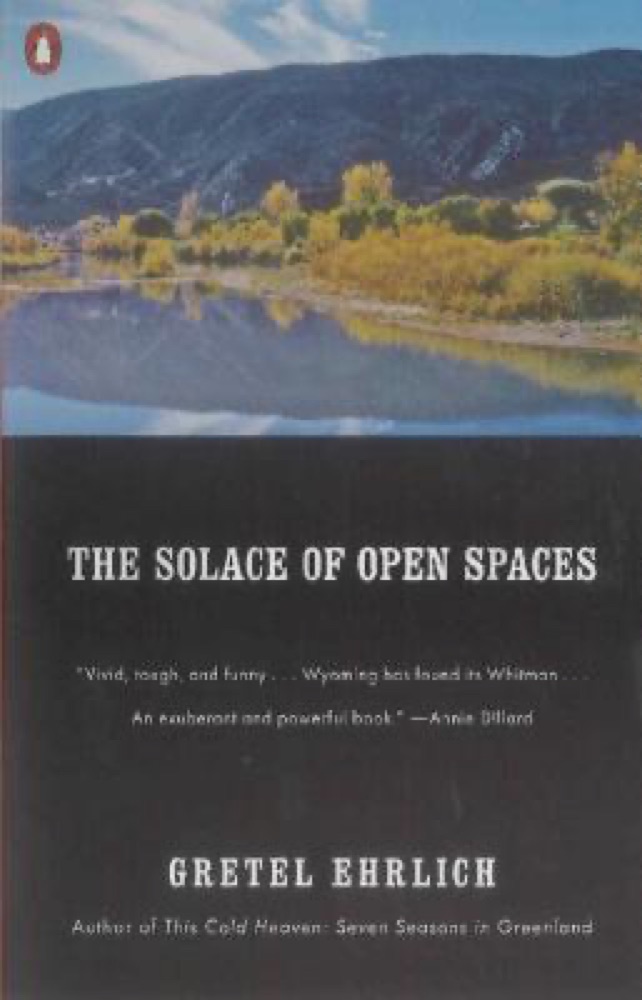
About Gretel Ehrlich
We have collected 21 quotes from 1 book by Gretel Ehrlich on BookQuoters.
More about the author →About the book
A stunning collection of personal observations that uses images of the American West to probe larger concerns in lyrical, evocative prose that is a true celebration of the region.
Book details
- First published
- 1984
- Author
- Gretel Ehrlich
- Genre
- Nonfiction
- Goodreads rating
- 4.10 (8k ratings)
Keep reading
H is for Hawk
 Where the Bluebird Sings to the Lemonade Springs: Living and Writing in the West
 Deep Creek: Finding Hope in the High Country
 Travels with Charley: In Search of America
 One for the Blackbird, One for the Crow
 West with the Night
 The Journey Home: Some Words in Defense of the American West
 Plainwater: Essays and Poetry
 The Plover
 Between a Rock and a Hard Place
 Arctic Dreams
 The Angel Esmeralda
 The Abundance
 O Pioneers!
 The Death of the Heart
 Angle of Repose
 Embers
 And the Mountains Echoed
 Winter Hours: Prose, Prose Poems, and Poems
 The Quick and the Dead
 High Tide in Tucson
 In the Heart of the Heart of the Country and Other Stories
 Swann's Way
 In the Wild Light
 View with a Grain of Sand: Selected Poems
 Sweet Thursday
 Bag of Bones
 Autumn
 South of the Border, West of the Sun
 Split Tooth
 Miss Lonelyhearts
 The Sea Keeper's Daughters
 In Search of Lost Time
 The People in the Trees
 The Offing
 Smilla's Sense of Snow
 Winter
 Flights
 The World-Ending Fire: The Essential Wendell Berry
 The Sea, the Sea
 Desert Solitaire
 TransAtlantic
 Hard-Boiled Wonderland and the End of the World
 Housekeeping
 The Ground Beneath Her Feet
 The Empusium
 Upstream: Selected Essays
 The Dog Stars
 The Hungry Tide
 The Stone Diaries
 Journal of a Solitude
 To The Bright Edge of the World
 The Sheltering Sky
 The Grapes of Wrath
 Sexing the Cherry
 Poems, 1962-2012
 Kafka on the Shore
 Opened Ground
 The Yellow Birds
 This Is Happiness