

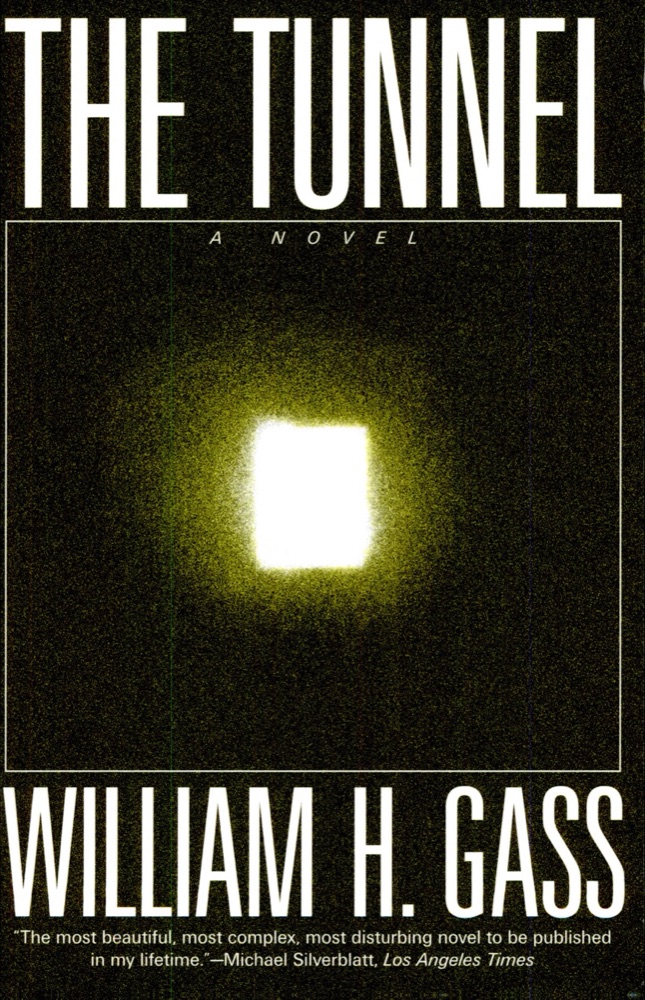
 The Tunnel
Quotes from the Book
Sports, politics, and religion are the three passions of the badly educated.
48
And I am in retirement from love.
21
I want to rise so high that when I shit I won’t miss anybody.
11
I suspect if we were as familiar with our bones as with our skin, we'd never bury dead but shrine them in their rooms, arranged as we might like to find them on a visit; and our enemies, if we could steal their bodies from the battle sites, would be museumed as they died, the steel still eloquent in their sides, their metal hats askew, the protective toes of their shoes unworn, and friend and enemy would be so wondrously historical that in a hundred years we'd find the jaws still hung for the same speech and all the parts we spent our life with titled as they always were - rib cage, collar, skull - still repetitious, still defiant, angel light, still worthy of memorial and affection. After all, what does it mean to say that when our cat has bitten through the shell and put confusion in the pulp, the life goes out of them? Alas for us, I want to cry, our bones are secret, showing last, so we must love what perishes: the muscles and the waters and the fats.
5
I could not shake my point of view, infected as it was, and I took up their study with a manly passion.
2
We do not converse. She visits me to talk. My task to murmur. She talks about her grandsons, her daughter who lives in Delphi, her sister or her husband - both gone - obscure friends - dead - obscurer aunts and uncles - lost - ancient neighbors, members of her church or of her clubs - passed or passing on; and in this way she brings the ends of her life together with a terrifying rush: she is a girl, a wife, a mother, widow, all at once. All at once - appalling - but I believe it; I wince in expectation of the clap. Her talk's a fence - shade drawn, window fastened, door that's locked - for no one dies taking tea in a kitchen; and as her years compress and begin to jumble, I really believe in the brevity of life; I sweat in my wonder; death is the dog down the street, the angry gander, bedroom spider, goblin who's come to get her; and it occurs to me that in my listening posture I'm the boy who suffered the winds of my grandfather with an exactly similar politeness, that I am, right now, all my ages, out in elbows, as angular as badly stacekd cards. Thus was I, when I loved you, every man I could be, youth and child - far from enough - and you, so strangely ambiguous a being, met me, h eart for spade, play after play, the whole run of our suits.
2
The contemporary American writer is in no way a part of the social and political scene. He is therefore not muzzled, for no one fears his bite; nor is he called upon to compose. Whatever work he does must proceed from a reckless inner need.
1
Those hundreds of feet were light. In washing them off, I pretended the hose was a pump. What have I missed? Childhood is a lie of poetry.
1
She crowds each moment with endeavor.
1
All that could happen was alone with me and I was alone with it.
1
This Midwest. A dissonance of parts and people, we are a consonance of Towns. Like a man grown fat in everything but heart, we overlabor; our outlook never really urban, never rural either, we enlarge and linger at the same time, as Alice both changed and remained in her story.
1
Such a person has no place. He can't be found. He's like one of those unphysical things they talk about in science now–like one of those things that's moving, you know, always moving on, but through no space.
1
It's true there are moments - foolish moments, ecstasy on a tree stump - when I'm all but gone, scattered I like to think like seed, for I'm the sort now in the fool's position of having love left over which I'd like to lose; what good is it now to me, candy ungiven after Halloween?
1
I wanted to be famous, but you bring me age—my emptiness. Was it that which I thought would balloon me above the rest? Love? where are you? … love me. I want to rise so high, I said, that when I shit I won’t miss anybody.
Hours of insanity and escape . . . in which I write inadequate verse, read, rage . . . record anecdotes which fade into the page like stains . . . beat time with my pencil’s business end . . . nip at the loose skin on the side of my hand with my teeth . . . cast schemes and tropes like horoscopes . . . practice catachresis as though it were croquet . . . grrrowl . . . kick wastebaskets into corners . . . realize that when I picture my methods of construction all the images are architectural, but when I dream of the ultimate fiction—that animal entity, the made-up syllabic self—I am trying to energize old, used-up, stolen organs like Dr. Frankenstein . . . grrrind . . . throw wet wads of Kleenex from a spring or winter cold into the corner where they mainly miss the basket . . . O . . . Ohio: I hear howling from both Os . . . play ring agroan the rosie . . . pace . . . put an angry erection back in my pants . . . rhyme . . . Then occasionally perceive beneath me on the page a few lines which . . . while I was elsewhere must have . . . yes, a few lines which have . . . which have the sound . . . the true whistle of the spirit. Wait’ll they read that, I say, perhaps even aloud, over the water running in the kitchen sink, over the noise of my writing lamp, coffee growing cold in the cup, the grrowl of my belly. Yet when I raise my right palm from the paper where, in oath, I’ve put it, the whistle in those words is gone, and only the lamp sings. Till I pull its chain like a john.
Serious writing must nowadays be written for the sake of the art. The condition I describe is not extraordinary. Certain scientists, philosophers, historians, and many mathematicians do the same, advancing their causes as they can. One must be satisfied with that.
Leaves move in the windows. I cannot tell you yet how beautiful it is, what it means. But they do move. They move in the glass.
Corruption, in these bugs, is splendid.
For those who chose to build off modernism, fiction became a field for radical explorations in narrative form and voice. Writers set out in search of new techniques that could serve as sources of discovery and offer unique opportunities for amplifying the potential meaning of their subject matter.
The purpose of an imaginative narrative isn’t to confirm what we think we already know about reality; rather, it offers “a record of the choices, inadvertent or deliberate, the author has made from all the possibilities of language.” A fictional cat may reflect qualities of a real cat, but it is better appreciated as a product of the author’s agile mind.
How can I think of such ludicrous things—beauty and peace, the dark soul of the world —for I am the wife of the house, concerned for the rug, tidy and punctual, surrounded by blocks.
The ordinary fears of daily life. Healthy fears. Womanly, wifely, motherly ones: the children may point at the wretch with the hunch and speak in a voice he will hear; the cat has fleas again, they will get in the sofa; one’s face looks smeared, it’s because of the heat; is the burner on under the beans? the washing machine’s obscure disease may reoccur, it rumbles on rinse and rattles on wash; my god it’s already eleven o’clock; which one of you has lost a galosh? So it was amid the worries of our ordinary life I bent, innocent and improperly armed, over the bug that had come undone. Let me think back on the shock . . . .
Your clients are thin with the worms of worry, skinny from the scares inside them. Fatten them on certainty.
But then my wife is subject to failures of the imagination. I have tried to carry her but her sentiments are too readily aroused. Her eyes stay at the skin. Only her heart, only her tenderest feelings, go in. I, on the other hand, cut surgically by all outward growths, all manifestations, merely, of disease and reach the ill within.
young worshipers of flesh who live on her right and who never appear except to hang out towels or to speed in and out of the late afternoon in their car. Their hands are for each other. They allow the weeds all liberty.
His eyes were holes I fell in. I dodged his shadow lest it cover me, and felt a fool. He’s not so old, sixty perhaps; but his eyes run, his ears ring, his teeth rot. His nose clogs. His lips pale and bleed. His knees, his hips, his neck and arms, are stiff. His feet are sore, the ankles swollen. His back, head and legs ache. His throat is raw, his chest constricted, and all his inner organs—heart, liver, kidneys, lungs, and bowels—are weak. Hands shake. His hair is falling. His flesh lies slack. His cock I vision shriveled to a string, and each breath of life he draws dies as it enters his nose and crosses his tongue.
It was good I was glad he was there it wasn’t me was there sticking up bare in the wind on a horse like a stick with the horse most likely stopped by this time with his bowed head bent into the storm, and I wouldn’t like lying all by myself out there in the cold white dark, dying all alone out there, being buried out there while I was still trying to breathe, knowing I’d only come slowly to the surface in the spring and would soon be soft in the new sun and worried by curious dogs.
For a while, every day, even though the snow was piled and the sky dead and the winter wind was blowing, I watched for my aunt to come again and bring me a book like my ma’d said she would. She never came.
Watch on YouTube
About William H. Gass
We have collected 105 quotes from 4 books by William H. Gass on BookQuoters.
More about the author →More by William H. Gass

About the book
IN THIS SUITE of five short pieces -- one of the unqualified literary masterpieces of the American 1960s -- William Gass finds five beautiful forms in which to explore the signature theme of his fiction: the solitary soul’s poignant, conflicted, and doomed pursuit of love and community. In their obsessions, Gass’s Midwestern dreamers are like the "grotesques" of Sherwood Anderson, but in their hyper-linguistic streams of consciousness, they are the match for Joyce’s Dubliners. First published in 1968, this book begins with a beguiling thirty-three page essay and has five fictions: the celebrated novella "The Pedersen Kid," "Mrs. Mean," "Icicles," "Order of Insects," and the title story.
Book details
- First published
- 1968
- Author
- William H. Gass
- Genre
- Fiction
- Goodreads rating
- 3.97 (3k ratings)
Keep reading
 Johnny Panic and the Bible of Dreams: Short Stories, Prose and Diary Excerpts
The Tunnel
Johnny Panic and the Bible of Dreams: Short Stories, Prose and Diary Excerpts
The Tunnel
 Sixty Stories
 An Unnecessary Woman
 Girl with Curious Hair
 The Story of the Lost Child
 Old Babes in the Wood: Stories
 Winter Hours: Prose, Prose Poems, and Poems
 Brideshead Revisited: The Sacred and Profane Memories of Captain Charles Ryder
 The Untouchable
 Monday or Tuesday
 Sexus
Sexus
 Nightwood
 Burning Your Boats: The Collected Short Stories
 Min kamp 2
 Inferno
 Plainwater: Essays and Poetry
 The Brooklyn Follies
 Selected Stories
 The Notebooks of Malte Laurids Brigge
 The Swan Thieves
 My Friends
 Lit
Lit
 By Grand Central Station I Sat Down and Wept
 The Diary of Anaïs Nin, Vol. 1: 1931-1934
 Super Sad True Love Story
 Swann's Way
 Betting on the Muse: Poems & Stories
 Dream Count
 Orlando
 Glass, Irony and God
 The Muse
 In the Woods
 The World and Other Places: Stories
 Tar Baby
 The Quick and the Dead
 The Subterraneans
 Possession
 The Color Master: Stories
 What I Loved
 Dust Tracks on a Road
 Flights
 Essays of E.B. White
 Humboldt's Gift
 The Golden Notebook
 V.
V.
 The Sea, the Sea
 Miss Lonelyhearts
 The Stories of Vladimir Nabokov
 Tropic of Cancer
 Mao II
 The Complete Short Stories
 Broken Music
 What Matters Most is How Well You Walk Through the Fire
 A Sport and a Pastime
 The Folded Clock: A Diary
 The Savage Detectives
 All of Us: The Collected Poems
 Devotion
 The Real Life of Sebastian Knight