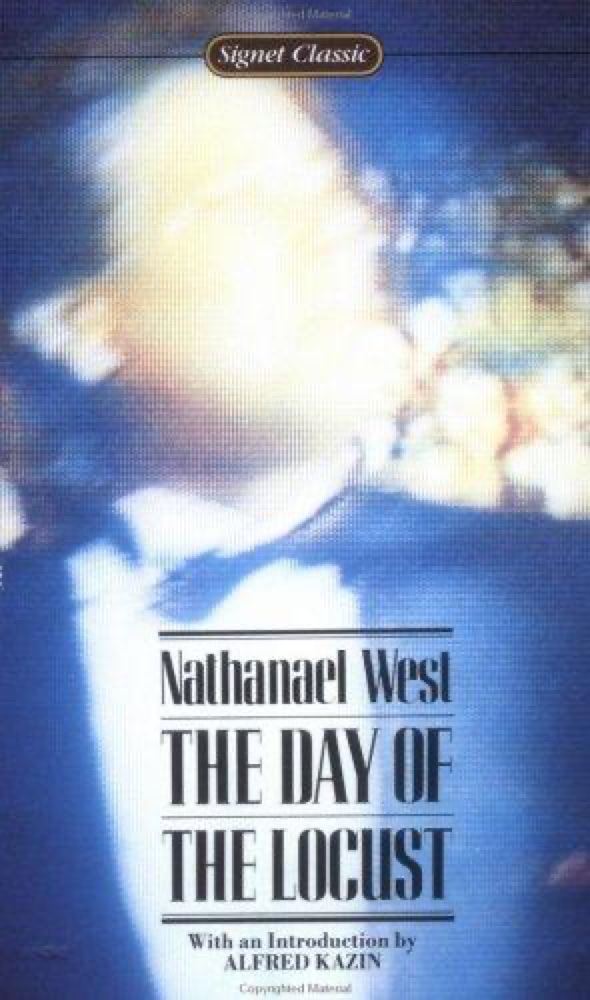
 The Day of the Locust
Quotes from the Book
He read it for the same reason an animal tears at a wounded foot: to hurt the pain.
59
He's an escapist. He wants to cultivate his interior garden.
29
Art Is a Way Out. Do not let life overwhelm you. When the old paths are choked with the débris of failure, look for newer and fresher paths. Art is just such a path. Art is distilled from suffering.
27
Her sureness was based on the power to limit experience arbitrarily. Moreover, his confusion was significant, whereas her order was not.
25
Humanity...I'm a humanity lover. All the broken bastards...
14
Love a man even in his sin, for that is the semblance of Divine Love and is the highest love on eath. Love all God's creation, the whole and every grain of sand in it. Love the animals, love the plants, love everything. If you love everything, you will percieve the divine mystery in things. Once you percieve it, you will begin to comprehend it better every day. And you will come at last to love the whole world with an all-embracing love.
13
No dream ever entirely disappears. Somewhere it troubles some unfortunate person and some day, when that person has been sufficiently troubled, it will be reproduced on the lot.
12
He was giving birth to groups of words.
10
what goes on in the sea is of no interest to the rock
9
It's solitary drinking that makes drunkards.
8
He knew now what this thing was — hysteria, a snake whose scales are tiny mirrors in which the dead world takes on a semblance of life. And how dead the world is . . . a world of doorknobs. He wondered if hysteria were really too steep a price to pay for bringing it to life.
7
Every child, everywhere; in the whole world there was not one child who was not gravely, sweetly dancing.
7
But now let us consider the holes in our own bodies and into what these congenital wounds open. Under the skin of man is a wondrous jungle where veins like lush tropical growths hang along over-ripe organs and weed-like entrails writhe in squirming tangles of red and yellow. In this jungle, flitting from rock-gray lungs to golden intestines, from liver to lights and back to liver again, lives a bird called the soul.
6
As far as he could discover, there were no signs of spring. The decay that covered the surface of the mottled ground was not the kind in which life generates. Last year, he remembered, May had failed to quicken these soiled fields. It had taken all the brutality of July to torture a few green spikes through the exhausted dirt. What the little park needed, even more than he did, was a drink. Neither alcohol nor rain would do. Tomorrow, in his column, he would ask Broken-hearted, Sick-of-it-all, Desperate, Disillusioned-with-tubercular-husband and the rest of his correspondents to come here and water the soil with their tears. Flowers would then spring up, flowers that smelled of feet. "Ah, humanity..." But he was heavy with shadow and the joke went into a dying fall. He trist to break its fall by laughing at himself.
6
Once he had tried to get fired by recommending suicide in his column. All that Shrike had said was : "Remember, please, that you job is to increase the circulation of our paper. Suicide, it is only reasonable to think, must defeat this purpose".
5
He did not feel guilty. He did not feel. The rock was a solidification of his feeling, his conscience, his sense of reality, his self-knowledge.
5
You dedicate your life to the pursuit of pleasure. No over-indulgence, mind you, but knowing that your body is apleasure machine, you treat it carefully in order to get the most out of it.
5
Art Is One if Life's Richest Offerings. For those who have not the talent to create, there is appreciation.
5
A button machine makes buttons, no matter what the power used, foot, steam or electricity. They, no matter what the motivating force, death, love or God, made jokes.
4
His heart was a rose and in his skull another rose bloomed. The room was full of grace. A sweet, clean grace, not washed clean, but clean as the innersides of the inner petals of a newly forced rosebud.
4
As he stood smiling, a little wave crept up out of the general welter and splashed at his feet for attention. It was Betty.
3
Every order has within it the germ of destruction. All order is doomed, yet the battle is worth while.
3
...the gray sky looked as if it had been rubbed with a soiled eraser. It held no angels, flaming crosses, dove-bearing doves, wheels within wheels. Only a newspaper struggled in the air like a kite with a broken spine. He got up and started again for the speakeasy.
2
Men have always fought their misery with dreams. Although dreams were once powerful, they have been made puerile by the movies, radio and newspapers. Among many betrayals, this is the worst.
2
He sees that the majority of letters are profoundly humble pleas fpr moral and spiritual advixe, that they are inarticulate expressions of genuine suffering. He also discovers that his correspondents take him seriously. For the first time in his life, he is forced to examine the values by which he lives. This examinatin shows him that he is the victim of the joke and not the perpetator.
2
Life is worthwhile, for it is full of dreams and peace, gentleness and ecstasy, and faith that burns like a clear white flame on a grim dark altar.
1
Man has a tropism for order. Keys in one pocket, change in another. Mandolins are tuned G D A E. The physical world has a tropism for disorder, entropy. Man against Nature...the battle of the centuries. Keys yearn to mix with change. Mandolins strive to get out of tune. Every order has within it the germ of destruction. All order is doomed, yet the battle is worth while.
1
Americans have dissipated their radical energy in an orgy of stone breaking.
1
He felt like an empty bottle that is being slowly filled with warm, dirty water.
1
Watch on YouTube
About Nathanael West
We have collected 56 quotes from 3 books by Nathanael West on BookQuoters.
More about the author →More by Nathanael West
The Day of the Locust
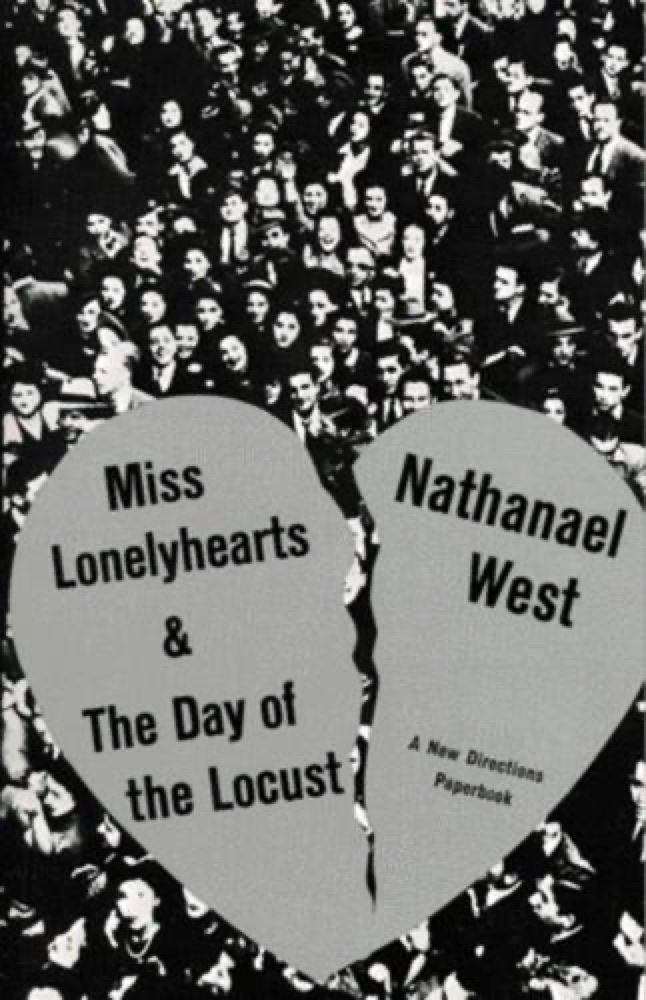 Miss Lonelyhearts / The Day of the Locust
About the book
The blackly comic energy of Nathanael West’s Miss Lonelyhearts—its caustic ebullience, the strange buoyancy of its suffering—is a remarkably American achievement, a kind of death-dance capered on the corpse of a vividly rendered early 1930s Manhattan. In the darkening curl of the Depression, misery is the fulcrum of national experience, a dismal engine that purrs especially for West’s titular protagonist. As a newspaper advice columnist, he is privy to the secret despair of an American chorus: the lost, the young, the deformed, the forgotten.
Book details
- First published
- 1933
- Author
- Nathanael West
- Genre
- Fiction
- Goodreads rating
- 3.55 (7k ratings)
Keep reading
 Dead Souls
 Orlando
 Humboldt's Gift
 The Sailor Who Fell from Grace with the Sea
 Ragtime
 Absalom, Absalom!
 Independent People
 V.
V.
 Victory
 The Naked and the Dead
 Selected Stories
 In the Heart of the Heart of the Country and Other Stories
 The Tunnel
 Keep the Aspidistra Flying
 Tales of the Jazz Age
 The Man Who Laughs
 The Illustrated Man
 The Man Without Qualities
 The Heart of the Matter
 Fathers and Sons
 Uncle Tom's Cabin
 The Narrow Road to the Deep North
 Winter's Tale
 Jacob's Room
 Of Human Bondage
 The Enchantress of Florence
 Spring Snow
 Selected Poems
 Manalive
 Another Roadside Attraction
 Antic Hay
 Sweet Thursday
 The Quick and the Dead
 Crome Yellow
 The Magic Mountain
 A Soldier of the Great War
 The Great Mistake
 The Story of the Lost Child
 London Fields
 The Sea, the Sea
 Cat's Cradle
 Henderson the Rain King
 Birdsong
 Martin Eden
 Selected Stories of Anton Chekhov
 The Shipping News
 Light in August
 Birds Without Wings
 Wind, Sand and Stars
 The Magus
 Betting on the Muse: Poems & Stories
 Fierce Invalids Home from Hot Climates
 The Pleasures of the Damned
 A Portrait of the Artist as a Young Man
 A Fine Balance
 The Volcano Lover: A Romance
 Misery
 The Agony and the Ecstasy
 The Real Life of Sebastian Knight
 Sexus
Sexus